


LG will reveal a circular smartwatch next week to compete with the Moto 360

Of the three Android Wear smartwatches introduced at Google’s developer conference in June, the Moto 360 was by far the crowd favorite; its circular watchface gives it a classic, elegant look, and a stark contrast to the squarish Samsung Gear Live and LG G Watch. It turns out that LG wasn’t very excited about its first Wear watch either: It’s going to introduce a round-faced sequel — called the LG G Watch R — next week in Berlin, shortly after Motorola officially launches its new timepiece.
The teaser, provided to us by a trusted source, is currently unlisted on LG Mobile Global’s YouTube channel and embedded above. Plenty of details are left out — gotta leave something for the big reveal, of course — but you can clearly see a circular display (we’re assuming R stands for Round) with several new watchfaces. And unlike the original G Watch, the R comes with a button on the side. We also caught a few brief glimpses of a digital step counter, distance meter and compass. Finally, the teaser proclaims that we’ll learn more at IFA 2014 next week.
The short turnaround between G Watches (2.5 months) is indicative of LG’s strategy. A typical product development cycle spans the course of several months, and depending on the device, could take up to a year or more. This means the G Watch R was in development alongside the original, so the square model was likely a proof of concept; something to satisfy the early adopters and work out bugs while the stylish version wrapped up development. In other words, the R is the marquee smartwatch LG’s really banking on, and the fact that it’ll be introduced just hours after the 360′s launch means that all of the momentum and hype Motorola has spent months building up may quickly vanish. Whether it was a stroke of luck or brilliant timing on LG’s part, it shows either way that the competition will be heating up next week.
LG’s not the only manufacturer coming out with a new watch soon. ASUS will launch one at IFA as well (though its shape is square in its teaser); HTC has something in the works for later this year; Samsung could easily launch another Gear or five for the holidays; and let’s not even get into the Apple watch speculation. The Moto 360 is still the best-looking smartwatch we’ve seen thus far, but the space is becoming much more crowded than it was two months ago, and it may not retain that top-dog status for long after it finally gets released.

Filed under: Cellphones, Wearables, Wireless, Mobile, Google, LG
Source: LG Mobile Global YouTube
.CPlase_panel display:none;

Data breaches compromised the info of US undercover investigators

Data theft is normally pretty bad all on its own, but a recent breach at US Investigations Services (a background check company) may have created some extra-strong headaches for the US government. Reuters understands that the intrusion exposed personal information of 25,000-plus Department of Homeland Security workers, including “some undercover investigators.” There’s no certainty that the attackers stole those agents’ information, but there’s a real chance that their identities are out in the wild — a big problem if suspects can double-check identities and avoid getting caught. The concern is exacerbated by the nature of the attack, which USIS believes might have been “state-sponsored.”
The potential for future damage is limited. Homeland Security has frozen its work with USIS for the next while, and the FBI is already investigating what went wrong. Until it’s clear just what happened and who’s at risk, though, there are going to be a lot of nervous officials — they won’t necessarily know which new hires they can trust.
[Image credit: Sean Gallup/Getty Images]
Filed under: Internet
.CPlase_panel display:none;

Coin makes up for its delayed smart card launch with an expanded beta test

Not happy that Coin said it was only shipping a beta version of its Bluetooth credit card this fall, rather than the finished product it originally promised for the summer? You’re not alone — and the company is aware that it needs to make amends for angering early adopters. The fledgling payment firm has apologized for both the delay and lack of transparency by significantly expanding the reach of its beta program. It’s planning to run a nationwide test for beta backers at “no cost,” and it will expand the initial number of slots in that dry run from 10,000 to 15,000 — not a perfect solution, but definitely more accommodating. It’s also hoping to increase the number of slots over time, so you may not have to wait for the finished product if you miss out on the first wave.
Of course, this olive branch to customers wouldn’t be very helpful if the startup weren’t tackling the issues that miffed so many in the first place. It’s promising more updates on its progress in the future, and hopes to boost the card’s compatibility beyond the 85 percent claimed today; that’s part of what the beta is for, after all. You can get a refund if Coin’s antics still rub you the wrong way, although the company is clearly hoping that you’ll give it a second chance.
Filed under: Peripherals, Internet
.CPlase_panel display:none;

You can steal data from a computer by touching it

Normally, breaking a PC’s security involves either finding security exploits or launching brute force attacks, neither of which is necessarily quick or easy. However, a team at Tel Aviv University has come up with a potentially much simpler way to swipe data from a computer: touch it. If you make contact with a PC while you’re wearing a digitizer wristband, you can measure tiny changes in electrical potential that reveal even stronger encryption keys (such as a 4,096-bit RSA key). You don’t even have to touch the system directly in some cases — researchers also intercepted keys from attached network and video cables.
Don’t worry about overly grabby strangers stealing your data just yet. The technique primarily focuses on GnuPG’s encryption software, which already has a patch to limit the effects. Thieves also have to monitor the electricity while decryption is taking place, so they can’t just grab info on demand. However, the very nature of the technique makes it difficult to stop completely — unless you’re a fan of insulation and Faraday cages, someone with physical access to your system may always have an opportunity to peek into your most sensitive content.
Filed under: Science
Source: Tel Aviv University
.CPlase_panel display:none;

Is Android L’s official name going to be ‘Lemon Meringue Pie’?
 With each new build of Android comes the game where we try and guess what the official name of the build is going to be. For this next build, which we currently only know as Android L, we’ve had assertions that it called ‘Lollipop’, however the answer might actually lie in the Android L preview code, and its name could be “Lemon Meringue Pie“. According to Android Police, the Android SDK refers to the preview builds for Nexus 5 and Nexus 7 as the “lmp-preview-release”:
<!– From: file:/usr/local/google/buildbot/repo_clients/https___googleplex-android.googlesource.com_a_platform_manifest.git/lmp-preview-release/frameworks/support/v7/cardview/res/values/colors.xml –>
<eat-comment />
<color name=”cardview_dark_background”>#FF202020</color>
<color name=”cardview_light_background”>#FFFAFAFA</color>
<color name=”cardview_shadow_end_color”>#03000000</color>
<color name=”cardview_shadow_start_color”>#37000000</color>
<!– From: file:/usr/local/google/buildbot/repo_clients/https___googleplex-android.googlesource.com_a_platform_manifest.git/lmp-preview-release/frameworks/support/v7/cardview/res/values/attrs.xml –>
<eat-comment />
<declare-styleable name=”CardView”>
<!– Background color for CardView. –>
<attr name=”cardBackgroundColor” format=”color” />
<!– Corner radius for CardView. –>
<attr name=”cardCornerRadius” format=”dimension” />
</declare-styleable>
<!– From: file:/usr/local/google/buildbot/repo_clients/https___googleplex-android.googlesource.com_a_platform_manifest.git/lmp-preview-release/frameworks/support/v7/cardview/res/values/dimens.xml –>
<eat-comment />
<dimen name=”cardview_default_radius”>2dp</dimen>
<dimen name=”cardview_elevation”>2dp</dimen>
<dimen name=”cardview_shadow_size”>2dp</dimen>
<!– From: file:/usr/local/google/buildbot/repo_clients/https___googleplex-android.googlesource.com_a_platform_manifest.git/lmp-preview-release/frameworks/support/v7/cardview/res/values/styles.xml –>
<eat-comment />
And in yesterday’s leak of the HTC Nexus’ Wi-Fi certification (see the leak here), we can clearly see “LMP” as part of the firmware version for the device. So it seems pretty likely that “LMP” actually refers to the Android build name, which we’re guessing stands for Lemon Meringue Pie. Keep in mind though that the last build of Android, which we now know as Android KitKat, was actually called KLP, or Key Lime Pie, in the Android SDK and it seems it was a relatively last minute deal by Google to partner with Nestle for the launch.
Do you think LMP, or Lemon Meringue Pie, is the real name of the next Android build? Let us know your thoughts in the comments below.
Source: Android Police
//<![CDATA[
ord = window.ord || Math.floor(Math.random()*1E16);
document.write('‘);
//]]>
The post Is Android L’s official name going to be ‘Lemon Meringue Pie’? appeared first on AndroidSPIN.
.CPlase_panel display:none;

Wearable device shipments have soared in the past year

In case you had any doubts that wearable devices were catching on, Canalys just delivered some tangible proof. The analyst group estimates that the tech industry shipped roughly 4.5 million smartwatches and fitness trackers in the first half of 2014, or nearly 700 percent more than it managed a year earlier. Not surprisingly, most of the watches were Samsung devices — the Korean company’s rapid-fire Gear watch releases made it almost ubiquitous. Pebble and Sony also did well in this fledgling space. Fitbit and Jawbone, meanwhile, moved many of the simpler wristbands.
Having said this, wearables are still far from hitting the mainstream. Mobile device makers shipped over 300 million smartphones in the second quarter of the year alone; smart wristwear ultimately represents a drop in the bucket. And that’s also assuming that it’s selling well. Samsung’s quick reinvention of the Gear line was an admission that it didn’t have many fans early on. Shipments may be up across the board, but it’s possible that some of the companies involved are struggling. All the same, interest isn’t likely to cool down any time soon — between the arrival of Android Wear and rumors of watches from Apple and Microsoft, the category may just be getting started.
Filed under: Wearables, Samsung, Google
Source: Canalys
.CPlase_panel display:none;
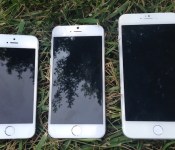
4.7-Inch and 5.5-Inch iPhone 6 to Carry 2x and 3x Retina Displays, Suggests Apple Journalist John Gruber
Throughout the past few months, a number of rumors have suggested many different resolutions for both the 4.7-inch and 5.5-inch iPhone 6, giving a variety of reasons as to how Apple will best optimize a larger screen size for both users and developers.
Prominent Apple journalist John Gruber has now given his in-depth take on the subject, stating that the 4.7-inch iPhone 6 will feature a resolution of 1334 x 750 with 326 pixels per inch, while the 5.5-inch iPhone 6 will have a resolution of 2208 x 1242 with 461 pixels per per inch.
 4.7-inch and 5.5-inch iPhone 6 mockups compared to iPhone 5s
Gruber notes that keeping the current “2x” Retina resolution at 326 ppi on the 4.7-inch iPhone 6 would be consistent with Apple’s previous patterns on iOS devices:
At 4.7 inches, 1334 × 750 works perfectly as a new iPhone display, addressing problem #1, showing more content. With point dimensions of 667 × 375, this display would show 1.38 times more points than the iPhone 5. At 326 pixels-per-inch, everything on screen would remain exactly the same physical size. There would just be 38 percent more room for content.
Gruber also adds that moving to a “3x” Retina resolution at 461 ppi for the 5.5-inch iPhone 6 would display an even greater amount of content while being able to render the same Retina pixels on a larger scale:
Everything works at these dimensions for a 5.5-inch display. With an increase in area of 68 percent and a scaling factor of 1.06, this display would address both reasons why someone might want a very large iPhone: it would show a lot more content, and it would render everything on screen, point-for-point, a little bit bigger. And at 461 pixels-per-inch, everything would be amazingly sharp.
In both of those examples, existing apps would still be able to run at such resolutions, as optimizing current apps would be made easier considering the scaled nature of the displays.
The given 1334 x 750 resolution of the 4.7-inch iPhone 6 contrasts information and photos shared by luxury modified iPhone vendor Feld & Volk earlier this week, which showed the display of the 4.7-inch iPhone 6 under a microscope that was said to carry a resolution of 1704 x 960. That resolution has also been cited in previous rumors, but Gruber claims in his post that an iPhone 6 with a resolution of 1704 x 960 would only work well for 4.0-inch displays, as it would not show any additional content compared to the iPhone 5 when measured in touch points.
Gruber also comments on the possibility of both a 4.7-inch and a 5.5-inch iPhone 6 with a resolution of 1472 x 828. The claim states that such a resolution on the 4.7-inch device would render UI elements and text about 10 percent smaller, while such a resolution on the 5.5-inch device would equal out to be 307 pixels per inch, or only marginally better than Apple’s original definition of the Retina display as being at least 300 PPI.
The iPhone 6 is expected to be unveiled on Tuesday, September 9 at a media event. It is likely that the 4.7-inch version will go on sale about a week after the announcement, as the 5.5-inch may be held back due to production issues. In addition to a larger display, the iPhone 6 will likely feature a thinner design, a faster A8 processor, an improved camera, a more durable Touch ID sensor, and more.
.CPlase_panel display:none;

Feedback Loop: obscure TV channels, what’s in your bag and more!

Happy Saturday! Welcome to another edition of Feedback Loop! This week we’re exploring obscure TV channels, the gadgets you travel with and just how much space is too much on your phone. So sit back, get comfy and get ready to talk with fellow readers.
Do you need 128GB in a phone?
With rumors circulating that the iPhone 6 will come in a 128GB model, Dave is wondering if we really need that much storage. He’s currently using around 40GB in his 64GB iPhone, but still wants more room for his apps and music. Would you want a phone with this much capacity or is it kind of unnecessary?
What are your favorite weird or obscure TV channels?
Our very own Zach Honig explores the odd collection of channels bundled into your cable TV subscription; turns out we’re paying for a lot useless and redundant crap. However, Kris enjoys some of the more obscure networks she receives — in particular the rerun-heavy Cozi and the diverse action of ONE World Sports. If you have a cable plan, what obscure channels are you tuning into?
What do you keep in your bag?
Whenever I head to the office or get ready to fly, I always feel like I overpack my bag. I stuff it with what seem like essential items, but maybe some of you have ideas for how to lighten my load. Whether you travel light or like to pack your bag full of gear, head on over to share what you’re rocking while on the go.
OnePlus One vs. Oppo Find 7
After being lucky enough to acquire a OnePlus One, as well as grabbing an Oppo Find 7, awsom is looking for help in figuring out which one is superior. Brad and Chris reviewed both phones already, but we’re curious to know what you think. If you have either device, give awsom a hand in determining which one is the best.
Other discussions you may also like:
- Are my Cat 5 Ethernet cables pretty useless?
- What are some of your favorite tech podcasts?
- How do you backup and manage all of your valuable data?
That’s all this week! Want to talk about your favorite gadget or have a burning question about technology? Register for an Engadget account today, visit the Engadget forums and start a new discussion!
.CPlase_panel display:none;

Google’s modular phone gets cheaper thanks to a new processor

One of the biggest challenges behind Google’s modular Project Ara phone platform has been getting processors to play nicely with the technology. How do you let someone swap out the very heart of their device as easily as they would a memory card? By creating a CPU for that very purpose, that’s how. Rockchip has started work on a system-on-chip with modular tech built-in; your phone won’t need any bridge chips or other special tricks to let you switch processors on a whim. You won’t see the hardware in action until a Rockchip-based Ara prototype arrives in early 2015. However, the plans show that Google’s vision of a completely upgradable handset is both feasible and potentially inexpensive. Don’t be surprised if some of the earliest Ara phones (or rather, their parts) easily fit within your budget.
Filed under: Cellphones, Mobile, Google
Source: Google ATAP (Google+)
.CPlase_panel display:none;
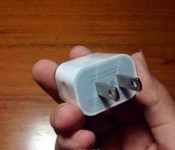
Image of Redesigned Apple USB Power Adapter Surfaces
A new image said to be of a redesigned Apple USB power adapter has been shared by a user on Weibo (Google Translate, via Gizmobic), hinting that Apple’s supposed new Lightning cable may be released alongside a new charger. The power adapter appears to be more rounded compared to Apple’s current offering, and also includes grooves on each side to improve comfort while holding and inserting the accessory.

While it is possible that the product in the image could be of a fake, the charger does have the signature “Designed by Apple in California” text along with other applicable information and logos. The user also shows another image of the new Lightning cable with its reversible USB connector, which has been spotted in a number of other photos and even a video throughout the past few weeks.
If both new products turn out to be real, it is possible that Apple could ship a new Lightning cable and new USB power adapter alongside this fall’s expected lineup of new iOS devices, possibly starting with the iPhone 6 next month.
.CPlase_panel display:none;
 AIVAnet