



What’s on your HDTV: 66th Annual Primetime Emmys, ‘Madden ’15’, Jim Jeffries

This week in TV gets started off with a bang thanks to the Primetime Emmys. Netflix snagged 31 nominations for its original content, now we’ll see if it can take home more trophies than the three it won last year as House of Cards faces off with Breaking Bad, Game of Thrones, True Detective, Downton Abbey and Mad Men for the Outstanding Drama Series award. Of course, the streamer isn’t resting on its laurels having just introduced Bojack Horseman last week, and it’s kicking off a new run of stand-up comedy specials this week with Jim Jeffries: Bare. Fans of The Walking Dead and Sons of Anarchy can grab the latest seasons on Blu-ray, while Madden NFL 15 lights up game consoles this week and the college football season gets started. All of that against the backdrop of FXX’s Every Simpsons Ever marathon which will keep running until Monday. We’ve got a new format to show you what’s new this week, hit the gallery below to check out each day’s highlights, including trailers and let us know what you think (or what we missed).
Filed under: Home Entertainment, HD
.CPlase_panel display:none;

The NSA’s search tool is a Google for the world’s communications data

If sharing really is caring, then the NSA must care a lot. That’s the thrust of a new report from The Intercept that pulled back the curtain on a search system called ICREACH — launched in 2007, the system allows members of more 20 different US agencies to quickly sift through the communications metadata of both foreigners and citizens on US soil. And the reason for all this? Well, the stated goal was to allow members of these government agencies to identify persons of interest and help agents monitor the activities of “intelligence targets” at home and abroad. Putting aside its ability to crawl through some 850 billion metadata records (and growing), one of ICREACH’s greatest assets might be its straightforward interface. It’s referred to in internal documentation as being “Google-like” and allows researchers to dig into metadata records by punching in simple “selectors” like email addresses and phone numbers.
This isn’t the first time the name ICREACH has been made public knowledge (barring all the Google search results for job openings for people fluent in intelligence tools like it). Glenn Greenwald’s book No Place To Hide included a slide among its myriad documents that highlighted the some of the metadata types that were accessible through ICREACH:

According to The Intercept’s Ryan Gallagher, it’s that bit about foreigners that affords ICREACH much of its immunity from congressional oversight. The system was designed to cull information primarily from foreign communications networks (which is kosher thanks to President Reagan’s Executive Order 12333), though The Intercept asserts that the system also contains “millions of records on American citizens who have not been accused of any wrongdoing.” The metadata itself — the sender and recipient of a call or message, identifying information about the device used, etc. — might not seem terribly troubling, but in aggregate it could provide a fairly comprehensive picture of what a given person was doing when, and where. All told, it’s a scarily powerful bit of tech at the disposal of multiple agencies, and since much of the information released was based on documents that are years old, it’s not clear how ICREACH’s, well, reach has shifted or expanded since.
Source: The Intercept
.CPlase_panel display:none;

The Big Picture: How EA captured player faces for Madden NFL 15

If you’ve ever wondered how video game studios transform real-life people into their multi-pixeled personas, here’s one method. SB Nation’s Sarah Kogod recently made the trip to Baltimore where EA was set to capture facial images from the Ravens’ players for Madden NFL 15. There, she encountered the developers new “mobile” rig that leverages a dozen DSLRs situated in two rows of six each in order to snap all of the close-up details. The frame is part TV stand and part wheel chair lift that allows the entire thing to be positioned just so from a connected laptop. In fact, three teams, each outfitted with one of the multi-camera rigs, set out this summer to capture player images from all 32 NFL teams during OTAs and training camp. Before now, artists have had to work from stock photos in order to create a player’s virtual counterpart, and accuracy suffered. The folks at EA say that as games become increasingly more life-like, that gamers notice “any blemish that’s off… people catch that.”
[Photo credit: Sarah Kogod/SB Nation]
Filed under: Gaming
Source: SB Nation
.CPlase_panel display:none;

Likely Fake iPhone 6 Box Insert Surfaces [iOS Blog]
While we’ve seen dozens of images depicting iPhone 6 elements that are likely to be real versions of parts that will make their way into the finished device, we’ve also been seeing quite a few iPhone 6 mockups, iPhone 6 clones, and other fake iPhone 6 parts as we creep closer to the device’s launch date.
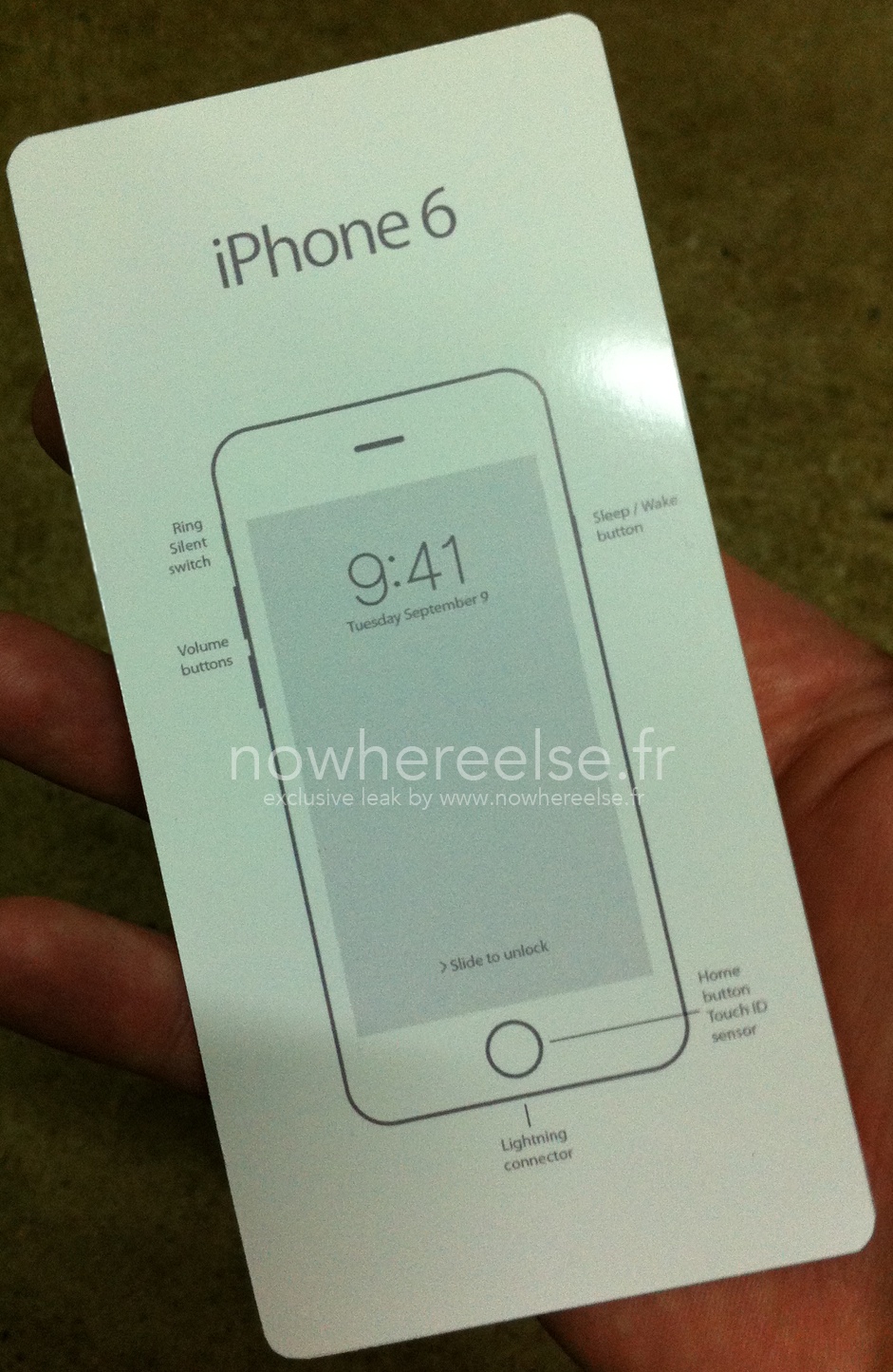
French site Nowhereelse.fr [Google Translate] has today shared what it believes may be a genuine iPhone 6 box insert (or quick start guide) that “confirms” the launch date of the iPhone 6 as Tuesday, September 9, but MacRumors believes the insert to be fake based on several different design elements.
 (Click for Full Size)
Nowhereelse.Fr compares the September 9 date listed on the fake insert to the “10″ date on the calendar icon of the original iPhone 5s card as proof the iPhone 6 insert is real, but the site erroneously assumes that the date on the iPhone 5s insert referred to the Tuesday, September 10 unveiling of the iPhone 5s.
The “10″ date actually corresponds to the date when iOS 7 debuted, Monday, June 10. Therefore, the iPhone 5s card did not depict the phone’s debut date, which means an actual Apple quick start card for the iPhone 6 would be unlikely to display “September 9″ over the iOS default date.
Additionally, the design of the card also lacks slashes between the Ring/Silent switch and Home Button/Touch ID sensor, and the font of the time is not quite in line with Apple’s style. Nowhereelse.Fr claims that Apple has opted for a more simple insert design that does not show the actual device to explain its difference from the iPhone 5s insert, but it is unclear whether that is factual. Even when poised as a possible rough draft for a finished quick start guide, the glaring errors on the card continue suggest that it is indeed a fake and not representative of the actual insert card that will be included with the finished iPhone 6.
Apple is expected to introduce its iPhone 6 on Tuesday, September 9 at a media event. The device is rumored to come in two variations, 4.7 inches and 5.5-inches, but it is unclear if both models will ship at the same time as production issues are said to be plaguing the larger iPhone 6.
.CPlase_panel display:none;

Happy accident: Sphero makes the move from toy to teaching

Orbotix, now simply known as Sphero, had the world in awe when it introduced its smartphone-controlled, ball-shaped toy back in 2010. Back then, we were still getting used to the concept of “connected” things. Today, nearly four years after making its debut at the Consumer Electronics Show, Sphero is one of the most popular peripherals around, on iOS and Android alike. But while the robotic ball may have started off as a knickknack for kids, or adults, to play with, it has recently started to break into another, more serious field: education. In an effort to boost that, Sphero launched an initiative called SPRK about five months ago, with the goal of letting schools adopt its product into education curriculum. Simply put, kids could not only learn about programming, but also have fun doing so.
The SPRK program, short for Schools Parents Robots Kids, is divided into two main segments: Core and Stem. Core is a series of lessons designed to help kids build their coding skills, both visual- and text-based. Stem, on the other hand, is the next step up for those who have mastered Core, offering a number of different challenges that let students experiment and build contraptions for Sphero. To assist with this, Sphero has two programming applications, available for iOS and Android; MacroLab uses visuals to get kids started with the learning process, while orbBasic is a more advanced, text-based language tool. By using MacroLab and orbBasic, students can, for example, program the Sphero ball to follow a number of custom commands, among other things.

Naturally, SPRK isn’t only about the young ones, as parents and teachers also play a big role in the program. “Any teacher can teach this, even if they don’t know robotics,” Ross Ingram, Sphero’s community manager, told Engadget. “It’s easy for teachers to adopt it into a curriculum. It’s instant gratification for kids — they are able to see their progress instantly.” And although SPRK is geared for third, fourth and fifth graders currently, Sphero’s idea is to expand beyond those levels, all the way up to high school and college. As Ingram puts it, “Sphero can grow up with them. There’s an SDK for iOS, Python, Ruby, so they can keep coding as they grow up.”
“Any teacher can teach this, even if they don’t know robotics.”
At the moment, 250 schools have integrated Sphero as part of their education syllabi, both here in the US and around the world. One of the reasons so many schools have decided to do so is because they can buy Spheros in bulk for a low cost — the company says it can sell them “at a cost of goods,” which is likely a lot less than the $80–$130 each sphere costs via retail channels, depending on which generation it is. “We’re already making money through our consumer channel, so it’s easy for Sphero to explore,” Adam Wilson, founder and chief software architect, explained. “As a robotics company, we can create other things to integrate them with this educational program. Our main goal is to teach kids stuff. This isn’t our main line of business.”
“It was a happy accident. We want to make a difference.”
Sphero told us there were never any plans to make its robot an educational tool, but the approach from many parents paved the way to eventually follow that path. Essentially, the grown-ups thought it would be a great idea to take advantage of Sphero’s fun attributes and, consequently, turn it into a training tool for robotics and programming. With SPRK now underway, Sphero wants to just embrace it, grow it and use it to make a dent in the educational world.
“It was a happy accident. We want to make a difference,” said Wilson.
[Image credits: Sphero Education; Edgewater Echo]
Filed under: Peripherals, Robots, Internet, Software, Alt
.CPlase_panel display:none;

Facebook fights clickbait articles, you won’t believe what happens next

Filed under: Internet, Facebook
Source: Facebook Newsroom
.CPlase_panel display:none;

Amazon buying Twitch, expanding video empire to live streaming

It’s official: after plenty of rumors about both Google and Amazon buying massively popular video streaming service Twitch, Amazon announced it as official this afternoon. Amazon is buying Twitch for $970 million in cash, though it’s yet to go through government approval. Amazon head Jeff Bezos is pretty excited about the deal and, apparently, about gaming:
“Broadcasting and watching gameplay is a global phenomenon and Twitch has built a platform that brings together tens of millions of people who watch billions of minutes of games each month – from The International, to breaking the world record for Mario, to gaming conferences like E3. And, amazingly, Twitch is only three years old.”
Yes, the head of Amazon did just shout out Valve’s annual “The International” game tournament. Sure. Anyway, Twitch released its own statement about the deal. In it, CEO Emmett Shear thanks the Twitch community for believing in his company. He also details why he and his executive team chose Amazon:
“We chose Amazon because they believe in our community, they share our values and long-term vision, and they want to help us get there faster. We’re keeping most everything the same: our office, our employees, our brand, and most importantly our independence. But with Amazon’s support we’ll have the resources to bring you an even better Twitch.”
Earlier this year, reports from a variety of publications cited ongoing talks between Twitch and YouTube-owner Google about an acquisition. VentureBeat even went as far as to “confirm” the deal; reports surfaced this morning about the Amazon deal, which Bezos and co. confirmed this afternoon.
Today’s news isn’t Amazon’s first foray into gaming. The company previously purchased game dev studio Double Helix and hired up a sizable staff of game industry veterans to operate what’s now known as “Amazon Game Studios.” Heck, Amazon released a gamepad with its Fire TV set-top box and launched one of its own games (Sev Zero) alongside the box.
Twitch is the most widely-used live game streaming service, besting competitors like Ustream and even the mighty YouTube. The service, previously known as Justin.tv, primarily hosts livestreams of gaming content, though it’s also used for live events and other broadcast functions. The service is built into both the PlayStation 4 and Xbox One, though it originally gained popularity with the PC gaming crowd. As of late, it’s become the go-to service for livestreamed gaming events, from the aforementioned annual Valve tournament to the major press conferences at the game industry’s annual trade show, E3.
Filed under: Gaming, Internet, Software, Amazon
.CPlase_panel display:none;

Watch this: A robot traverses the English countryside on a hoverbike

Oh, that? It’s just a robot riding across the English countryside on a 1/3-scale model of a hoverbike. The folks at Malloy Aeronautics are hard at work on a similar full-sized vehicle for humans, but as part of its Kickstarter effort to raise funds for the project, a smaller version is offered to backers. What was originally a proof of concept piece is now a fully-operational aerial drone, and can be yours if you’re willing to part with around $1,000 (£595) in support of the endeavor. For now, just enjoy watching that tiny robot take flight in your stead, just after the break.
Filed under: Transportation
Via: Popular Science
Source: Malloy Aeornautics
.CPlase_panel display:none;

Sound off! Have you replaced your remotes with a mobile device?

Between Chromecast, Roku, Apple TV, TiVo, Xbox One and Playstation 4, our entertainment centers are getting pretty crowded. Who even has room for all those remotes? Thankfully, though, there are a number of apps and devices that can turn your smartphones and tablets into the ultimate universal remote. How have you tamed your massive controller collection? Tell us in the Engadget forums.
Filed under: Cellphones, Home Entertainment, Tablets, HD, Mobile
.CPlase_panel display:none;

A closer look at Ralph Lauren’s smart shirt for athletes

I wish I could say I went “hands-on” with Ralph Lauren’s new tech-infused smart shirt, but that would have meant putting my hands all over Marcos Giron, the collegiate tennis player who’s making his US Open debut this week. I’m sure he would not have appreciated that. Even though I kept my hands to myself, however, I still got to see the shirt (and Giron) in person at a press event here in New York, where the tennis tournament is already underway. (Note: Some ball boys will wear the shirt. Also, Ralph Lauren is a US Open sponsor.) Read on to see how it works.
The Polo Tech shirt, which was made with the help of Canadian tech firm Omsignal, has built-in sensors that track the wearer’s heart rate and movement. That data then gets sent to an iOS app, thanks to a Bluetooth-enabled box that detaches from the shirt when it’s time to do laundry. Basically, it’s designed to take the place of a standalone fitness tracker or heart rate monitor — gear that could potentially get in the way while you’re trying to move
The main potential problem seems to be how tight the shirt seems. And no, that’s not just because Mr. Giron happens has well-defined pecs; this kind of tech-infused clothing is apparently easier to make when the garment is form-fitting. In an interview, David Lauren, senior vice president of advertising, marketing and public relations, said it’s important that the sensors be close to the body, so that they give a more accurate read-out. As the technology evolves, though, he says the company will consider making other athletic apparel, and even “normal” clothes like suits, ties and dresses. “We wanna look at everything,” he said. Of course, for Ralph Lauren to make headway there, it’d first have to find a solution to that accuracy problem. In addition, Mr. Lauren indicated that it’s tricky figuring out how to embed sensors into different kinds of fabrics, so there’s that challenge too.
With time, the “black box” will probably get smaller as well. At present, it’s definitely conspicuous, as you can tell from the above photo, though without having used it, I can’t say if it’s actually distracting. In any case, a Ralph Lauren spokesperson indicated that the box could one day have a more discreet design. Something the size of a button, perhaps.
The app itself is sleek and well-designed, if a bit simple. From your iOS device, you can see your heart rate, breathing rate, steps taken, calories burned and time in “the zone” — whether that be warmup, fitness, aerobic, anaerobic or maximum effort. From there, you can also go to a dashboard in the browser, as you can with other workout-tracking services, like Garmin Connect. There will also be an iPad dashboard, which should be especially ideal for coaches. For the regular guy buying this from a department store, though, the iPhone app should be enough — you probably just want to glance at the app after your workout to see how hard you were going.
For now, this shirt is just a prototype, though Ralph Lauren has firm plans to launch it next year. At that point, there will be both men’s and women’s styles. No word on pricing, except that it’s expected to fall in line with other Polo-brand shirts. Do with that what you will, folks.
Filed under: Wearables
.CPlase_panel display:none;
 AIVAnet