



Instagram’s Hyperlapse app turns shaky video into smooth time-lapse beauties

The videos you see on Instagram right now are rarely worth writing home about — after all, most people just slap filters on them and cast them out into the social ether. As it turns out, the folks at Instagram have cooked up a new to create truly beautiful shareable videos with a new app they call Hyperlapse. In traditional Instagram fashion, it’s a breeze to use: all of the heavy lifting is done behind the scenes, so all you have to do is record what’s happening in front of you and choose how fast (between 1x and 12x) you want the resulting creation to play back. The end result? Some incredibly smooth, downright entrancing time-lapse videos that don’t require a desktop to make.
Curiously enough, Instagram’s new (and as-yet unreleased) app happens to share a name with another awfully neat bit of image processing tech. Microsoft showed off its own Hyperlapse at this year’s Siggraph conference and it too smooths out the shakiness from videos captured from devices like GoPros and Google Glass. It won’t surprise you to hear that Microsoft’s approach seems just a bit more complex – Redmond’s Hyperlapse calculates the camera’s path and chews on the geometry of the scene to create a new, smoother path to align images too, and it requires considerably more hardware to get the job done too. Alas, Hyperlapse won’t hit the App Store for a few more hours at least (don’t fret Android fans, you’ll get it soon too), but we’ll keep you posted once it does.
Source: Wired
.CPlase_panel display:none;

Florida university lets students buy titles for its e-book-only library

It’s not uncommon for libraries to offer e-books in addition to dead-tree copies, but the newly opened Florida Polytechnic University takes its digital tome offerings a lot more seriously. The institution has decided to completely forego stocking its library with paper books and will instead rely solely on e-books, which its 550 students (the school is so new, it’s not even licensed yet) can browse on tablets, laptops or e-readers. Now, here’s the kicker: the students can browse any book they want using the school’s proprietary software, but they can access it for free only once — the second time someone clicks on it, he/she ends up purchasing it for the whole school. In fact, the university has set aside $60,000 for e-book purchases, leaving the library’s catalog in its student body’s hands.
Aside from that, the school’s also discouraging students from printing out documents even though printers are available in the library, in an effort to move away from using paper. Students who still prefer holding hard copies, however, can always just borrow a book or two from the school’s off-campus library, which it shares with another institution.
[Image credit: Multicm/Wikimedia]
Filed under: Misc
Via: io9, Business Insider
Source: Reuters
.CPlase_panel display:none;
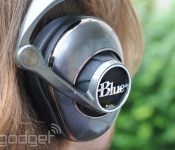
Blue’s first headphones have a built-in amp for better mobile audio

Blue Microphones, as the company’s name suggests, specializes in recording equipment, from professional studio mics to desktop models to mobile accessories. Today, Blue is breaking into a brand new product category, though not really out of its comfort zone, with the launch of the Mo-Fi headphones. It’s a move you may have been expecting, given Blue announced its intentions at the beginning of the year, and has continued to tease this first foray into listening gear ever since. Put simply, the idea is to bring the kind of high-fidelity audio you’d get from a home sound system to other, more portable devices (as long as you’re willing to pay for it). Blue’s Mo-Fi cans are available in the US today for $350, and will be coming to the UK “soon” for £275.
The Proposition

Part of the reason high-end home audio setups are able to kick out superb-quality sound is due to their large amplifiers. The problem, as it were, with the devices most people listen to music on is that their amplifiers are tiny chips, not sizable pieces of dedicated hardware. The more power you want from these chips, the more distorted the output becomes, which affects the clarity and definition of what you ultimately hear. Thus, in an effort to improve the listening experience for smartphone, tablet and computer users, Blue’s Mo-Fi headphones feature a built-in, custom-made amplifier. This means the source device has to do hardly any of the amplification work, making for a much higher-quality output when the dedicated headphone amp has done its magic. It helps, of course, that the signal is then piped out of custom, 50mm drivers tuned specifically for the internal amp.
Getting into the headphone game was a relatively easy decision for Blue. As CEO John Maier told us, headphones and microphones share more or less the same technology, they’re just put together differently. As well as knowing its hardware, Blue has a ton of experience in audio processing, too, with microphones like the Nessie and Spark Digital able to enhance recordings automatically (no software required). It only makes sense, then, to leverage this expertise and attempt to create some great-sounding headphones.
The Tech Specs

You don’t need to be an audiophile to grasp the benefit of a external amplifier, but for those who’d like a breakdown of the key specs:
- Amplifier:
- 240mW output power
- 0.004% total harmonic distortion plus noise
- 10Hz – 20kHz frequency response
- Less than 105 dB signal-to-noise ratio
- Less than 20 uV of amplifier noise
- Drivers:
- 50mm fiber-reinforced dynamic drivers
- Sealed enclosure with tuned damping materials
- 42 ohms impedance
- 15 – 20kHz frequency response
Aside from the cans themselves, you also get a selection of cables in the box, all with gold-plated connectors. There’s a regular 3-meter cable and a 1.2-meter lead with volume and track-selection controls that work with Apple devices. Both cables terminate with a standard, 3.5mm jack, but can be modified with either of the included 6.35mm or airplane adaptors (the two-pronged type). You also get a velvety carry pouch, USB cable and wall plug for charging the internal 1,020mAh battery, which powers the amp for 12-15 hours of listening time.
How They Look

With an integrated amp, Blue’s trying to do something a little different with its Mo-Fi headphones, and they certainly look unorthodox, too. It might appear as if an overzealous engineer has taken Blue’s usual, retro design language and added a futuristic flare, but all the visual complications are purely in the pursuit of comfort. The elaborate, multi-hinged headband, which would usually be just one flexible semi-circular piece, keeps the earcups vertical and always parallel to one another, regardless of how wide you open them. This means no matter the size of the head wearing them, pressure is distributed uniformly over the entire earcup. This is both for comfort’s sake and isolation, as the snug fit means there’s no opening for outside sound to get in or your music to leak out. You can even adjust the tension of the hinges from a dial on the top of the headband, should you want to change how tightly the cans clamp down.
The earcups themselves are attached to moveable arms with smooth, friction-based joints that allow you to adjust the orientation of each one individually. They’re not only handy for getting the Mo-Fis fitted just right, but if you tend to slip headphones down around your neck, extending the arms fully will stop the earcups digging in to your throat area. While the intricate design is geared towards making the cans more comfortable than your average pair, I can’t say they actually are an improvement over others I’ve used.

For one, there’s too much give to the earcup foam, leaving the outer perimeter of my ears slightly squashed against the thin layer of mesh that covers the plastic speaker grilles. It’s not immediately painful, but it can be after an extended period of use. I usually prefer the cocoon of over-ears to any other style of headphone, but I find my ears reaching stifling temperatures far too quickly in the Mo-Fis. My main gripe with them, though, is they’re far too heavy at 466g (16.44 ounces). They might be built with portable devices in mind, but they aren’t portable themselves, due to both the size and weight of them. I’ve been wearing them consistently for some time, and yet my neck hasn’t gotten round to accepting the burden for any extended period of time without needing some restpite.
In terms of materials, the majority of the headphones are covered in an attractive, metallic-grey plastic; a faux-leather material covers the foam on the headband and around the earcups. There are also accents of faux-metal plastic around the earcups, and where the Blue logo sits at the end of each driver (a layer of rubber hides the driver as it merges into the earcup). A yellow LED beneath the Blue logo on either side indicates when the headphones are powered up, and blink when they’re running out of battery. The Mo-Fis might not be as pleasant to wear as I would like, but the build quality is almost faultless. All the complicated hinge mechanisms are solid, not flimsy, and every component fits together perfectly. It’s also important to note that the Mo-Fis I’ve been using are the final design but not the final build, so retail units will be finished to an even higher standard.
How They Sound

In short, the Mo-Fis easily produce the best quality sound of any headphones I’ve used. I’m no connoisseur, but I’ve used my fair share of different styles and brands ranging in price from ten bucks to around two hundred. Mo-Fis have three ‘modes’ you choose via a switch on the base of the left earcup. Two of them — “On” and “On+” — take advantage of the internal amplifier that substantially boosts music volume. Beyond that, though, the cans kick out a rich, well-defined sound that source devices are simply incapable of producing alone. You don’t even need super high-bitrate tracks to feel the benefit. The vast improvement in clarity and warmth is easily noticeable when streaming music online or playing normal-definition mp3s.
The + in On+ signifies outbound audio is being given a slight bass boost in addition to running through the amp as normal. The increased emphasis is only subtle — it’s intended for adjusting the levels of vinyl-era tracks and any others where bass frequencies are being lost to the overall melody. The final mode is “Off,” which means the amp isn’t powered up but the drivers are still capable of producing sound. You only really want to use this when you’re out of battery (the amplification is then taken care of by the source device), or if you are plugging into a sound system that has a superior amplifier.

The headphones also have a neat kill-switch feature: when you remove them and the earcups come close together, the amp turns off to conserve battery life. Otherwise, there’s no wireless or noise-canceling capabilities; both could negatively impact sound quality, which is at odds with what Blue’s trying to achieve. And achieve it has, because the Mo-Fi headphones sound great, even if they are too bulky and at times, uncomfortable.
Up Next

Blue’s only dipped a toe into the headphone market with its first set of cans, but CEO John Maier intends to go swimming. He believes there’s plenty of opportunity left in the headphone category, from sporty models right up to top-of-the-range, audiophile gear. Within six months, Blue plans to release another set of headphones with different drivers that’ll be higher-end than the Mo-Fis launching today. More models are also set to pad out the range by the end of next year. The company’s looking into other making other input/output devices, as well — anything that could suit its expertise. Microphones will continue to be a major focus, of course, and Maier says there are still niches within the category Blue is yet to address.
Filed under: Portable Audio/Video, HD
Source: Blue Microphones
.CPlase_panel display:none;

Verizon’s HD voice and video chat service nearly ready to launch nationwide

LTE isn’t just about getting incredibly fast data speeds on our smartphone or tablet. Sure, that’s been what the technology’s been primarily used for ever since it was introduced a few years ago, but it’s capable of providing crystal-clear phone calls as well through a service known as Voice over LTE (VoLTE). The catch is that it’s up to each carrier to provide the service. AT&T and T-Mobile have begun rolling out the capability in a handful of cities, but Verizon announced today that it’s nearly ready to flip the switch on VoLTE nationwide, and it’ll happen in a matter of weeks. Whether that means two or fourteen, Verizon won’t say. But when it’s ready, this functionality will be pre-loaded on new devices and pushed to existing phones in a downloadable update (provided the hardware is compatible, which many devices are).
Over the last year, Verizon execs have remained committed to pushing out its VoLTE capability before the end of 2014; a nationwide deployment in “the coming weeks” will certainly fit within the company’s roadmap. In short, VoLTE makes it possible for carriers to forego the traditional circuit-switching method of connecting phone calls and using the network’s robust LTE network to transmit your calls via IP instead. This means that instead of dealing with staticky calls patched through Verizon’s old-fashioned 1xRTT, you should now enjoy phone conversations with higher clarity and in high-definition. It will also introduce its own video calling capability, which the carrier believes will have better quality than current services like Skype or FaceTime.
Though it sometimes seems as though we don’t use our phones for actual calls anymore, high-definition voice is a critical trend in the US wireless industry; all four national operators have either introduced or promised a boost in call quality using HD Voice technology. For Verizon, it’s not just a competitive matter — it’s also a way to push its network forward into an LTE-only world. It plans to bring its first LTE-only handsets to market in early 2016, but all of the company’s services need to rely solely on LTE before that happens, which is no small task. (It’s getting close: Currently, execs say, up to 80 percent of total data traffic is running on Big Red’s LTE network.)
In order to make this happen without it becoming a huge burden, it needs to phase out older technologies like 1x and CDMA and use that extra room to boost capacity. The more people using VoLTE, the fewer people will rely on non-LTE services. Technically, Verizon reps say, the older tech will still run until the end of the decade, but its capacity will be gradually reduced and refarmed to cover LTE’s increasing needs.

We had a chance to hear VoLTE voice calls alongside old-fashioned calls, and there’s an incredibly noticeable difference between the two; the static is largely missing and voices are rarely muffled. But there are catches. First, VoLTE calls cannot fall back to 1x; if you leave an LTE area, be prepared to drop the call and redial. You can go into the phone settings and choose which mode you want to use right off the bat, but Verizon says that the phones will be smart enough to automatically decide — based on signal strength and other factors — whether to initiate the call on VoLTE. (In theory, if you’re in a fringe LTE area, the phone will know not to risk going high-def and will opt for 1x instead.) Time will determine how reliable that feature is.
Verizon plans to offer interoperability on HD calls, which means that it’ll work with any AT&T, T-Mobile and Sprint device with the same technology built-in. The functionality is still being tested in the labs for now, but this will become incredibly important as networks continue rolling out the service.
One last catch relates to Verizon’s video calling: All calls will be billed as both minutes and data. Chances are you’re on a plan with unlimited minutes, so the former won’t matter; it’s the data that stings the most, especially since the network no longer offers unlimited data plans. Still, this is a start, and as the tech becomes even more proven and more capacity is added, perhaps the plans will change.
VoLTE technology isn’t just about HD Voice and video calls, but that’s all that Verizon is focusing on at the moment. It’s got more VoLTE-related features in the works for later, but the carrier is keeping those a closely-held secret for now; it first needs to ensure the network is ready before moving on to new projects. But, execs assured us, what we’re seeing right now is just the tip of the iceberg.
[Image credit: AP (main image), Verizon (screenshots)]
Filed under: Cellphones, Wireless, Mobile, Verizon
.CPlase_panel display:none;

Swatch is finally coming around to this ‘smartwatch’ business

Spare a thought for the watchmakers of this world, who might start to feel the pinch as more people buy a smartwatch. According to the Wall Street Journal, Swatch is the latest old-school outfit to realize that it needs more than a janky, barely-readable touchscreen to appeal to its customers. The company has let it be known that it’ll add fitness functions to its Touch line of watches, although it wouldn’t reveal specific features that we’d expect to see. The new units won’t arrive until 2015, which still leaves plenty of time for companies like Samsung, LG and Motorola to steal a march on mainstream wearables. Still, Swatch’s parent company also owns Omega, and we’d gladly trade in a Galaxy Gear for a Seamaster Professional with James Bond’s cutting laser in the bezel.
Filed under: Wearables
Source: The Wall Street Journal
.CPlase_panel display:none;

Netflix asks FCC to stop Comcast/TWC merger citing ‘serious public interest harm’

As it promised, Netflix has filed a petition to the FCC demanding that it deny the proposed merger between Comcast and Time Warner. The 256-age document claims that such a merger would result in “serious public interest harm,” and no discernible public interest — two red flag items for regulatory bodies. Netflix cited several examples of harm already inflicted on it by Comcast or Time Warner Cable. The most familiar one was to “shift Netflix traffic to paid interconnections,” in other words use network congestion as an excuse to push Netflix to paid “fast lanes.” It also argued that consumer data caps are another tactic that have been used to deter consumers from streaming companies like Netflix.
Netflix added that a merged cable giant would have huge leverage over it and rivals like Hulu. It said Comcast and TWC’s claims that there is enough competition in the market are disingenuous, since DSL offerings from AT&T and Verizon often have insufficient speed for Netflix streaming. It added that those companies offer their own streaming services (like paid video-on-demand), and thus have “incentives to interfere” with third-party companies like Netflix.
It also argued that it’s prohibitively expensive for consumers to switch broadband services, and that even if they wanted to, there are often zero alternatives — a situation that would worsen with a merger. Finally, it complained about the problem of “terminating networks,” or the point at which user data switches from one network to another, saying that providers can deliberately congest such routes to extract fees — and in fact, have no incentive not to.
There are many more arguments listed, and most of them are well known to the public. But Netflix’s legal challenge to the FCC is significant, since it (and its customers) may suffer the most from a merger. It has now joined the Dish Network in filing a formal brief along with numerous consumer groups.
Filed under: Networking, Internet
Source: Netflix
.CPlase_panel display:none;

Moleskine now has Livescribe-compatible notebooks

If you’ve always wanted to take the plunge and get a Livescribe smartpen but shudder at the thought of giving up your beloved Moleskine notebooks, well, have we got great news for you. Yep, you guessed it: Livescribe has partnered with the iconic paper notebook maker to produce special edition Moleskine notebooks filled with the special Livescribe paper required for the smartpen to do its job. If you don’t know already, Livescribe smartpens have the ability to record audio so that they’re paired with simultaneously written notes. Different pen models offer different features — the Sky WiFi pen hooks up to Evernote while the Livescribe 3 uses Bluetooth to sync those notes with a corresponding iOS app. No matter which pen you want however, all will work with the limited edition Moleskine book. It’s got the look and feel of traditional Moleskine tomes, complete with elastic closure and an expandable inner pocket (which, incidentally, comes with a handy cheat sheet of smartpen controls). If you want to snag one though, you better act soon — there’s a limited supply and each book will cost you $29.95.
Filed under: Misc
Source: Livescribe, Moleskine
.CPlase_panel display:none;

Evernote’s getting physical (again) with a new line of office accessories

The idea of Evernote selling physical goodies might have seemed weird at first, but people took to it quickly, enough (the company says) for the merchandise to rake in $8 million in revenues since fall. If that’s true, then it’s not surprising that the company’s come up with a new line of items, this time focusing on ones a bit less intriguing than Evernote-branded socks. The app’s creators have partnered with California designer Eric Pfeiffer to put their own spin on stackable cups, trays and tablet docks for your office. While the tray and the tablet dock are made of wood and only come in one variant each, you can choose between cups with wooden and brightly colored bases. These items are now available on Evernote Market for $20 to $50, with the dock being the most expensive of the bunch. Also, the company’s launching Evernote Market in China at the same time, loaded with items both from this new line and the old one.
According to a company rep, Evernote’s conjured up a new line of physical goods, because it “wants to own both your digital and physical workspace, and help you keep it organized and pleasing.” In fact, it’s launching even bigger desktop furniture on October 4th, at this year’s Evernote Conference in San Francisco
Filed under: Misc
Source: Evernote Market
.CPlase_panel display:none;

Spotify is now free for Windows Phone users

Spotify has offered free, ad-supported streaming to Android and iOS for months, leaving Windows Phone users wondering what they’d done wrong to be so roundly ignored. Today, it seems, Spotify has finally remembered that they exist, and has announced that both Windows Phone 8 and 8.1 devices will enjoy “free” music from today. The updated app, available from the Windows Store, also has a few other tweaks, including better search and discovery features, helping you to work out which artists you love, and which artists are, eh, kinda okay, I guess.
Filed under: Cellphones, Portable Audio/Video, Mobile, Microsoft
Via: The Verge
Source: Spotify, Windows Store
.CPlase_panel display:none;

Everyone’s making a sapphire phone, here’s Huawei’s

Rumors of the next-gen iPhone donning a scratch-proof sapphire screen have been going around since the Apple sapphire plant announcement, and it appears that Huawei wants in on the hype, as it prepares for the launch of a sapphire edition Ascend P7. While no price has been announced just yet (it’ll naturally be more expensive, of course), a Huawei rep told us that said phone will be available in its Chinese online store in limited quantity, with the first batch due in September, followed by another lot in November. If all goes well, Huawei will become the first Chinese brand to sell a smartphone with a sapphire screen, but it’ll have to act fast as local rivals Xiaomi and Vivo are also rumored to be mulling sapphire devices.
The scarcity of the special edition P7 casts doubt on the feasibility of making large sapphire screens more mainstream: It’s very costly, plus the hard material becomes more brittle when scaled up, as our own Brad Molen established from multiple interviews. Having said that, the sapphire-encased Kyocera Brigadier is already available stateside for a mere $400 off-contract, so it’s just a matter of time before everyone else gets their hands on the same screen supplier.
Filed under: Cellphones, Mobile
.CPlase_panel display:none;
 AIVAnet
