


Casio’s newest G-Shock has a giant dial for (complicated) music control

Casio continues to inch its G-Shock series towards something a little smarter, while holding onto a simple monochrome LCD display and that distinctly G-Shock styling. The “G’mix” GBA-400 improves on the typical digital watch feature list through Bluetooth, a pair of dedicated apps (one for the watch part, one for the music playing part) and your smartphone, whether it’s iOS or Android. Oh and there’s a giant dial control on the side and it’s really satisfying to play with.

See? Once you’ve linked the G-Shock to your smartphone, the dial can be setup to adjust volume, skip tracks, and even cycle through several different equalizer settings. You can also make your own custom equalizer profiles within the companion music app — and even decide which modes get added to the watch-based selector. To cycle through those menus, however, you need a depress another button. Bluetooth syncing is assigned to yet another button, while the third button does illumination and the fourth cycles through digital watch features like stopwatch and alarm.
For a digital watch with a few tricks up its sleeve, it’s unfortunately not all that intuitive. There’s a lot of buttons, and a lot of scrolling to get what you want done — we had to ask multiple times for driving instructions, inadvertently changing equalizer settings when we simply wanted to skip a track. We also don’t quite get the reasoning for two mandatory app downloads: surely Casio could integrate the watch features into the music app?
The G’Mix’s best trick is its music recognition integration, courtesy of SoundHound. With two scrolls upwards on the rotary switch, it’ll kick your smartphone into action, listening to the music. While it’ll offer up artist and purchase details within the phone app, it’ll also send a basic line of song information to the watch face itself — it all works without you having to touch the phone at all. From our brief testing with Casio’s team, it had no problem picking up a couple of ’80s hits — and it was all relatively easy to initiate.

Through the same Bluetooth connection, the new G-Shock can also sniff out your phone and ring it, when it’s somehow hidden itself. (Last year’s models apparently packed the same skill.) Unlike a lot of Casio’s watches, there’s no solar charging here, but the battery is rated for two years, which factors in using the mobile link feature for about two hours a day. Obviously, two years per battery change sounds much better than current smartwatch mileages — even the skill set of the Casio model is a severely reduced one. The watch goes on sale in Japan first, priced at 23,000 yen (roughly $220), but it’ll roll out globally after that — Casio expects to offer the model in the west later this year.
Filed under: Wearables
.CPlase_panel display:none;

‘All Together Now’ is a Fox sitcom about friends who unplug

Time spent with friends is supposed to be cherished. Nowadays, however, the existence of things like Facebook, Instagram, Snapchat and Twitter make those moments a little less special for some people, namely because they keep their eyes hooked to whatever device they have near them. To that end, according to Deadline, Fox has green-lit a TV sitcom called All Together Now, which features a plot based on six friends in their late 20′s who are keen to unplug from their mobile devices and interact with one another “for as long as they can stand it.” All Together Now is set to be produced by Alec Sulkin and Julius Sharpe, who most recently worked with Fox on Dads, a show canceled last May, after only one 19-episode season, due to very bad reviews. The new sitcom still hasn’t begun production, so it’ll likely be a while before it premieres — hopefully it’s enough time for you to gather your thoughts and realize that this is really happening.
[Image credit: Associated Press]
Filed under: Cellphones, Home Entertainment, Tablets, Mobile
Via: The Verge
Source: Deadline
.CPlase_panel display:none;

The Times of India wants access to its journalists’ social networks

Over the past few years, social networks have become an extremely powerful tool for every journalist, whether it’s here in the United States or elsewhere across the world. But social networks like Twitter and Facebook aren’t just a venue for sharing links or live-tweeting breaking news events, as great as that is — it’s also about the engagement one can have with readers and other fellow journalist. Knowing this, The Times of India has recently implemented a new policy that requires its journalism employees to hand over Twitter and Facebook passwords, as it looks to gain control of what they can and cannot post on their social accounts.
The company shall be the owner of the access passwords, username and associated email address for the User Account, which shall be used by you on behalf of the Company to make posts. Company retains administration rights of the User Account, which shall be made accessible to the Company on demand. It is understood that sharing of such details of the User Account shall be an integral part of your contract with the Company and shall also be necessary for processing any settlement related to termination of such Contract.
According the report from Quartz, the new contract implemented by Benner, Coleman and Company Ltd., also known as The Times Group and publisher of The Times of India, also demands access even after an employee leaves the company. “The company may upload news or other material on the company User Account through any means, including automated upload streams, at its sole discretion, notwithstanding any termination of your contract with the company,” reads another excerpt from the document. What’s more, Quartz says that reporters who have raised concerns over the situation have been told that this “will be addressed in due course” — which, as you can imagine, doesn’t sound promising at all.
Via: Fast Company
Source: Quartz
.CPlase_panel display:none;

Rdio, Songza and other music services won’t eat your T-Mobile data

T-Mobile’s Music Freedom initiative raised a few eyebrows when the Uncarrier revealed it a few months ago – it granted most-favored nation status to a handful of music streaming services so whatever data they used wouldn’t count against your monthly data cap. With Pandora, Spotify, iTunes Radio in the mix, the move seemed like a win for consumers… unless you happened to pay someone else to get your streaming fix. Thankfully, T-Mobile is finally expanding the list of supported services to include beloved also-rans like Rdio, Google-owned Songza, and more. Support for the six new streaming services has gone into effect today, but T-Mobile admitted in a statement that one fan-favorite service would take a little more time to set up. You see, the carrier kicked off a poll shortly after Music Freedom’s launch to see what unsupported service people wanted to use the most. The winner? None other than Google Play Music — hardly a surprise, but T-Mobile admitted in a statement that it won’t be added to the fold until later this year.
Filed under: Mobile
Source: T-Mobile
.CPlase_panel display:none;
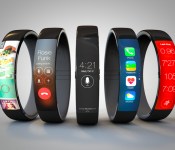
Apple to Unveil Wearable Device on September 9 Alongside iPhone 6
Apple has plans to unveil its upcoming wearable device in September, alongside the iPhone 6, reports Re/code. The site previously suggested Apple had planned to debut the device at an October event, but now says that Apple’s plans have changed.
 iWatch concept by Todd Hamilton, based on the Nike Fuelband
Remember back in June when I said Apple hoped to schedule a special event in October to show off a new wearable device? Remember how I also said this: “Could things change between now and fall? That’s certainly possible.” Turns out that was a prescient hedge, because things have changed. Apple now plans to unveil a new wearable alongside the two next-generation iPhones we told you the company will debut on September 9th.
According to Re/code, the device will “make good use” of both HealthKit and HomeKit, two sets of APIs that were introduced during WWDC. HealthKit, which ties into Apple’s iOS 8 Health app, focuses on health and fitness, while HomeKit is a home automation platform designed to allow users to control a variety connected devices.
Though Apple has plans to introduce a wearable device in September, there is no word on when the device might ship. Given a lack of part leaks and rumors pointing towards a late 2014 or early 2015 launch, it is likely the device will be shown several months before it will be available to consumers.
Apple’s upcoming wearable device has been frequently referred to as the iWatch by both MacRumors and other rumor sites, but it remains unclear what Apple will call the device at launch. It is expected to be a wrist worn device, however, and rumors have suggested that it will come in multiple sizes with several different designs available at multiple price points.
It is also expected to incorporate an array of different health and fitness sensors to measure various health-related metrics like steps taken, sleep quality, heart rate, and more.
.CPlase_panel display:none;

Apple Seeds OS X Mavericks 10.9.5 Build 13F24 to Developers [Mac Blog]
 Apple today seeded Mavericks 10.9.5 build 13F24 to developers, just over a week after seeding the fourth OS X 10.9.5 beta, build 13F18, and more than a month after releasing OS X 10.9.4 to the public.
The beta is available through the Software Update mechanism in the Mac App Store and through the Mac Developer Center.
It is unclear what improvements the 10.9.5 update will bring to Mavericks, but it is likely to include bug fixes and stability enhancements. Apple is asking developers to focus on USB, USB Smart Cards, Graphics, Safari, and Thunderbolt.
Along with working on improvements to Mavericks, Apple is also beta testing OS X Yosemite, which is due to be released in the fall. The last Mavericks update, 10.9.4, added several Wi-Fi fixes and improved wake from sleep reliability.
.CPlase_panel display:none;

Intel’s tiny 3G modem will put always-on data in your smartwatch

There are already smartwatches and other wearables with cellular data built-in, but the bulky hardware they need for that wireless access makes them less than elegant. Intel clearly isn’t happy with this state of affairs, as it just unveiled an extra-tiny modem that should put truly sleek, always-connected devices on your body — and seemingly everywhere else. The new XMM 6255 isn’t much larger than a penny (0.47 square inches), but delivers a full-fledged 3G data link. It’s built to take abuses like power spikes, and it doesn’t need a big antenna to get a good connection; it can even get solid performance in a low-signal area like your basement.
The company isn’t ready to say just who’s using the miniscule modem in finished products, but the technology could be relatively ubiquitous. Besides more wearables that don’t have to rely on your phone to get online, you could see a larger internet of things where even relatively small devices have their own internet service; it’s reasonable to expect a lot of smart sensors and security systems that can always talk to the outside world.
Filed under: Wearables, Wireless, Networking, Intel
Via: BBC
Source: Intel
.CPlase_panel display:none;

Russia wants to ban films that make it seem oppressive or silly

Filed under: Home Entertainment, HD
Via: AV Club
Source: 9AM News (translated)
.CPlase_panel display:none;

Kickstarter has a new king: Coolest, an all-in-one cooler

Back when it introduced its first smartwatch, there’s no doubt that Pebble took the crowdfunding world by storm. But, more than two years after Pebble broke and set new records on Kickstarter, a cooler is now doing the same. As of today, Coolest is the most successful Kickstarter ever, at least in terms of money pledged on the site. The project has managed to lure in nearly 50,000 backers and collect a little over $10,424,610 million so far, shattering Pebble’s previous milestone of $10,266,845 million. Coolest is pretty much a portable party on wheels, complete with a plethora of built-in accessories, including a removable, waterproof Bluetooth speaker, USB charger, cutting board, storage space for plates and, wait for it, a battery-powered, rechargeable blender. In case that wasn’t enough, the do-it-all cooler will be LED-lit on the inside, for those times when you’re out camping late, and have a bottle opener to boot — we all know how important the latter feature is. You still have a chance to try to get your own, but hurry because there are only 58 hours to go.

Filed under: Misc, Peripherals
Via: TechCrunch
Source: Coolest (Kickstarter)
.CPlase_panel display:none;

Jabra’s pulse-tracking earbuds tout Bluetooth connectivity for fewer tangles

Heart rate tracking in-ear headphones are starting to pop up on the regular it seems. A couple weeks ago, SMS Audio revealed its collaborative effort with Intel, and now Jabra’s joining the fray, but without the tether. In an effort to limit cord tangles, the audio outfit’s Sport Pulse wireless earbuds connect to your phone via Bluetooth for sorting tunes and tracking your pulse. Dolby sound handles the listening duties while an in-line remote wrangles those mid-run track changes. Inside, an optical biometric heart rate monitor keeps tabs on your workout, beaming collected data to the Sport Life companion app and peppering your activity with personalized coaching for added motivation. And as you might expect, the software helps plan workouts and logs info from each session. The wireless set goes on sale October 1st for $200 (£200), but you can pre-order now if you’re unable to contain the excitement.

Filed under: Portable Audio/Video
Source: Jabra
.CPlase_panel display:none;
 AIVAnet