


Apple Granted Patent for Fifth Avenue Glass Cube Store Design [Mac Blog]
Apple has been granted a patent for the design of its iconic glass cube Fifth Avenue retail store, reports Patently Apple.

The decision comes four years after Apple applied for a trademark related to the store’s design, which is still currently pending. The panted granted today was originally filed on October 15, 2012 and credits eight inventors including former Apple CEO Steve Jobs.
Apple’s Fifth Avenue store opened on May 19, 2006 and was designed by architectural firm Bohlin Cywinski Jackson. Due to a structural overhaul that took place in 2011, the location currently uses 15 panes of glass as opposed to 90 used in the original cube. The renovations on the newer cube also did away with nearly all of the hardware that previously held the original panes together, resulting in a “seamless” design.
.CPlase_panel display:none;

Researchers working on nanobots that directly attack tumors to cure cancer

For all the advancements we’ve made with technology and medicine, a cure for cancer still eludes us. But maybe that’s because we haven’t enlisted nanoparticles to attack tumors just yet. New research from the University of California’s Davis Cancer Center, spotted by PhysOrg, suggest that could be a reality sometime soon. By attaching a tumor-recognition module to a nanorobot, doctors would be able to both diagnose a cancerous growth and inject drugs directly into the carcinoma. This would effectively target only the malignant cells and leave the surrounding areas unharmed — taking things a few steps further than, say, the nanodiamonds we’ve heard of. It’s a stark contrast to how chemotherapy treatment typically works, too, which is a blanket attack on all of a certain type of cell that often inflicts as much collateral damage as it does good. Who knows, a world where cancer patients don’t have their hair or bone marrow destroyed during treatment might not be too far off after all.
[Image credit: Shutterstock / StockLite]
Via: PhysOrg
Source: Nature
.CPlase_panel display:none;
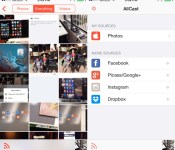
AllCast’s media streaming app is coming to iOS ‘slowly but surely’

Envious of Android’s stream-wrangling AllCast app, but not ready to switch mobile platforms? You’re in luck: the app’s creator just teased the iOS version of the app on his Google+ page. A pair of screenshots (featured above) shows the work-in-progress, punctuated only with developer Koushik Dutta’s brief commentary: “Slowly but surely.” The port was apparently sparked by a handful of new iOS8 APIs that it possible to cast from other apps besides AllCast. So, when will it be here? Dutta says he hopes to release the app in a few weeks, possibly the end of September.
Filed under: Cellphones, Mobile, Apple
Source: Google+
.CPlase_panel display:none;

Scientists catch Schrödinger’s cat with quantum physics

Schrodinger’s cat, the good ole thought experiment that’s been twisting (non-Quantum physicist) brains for decades. Scientists might have just caught it. Or not. Typical. What you see above is a combined image where a stencil was bombarded with cosmic rays photons, but the photons that generated the image actually never interacted with the stencil — stay with us. It was separate photons (which shared the same quantum state as the ones that hit the camera) which arrived at the stencil. The science goes that when two separate particles are entangled, their physical properties appear to correlate and they share a single quantum state.
Researchers at the Austrian Academy of Sciences in Vienna created yellow and red pairs of entangled photons. While yellow photons were fired at the cat stencil, the red photons were sent to the camera. Quantum entanglement could offer a huge array of benefits, including highly advanced data security and quantum communication, which sounds equal parts complicated and futuristic.
Source: New Scientist
.CPlase_panel display:none;

Olympus’ newest mirrorless camera is built for selfies

Even Olympus can’t resist the allure of selfies, it seems. The company has just unveiled the PEN E-PL7, a retro-tinged mirrorless camera whose centerpiece is a 3-inch flip-out LCD that makes those trendy self-portraits a little easier. When you swing out the display, it kicks into a “Selfie Mode” which lets you tap the screen to capture a slightly time-delayed (and hopefully, better-prepared) shot. There’s a selfie interval option to snap successive photos in different poses, and powered zoom lenses will automatically kick into a wide-angle view to make sure your pretty face is in the frame.
It’s not just about stroking your ego. The E-PL7 still has a 16-megapixel sensor like the E-PL6, but it carries both the E-M10′s three-axis image stabilization and a fast 81-point autofocusing system that can shoot a moving subject at up to 3.5 frames per second (8FPS in regular bursts). And you’ll be glad to hear that WiFi has finally reached the mid-tier PEN line — you can both share pics through your phone or control the camera from a short distance away.
If you’re tempted, the E-PL7 won’t cost too much when it ships in late September. Spending $600 will get you the body alone, and $700 bundles a 14-42mm f/3.5-5.6 standard zoom lens. The accessories don’t arrive until October, although there are two that will be worth waiting for if you’re going diving: a $700 underwater shell will keep your camera safe, while a matching $500 flash will illuminate darker waters.
Filed under: Cameras
Source: Olympus
.CPlase_panel display:none;

Microsoft explains how it’s getting rid of fake Windows Store apps

You may have heard that the Windows Store has a serious problem with counterfeit apps; for every legitimate title, there’s seemingly a horde of fakes meant solely to take your money and run. At last, though, Microsoft has detailed what it’s doing to cull these scams from its shop. To begin with, it recently toughened up the requirements so that app categories, icons and names reflect what you’re really getting; hopefully, you’ll see less junk going forward. The folks in Redmond are also scouring the existing catalog, and have pulled 1,500 apps so far. There’s still a long way to go (search for “iTunes” and you’ll see plenty of copyright abuse), but this represents a good start.
For some, the biggest solution may be what Microsoft isn’t doing — namely, paying developers for every app they publish. A promotion the company ran last year gave $100 per finished app no matter how much work was involved, which actually punished those who took the time to write top-notch software. The strategy suggested to some that Microsoft was obsessed with catching up to the quantities of apps in Apple’s App Store or Google Play, quality be damned. Both the crackdown and the end to those pay-per-app promos should go a long way toward changing this reputation, but it will only be successful when you can safely assume that most Windows Store apps are the real deal.
Filed under: Desktops, Laptops, Tablets, Software, Microsoft
Source: Building Apps for Windows
.CPlase_panel display:none;

Smartwatch Mania with ASUS, LG, and Samsung! – ManDroid Daily

Welcome to Smartwatch Mania! Wow. Passed couple hours have been very intersting indeed, folks. ASUS, LG, and Samsung all teased new smartwatches today that will be officially unveiled at IFA. Not bad designs for these smartwatches. I kind of dig LG’s new design with that circular face. Let us know which watch will be landing on your wrist, or will you still go with the Moto 360. Enjoy the Daily!
Android News
ASUS ZenWatch
LG G-Watch R
Samsung Gear S
Import G+ videos to YouTube
//<![CDATA[
ord = window.ord || Math.floor(Math.random()*1E16);
document.write('‘);
//]]>
The post Smartwatch Mania with ASUS, LG, and Samsung! – ManDroid Daily appeared first on AndroidSPIN.
.CPlase_panel display:none;

Heat Seek temperature monitors want to keep NYC tenants warm, bring scummy landlords to justice

Ugh. Landlords from hell. They leave doors damaged and plumbing to rot, don’t care that killer molds are growing behind the walls, and in NYC, they couldn’t care less if you freeze in the winter. Since it’s darn hard getting an inspector to come and verify a heat violation, a new KickStarter project called Heat Seek NYC wants to give people the power to gather their own evidence using simple internet-connected temperature sensors. These Heat Seek sensors constantly monitor indoor temperature and upload the results online like Nest does, so they can be accessed through an app monitored, say, by a lawyer building a tenant’s case.
They come in two types: the more expensive “hub” that’s connected to the internet and the cheaper “cell” that wirelessly transmits data to the hub. In case there are several tenants in one building who need their indoor temps monitored, for instance, they can get several cells and a single hub. These sensors aren’t just for people getting cheated by scummy lessors, though. According to the project’s creators, they’re also working with responsible, law-abiding landlords to determine areas of their building that need to be patched up to prevent heat loss.
If you need to get some temp monitoring done, you can get one of Heat Seek’s hubs or cells (with a February 15, 2015 ETA) through the Kickstarter campaign for at least $60. Even better, most of the project’s funding options are a buy-one-give-one deal. So, you’re putting a cell or a hub in the hands of an NYC tenant (the project aims to distribute up to 1,000 sensors) who truly needs it when you purchase one.
Filed under: Household
Via: The Verge
Source: Kickstarter
.CPlase_panel display:none;

Water-powered phone chargers are coming to downtown Seoul

Unless you’ve made a habit of carrying around a solar charger, topping off your phone outdoors can be a bit of a challenge. Well, unless you’re living in South Korea. The city of Seoul just announced that it’s building a series of outdoor recharging stations along the Cheonggyecheon, a manmade stream in the city’s downtown area. The chargers won’t draw from the city’s power grid, however — they’ll draw current from a collection of hydroelectric turbines embedded in the stream. The project’s developer says the stations will be able to fully charge most devices in 2-3 hours. If the five stations currently in production turn out to be a hit, the city says it will consider expanding the network. See? Low battery life is no excuse for avoiding the great outdoors.
[Image credit: AFP/Getty Images]
Filed under: Cellphones
.CPlase_panel display:none;

‘BioShock’ for iOS Now Available Worldwide [iOS Blog]
Following hints of a release earlier this summer, the iOS version of 2K Games’ original first person shooter BioShock is now available in the App Store. Rumored since 2008, BioShock on iOS is a port of the full, original game first released in 2007.
Set in 1960, BioShock asks players to take on the role of Jack, a plane crash survivor who finds his way into the defunct underwater city of Rapture. Jack has to fight his way out of the city, battling Big Daddies and other enemies while using an array of heavy weaponry and taking advantage of genetics-altering plasmids that grant him super powers. Over the course of the game, players also discover the rich history behind the creation of Rapture and its eventual fall.
One of the greatest first person shooters of all time, BioShock comes to iOS!
BioShock is the “genetically enhanced” first person shooter where you can turn everything into a weapon: the environment, your body, fire and water, and even your worst enemies.You are a cast-away in Rapture, an underwater Utopia torn apart by civil war. Caught between powerful forces, and hunted down by genetically modified “splicers” and deadly security systems, you have to come to grips with a deadly, mysterious world filled with powerful technology and fascinating characters. No encounter ever plays out the same, and no two gamers will play the game the same way.
Earlier this month, our sister site TouchArcade went hands on with BioShock for iOS, and found that it runs “like a dream on iOS hardware” but had somewhat poor virtual controls as is common with first person shooters on a touchscreen. It does, however, work very well with a Bluetooth controller, which makes it “just like playing on a console.” The game’s graphics were slightly toned down to make it run on iOS, removing the fog and dynamic shadows, but TouchArcade says “you’d be hard-pressed to tell.”
BioShock is limited to newer iOS devices, including the iPad Air, Retina iPad mini, fourth-generation iPad, and the iPhone 5/5c/5s.
BioShock can be downloaded from the App Store for $14.99. [Direct Link]
.CPlase_panel display:none;
 AIVAnet