


James Cameron found himself at the bottom of the ocean

James Cameron emerges from the DEEPSEA CHALLENGER after his successful solo dive to the Mariana Trench, the deepest part of the ocean. (Mark Thiessen/National Geographic)
There came a moment halfway through Deepsea Challenge 3D when I realized James Cameron’s new film isn’t really about exploring the depths of the ocean in the name of science. It’s about James Cameron visiting the bottom of the ocean because James Cameron felt like it.
Ostensibly, of course, the film, which is set for a nationwide release on August 8th, is about much more than that. Backed by a team of scientists and engineers, Cameron spent seven years building a submersible capable of reaching the deepest point in the ocean, seven miles below sea level. Following a series of tests, many of them documented in this film, Cameron finally piloted the Deepsea Challenger into those depths, reaching the Mariana Trench in March 2012 and making him the first person to complete that journey since the Trieste touched down in 1960. This time, though, the vessel was kitted out with a couple 3D cameras, allowing Cameron to document the experience on video for the first time. (In fact, the documentary only features a few minutes of footage from the trench, but more on that later.) Basically, this film offers a first, if fleeting, look at the Earth’s crust from 36,000 feet down under — which means Cameron, the Academy Award-winning director, is as much an explorer here as he is a filmmaker.
This film offers a first look at the Earth’s crust from 36,000 feet down under — which means Cameron, the Academy Award-winning director, is as much an explorer here as he is a filmmaker.
And he never lets you forget it, either. By the time the first 45 minutes are up, we’ve seen clips from three of Cameron’s films, including Titanic, Avatar and The Abyss, along with dramatized flashbacks to Cameron’s childhood, when he dreamed of being the next Jacques Cousteau. (I can’t make out everything I jotted down in that darkened theater, but I believe the word I used was “masturbatory.”) Even interviews with Cameron’s wife, Suzy Amis, feel like a bizarre kind of Cameron propaganda — that’s partly because audiences will recognize her as Rose’s granddaughter from Titanic, and also because her main purpose is to vouch for how serious her husband is about deep-sea travel.
To be fair, some of this was unavoidable. In producing The Abyss, the 1989 deep-ocean sci-fi film, Cameron consulted with various members of the deep-sea-diving community, including Don Walsh, one of the two men aboard that original 1960 voyage into the Mariana Trench. By the time Cameron began work on the Deepsea Challenger in 2005, he had already led seven deep-water expeditions, including three to the Titanic, and one to the wreck of the Bismarck, a World War II-era battleship that sank in the North Atlantic. The point is: Cameron isn’t just another Richard Branson, a rich guy with time on his hands and a penchant for spaceships. The man has experience piloting remotely operated underwater vehicles, and sending him down 36,000 feet unaccompanied was not a stunt. He knows a thing or two about submersibles, not to mention 3D cameras and underwater lighting techniques.

The DEEPSEA CHALLENGER is the centerpiece of DEEPSEA CHALLENGE. (Mark Thiessen/National Geographic)
It’s all a bit much, though. The film too often feels like an infomercial for James Cameron, sometimes at the expense of actual science talk. At one point, for instance, the film touches on underwater earthquakes, and how studying them might help us better prepare for the tsunamis they cause. We’re then treated to a brief montage reminding us of the devastating 2011 tsunami that ravaged eastern Japan. It’s thrilling to see a wall of water in 3D, but the moment quickly passes: Cameron moves on and never mentions the subject again. I’m no scientist, as you all know, so it’s not my place to question Cameron’s claim that this kind of exploration will one day aid tsunami research. But without much explanation as to why these expeditions are helpful, those clips of homes floating down the street come dangerously close to feeling like props.
I can’t make out everything I jotted down in that darkened theater, but I believe the word I used was “masturbatory.”
Meanwhile, we only find out in a postscript at the end of the film that Cameron’s flagship voyage led to the discovery of 68 new species — over 100 if you count the other dives. Not mentioned in the film: One shrimp-like amphipod produces the same compound already used in clinical trials to treat Alzheimer’s disease. And then there’s my personal favorite: a see-through sea cucumber the size of a crayon (I mean, what?!). Those are just two of the life-forms managing to survive in the darkness at 36,000 feet below sea level. Seems kind of important, right? Or at least interesting enough for Cameron to discuss? And yet, it comes as an afterthought as the final credits are about to roll. Even then, you’d have to be reading the companion site to appreciate how fascinating this stuff is. Which is insane: If I were James Cameron, I would constantly be reminding you that I discovered a sea cucumber.

James Cameron is believed to have discovered a see-through sea cucumber, similar to the Enypniastes pictured here. (Census of Marine Life)
Then there are the topics that don’t get lip service at all. Is deep-sea mining a possibility? Will we ever see tourist expeditions, à la what Branson is proposing with Virgin Galactic? Did you know that the Mariana Trench has been proposed as a nuclear-waste dump? I did, but that’s only because I read it on Wikipedia. After 90-some-odd minutes, the most sincere reason Cameron offers for his voyage is that he was able to satisfy his inner 9-year-old.
Ironically, too, Cameron’s final cut features very little footage from seven miles below. In movie-time, it takes about 10 minutes to get to the bottom of the ocean, at which point we spend little more than 10 minutes looking around. To be fair, there’s not much to see. The terrain is “flat and featureless,” to quote Cameron himself, with no animal tracks. Also, Cameron’s stay was shorter than expected: He had intended to spend five hours down there, but left after three due to a series of mechanical failures.
The film too often feels like an infomercial for James Cameron, sometimes at the expense of actual science talk.
For that reason, then, the most rewarding parts of the film are the parts where we get to see Cameron and team testing the Deepsea Challenger in increasingly deep (and difficult) waters. One failed shallow-water attempt early in the film is particularly riveting, as is that final, eerily quiet descent into the deep. At one point, we hear a startling crack many feet underwater — the sound of something possibly going very wrong. It made me wonder who would be crazy enough to test this gear, and it’s fun to think that person is actually James Cameron.
Much like Titanic itself, Deepsea Challenge 3D manages to be suspenseful, even though we know precisely how it’s going to end. If only the final product weren’t so shallow.
[Image credit: Mark Thiessen/National Geographic (James Cameron; Deepsea Challenger); Census of Marine Life (Sea Cucumber)]
Filed under: Misc
.CPlase_panel display:none;

Surprise, surprise: Mini flagship devices are reporting lower than expected Sales
 Those well versed in the smartphone market will know there is one type of device that is an obvious disappointment: mini flagship devices. Samsung, HTC, LG and Sony have all done it; after announcing their new flagship device, they quickly follow it up with a mini device that resembles the flagship device only in name, with less powerful hardware, sometimes less features, and yet the price often remains higher than mid range devices. Sources in Taiwan have reported that these devices performing poorly due to “uncompetitive performance price ratios”. This is especially obvious in the Asian region where mid range devices are sometimes half the price of these so-called “mini” devices.
The only exception to the above rules is the Sony Xperia Z1 Compact, which ditched the “mini” nomenclature in hopes of avoiding the stigma associated with these devices. Unfortunately, according to this report, the Z1 Compact has also under-performed on its expectations. This is a shame as the Z1 Compact is the only “mini” device that is a genuinely impressive smartphone, with all the flagship hardware squeezed into a 4.3-inch frame. With this feedback in mind, expect manufacturers to shy away from “mini” devices.
What do you think about the performance of these mini flagship devices? Let us know your thoughts in the comments below.
Source: DigiTimes via Phone Arena
//<![CDATA[
ord = window.ord || Math.floor(Math.random()*1E16);
document.write('’);
//]]>
The post Surprise, surprise: Mini flagship devices are reporting lower than expected Sales appeared first on AndroidSPIN.
.CPlase_panel display:none;

Hello there: HP teams with Gilt to design “a Michael Bastian smartwatch”
 With the release of Android Wear, the benchmark for style in the smartwatch world would seem, by popular consensus, to be Motorola Moto 360. Well, there may be a new challenger to the arena, and its from a manufacturer you might not be expecting a smartwatch to come from. That manufacturer is HP, who is teaming with Gilt, an online retailer, to create what is so far looking like a very intriguing device. Designed by U.S. designer Michael Bastian, the smartwatch apparently takes some of its cues from the interior of luxury cars.
 It seems unlikely that the device will be running Android Wear as it is said the smartwatch will be able to be paired with both Android and iOS devices. There will also be a companion app that will allow you to customize the interface of the watch to your liking, though there’s nothing more specific about that yet. There’s also no word on pricing yet, though you can sign up for updates, however we’re assuming that level of style isn’t going to be cheap. Still, it looks like it’s going to be a thing of beauty, and it’s interesting to see HP enter the smartwatch market in such a unique way.
What do you think about the Michael Bastian smartwatch? Let us know your opinion.
Source: Gilt via engadget, Hypebeast
//<![CDATA[
ord = window.ord || Math.floor(Math.random()*1E16);
document.write('’);
//]]>
The post Hello there: HP teams with Gilt to design “a Michael Bastian smartwatch” appeared first on AndroidSPIN.
.CPlase_panel display:none;

Google’s peculiar floating barge meets its maker

Remember Google’s mysterious floating barge? Well, you probably won’t for much longer, because it’s met an untimely end. According to the Portland Press Herald, the search giant no longer has a use for the iconic four-story structure, so it’s been sold to an anonymous “international barging company” and will be broken down for scrap. It’s a rather damp end for the barge, which was set to become a high-tech showroom for inventions like Glass, self-driving cars and other top-secret inventions from Google’s X lab, after it first appeared in Portland Harbor late last year. Google’s yet to comment on why it’s no longer interested in hosting tech-centric cocktail parties, but cost is likely the ultimate factor. It paid $400,000 in property taxes alone to moor the barge on the city’s waterfront — then there’s also the small matter of retrofitting its 63 shipping containers into something that Californians would actually want to visit.
[Image credit: Tom Hilton, Flickr]
Filed under: Transportation, Google
Source: Portland Press Herald
.CPlase_panel display:none;
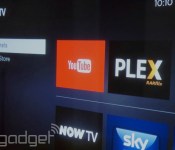
YouTube comes to Sky’s Now TV box

Sky’s done a reasonable job of bringing new channels to its Now TV set-top box, especially given the rebranded Roku is just a vehicle for selling short-term entertainment and sports passes to the contract-adverse. Today, that £10 box gets a little bit more useful, with the addition of an official YouTube app to the Now TV channel store. Sky can take credit for giving it the green light, but its arrival is no big surprise when the channel launched across the entire Roku range a few months ago (after being exclusive to the Roku 3 for a time). It’s been possible to watch YouTube content on the Now TV box through third-party channels such as Plex, but the official app has a much better interface for searching and browsing. Unfortunately, it’s slow to navigate to the point of frustration, but if you want to catch a quick fail compilation while the kettle’s boiling, it’ll do the trick.
Filed under: Home Entertainment, Internet, HD
Source: Sky
.CPlase_panel display:none;

Take a look at HP’s luxury smartwatch

Despite their utility, smartwatches remain a geeky niche item thanks to a certain lack of je ne sais quoi. However, HP is partnering with a retailer called Gilt to build an Android and iOS compatible smartwatch that may finally tick the style box, thanks to US designer Michael Bastian. He’ll take care of the design, which will feature a circular, 44mm stainless steel design and three swappable bands: black rubber, brown leather, olive green nylon and a limited edition black.
Bastian says the design cues came from luxury automobiles, namely interior features like the dashboard and trim. Meanwhile, HP will will add the watch’s smart features, which will reportedly include notifications like email, text and calls, along with user controls for music and other apps. It’ll reportedly arrive this fall, with no word yet on pricing — but we imagine it will be in the “if you have to ask” category.

Via: Hypebeast, Fashionista
Source: Gilt
.CPlase_panel display:none;

Typo’s iPhone keyboard is back and it still looks a lot like a BlackBerry

Auto-correct fails can be pretty hilarious, but if you’d rather avoid them altogether (boo!) maybe a litigious phone case’s second coming is up your alley. See, earlier this year Ryan Seacrest’s iPhone accessory company, Typo, found itself on the wrong side of the law when BlackBerry filed suit against it. Why? Because, well, its product looked an awful lot like something you’d find on one of the Canadian outfit’s devices. But, that copyright infringement applied to Typo, not the almost identical Typo 2. As iMore tells is, the American Idol host has added a few new bits and bobs like a lock key, backlight and battery indicator to the keyboard that’ll hopefully distract Chen and Co.’s attorneys. The accessory starts shipping this September, but you can pre-order now for $99 — whether its maker is back in court by then is anyone’s guess.
Filed under: Cellphones, Mobile, Blackberry
Via: iMore
Source: Typo
.CPlase_panel display:none;

See how Tesla intends to Supercharge the world

Is the thought that you might end up running out of juice in the middle of nowhere keeping you from buying an electric vehicle? Tesla wants to assuage those fears (in hopes that you’ll get one of its EVs, of course) by laying out its plans to build a lot more Supercharger stations in the US. At the moment, there are only 103 stations in the country, but according to Tesla CEO Elon Musk, there’ll be enough Superchargers in 2015 to cover 98 percent of the US population (see GIF above). You can always charge your cars at home, of course, but the stations are supposed to provide you power when you need it in the midst of a long drive, say if you’re going from coast to coast. Unlike gasoline-powered cars, though, EVs need some time to juice up, so you might have to line up to charge… assuming more people dump their traditional vehicles for a Tesla.
Sure enough, the company’s Q2 earnings report published earlier indicate that more people are converting to Tesla, and it’s doing better than analysts expected. The company delivered 7,579 Model S cars in the second quarter and is on track to deliver a total of 35,000 vehicles this year. Tesla also managed to bring in twice as much cash this quarter ($769.3 million), but that didn’t stop it losing about $62 million in that same three-month period. The automaker also revealed that it plans to spend between $750 and $950 million in 2014 for several projects, including these Supercharger stations and its battery mass production site called the Gigafactory.
While most of the new Superchargers will be built in the US, Tesla’s also planning a considerable expansion in Europe. Some stations are also slated to be built in Asia, mainly in China, where the Model S (in the company’s words) “is off to a very encouraging start.”
Supercharger growth in Europe:

And in Asia:

Source: Tesla
.CPlase_panel display:none;

Making a parody will soon become legal in the UK

When it comes to the right to take the mickey out of famous songs, movies or books, the UK has always cast envious eyes toward the US. That’s because a Brit couldn’t parody something unless they’d been given direct permission from the creator or paid for a license. That meant for most people, making a parody was legally impossible, and saw several famous instances of works being pulled from YouTube. Thankfully, that’s all set to change on October 1st, when the Copyright and Rights in Performances (Quotation and Parody) Regulations 2014 are set to come into force.
If you’re a YouTube sensation-in-waiting, just gagging to unleash your parodies onto the world, what is it that you can and can’t do under the new rules? For a start, you can make a pastiche, caricature or parody, and while there’s no word on transformative works (i.e. mashups like Buttery Biscuit Base and They’re Taking the Hobbits to Isengard) we’d imagine they’re pretty safe, too. What you can’t do is making something so similar, that people might buy or listen to your work instead of the original, so you probably can’t make a Weird Al-style version of a pop song — so Newport State of Mind would probably still not be covered. You’re also not able to contravene the original creator’s moral rights, which means you need to give credit where necessary and you can’t defame the author by association. That means that you can’t compare your least liked recording artists to any European war criminals of the 20th century, no matter how badly their music stinks.
Filed under: Internet
Via: Open Rights Group, Chortle
Source: Legislation.gov
.CPlase_panel display:none;
Samsung to announce Samsung Galaxy Note 4 on September 3rd, ahead of IFA 2014
 Samsung has traditionally announced its new Galaxy Note devices around the time of the mobile convention, IFA, and it appears this year will be no different. The Korea Times is reporting that Samsung will indeed be announcing its next Galaxy Note, the Samsung Galaxy Note 4, on September 3rd, just before the start of IFA 2014, which is running from September 5th-10th. If you’re in the business, The Korea Times is saying that you should be receiving an invite from Samsung very soon. Still waiting for my Unpacked 5 invite, Samsung…
Word in the street is that Samsung is actually pushing things along quite quickly regarding the Note 4, primarily due to the rumours that Apple’s iPhone 6 is going to be slightly larger, thus challenging more of Samsung’s market in the phablet space. Because of this, it’s expected that the Note 4 will become available very soon after the announcement on September 3rd, much like for its predecessor, the Note 3. Samsung is hoping this works in their favour considering their lackluster earnings report for Q2 which highlighted their struggles as a result of the Galaxy S5 launch. Still, the Galaxy Note devices have never let us down, so we’re excited to see what Samsung brings to the table.
Are you looking forward to the Samsung Galaxy Note 4 announcement? Let us know what you think in the comments.
Source: The Korea Times via SamMobile
//<![CDATA[
ord = window.ord || Math.floor(Math.random()*1E16);
document.write('’);
//]]>
The post Samsung to announce Samsung Galaxy Note 4 on September 3rd, ahead of IFA 2014 appeared first on AndroidSPIN.
.CPlase_panel display:none;
 AIVAnet