


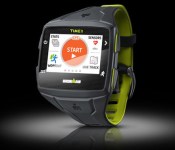
Timex’s new Ironman smartwatch does data without a smartphone

Timex just added a new entry to its Ironman line of GPS watches, ‘cept it’s not just any ole timepiece this time — it’s a 3G-connected smartwatch that doesn’t even need to pair up with a phone. The company calls it the Ironman One GPS+, and while it may have features commonly found in a smartwatch, it was made mostly for athletes like its predecessors. It has the capability to upload your run data to a fitness website with one tap, for instance, and you can even assign contacts to monitor your run in real time. One version also comes with a heart monitor a la Samsung Gear Fit and a chest strap, but unlike the ordinary one that costs $350 (which is already steep, as other smartwatches today cost around $200), it’ll set you back $450.
Other than these health-focused features, the One GPS+ also has a built-in messaging app where friends can contact you through a special email address. And, in case of an emergency, there’s an SOS button you can press that alerts friends and family with your location. The ruggedized watch (designed to be water resistant for up to 150 feet) comes with 4GB of storage for music, which can only be heard through a Bluetooth headset. Its battery can last up to 8 hours with the GPS on, and up to three days without. These capabilities might be enough for people who don’t want to be inundated with notifications on their wrists, but those who yearn for more may want to look at alternatives (like Android Wear devices) instead.
Timex’s answer to the LG G Watch, Pebble and HP Gilt, among many other smartwatches out there, was made in partnership with AT&T and Qualcomm, with the former providing free 3G access for a year. Timex didn’t say how much the mobile internet service will cost after that. Qualcomm, on the other hand, will supply the the chipset, the Brew platform and the low-power 1.5-inch Mirasol display that it showcased a year ago through the Toq smartwatch. The company doesn’t exactly have a shipping date in mind yet, but you can already pre-order the One GPS+ through Timex’s website.
Filed under: Wearables, Mobile
Via: USA Today, TechCrunch
Source: Timex
.CPlase_panel display:none;

Watch the Rosetta spacecraft rendezvous with a comet at 4:00AM ET

After ten years in space and many complex maneuvers later, the European Space Agency’s Rosetta spacecraft is finally in position to rendezvous with the 2.5-mile diameter comet 67P. At 4AM EST today (10AM CEST), the ESA will broadcast a live webcast showing the first signals from the comet’s orbit. Once it gets close enough, the Rosetta will execute a final “close approach trajectory insertion,” a six minute thruster burn that will take it close enough to the comet to be captured by its gravity. Later in the year, a 62-pound lander called Philae will leave the mothership and lock itself down to the comet with harpoons. Using onboard instruments, it’ll examine its composition and relay the information to earth. Finally, Rosetta will tag along with the comet as does a close orbit around the sun, examining how it changes when heated. Meanwhile, enjoy the show (below) as it approaches the giant rock.
Source: ESA (Rosetta)
.CPlase_panel display:none;

Google Workshop the MotoMaker of Nexus! Moto 360 Looks Pretty!

Welcome Android friends. Time to talk a little Android with you. Looks like Google will be taking the Moto approach by giving users the option to make themselves custom cases for there Nexus 5 phones. More pretty images of the Moto 360 have surfaced from evleaks, and did you know Timex made a smartwatch? Don’t think most of use did, and boy is it pretty fugly. Enjoy the video.
Android News
Google Workshop
Moto 360 renders
Samsung UNPACKED invites sent out
Pebble’s new line
Timex smartwatch
//<![CDATA[
ord = window.ord || Math.floor(Math.random()*1E16);
document.write('’);
//]]>
The post Google Workshop the MotoMaker of Nexus! Moto 360 Looks Pretty! appeared first on AndroidSPIN.
.CPlase_panel display:none;

These robots have x-ray vision, thanks to WiFi

These robots from the labs of a University of California, Santa Barbara professor might not be able to outrun anyone, but they sure have a special ability of they own: they can see through walls using only WiFi signals. For the technique to work, the machines work in pairs, with one broadcasting wireless transmissions and another (positioned on the opposite end) measuring them. Since walls and objects reduce signal strength, the receiver can distinguish between empty and occupied spaces to create an accurate map of the area. These aren’t the first robots we’ve seen that can peer through concrete, but the Cougar20-H surveillance robot that emerged years ago uses a number of sensors, whereas UCSB’s creation depends solely on WiFi.
In the future, the researchers believe the technology can be used for search and rescue (it’ll certainly be very useful in rescuing people out of collapsed buildings after earthquakes), to determine the occupancy level of a location and as a helper for archaeological digs. Also, these robots can potentially be outfitted with technology that can classify the object (if it’s human, or what it’s made of if it’s not) they’re seeing through walls. The UCSB team, which has been working on this project for years, has just released a video of the robots in action that you can watch below.

Filed under: Robots
Source: University of California, Santa Barbara
.CPlase_panel display:none;
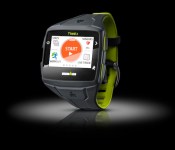
A Timex Smartwatch Doesn’t Need Your Phone Connected to It

Smartwatches are slowly taking the tech world by storm, and with the introduction of Android Wear, that storm is building up to be a hurricane of sorts. The only real drawback of using a smartwatch, is of course the fact that you have to connect your watch to your phone via bluetooth in order to utilize all the functions. Some of us don’t really look at this as a nuisance, but others might. Maybe a Timex smartwatch is for those that hate the fact that they have to have their phone connected to their watch at all times.
Yes, the popular watch manufacturer, Timex, has created a smartwatch called the IronMan One GPS+, that doesn’t need to be connected to your phone at all. You can receive messages, utilize GPS, and play your music, all without having your phone close by. The downside: it is ugly as all hell. Sure, it could be nice to have an independent smartwatch, instead of an extension for your phone, but who needs that? We will never get rid of our smartphones, and when it comes to a design of a smartwatch, we want something a little sleek. This watch isn’t exactly about style, but Timex promises that it can withstand water and any other environment thrown at it like their traditional watches.
You can grab the One GPS+ for $400 with free data for a year on AT&T, if you are willing to sign up for a new contract of course. Doesn’t seem like this watch will make much of a splash in the tech world, but it is only the first smartwatch from Timex. There was a video showing off the new watch, but for some reason that video went into private mode, so hopefully they will make it public again for all of you to see.
Source: The Verge
//<![CDATA[
ord = window.ord || Math.floor(Math.random()*1E16);
document.write('’);
//]]>
The post A Timex Smartwatch Doesn’t Need Your Phone Connected to It appeared first on AndroidSPIN.
.CPlase_panel display:none;

Samsung teases a Galaxy Note 4 reveal for September 3rd

It’s that time of year again: smartphone-reveal-event season, and Samsung is holding one next month, in three cities, simultaneously. A recent invite sent to the press, embedded after the break, asked us to “note the date” of September 3rd on our calendars for a product unveiling in New York. It’s the latest in the Korean outfit’s series of Unpacked events, and it’s happening just a few days before Apple’s supposed product reveal. Given the cheeky wording of the email, we’d suspect it’s pertaining to the Galaxy Note 4 (it’s almost assuredly about the Note 4). Whatever it may or may not end up being, though, you can rest assured that we’ll be there covering it live just for you.

Filed under: Cellphones, Mobile, Samsung
.CPlase_panel display:none;

Apple and Samsung agree to drop all their patent lawsuits outside of the US

So much for fighting to the bitter end — Apple and Samsung have just announced an agreement that will see them end all patent lawsuits against each other outside of the US. For those not keeping score, that means they’re dropping cases in Australia, France, Germany, Italy, Japan, the Netherlands, South Korea and (phew!) the UK. The two tech companies aren’t automatically buddy-buddy after this, however. Besides continuing their existing American cases, they aren’t pursuing any licensing deals or other pacts that would avoid trouble in the future. Still, if you’ve been hoping that Apple and Samsung would finally make nice and focus on beating each other in the marketplace instead of the courtroom, you’re much closer to getting your wish.
Filed under: Cellphones, Mobile, Apple, Samsung
Source: Bloomberg
.CPlase_panel display:none;

Apple and Samsung Agree to End Non-U.S. Patent Disputes
Apple and Samsung have issued a joint statement today announcing an agreement to drop all patent lawsuits against each other outside of the United States, according to Bloomberg.

“Apple and Samsung have agreed to drop all litigation between the two companies outside the United States,” the companies said in the statement. “This agreement does not involve any licensing arrangements, and the companies are continuing to pursue the existing cases in U.S. courts.”
The move is yet another signal that the long-running patent dispute between Apple and Samsung may be winding down, as it was reported in June that the two companies were trying to find “common ground”. The two also agreed to drop their cross-appeal rulings on the ITC ban of older Samsung phones around the same time.
In May, it was reported the two were looking to negotiate an out-of-court settlement. And earlier this year, it was reported that Tim Cook sat down with Samsung Electronics CEO Oh-Hyun Kwon in a mediation session. However, the two sides did not come to an agreement at that time.
Apple has already settled patent disputes with other companies, like Google / Motorola Mobility in May of this year and HTC back in 2012.
.CPlase_panel display:none;

Note the Date: Samsung schedules Unpacked event for September 3

The next-generation of Galaxy Note is less than one month away Confirming rumors from earlier in the week, Samsung has officially sent out invitations to an Unpacked event for September 3. With it, of course, comes all but final confirmation of a Galaxy Note 4 announcement. You’ll see the whole “Note the Date” blurb that accompanies with… Read more »
The post Note the Date: Samsung schedules Unpacked event for September 3 appeared first on AndroidGuys.
.CPlase_panel display:none;
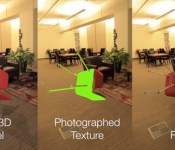
Image-editing technique lets 2D objects get flipped, turned upside-down

Sure, Photoshop and other image editors are becoming increasingly good at transforming elements of a photo, but most of those tweaks are limited to two dimensions (resizing, rotating, repositioning, etc.). Researchers at Carnegie Mellon are pushing into the third dimension, using a technique that compares the 2D objects in a regular photo with 3D models freely available online. The result? The ability to manipulate part of photo as if it were a real, three-dimensional object, even exposing angles and sides that weren’t visible in the original image.
The new technique takes advantage of the growing number of publicly available 3D models online (the researchers, for example, call out TurboSquid and 3D Warehouse, in particular). First, a user selects part of a standard image, like a chair or a banana. Then they search online repositories for a 3D model that’s a close match. Once imported into the image, a three-dimensional mesh is rotated and tweaked until it closely matches the 2D element (after all, not every banana curves the same way and not every pear is the same size). At that point, the technique estimates lighting based on the rest of the photo and uses data from the 3D model to guess at parts of the object that can’t be seen in the original pic.
Check out the video below to see some of what’s possible, like changing the angle of WWII planes to face the viewer, closing the lid of a laptop or setting upright a knocked-over chair. While the team admits the technique isn’t perfect (it still has issues with translucency), and further development will likely include automating the search process, the potential is already pretty apparent.
Filed under: Science, Software
Source: Carnegie Mellon University, Carnegie Mellon University (2)
.CPlase_panel display:none;
 AIVAnet