



Why Uber’s ridesharing revolution could be undone by archaic laws and aging industry

Like electric cars, the decentralization of broadcast television, renewable energy and other burgeoning technologies, the world of “ridesharing” — largely embraced by consumers — is facing tremendous pushback from entrenched players around the world.
These entrenched players take archaic laws and employ them to keep new competition out. This concept isn’t new to business, or even transportation business. The fight over Uber, Lyft and other ridesharing programs is the same fight that’s played out across human history time after time: A new technology threatens to upend an existing technology, and the industry supported by the existing technology stands together to push back against the inevitable. Remember buying CDs at your local music store? Exactly.
DISRUPTION AND CHAOS
In the case of Uber and its ilk in New York City, the entrenched players are the so-called black cab companies. We’ll spare you the minutiae of different forms of hired car in NYC — this is what matters: Yellow cabs are only legally allowed to pick up street hails, while black cabs are only allowed to operate on an arranged pick-up basis.
Initially, this meant that ridesharing services weren’t allowed to operate in NYC at all. But when NYC’s Taxi & Limousine Commission (TLC) announced and began a pilot program for yellow cabs to use services like Uber, black cab companies banded together to sue the NYC government and the TLC. They even succeeded in temporarily shutting down the pilot program.
New York City’s ridesharing battle is a great example of the challenges rideshare companies face globally. In Belgium, taxi regulation law dictates that Uber will be fined €10,000 (about $13K) for reach ride it offers. In France, the existing taxi industry continues to protest services like Uber, which they say threatens their livelihood (as in NYC, French taxi licenses are very costly). Those protests have turned violent in at least one case.
ARCHAIC LAWS AND ENTRENCHED PLAYERS
There are two major hurdles that ridesharing services must overcome to operate freely: existing laws/regulations/licensing and entrenched industry.
Rather than combat these issues from the start, ridesharing companies took their case to consumers. Uber opened in 2009 starting with San Francisco, while Hailo opened in 2011 in London, and Lyft also began operations with SF (but in 2012). Each company is a variation on the concept of “ridesharing,” but how they work for you and me is generally the same across the board: A mobile phone app scans for available rides near your location, and when it finds them, you can choose to be picked up. Some have payment options built in, while others don’t. And some make it optional. Uber, for instance, offers a variety of transportation services depending on the locale (including a helicopter for one day).
After establishing a base of drivers and passengers, ridesharing is now being challenged by both legislators and existing taxi/limousine companies.
AFTER EXISTING LAWS ARE CHANGED, THE REAL BATTLE BEGINS
Using NYC as an example once more, the initial challenge was a legal loophole; since ridesharing apps act as a means to “hail” a car to a location — which is partially illegal in NYC — yellow cabs couldn’t use the service. Yellow cabs make up the vast majority of NYC’s car services. Only after the city’s Taxi & Limousine Commission declared a trial were ridesharing services allowed to operate.

Of course, having cleared the initial hurdle of the TLC, New York’s black cab companies filed suit.
Their suit claims that services like Uber blur the line between traditional yellow cab and black cab services, that it disadvantages elderly customers (a demographic that tends not to own smartphones) and that it enables discrimination (ridesharing apps allow drivers to choose who they pick up).
Let’s be clear: Black cab companies are not concerned with any of these complaints. The reason the lawsuit exists is to attempt to prevent companies like Uber from encroaching on long-established businesses. It’s a lawsuit against innovation, against consumers and — above all — a lawsuit over money. It’s a lawsuit against the potential for competition.
FOUR-WHEELED TORTOISES
This same scenario exists in some form everywhere that ridesharing faces legal challenges. Are ridesharing companies perfect? No. Are they in the business of making money? Yes, absolutely. Their ability to even compete with existing car services is the issue. Uber and others offer a service that consumers want: an easier, better experience taking car services. Consumers should be able to make the choice.

And history agrees. In 1650s London, the “watermen” who operated ferries whisking Londoners up and down the Thames petitioned their government to limit horse-drawn carriages. Rather, the watermen specifically petitioned for the removal of “these upstart four-wheeled tortoises.” Their reasoning? That their business “hath been long reputed very useful to the Commonwealth,” and that the watermen and families would be “utterly ruined.” They also argued that the horses ate too much hay and defecated in the streets. In so many words, they argued that “these guys are trying to compete for our business!” Less than 10 years later, horse-drawn carriages were officially regulated by English law, and, well, there aren’t so many watermen rowing down the Thames these days.
It might not be Uber, or Lyft, or Hailo, or any of the services operating right now, but the world of taxi services is ready for innovation. Though we’re currently stuck in the quagmire of entrenched players fighting legal battles to keep that innovation at bay, time will win. It always does. Hopefully for us that’s sooner than later.
[Image credit: AP Photo/Mark Lennihan (lead taxi photo), Uber (video one), TestTube (video two), AP Photo/Paul White (Spanish protest photo), Internet Archive Book Images/Flickr (Thames Watermen)]
Filed under: Cellphones, Transportation, Internet, Mobile
.CPlase_panel display:none;

Pandora deal helps indie musicians get noticed on internet radio

The agreement is big, whether you’re an up-and-coming artist or just want to hear music beyond the big three record companies. Merlin’s labels represent about 10 percent of streaming music worldwide, so you’re likely to notice if you listen to enough tunes. Of course, this isn’t quite a selfless gesture. On top of the extra attention it draws to Pandora, the pact gives the company a better shot at offering service outside of the US. It has offerings in Australia and New Zealand, but the lack of direct artist connections has made it hard to expand elsewhere. That may prove crucial — Pandora has to compete against international heavyweights like Apple and Spotify in the online radio space, so it might not want to depend on one country for its success.
[Image credit: Spencer Platt/Getty Images]
Filed under: Internet
Via: CNET
Source: Pandora (1), (2)
.CPlase_panel display:none;
China Said to Ban Government Purchases of Apple Hardware Amid Heightened Security Concerns [Mac Blog]
According to Bloomberg, China’s National Development and Reform Commission and the Ministry of Finance have prohibited government purchases of Apple hardware, citing security concerns as the reason for the ban.

Ten Apple products were not included on a recent government procurement list from June that governs the spending of public funds, according to anonymous government officials who provided the information to Bloomberg. Products include the iPad, iPad Mini, MacBook Air and MacBook Pro.
Earlier procurement lists also banned antivirus software from Symantec and energy-efficient computers from Microsoft. Tension between China and companies in the US has been heightened following accusations of hacking and spying.
“When the government stops the procurement of products, it sends a signal to corporates and semi-government bodies,” said Mark Po, an analyst with UOB Kay Hian Ltd. in Hong Kong. “The Chinese government wants to make sure that overseas companies shouldn’t have too much influence in China.”
The reason for Apple’s omission from the list of approved hardware is apparently being debated, however, with Caixin reporting [Google Translate] stating that Apple simplify failed to qualify for a semi-annual update to the list of approved vendors of energy-efficient devices. The report speculates that a miscommunication may have resulted in Apple failing to submit the required information for inclusion on the list.
Apple has a growing presence in China, with 26 percent revenue growth reported in Q3 2014 due to increases in iPhone, iPad and Mac sales. Apple recently opened its eleventh retail store in China and has made a concerted push to attract Chinese developers to the iOS App Store. Apple currently is the fifth largest smartphone vendor in the country, accounting for 7% of market share.
Note: Due to the political nature of the discussion regarding this topic, the discussion thread is located in our Politics, Religion, Social Issues forum. All forum members and site visitors are welcome to read and follow the thread, but posting is limited to forum members with at least 100 posts.
.CPlase_panel display:none;
ABC News’ New Apple TV Channel Showing Strong Live Video Usage
Roughly six weeks ago, ABC News launched a new Apple TV channel offering a wide range of live and on-demand content from both national and select local feeds. Based on the first 30 days of availability, ABC News has now put together an infographic that offers a look at how the channel is being used. Among the interesting observations:
– Live video usage on Apple TV, which accounts for 20 percent of channel views, is 50 percent higher than on mobile and desktop combined.
– Apple TV viewers spend 65 percent more time per visit than desktop users.
– Peak usage for the ABC News Apple TV channel falls at 9 PM Eastern Time, likely due to that time period encompassing evening viewing hours for most of the United States.
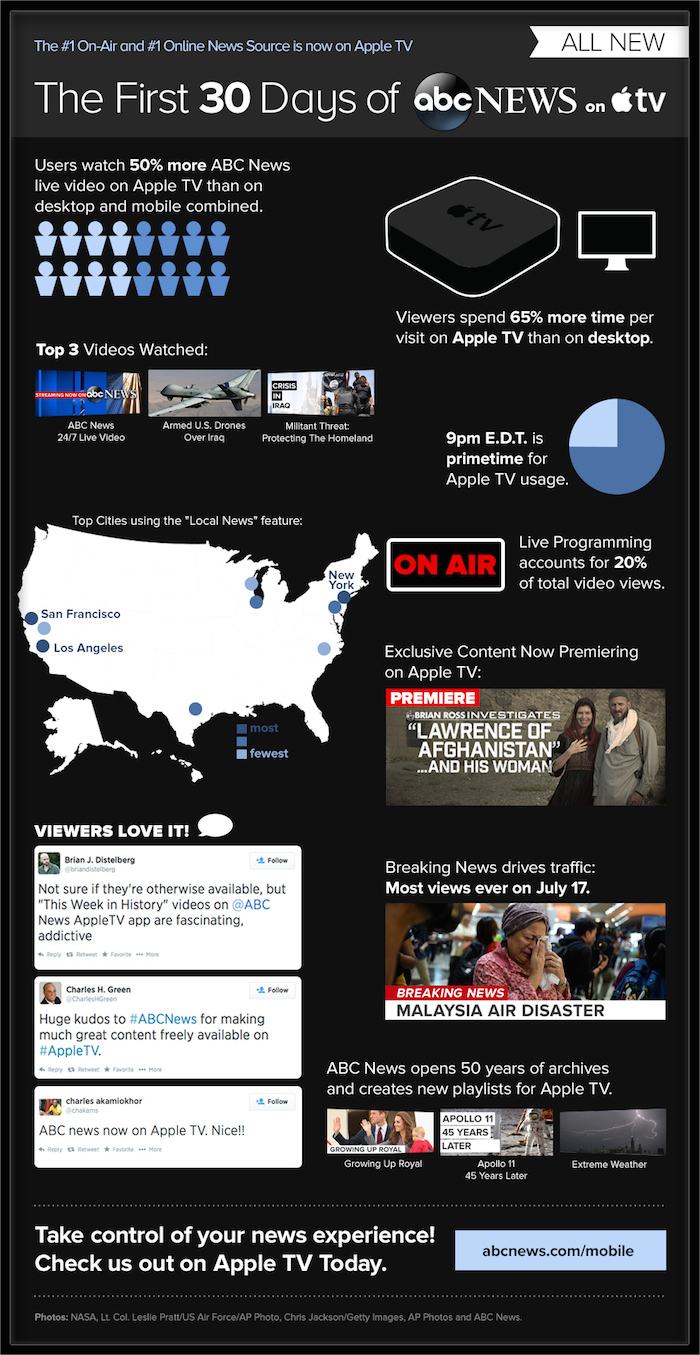 Click for full infographic
Alongside today’s usage data release, ABC News is also announcing the addition of three new local stations to the channel: Albuquerque (KOAT), Boston (WCVB), and Honolulu (KITV). The new additions join the original nine local stations made available on the channel at launch.
Apple has been adding new channels to the Apple TV at a fairly rapid pace, at least in the United States, although many of them require authentication through an existing cable service provider. The company has long been rumored to be working on a more powerful set-top box, but the latest rumors have suggested the device is unlikely to arrive until 2015.
.CPlase_panel display:none;

Sprint dials up Marcelo Claure as new CEO

Sprint on Wednesday announced it has selected Marcelo Claure as the new President and CEO, replacing Dan Hesse. Claure, who was a member of the Sprint board of directors is Founder and CEO of Brighstar Corp. He will resign from his post on August 11 whereupon SoftBank will acquire his remain company shares. Hesse, who… Read more »
The post Sprint dials up Marcelo Claure as new CEO appeared first on AndroidGuys.
.CPlase_panel display:none;

Sony calls it quits on PlayStation Mobile for Android

Sony has officially confirmed it will no longer support the PlayStation Mobile for Android endeavor. Designed to bridge the game between PS Vita and Android gaming, the certification process will still run for devices powered by Android 4.4.2 and older. Anything newer, however, and Sony is not making any guarantees for quality of experience or… Read more »
The post Sony calls it quits on PlayStation Mobile for Android appeared first on AndroidGuys.
.CPlase_panel display:none;
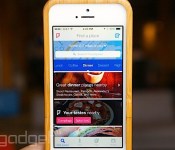
Foursquare wants to be the mayor of personalized local search

About three months ago, Foursquare announced that it would be splitting its app in two. It launched Swarm for check-ins and everything social, while the main titular offering would focus on being a customized discovery and recommendation engine — which is what CEO and co-founder Dennis Crowley wanted Foursquare to be all along. Today, the company finally unveiled the brand new reimagined Foursquare it teased last week, sporting a new visually enticing design replete with superhero-inspired logo. And though I’ve only had a brief amount of time with the app so far, I’m convinced that Foursquare’s bet to go all-in on personalized local search might actually pay off.
It starts right from the very beginning with a brand new on-boarding process. As soon as you launch the app, you’ll be guided through a tutorial that’ll prompt you to specify a few “tastes” such as “comedy club” or “spicy food” or “coffee” so that the app knows to bring up suggestions of places that best fit those interests. Foursquare tells us there are nearly 10,000 “tastes” to choose from at launch, though we’re sure more will be added over time. And of course, you’re free to add or remove those “tastes” as your, uh, tastes change. This is at the heart of what makes the new Foursquare tailored just for you — your tastes won’t be the same as mine, and therefore, what you see on Foursquare won’t be the same as what I see on Foursquare. As you move throughout the app, your tastes will be highlighted in pink, indicating that the spot was selected based on them.
Another big component of the new app is the introduction of “expertise.” Here’s how it works: whenever you leave a tip on Foursquare, you’ll gain “expertise” on a certain topic or place. If those tips are then liked or saved by lots of other people, your “expertise” on that subject will grow. So for example, if you tend to leave great tips on sushi restaurants, you could be designated a sushi expert, and will be marked as such so that people will trust your judgment. And here’s the part where pushing out the whole checking-in thing to a separate app makes sense: since you no longer have to share your location on Foursquare, you’re able to follow anyone — it doesn’t need to be a friend or someone you know — to see what great tips and insights they have to share. So if a total stranger decides to follow me on Foursquare because they noticed I’m an expert on fast food, it’s perfectly fine, because he won’t get to see where I am; all he’ll see are my tips on ordering the perfect burger from In-N-Out.

The rest of the app has also been reorganized and revamped. The first tab you’ll see, for example, is for “Find a Place,” with a big search field located at the top, followed by categories like “Lunch” and “Coffee.” Under each category are a few dynamic lists that change every so often. Examples include “Great lunch places nearby” or “Recommended by the people you follow” or “Great for groups” or “Plenty of outdoor seating” or “A boozy lunch.” Just as with the previous Foursquare app, you can dial down your choices even further by selecting price point, distance and other features like if it’s considered a romantic spot for couples. The design overall is much more visually rich than before, with much heavier emphasis on photos.
Other tabs in the app include “Here,” which tells you what’s good in your vicinity, “Tips,” which gives you a list of tips based on Staff Picks, who you’re following, your tastes or just whatever’s popular, and your Profile, which gives you a bunch of stats like the number of folks you’re following and how far along you are on your expertise levels. Throughout the app, you’ll see a the Foursquare icon on the upper-left and the tips icon on the upper-right. The former will lead you to further personalize those tastes and some suggestions on who to follow, while the latter lets you leave those aforementioned tips.

What’s particularly notable is that you don’t need Swarm to use the new Foursquare — indeed, the whole idea of checking in to a location is entirely absent if you don’t have Swarm installed. The idea, after all, is that you’ll now be using Foursquare to look for cool places to go, rather than finding out where your friends are.
Of course, I’ve only had a day or two with the new Foursquare app, so it’s difficult to tell how good its recommendations are just yet. But so far I think the combination of both the tastes and expertise features is what will really make a big difference in setting Foursquare apart from Yelp and Google. The argument behind Foursquare’s unbundling is that with the two functions clearly separated, the company could finally bring out the best of both worlds without one interfering with the other. So far, it looks like that decision was not such a bad idea after all.
Source: Foursquare
.CPlase_panel display:none;

Google’s Science Fair finalists want to find quasars and wake you with smells

Want to be inspired by the next generation’s ingenuity, while simultaneously feeling like you’ve underachieved? Here are the global finalists for Google’s Science Fair 2014! As with previous years, the entries are high-minded and often brilliant, as the young teams try to solve problems like cyberbullying, food scarcity and just waking up. The students, aged 13 to 18 years, come from across the world: For instance, Russia’s Anastasia Korovyanskaya (aged 17-18) came up with an ultrasonic burner, while Pranav Sivakumar (US) in the 13- to 14-year-old category has proposed a method for spotting gravitationally lensed quasars. Judged by a panel of academic and industry leaders, competitors are vying for prestigious awards including a $50,000 scholarship from Google, a National Geographic expedition and a behind-the-scenes visit of Virgin’s Galactic Spaceport. The winners will be announced on September 22nd, but meanwhile take a closer look at the finalists right here.
Filed under: Science, Alt, Google
Source: Google Science Fair 2014
.CPlase_panel display:none;

You can’t stop the selfie

You can’t escape the selfie. No one can. Celebrities do it; politicians do it; and it’s likely you or someone you know has done it. Selfies have become so ubiquitous that it was dubbed Word of the Year in 2013, and it’s even entered the Oxford English Dictionary, where it’s defined as “a photograph that one has taken of oneself, typically one taken with a smartphone or webcam and uploaded to a social media website.” The latter part of that description is why the selfie is more than just a simple self-portrait — it’s meant to be shared.
One could argue — and James Franco certainly has — that the selfie is a window into one’s personality. It’s a quick way to show the world who you are on the internet — like an online avatar if you will. I’ll admit I’ve taken a few selfies myself, but always with a twinge of guilt that I was being shallow or vain. That guilt, however, is apparently not a concern for the majority of us. Selfies have well and truly permeated popular culture to, as you’ll see in the gallery here, ridiculous levels.
[Image credit: Shutterstock]
Filed under: Internet
.CPlase_panel display:none;

UK regulator proposes crackdown on misleading Facebook and Twitter ads

While Twitter and Facebook are enjoying returns from their native advertising platforms, it’s still not easy to tell if a tweet or status update is actually a company trying to sell you something. It’s a practice that the UK’s Financial Conduct Authority (FCA) has become increasingly aware of, so it’s begun consulting opinion on whether it should enforce stricter rules on promotional messages shared by financial firms. Blogs, social networks and photo and video services are all in the FCA’s crosshairs, as it looks to crack down on companies that rely on misleading messages like “Join us now and we promise you’ll make a 758% profit on your first stock investment” to sign up new users.
As expected, some of them have already kicked up a fuss, arguing that character limits make it hard to warn users about adverts. However, the FCA cites accepted methods, like the use of #ad or embedding additional information inside an image, to show how easy it is for them to comply. Interested parties will have until November to show their support (or voice their concerns), with final rules set to be put into force by the end of next year — great news if you’re tired being spammed with offers that always seem too good to be true.

Filed under: Internet
Source: FCA
.CPlase_panel display:none;
 AIVAnet