


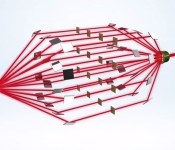
Desktop-sized laser supercomputers could be coming by 2020

Small, eco-friendly optical supercomputers may soon be crunching quadrillions of calculations per second (exaflops) if a company called Optalysys has its way. It claims to be months away from demonstrating a prototype optical computer that will run at 346 gigaflops to start with — not as fast as the best supercomputers, but pretty good for a proof-of-concept. Here’s how it works: low-intensity lasers are beamed through layers of liquid crystal grids, which change the light intensity based on user inputted data. The resulting interference patterns can be used to solve mathematical equations and perform other tasks. By splitting the beam through multiple grids, the system can compute in parallel much more efficiently than standard multi-processing supercomputers (as shown in the charming Heinz Wolff-hosted video below).
It also uses very low amounts of power, with exascale-level systems capable of running for mere thousands of dollars a year, compared to millions a year for the Tinanhe-2, the current supercomputer champ. After launching the prototype system, the company plans to build two products: a “big data” optical co-processor that can work with existing supercomputers, and a standalone optical solver supercomputer. It expects the latter to launch as a product in 2017 at 9 petflops, with up to 17.1 exaflops (17,100 petaflops) by 2020. By way of contrast, the Tianhe-2 does about 34 petaflops. It all sounds pretty pie-in-the-sky at this point, but we should have a better idea of the feasibility when the prototype arrives in January.
Filed under: Desktops, Science, Alt
Via: HPC Wire
Source: Optalysys
.CPlase_panel display:none;

You can now add a callback number to your lost (and locked) Android phone

Look, there are some people out there who wouldn’t bother returning your lost phone, and the best you can do is try to appeal to their conscience. One way to do that is through Android Device Manager, which now has the capability to add a callback number on the phone’s lock screen that the finder can contact. You can now even write a message to the phone’s finder (or thief, if you’re unlucky) on the screen through the “lock” section of the app or web menu. The Device Manager, for those who’ve only just heard of it, is an app that lets you find lost devices remotely, or lets you lock them with a different pin than the one you typically use through its web interface. These features give the person who picks up your phone a really easy way to get in touch, so make sure to update the app, just in case you end up needing them.
Via: Phandroid
Source: Google Play
.CPlase_panel display:none;

iPhone 6 Clone Passed Off as Real Product to Street-Goers in Prank Video [iOS Blog]
While Apple next-generation iPhone is still over a month away from being announced, a number of clones from various companies have hit the market to try and capitalize on customer anticipation. In a video posted to his channel, YouTuber Jonathan Morrison took Goophone’s “i6″ clone to Hollywood Boulevard to see if people would see the Android-based device as a real iPhone 6.
Individuals were told that the clone was the iPhone 6 and came with a number of new features, including an eight-day battery life, an “A10″ processor, and a high-resolution 8K sapphire display with 3D capabilities. Most people in fact believed those features, with one man proclaiming the phone felt “super fast” and another saying that the display “looked much clearer” than the display on his iPhone 5s.
At one point, a young individual in a crowd asks “How many milliamps does it have?” Morrison replies with “7,000″, causing the person to respond “How does that fit in there?!” Others were also told about additional features, with one woman believing that the phone’s photos were too high of a resolution for its screen, and a man in awe over the claimed “26-core” processor.
After being asked about Apple’s efforts in comparison to Samsung’s, one man even claims that the device is “really great” and that Apple has “caught up with this one.” Late night talk show host Jimmy Kimmel pulled a similar prank on Hollywood Boulevard last month, with his team showing pedestrians a $20 Casio watch and claiming it to be Apple’s long-awaited iWatch.
.CPlase_panel display:none;

Origami robot doesn’t need a human to assemble itself and start working

Folding robots are nothing new, but scientists from Harvard and MIT have taken it to the next level, by designing one that assembles itself and walks away to do its job with zero human input. The robots start out as a flat sheet of paper and polystyrene plastic (which you most likely know as Shrinky Dinks) etched with strategically placed hinges. Since those materials aren’t enough to make a full-fledged robot, the scientists also placed a flexible circuit board in the middle (with circuits extending to every hinge), two motors, a microcontroller and two batteries. It’s the microcontroller that’s in charge of activating the circuits to produce heat on command, which then leads to the flat sheet folding itself like an origami. When the hinges cool after a few minutes and the polystyrene hardens, the microcontroller commands the robot to scuttle away and do its thing.
The same team of scientists created a foldable robot worm and a robot lamp in the past years, but this is their first creation that’s capable of performing a function after it builds itself. It’s far from being perfect, though, and still has a ways to go before anyone can use it for a particular purpose. For instance, the assembly process is triggered by slotting a battery in, but the researchers plan to modify the robot so that it starts folding itself based on environmental cues like changes in pressure or temperature. Also, the mechanical critters could use a different polymer other than polystyrene, one that requires less heat to start folding. At this point in time, the prototypes are prone to bursting into flames, since they use so much energy — in fact, just the assembly itself depletes a whole AA battery.
In the future, the team believes the robot can be used not only for search and rescue missions, but also for other far-out applications. They believe their design could be used to make flat satellites that assemble themselves in space, for one. The team also dreams of the day when people can rent origami robots for any reason they please, whether it’s just to help them sweep the lawn or to detect gas leaks.
[Image credit: Harvard’s Wyss Institute]
Via: The Wall Street Journal, IEEE
Source: Harvard Wyss Institute, Science
.CPlase_panel display:none;

Verizon adds push-to-talk to Android phones, makes smart walkie-talkies

Verizon’s push-to-talk services already existed, but it was a pretty creaky service. It’s now upgraded its offering (for five bucks a month), with a free six-month trial to anyone that signs up now. Right now. Supported Android devices range from the Galaxy S5 to Casio’s hardy G’zOne Commando 4G LTE — the latter is probably the most appropriate handset for the service. Verizon’s promising faster connections when trying to talk to your fellow paintballers (and handsome gardeners), as well as improved voice quality. If your device isn’t supported, you could hold out hope that the service rolls out to other phones in Verizon’s stable — Kyocera’s latest ruggedized smartphone is also set to get the feature later this year.
Filed under: Cellphones, Mobile, Verizon
Via: Android Beat
Source: Verizon
.CPlase_panel display:none;

Dish Anywhere app now looks much better on tablets

Since the very beginning, Dish has been doing a really good job with its Anywhere mobile app. Aside from letting Hopper with Sling owners use it to view their DVR recordings, the application also offers access to a robust library of on-demand content. To that end, Dish Anywhere has now been further improved on iPad, Android and Kindle Fire tablets, with a redesigned UI and fresh discovery features that let users easily find new stuff to watch. But there’s more beyond the pretty, image-heavy pages like the one pictured above. Dish made the app better in other ways, thanks to new features including a Watchlist, the ability to turn your device into a Dish remote, and more. If you haven’t grabbed the update, you can do so via the App Store, Google Play or Amazon Appstore, depending on what tablet you’re rocking these days.
Filed under: Home Entertainment, Tablets, HD
Source: Dish
.CPlase_panel display:none;

Apple Puts 20 Productivity Apps on Sale in iOS App Store for Limited Time [iOS Blog]
Apple today debuted limited-time deals on 20 productivity apps in the iOS App Store in a section of the store called “Amazing Productivity Apps”, with popular apps like Clear, Notability and Fantastical 2 getting special prices for a limited time.

The apps’ new prices range from $0.99 to $6.99, and include the following:
– Clear ($2)
– Notability ($2)
– MindNode ($5)
– Scanner Pro ($3)
– Fantastical 2 for iPhone ($5)
– Launch Center Pro ($2)
– Boxer for Gmail, Outlook ($5)
– Prizmo ($5)
– Tydlig – Typing Reimagined ($1)
– iTranslate Voice ($2)
– Writer Pro ($5)
– Grafio – Diagrams and Ideas ($4)
– PDF Expert 5 ($5)
– PCalc ($5)
– Gneo ($4)
– Due ($2)
– Todo ($2)
– TextGrabber ($7)
– MobileFamilyTree 7 ($7)
– Scanbot ($1)
Some of the discounts are fairly steep, like Writer Pro’s discount from $19.99 to $4.99, while others are discounted at least 50%, like Notability going from $4.99 to $1.99. However, it’s unknown how long these discounts will be in effect.
.CPlase_panel display:none;

Every game in EA’s on-demand service will always be in supply

So you’re excited about the prospect of paying one low fee for all-you-can-eat, erm, access to a swath of Electronic Arts’ games on Xbox One, yeah? Well the outfit has a few new details that might make its EA Access service a bit more enticing. For starters, any games on tap in “the Vault” won’t disappear once they’ve been added. That means that Battlefield 4, Madden 25, Peggle 2 and FIFA 14 from the beta aren’t going anywhere, EA’s COO Peter Moore tells CVG. He also says that additional AAA games will be en route, but that EA hasn’t quite figured out the specifics of when just yet. Moore notes that the Vault’s catalog will be “substantial” and that new, permanent, additions to it will be determined based on franchise and timing. “We have to make decisions along that way, so there’s no template, like 30 days after a game ships it goes into the Vault,” he says. Could EA be preparing the Vault for Titanfall? We’ll have to wait and see.
[Image credit: Getty Images]
Filed under: Gaming, Home Entertainment, HD
Via: Boy Genius Report
Source: CVG
.CPlase_panel display:none;

Yahoo wants to keep your email safe from prying eyes

Google revealed this past June that it was working on a way for users to easily encrypt their emails, but it turns out it’s not alone in its ambitions. Alex Stamos, Yahoo’s Chief Information Security Officer, said at the Black Hat conference in Las Vegas that the company wants to offer end-to-end encryption for Yahoo mail come 2015. What’s more, that PGP-based security system should interact seamlessly with Google’s — should they choose to, people from both sides of the Google-Yahoo divide will be able to send each other secure messages that are totally unintelligible to curious (or malicious) outsiders.
So there we have it, two major forces on the web working to make sure what we say in private isn’t subject to prying eyes. The thing to remember is that the actual meat of your messages is secure, but the metadata — who it’s coming from, who it’s being sent to, what’s in the subject line — is still fair game. Yahoo’s plan involves modifying the End-to-End web plugin that Google introduced earlier this summer, but this whole shebang hinges on making the process of swapping secure messages easy. We’ll have to see just how elegant Yahoo’s solution winds up being; the prolonged privacy of millions of users may soon depend on it.
Source: WSJ Digits
.CPlase_panel display:none;
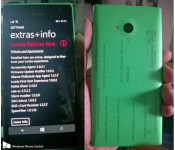
Microsoft’s new, selfie-friendly Windows Phone gets caught on camera

Rumors have swirled of Microsoft making a new Windows Phone that’s all about selfies, and it now looks like that portrait-oriented device is about to become a reality. WPCentral has scored photos of a prototype for the mid-range “Superman” (rumored to be named the Lumia 730) that would reportedly pack a 5-megapixel camera up front. That’s on par with what you’ll find on some Android phones, but it’s a big step up from the modest 1.3MP cam on the Lumia 720 this will likely replace. There’s no definitive evidence of the sensor, though, and it’s tough to verify additional claims of a 4.7-inch screen — don’t be surprised if the specs are different if and when Superman shows up.
However, the leak at least suggests that new software is coming down the pike. The hardware you see here is apparently running Debian Red, the codename for what may be a Lumia-specific take on the recently announced Windows Phone 8.1 Update 1. Just what that upgrade entails isn’t certain, but it’s safe to presume that it involves more than what Cyan offers. The real question may be when this selfie phone shows up, rather than what’s inside. While a leaked memo from Microsoft’s Jo Harlow claimed that high-end devices would show up “very soon,” it’s not clear what that means. Given that Debian Red hasn’t even been announced yet, it could be a long while before you’re holding this superheroic gadget in your hands.
Filed under: Cellphones, Mobile, Microsoft, Nokia
Via: The Verge
Source: WPCentral
.CPlase_panel display:none;
 AIVAnet