


Stacking solar cells leads to more efficient energy collection, lower bills

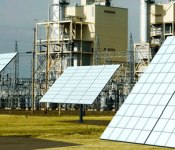
Thanks to the efforts of a North Carolina-based company, solar panels are about to get a lot more efficient. Semprius produces the collection devices by stacking materials on top of each other in order to catch more frequencies of light. In the process, cell stacking boosted efficiency to around 45 percent during tests. The new tech can be produced quickly using cells that are one millimeter across to reduce cooling needs while combining semiconductor materials and reusing the components cells are grown on. All of that will help Semprius achieve 50 percent efficiency in the next three to five years — up from the current 25 percent range. Unfortunately, the new method will be quite expensive until demand warrants mass production. However, more efficient collection will lead to lower overall cost in the long run, and make solar power as cheap as that produced by natural gas facilities.
Filed under: Science
Source: MIT Technology Review
.CPlase_panel display:none;
KitKat update rolling out for Sony Xperia E1 and E1 Dual
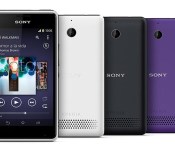
Sony has been working pretty hard to get their devices updated to Android 4.4 KitKat over the last several months. While the stateside devices have been lacking in updates, the rest of the worlds variants are moving right along. Today the Sony blog has alerted users of the Sony Xperia E1 and the E1 Dual that the KitKat update is ready for your downloading pleasure. Yes, a little later than expected, but it is official at least.

- Google’s Android 4.4; KitKat as standard – bringing performance & UI optimisation…
- We’ve added our tweaked Status Bar and Quick Settings… now more intuitive and customisable (and pretty easy on the eye)… cleaned up to ensure you only get the notifications you really need
- If you’ve got a Sony PlayStation 4, you might recognize our new user interface – we’ve added the same sleek launch animation and livewallpaper across the lock and home screens
- Better storage choice – you now have the option to easily move applications from internal memory to SD card – we recognised the need to have more control over your content… as something particularly useful for devices with slightly less space
- We’re also uplifting Sony’s entire native app portfolio to the latest versions – bringing tweaked / improved / current experiences for (to name but a few): Messaging, Smart Connect, TrackID, Sony Select, and Battery STAMINA Mode, Sony’s Media apps: WALKMAN, Album and Movies
- And proving pretty popular, now totaling over 2 million downloads (!) – our unique custom interface experience: “Xperia Themes”, with downloadable UI packs from Sony Select – skin up to 280 assets across your Xperia smartphone with a variety of styles…
As with all updates though, your region and carrier could put a slowmo process on the update offering. I assume that the update will be handled via the Sony PC Companion as well as via a traditional OTA. However, I have noticed some devices will only be updated via the Sony PC Companion. You may want to hook your device up to your PC and see if you have an update waiting for there.
Next on the docket of devices to get some KitKat treatment from Sony is the Xperia M2 and M2 Dual. So rest assured if you own one of those devices that you will see something soon.
Source: Sony Blog
//<![CDATA[
ord = window.ord || Math.floor(Math.random()*1E16);
document.write('’);
//]]>
The post KitKat update rolling out for Sony Xperia E1 and E1 Dual appeared first on AndroidSPIN.
.CPlase_panel display:none;
T-Mobile giving device unlocking an easier approach with new App
T-Mobile and the uncarrier initiative has certainly raised a lot of eyebrows. They have single-handedly changed the wireless game and a lot of people are loving it, I know I do. They continue to make changes that help alleviate customer pain points. While there will always be something to complain about, every small step helps in the long run. T-Mobile has just released and app that will undoubtedly be a welcomed sight for travelers. The apps is called “Device Unlock”, and while aimed at one specific device currently, it is one step closer to wireless freedom.
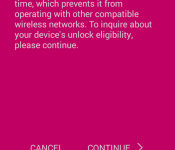
 The Device Unlock app only works with the more recent Samsung Galaxy Avant, a mid-range Galaxy device that is only $216 full price. The app offers a quick and simple UI to request that your Avant is SIM unlocked so that it can be used on other carrier networks at will. Pretty nice really. I assume this came about for more reasons than just a customer pain point. No one likes to call in to request a SIM unlock code. I assume this also got pushed through based on number of calls from customers who are only requesting an unlock code. Drive down the call volume, save time and money.
The app can be installed on any T-Mobile device, but it won’t do you a lick of good unless it is the Galaxy Avant. You will be met with a screen that tells you that your current device is unsupported. It wouldn’t be a bad idea to have it installed and check every so often if your current device gets some support for it though. If you have an Avant then you will be presented with two options, a permanent unlock and a temporary one. Your choice. Naturally i assume there will be a wait period and that you will input your email address to receive your code. I don’t have an Avant sitting around to try it on, so I am just guessing. If anyone out there does and they go through the process, please let us know how it worked out.
Source: Android Police
//<![CDATA[
ord = window.ord || Math.floor(Math.random()*1E16);
document.write('’);
//]]>
The post T-Mobile giving device unlocking an easier approach with new App appeared first on AndroidSPIN.
.CPlase_panel display:none;
LG G Vista headed to AT&T on August 22nd
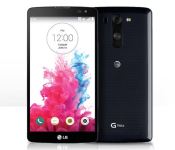
AT&T has announced a new LG device that is slated for the network on August 22nd. The LG G Vista will be a 5.7-inch mid-ranged device with a price point to match at just $354.99 out of pocket.

The 5.7-inch display offers up a resolution of 1280 x 720 with a 258ppi. It will launch with Android 4.4.2, carry a 8MP rear camera, 1.3MP front camera, 8GB onboard storage and support a micro SD card as well. Under the hood the LG G Vista offers up a Qualcomm quad-core processor at 1.2GHz, 1.5GB of RAM and is powered by a removable 3,200 mAh battery. The G Vista brings along some of the features that the LG G3 offers like the Knock Code, Laser AutoFocus for the camera and Dual Window.
The new mid-ranged LG device will launch in Indigo Black with a no contract price of $354.99. Alternatively you can grab it on a 2-year agreement for $49.99. On the Next18 you are looking at $14.80 a month and with Next12 it will add $17.75 a month to your bill.
Source: AT&T
//<![CDATA[
ord = window.ord || Math.floor(Math.random()*1E16);
document.write('’);
//]]>
The post LG G Vista headed to AT&T on August 22nd appeared first on AndroidSPIN.
.CPlase_panel display:none;

AT&T announces LG G Vista for August 22

The 5.7-inch phone will be $50 with a contract, $355 outright AT&T on Friday announced the upcoming availability of the LG G Vista. Featuring a 5.7-inch HD display and 8-megapixel rear camera, the smartphone is a lesser-powered take on the flagship G3 experience. Powered by Android 4.4.2 KitKat with LG software enhancements, the G Vista… Read more »
The post AT&T announces LG G Vista for August 22 appeared first on AndroidGuys.
.CPlase_panel display:none;
Apple Again Expanding Reno Data Center as Plans for Downtown Facility Stall
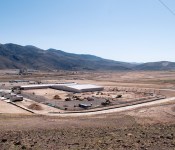
Apple is once again expanding its Reno, Nevada data center, adding several new data cluster buildings, reports Reno Gazette Journal. The upcoming expansion was documented in building permits filed recently with Washoe County.
 Apple’s Reno data center (Source: Wired)
This new round of expansion is expected to kick off the third phase of development for the center that was approved in 2012 and went live in 2013. Apple currently is in the second phase of construction, which is expected to be completed by the end of this summer.
“They just keep plugging along,” said Trevor Lloyd, senior planner for Washoe County. “Apple keeps submitting plans … and it looks like they’ll be expanding for a long time.”
Apple’s latest plans will boost the number of buildings on the site to nine, including eight data cluster buildings and an administration building, with plenty of room for further expansion on the 2,220-acre property.
As previously outlined by Wired, Apple’s initial plans call for a cluster of eight small interconnected data buildings, which the recent building permits cover the completion of. A second facility of equal size is planned for future expansion.
Apple also is building a solar panel farm that will generate up to 18–20 megawatts of power for data center operations and will supplement the plant’s current geothermal power.
While Apple improves its Reno data center operations, its proposal for a downtown facility has stalled, with Apple yet to submit building plans for a location in the Tessera District of Reno.
“I haven’t heard anything and, as far as I know, no one in the city has heard anything,” said Bill Thomas, assistant city manager for Reno. “I’m not saying we won’t hear from them but it’s been silence on their end (as of now).”
This downtown facility, which has been described as a “business and purchasing center”, is part of Apple’s original proposal and is required if the company is to receive up to $89 million in tax breaks on data center equipment over the next decade.
.CPlase_panel display:none;

Apple Makes $1.6 Million Donation to Support Chinese Earthquake Relief Efforts
 Following a major earthquake in China’s Yunnan Province earlier this week that killed over 600 people and caused widespread damage, Apple has made a donation of 10 million yuan ($1.6 million) in support of relief efforts in the region, reports CRIENGLISH.com. Apple has also updated its Chinese home page to acknowledge the disaster.
Apple CEO Tim Cook has also sent an email to company employees, shared by 9to5Mac, in which he expresses “deepest sympathies” to those affected and mentions Apple presence in the region and commitment to help.
Team,
Our deepest sympathies go out to the people of China’s Yunnan Province, which was struck by a devastating 6.5-magnitude earthquake over the weekend. Nearly 600 people died and over 2400 were injured in the worst earthquake to hit the region in 100 years. Rescuers have evacuated 230,000 people who are now displaced from their homes. The road to Longtoushan Township, the epicenter of the quake, has been blocked by landslides, making the rescue effort there even more challenging. Apple is eager to help. We are making a financial donation in support of the work of Mercy Corps and CFPA (China Foundation for Poverty Alleviation) to get supplies and relief to those affected by the earthquake and to help them through the process of healing and recovery. The tragedy in Yunnan Province is on the minds of many in the Apple community. Apple has over 6500 employees in China and Hong Kong as well as a growing developer community and deep ties to the workers in our supply chain who make Apple products. In this time of tragedy, our thoughts are with the victims and their families.
Tim
Apple made a similar but larger donation in support of relief efforts following another earthquake in China last year, and the company has committed to charity support on a number of other occasions, including facilitating donations from iTunes Store users following such disasters as Superstorm Sandy in 2012 and Super Typhoon Haiyan last year.
.CPlase_panel display:none;
Your music festival, upgraded

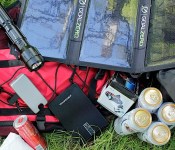
24 tallboys and 12 packs of ramen might seem like smart packing before a festival, but once you’re lost in a field, sunburnt and in the dark, those noodles become nothing more than primitive bartering currency. The primary pillars of any gadget-lover’s field-based rocking are light and power. We’ve got some solutions for that, and a few other festy-tech goodies.
You won’t need all of this to see you through a weekend — even we’re not this paranoid about running out of juice. But, if you want to make sure your festival is fully upgraded, technology can help. What follows is a selection of gadgets and apps we’d be reaching for if we were heading out into the wild (or at least, TomorrowWorld).
Filed under: Peripherals
.CPlase_panel display:none;

Authors take out full-page NYT ad to criticize Amazon

There’s no sign that Amazon and Hachette are close to burying their e-book hatchet, which has prompted the authors caught in the middle to speak up. One of those affected, Douglas Preston, penned an open letter to Jeff Bezos, requesting that he stopped singling out individual Hachette authors for “selective retaliation.” After it was published, however, nearly a thousand other writers, including Stephen King, Malcolm Gladwell and Jeffrey Deaver co-signed the letter — which has prompted the group Authors United to pay for the letter to be printed as a full-page advert in Sunday’s New York Times. Apparently the Kindle Team’s most recent letter fell upon deaf ears.
Filed under: Amazon
Via: Re/code
Source: Authors United, New York Times
.CPlase_panel display:none;

Researchers want to flood your body with disease-detecting diamonds

Forget the age-old cliché: diamonds might soon be a cancer researcher’s best friend, too. One of the real rubs in cancer screening is trying to detect breakaway tumor cells before they spread too far, causing the cancer to metastasize throughout the body. There’s where a young biotech company called Bikanta comes in: the team has started to use fluorescent nanodiamonds — basically a dust of crushed, imperfect diamonds — to help ferret out those tiny, troublesome proto-tumors before they get a chance to spread.
You might be surprised to learn that those nanodiamonds are awfully effective at lighting up your innards… and more specifically the tiny molecular imperfections that could signal shifting cancer cells. Bikanta CEO Ambika Bumb told TechCrunch that one of the biggest draws of the diamond approach is that those little bits of carbon don’t degrade over time, so researchers are left with clearer imaging results with less background noise. Turns out, nanodiamonds aren’t one trick ponies either. Bikanta’s tech can be used to look out for more than just cancer, and if you peer far enough into the future, you might see nanodiamonds being used as a component for smart drugs that can target and treat the very same abnormalities they detect.
Source: TechCrunch
.CPlase_panel display:none;
 AIVAnet