


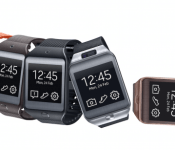
Samsung Gear Solo smartwatch to be announced alongside Note 4 at IFA 2014
 It’s been rumoured for some time now, and today, yet another rumour has suggested that the Samsung Gear Solo smartwatch is going to be announced alongside the Samsung Galaxy Note 4 at the Samsung UNPACKED event next month. This rumour comes from Yonhap News, who interestingly suggests that the device will be announced on September 4th, despite the fact invites for the event have already confirmed that the event will be held on September 3rd, though perhaps they are accounting for the time difference.
The Gear Solo is expected to be the next step up from its Gear 2 and Gear 2 Neo brethren by incorporating SIM card capabilities, allowing it to be operate ‘solo’ and make calls as a standalone device. It’s not clear what OS the device will be running on as Samsung has basically thrown out their platform-denoting naming conventions for the Samsung Gear Live, and is especially interesting given that Google has been unhappy with Samsung putting so much effort into its Tizen smartwatches. Whatever the case is, we’re excited to see what is announced on September 3rd at IFA 2014.
Would you be interested in a Samsung Gear Solo? Let us know what you think in the comments below.
Source: Yonhap News via Phone Arena
//<![CDATA[
ord = window.ord || Math.floor(Math.random()*1E16);
document.write('’);
//]]>
The post Samsung Gear Solo smartwatch to be announced alongside Note 4 at IFA 2014 appeared first on AndroidSPIN.
.CPlase_panel display:none;

Judge rules against NCAA in case over using athletes’ likenesses

After a group of former college athletes including Ed O’Bannon, Bill Russell and Oscar Robertson sued the NCAA and EA over the uncompensated use of their likeness in videogames and other media, EA and the NCAA reached a settlement last year for about $60 million. Today, ESPN reports that a judge has ruled on the case in favor of the athletes, saying the “NCAA rules unreasonably restrain trade.” In a 99-page ruling (posted by USA Today), US District Judge Claudia Wilken decided the NCAA can’t stop football and basketball student-athletes from being paid for the use of their name and likeness, but did allow the NCAA to set a cap on the amount the amount of compensation they can receive while in school, as long as it’s now below the cost of attendance. The NCAA can also cap the amount of money schools or conferences could deposit in a licensing trust that’s payable when athletes leave school or their eligibility runs out, but it would have to be at least $5,000 per year at big schools. In a statement, the NCAA said “We disagree with the Court’s decision that NCAA rules violate antitrust laws” and promised further comment later.
An injunction against the organization won’t take effect until the next recruiting cycle, but it will not be stayed pending any appeal. The plaintiffs themselves aren’t due to receive any damages, but this does put future athletes in line for a cut of the lucrative ($838 million last year) TV contracts and other licensing that occurs. EA had put a hold on its college games, but this could put them closer to a return, and could see the next Johnny Manziel counting some real cash.

Source: ESPN, Reuters, CBS Sports, Bloomberg, NCAA, USA Today
.CPlase_panel display:none;

Engadget Daily: the culture of leaks, surviving music festivals and more!

Today, we investigate the culture of leaks, learn how to enhance your music festival experience, review the first Chromebook to feature an i3 processor, watch a robot assemble itself and more. Read on for Engadget’s news highlights from the last 24 hours.
.CPlase_panel display:none;
FYI: Qualcomm says the OnePlus One can playback music for days

Your next party may not be one that rages on for days, but Quallcomm wants everyone to know, according to a recent blog post, that the OnePlus One, which features its latest Snapdragon 801 processor can play music for over 60 hours on a single battery charge. This is all thanks to Qualcomm Hexagon DSP, a technology… Read more »
The post FYI: Qualcomm says the OnePlus One can playback music for days appeared first on AndroidGuys.
.CPlase_panel display:none;
FCC Questioning All Carriers On Unlimited Throttling Policies
 According to FCC Chairman Tom Wheeler, the United States Federal Communications Commission is now questioning all wireless carriers on their network management policies, asking how carriers choose when to throttle customers, including those with unlimited data plans.
In a report from Reuters, Wheeler said that the FCC had written to all major U.S. carriers about its concerns on throttling practices following its inquisition into Verizon’s upcoming plan to throttle unlimited data customers during peak usage times.
“My concern in this instance – and it’s not just with Verizon, by the way, we’ve written to all the carriers – is that it is moving from a technology and engineering issue to the business issues … such as choosing between different subscribers based on your economic relationship with them.”
Last week, after Verizon announced plans to slow down the data speeds of unlimited customers using heavy amounts of data, the FCC questioned the carrier about its policies, with Wheeler stating that he was “deeply troubled” by the decision.
Verizon responded, suggesting its throttling plans were both fair and legal, and likely to impact only a small subset of customers. Verizon also noted that several other carriers, like Sprint, AT&T, and T-Mobile all have unlimited data restrictions in place. According to Wheeler, pointing towards the policies of other carriers was not a sufficient response. “‘All the kids do it’ was never something that worked for me when I was growing up,” he said.
AT&T, Sprint, and T-Mobile have long had policies in place that allow the carriers to opt to restrict the data usage of customers with grandfathered unlimited plans in an effort to encourage users to switch to pay-by-usage tiered data plans.
While the FCC did not share the letters sent to AT&T, T-Mobile, and Sprint, an FCC spokesperson said the letters were similar in nature to the original letter sent to Verizon. That letter asked the carrier to answer specific questions on its rationale for treating customers differently on plan type, the need for such throttling on efficient LTE networks, and the legality of throttling.
Verizon was the first to receive the letter because of the announcement of a new policy, according to the FCC spokesperson. Verizon will begin throttling its high-usage off-contract LTE customers accessing congested network cells beginning on October 1.
.CPlase_panel display:none;
You can now watch YouTube videos in 1440p on the LG G3

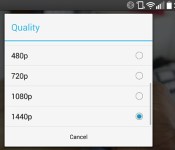
LG’s new flagship phone, the G3, stands out for its Quad HD (2,560 x 1,440) display, and the handset is taking advantage of all those pixels to offer a high-res YouTube experience. As was first reported by TalkAndroid, G3 owners can now watch YouTube videos in 1440p, a welcome bump up from the usual max resolution of 1080p. This feature reportedly comes via a recent update, and it’s still in the process of rolling out to all G3 handsets. If you’re currently using LG’s latest flagship, let us know if you’re seeing the 1440p options by commenting below. If you don’t have a G3, don’t despair; we’re bound to see a slew of new phones sporting Quad HD screens in the months to come.
[Photo credit: Phone Arena]
Filed under: Cellphones, Internet, Software, Mobile, LG
Via: Phone Arena
Source: TalkAndroid
.CPlase_panel display:none;

Here’s how you make your own 3D-printed virtual reality goggles

So you couldn’t get your hands on a nice virtual reality headset like the Oculus Rift, but you’d still like something a little fancier than a cardboard display. Are you out of luck? Not if Noe Ruiz has anything to say about it. He has posted instructions at Adafruit for do-it-yourself 3D-printed goggles that can be used for either VR or as a simple wearable screen. The design mates an Arduino Micro mini computer with a display, a motion sensor and lenses; the 3D printing both adds a level of polish and lets you tailor the fit to your cranium. This definitely isn’t the cheapest project (about $231 in parts) or the easiest, but it will give you head-tracking VR without having to wait for Oculus, Samsung or Sony to put out finished devices of their own. If you’re up to the challenge, you’ll find everything you need at the source link.
[Image credit: Noe Ruiz]
Filed under: Displays, Wearables
Source: Adafruit
.CPlase_panel display:none;

Carriers have to let you text 911 by the end of the year

You’ve had the option of texting 911 in a handful of US cities for a couple of months, thanks in part to voluntary efforts from bigger cellphone carriers. However, the FCC doesn’t want you to be left out solely because you’re on a smaller network. The agency has just adopted rules requiring that all American wireless providers have the capability for text-to-911 by the end of the year. You won’t necessarily get emergency messaging by that point, but carriers will have six months to implement it in a given region if a local call center makes a request.
Right now, the new regulation won’t make a big difference. Only Maine and Vermont are fully prepared to handle SMS in a crisis, and you’ll only find some form of coverage in 16 states. However, the FCC’s move means that adoption could grow very quickly — now that carriers can’t say no, 911 facilities are more likely to push for the technology. Don’t be surprised if you can soon send a text-based cry for help at any moment when a voice call would be difficult or dangerous.
Filed under: Cellphones, Wireless, Mobile
Via: GigaOM
Source: FCC
.CPlase_panel display:none;
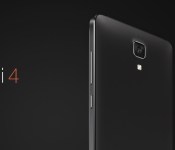
Xiaomi overtakes Samsung in China to be No. 1 smartphone Vendor
A new report coming from research group Canalys is indicating that Xiaomi has over taken Samsung in China to become the number 1 smartphone vendor with Samsung slipping to number 2.

Xiaomi saw sales in the second quarter go up by 240% compared to the previous year. This gave Xioami a 14% market share that edged out Samsung dropping them to second. Samsung’s slide to second in China “reflects rapidly shifting demand toward 4G handsets.”
As Samsung is seeking to “realign its channel inventory to meet changing demand” for more 4G handsets, it could show improvement in the third quarter. But, Canalys said, “with the market in China becoming even more competitive, it will not be straightforward [for Samsung] to reestablish leadership.”
I can’t say that the news surprises me much though. Xiaomi has been stepping their game up with some devices that have some serious specs that compete well at a better price. Take the Mi4 for instance. Snapdragon 801 processor at 2.5GHz, 3GB of RAM, 5-inch 1080p display, 13MP camera, 8MP front camera and a 3080 mAh battery with an approximate sale price, according to Hugo Barra, of $320 for the 16GB model or $400 for the 64GB model. That is out-of-pocket price. Then you have the big seller, the RedMi (Red Rice) that floats around $160 with a 1.5GHz quad-core processor.
Seems the talks that Xiaomi is the Chinese equivalent to Apple inc and is the fastest growing handset maker in the world, at the moment.
Source: Marketwatch
//<![CDATA[
ord = window.ord || Math.floor(Math.random()*1E16);
document.write('’);
//]]>
The post Xiaomi overtakes Samsung in China to be No. 1 smartphone Vendor appeared first on AndroidSPIN.
.CPlase_panel display:none;

Judge Rejects $324M Settlement Proposal in Apple, Google Class-Action Anti-Poaching Lawsuit
Judge Lucy Koh today rejected the settlement deal that Apple, Google, Intel, and Adobe had reached with tech workers over a lawsuit involving anti-poaching agreements, reports CNBC.
According to court documents, Koh believes the total settlement “falls below the range of reasonableness,” compared to the $20 million settlement that Pixar, Lucasfilm, and Intuit reached with tech employees in 2013. Proportionally, based on that settlement, Apple and the other tech companies should have to pay out at least $380 million.

The Court finds the total settlement amount falls below the range of reasonableness. The Court is concerned that Class members recover less on a proportional basis from the instant settlement with the Remaining Defendants than from the Settled Defendants a year ago, despite the fact that the case has progressed consistently in the Class’s favor since then. Counsel’s sole explanation for this reduced figure is that there are weaknesses in Plaintiff’s case such that the Class faces a substantial risk of non-recovery. However, that risk existed and was even greater when Plaintiffs settled with the Settled Defendants a year ago, when class certification had been denied. […]
Using the Settled Defendants’ settlements as a yardstick, the appropriate benchmark settlement for the Remaining Defendants would be at least $380 million, more than $50 million greater than what the instant settlement provides.
Tech workers initially levied the class action anti-poaching lawsuit against the companies in 2011, accusing them of creating no-hire agreements and conspiring not to poach employees from one another in an effort to keep salaries lower.
No-solicitation agreements revealed during the lawsuit dated back to 2005, involving Apple, Google, Intel, Adobe, Intuit, Lucasfilm, and Pixar, among others. The agreements prevented company recruiters from contacting employees placed on specific no-contact lists.
The United States Department of Justice stepped in back in 2010, ordering the companies to stop entering anti-poaching agreements, but the class-action civil lawsuit brought against the companies by 64,000 employees will remain open until a suitable settlement can be reached. The suit originally asked for $3 billion in damages, a significantly higher number than the 324 million agreed upon in April.
.CPlase_panel display:none;
 AIVAnet