


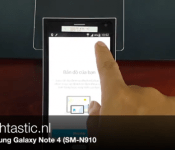
Disguised Samsung Galaxy Note 4 makes an appearance in leaked video
 As IFA 2014 nears, we’re going to undoubtedly see an increased number of leaks for the devices scheduled for announcement. The lucky leak of the day goes to the Samsung Galaxy Note 4 today and we see the device featured in a rather silent video. Of course, we can’t exactly confirm the leak’s integrity given that the device shown is heavily disguised, hiding probably the only thing that might differentiate it from older Samsung devices: a metal frame, which we have seen teased in Samsung’s Note 4 video. We do also see the S-Pen lying around next to the device, but there’s no effort to show it off in this particular video.
Whether this is the real deal or not, we’re pretty certain we have a good picture of what will make up the Note 4 when it is announced on September 3rd at Samsung‘s UNPACKED event. We’re expecting two variants of the device, one with an Exynos 5433 processor, the other with a Snapdragon 805 – which is available to you will depend on your market. We’re also expecting to see a 5.7-inch Quad HD display, for which we’ve had its beautiful wallpaper leaked already.
What do you think about this leak? Let us know your opinion in the comments below.
Source: TechTastic via Phone Arena
//<![CDATA[
ord = window.ord || Math.floor(Math.random()*1E16);
document.write('‘);
//]]>
The post Disguised Samsung Galaxy Note 4 makes an appearance in leaked video appeared first on AndroidSPIN.
.CPlase_panel display:none;

Samsung Asks NYC Street-Goers to Compare Galaxy Tab S and iPad Air in New Ad
Samsung has debuted a new video on its YouTube channel comparing its new Galaxy Tab S to the iPad Air on the streets of New York City. As first spotted by iGeneration (Google Translate), the video involves a host asking street-goers to use the Galaxy Tab S, highlighting the tablet’s display, weight, and camera.
When matched up side-by-side, some users claim that the Galaxy Tab S is “definitely thinner”, while others express that the tablet’s screen “looks brighter” when compared to the iPad Air. The host claims that the Galaxy Tab S has “one million more pixels than the iPad Air”, which is presented alongside small text on the bottom noting the 4,096,000 pixels of the Galaxy Tab S compared to the iPad’s 3,145,728 pixels. The video ends with a group of users choosing the Galaxy Tab S over the iPad Air, as Samsung ends the video with the tagline of “Thinner. Brighter. Lighter.” before showing the tablet from its front.
Samsung launched its first round of Galaxy Tab S ads last month, which mocked the iPad’s screen and lack of multitasking. The Galaxy Tab S was originally announced this past June, with Samsung touting the tablet’s high resolution (2560 x 1600) Super AMOLED display, fingerprint sensor, 11-hour battery life, and multitasking capabilities.
.CPlase_panel display:none;
Chrome update lets you share your browser, not your history

If you typically share your computer and your browser with a sibling, a roomie or a friend who has no respect for your privacy, this latest Google Chrome beta update might make things easier for you. It comes with a pull-down menu that lets you easily switch users, put the browser to guest mode or launch an incognito tab on Windows, Mac or Linux. According to some comments in the update’s Google+ announcement, though, you still have to log off from your accounts to be sure your activities remain for your eyes only, just in case someone decides to peek. The guest mode automatically deletes the other user’s browsing information, on the other hand, so they won’t have to worry about you seeing their secrets.

Aside from this update, Google has also unleashed a 64-bit Chrome beta for Mac, a few days after the company released a 64-bit stable version for Windows computers. This will make the browser launch more quickly and will generally make it faster than its predecessor. Finally, the new beta update also comes with a bunch of APIs for web app devs to play with. You can get Google Chrome beta (or any other channel you want, whether stable, Canary or Dev) through The Chromium Projects website.
Source: Google Chrome Blog, Chrome Releases, Google+, The Chromium Blog (1), (2)
.CPlase_panel display:none;

Oculus Rift turns rollercoaster ride into a virtual shooter

Some researchers study carbon nanotubes — and then there are these guys. Thomas Wagner and his students from Kaiserslautern University in Germany have used an Oculus Rift headset to transform a real rollercoaster into an virtual experience. That’s been done before on the sly, but this time it was legit: the group teamed up with rollercoaster builder Mack Rides, and developed several apps for an Oculus headset and built-in laptops. The VR “rides” are all synced to the motion of two different coasters by tracking their wheels. They include various themes like a wacky flying horse chariot ride, a submarine tour and a space shooter complete with game controller, as shown in the video below. It’s still just a (really fun) experiment, but the coaster maker and researchers are keen to commercialize it at some point. There are still bugs and patents to work out, but probably not the ones you’re thinking of. As shown in the FAQ, the headset won’t fall off, the Oculus sensors work despite extreme g-forces, and no, the VR won’t make you barf.
.CPlase_panel display:none;

Another Report Suggests NFC Support for iPhone 6, Chip to Be Provided by NXP
 Apple will feature near field communication (NFC) technology in the iPhone 6 with a chip provided by Dutch company NXP Semiconductors, according to a report from the Financial Times. The chip will allow the iPhone to be scanned by payment terminals and ticket systems, while also allowing for further integration with other methods.
Throughout the past week, a number of rumors and reports from various sources have claimed that the iPhone 6 will gain NFC support. Evidence of NFC capabilities provided by NXP first surfaced earlier this week in a claimed schematic, which showed the company’s PN65 chip on the iPhone 6′s logic board.
Yesterday, technology news website WIRED and Apple blogger John Gruber also suggested that the iPhone 6 would feature NFC, with the latter stating that Apple’s NFC-based mobile payment system would use a new secure enclave coprocessor built into the company’s new A8 chip, which was also suggested by previous reports.
Last month, it was reported that Apple was in talks with major credit card companies like Visa over a mobile payment solution that would utilize the credit card data already stored in millions of iTunes accounts. Apple also was said to be interviewing senior payments industry executives to take on roles within the company, possibly indicating that the company has been hard at work on creating its own mobile payments service.
Apple is expected to debut the iPhone 6 and a wearable device at an event on September 9.
.CPlase_panel display:none;

German press release suggests the LG G Watch R will cost €299
 Phone manufacturers appear to piling on the smartwatch news ahead of IFA 2014, with ASUS, LG and Samsung all making surprise announcements and teases before the festivities have even started. The LG G Watch R was one of the more striking devices to be announced – what with its almost watch-like appearance – but the real question is: how much does it cost? Well, if a German press release is anything to go by, the LG G Watch R will cost €299. While a direct exchange does translate to about $395 USD, a corrected estimate would probably be closer to $300 USD.
That is still a relatively high premium to pay for the G Watch R over the original G Watch – which costs $230 USD – particularly seeing as they are almost the same on the inside, but we assume there is a cost to pay for including a heart rate sensor and the technology for the circular OLED display. That said, the high price is sure to deter some people who were perhaps thinking it to be an alternative to the equally circular Moto 360, which is expected to cost $250. But in the end, it’s all about subjective tastes.
Are you a fan of the LG G Watch R? Is €299 too expensive for you? Let us know your opinion in the comments below.
Source: LG Germany via Android Police
//<![CDATA[
ord = window.ord || Math.floor(Math.random()*1E16);
document.write('‘);
//]]>
The post German press release suggests the LG G Watch R will cost €299 appeared first on AndroidSPIN.
.CPlase_panel display:none;

Militants use off-the-shelf drones for surveillance and propaganda

Video footage has emerged showing that ISIS militants deployed a $500 consumer drone to spy on a crucial Syrian airfield, which they eventually seized. Taken by a DJI Phantom FC40 drone, the video was spotted on YouTube (and pulled, since it also contained graphic scenes of execution). It shows images of the base from what looks like a lofty altitude, along with insurgents discussing how to use the info. They later sent in suicide bombers to attack the important northern airfield, but it’s unclear if the information from the drone was of much strategic use. However, the footage has further value for the group as propaganda. It formed part of a disturbing video meant to show that the group is high-tech (and extremely violent) which helps it attract and radicalize new recruits.
Filed under: Robots
Via: Business Insider
Source: Vocativ
.CPlase_panel display:none;

Google stops showing who wrote what in its search results

Google Authorship is no more. It has lived for only three short years, from the time Mountain View launched it in 2011, displaying people’s faces alongside anything they’ve written on a website tied to their Google+ accounts. Yes, it stopped showing author’s profile pics back in June, because the company wanted to unify mobile and desktop experiences, and Authorship snippets take too much space on a phone’s screen. But now it’s officially dead, dead, dead, with Google Webmaster Trends Analyst John Mueller issuing its death certificate. See, people haven’t been using it enough, and when they do, they almost always miss a step in the set-up process, like forgetting to link back to the publishing site on their Google+ profiles.
According to Search Engine Land, in a sample group of 500 authors across 150 major media websites, only 151 had set up their Authorship permissions correctly. And it’s not like they lost out by not fixing it — the tech giant didn’t even see any significant difference in click-throughs whether a search result comes with Authorship snippets or not. The feature just didn’t take off enough to meet Google’s expectations, so it was sent to the chopping block, just like Reader. Note that you might still come across some Authorship-like bits in your search results, though. Google still shows authors’ profile pics beside their G+ posts, so long as they’re in your circles, and you’re signed into your account.

Source: Search Engine Land, John Mueller (Google+)
.CPlase_panel display:none;

LG is getting out of plasma TVs too, expect an official announcement soon

On the B-side of LG’s announcement that it will start selling two 4K OLED TVs, is the bad news for plasma. Korean papers Yonhap News and The Korea Times report home entertainment division lead Ha Hyun-hwoi’s comments that the company will end production of plasma TVs soon. According to Ha, LG is conducting an internal study to decide when it will end plasma production — not a bad run after rumors said it would shut down in 2008 and 2009 — and will make an official announcement on the issue soon. LG is the last major brand making plasmas after Samsung announced its exit earlier this year, and Yonhap says that once LG shuts down, China’s Changhong Electric Co. (the same company once on the receiving end of $1 billion worth of stolen plasma tech from LG) will be the only major manufacturer left in the game. If you don’t love LCDs and you’re not ready to drop $3,500 on a 55-inch OLED, it may be time to grab one of the few remaining plasmas and ride that out for the next few years.
Filed under: Home Entertainment, HD, LG
Source: Yonhap News, The Korea Times
.CPlase_panel display:none;

Loud TV commercials will get quieter starting next June

Binging on Mad Men via Netflix or Blu-ray has a few advantages over watching the show when it broadcasts. Namely, not having to sit through commercials that jump higher in volume than anything heard in the halls of Sterling Cooper Draper Pryce. As spotted by The Hill, the FCC is hoping to change that last bit with an update to 2011′s Commercial Advertisement Litigation Mitigation (CALM) Act; the outfit recently ruled for further volume-fluctuation restrictions for certain TV ads. Starting June 4th next year, an improved loudness measurement algorithm will be implemented that should make watching TV a bit more pleasant. How? It won’t count the silent parts of an ad that can offset the commercial’s average volume measurement, thus bringing the overall audio level down — something that apparently hasn’t been done before. We can’t imagine that Harry Crane would be pleased by any of this.
[Image credit: Associated Press]
Filed under: Home Entertainment, HD
Via: The Hill
Source: FCC (PDF)
.CPlase_panel display:none;
 AIVAnet