



GoPro’s new Fetch mount lets your pooch capture video in comfort

It’s easy to get a dog’s-eye view of the world by strapping an action camera to your canine, but making it stable and comfortable is another matter — you don’t want Rover shaking off that costly video gear. That’s where GoPro’s new Fetch mount should come in handy. The padded harness lets your dog carry up to two cameras (back and belly) in comfort, whether it’s a tiny French Bulldog or a bigger Golden Retriever. The add-on includes a camera tether and water resistance, too, so your companion can play rough without losing any equipment. You’ll have to spend a significant $60 to make Fetch happen, but it might be worth the outlay if you’re eager to record the adventures of a four-legged friend.
Filed under: Cameras, Peripherals, Wearables
Source: GoPro
.CPlase_panel display:none;

California governor signs smartphone kill switch into law

Well, it’s official: following a drawn-out Senate voting process, California governor Jerry Brown has signed his state’s smartphone kill switch bill into law. Companies wanting to sell handsets in the state now have to include a remote disabling option that lets you render a stolen device unusable. There are certain exceptions, primarily for incompatible older gear, but manufacturers face fines as high as $2,500 per phone if they don’t follow the rules.
California isn’t technically the first state to enact a kill switch measure; that honor belongs to Minnesota. However, the combination of a large population and an important role in the tech world will make this law tougher to ignore, since phone makers risk giving up a huge potential audience if they flout regulations. There isn’t much danger of that happening when most major brands have already embraced the technology, but this should keep any stragglers in line. Is it a good idea? That’s a tougher call — while studies suggest that mandatory kill switches could save money by deterring crooks, there are concerns that the requirement could both hinder progress in anti-theft systems and complicate any phone launches. It’s too late to back out, so we’ll just have to see how this safeguard works in practice.
Source: Governor of California
.CPlase_panel display:none;

California Law Now Requires All Smartphones to Have Built-In Kill Switches By July 2015
A California bill requiring all smartphones sold in the state to have antitheft technology installed was today signed into law by California governor Jerry Brown. Introduced in February, the SB-962 Smartphones bill, which mandates a “kill switch” for cellular devices, was initially approved by the California State Assembly in early August and passed a final vote in the California Senate shortly after.
The law requires smartphones to include software or hardware that will render the device inoperable to an unauthorized user in the event that the phone is misplaced or stolen. The anti-theft technology, which has to be able to withstand a hard reset or operating system downgrade, must prevent reactivation of the smartphone on a wireless network except by the authorized user. The anti-theft tools must be installed during the phone’s initial setup process, and it must be reversible so an authorized user can unlock the device if it is returned to their possession.
California’s new law is designed to curb smartphone thefts, which have long been a problem plaguing major metropolitan areas like San Francisco and New York City. Co-sponsored by San Francisco district attorney George Gascón and state Senator Mark Leno, the law will go into effect in July of 2015.
“California has just put smartphone thieves on notice,” said Senator Leno, D-San Francisco. “Starting next year, all smartphones sold in California, and most likely every other state in the union, will come equipped with theft deterrent technology when they purchase new phones. Our efforts will effectively wipe out the incentive to steal smartphones and curb this crime of convenience, which is fueling street crime and violence within our communities.”
“This epidemic has impacted millions across the nation and millions more around the globe, but today we turn the page,” said District Attorney George Gascón. “Seldom can a public safety crisis be addressed by a technological solution, but today wireless consumers everywhere can breathe a sigh of relief. Soon, stealing a smartphone won’t be worth the trouble, and these violent street crimes will be a thing of the past. The devices we use every day will no longer make us targets for violent criminals.”
While the bill will likely affect smartphone manufacturers like Samsung and Microsoft, Apple already ships its iPhones with Activation Lock, a feature first introduced with iOS 7. Activation Lock locks the device to a user’s iCloud account and is turned on when Find My iPhone is enabled. A stolen iPhone is essentially bricked with Activation Lock, as thieves cannot sign out of Find My iPhone, deactivate iCloud, or wipe the device without the original user’s Apple ID.

A similar federal law might be passed, if The Smartphone Theft Prevention Act is approved. This act would mandate the inclusion of a “kill switch” in all smartphones sold across the country, which would be used to make a lost or stolen device inoperable and allow consumers to remotely wipe all of their personal data.
Currently, only Minnesota and California have legislation mandating anti-theft technology for smartphones, but back in April, major smartphone manufacturers like Apple, Google, Samsung, Nokia, and all major carriers agreed to add anti-theft tools to all smartphones manufactured after July 2015.
.CPlase_panel display:none;

Google’s app for presentations, Slides, launches on iOS

It took quite a while to get here, but Google has finally brought its Slides app to Apple’s mobile platform. Roughly three months ago, the search company introduced standalone apps for creating/editing documents, spreadsheets and presentations, but Slides didn’t arrive until weeks later, and only on Android. As of today, Google’s application for PowerPoints presentations is now also available on iOS. Those of you who own an iPhone, iPad or iPod touch can use Slides to make, edit and view files, which shouldn’t come as a new experience if you’re already familiar with the Docs and Sheets apps. Speaking of which Docs and Sheets as well — Google notes it’s now easier than ever to work on projects from any of your devices, anywhere, thanks to enhanced saving and offline editing features.
Filed under: Cellphones, Tablets, Software, Mobile, Google
Source: App Store
.CPlase_panel display:none;

We’re hiring writers in NYC!

If you hadn’t noticed, things are changing around here. No, we haven’t figured out how to clone reporters (we’re just really good at Photoshop), but we do have a new vision and we’re looking for a few good folks to help us see it through. If you’re an experienced writer with a deep interest in technology (and a good sense of humor) living in New York City, check out the details after the break.
We’re looking for writers with:
o. At least two years of experience
o. Passion and a unique voice
o. A deep understanding of technology
o. Experience writing for the web
o. A pleasant disposition
o. Photography skills
And a little bit of experience with:
o. HTML
o. Photoshop
Must be willing to:
o. Work well with others
o. Rethink the way we tell stories
o. Write on tight deadlines
Must be:
o. Based in NYC
o. A self-starter
o. Witty
Interested? Hit us up with a resume, cover letter and links to your best work at jobsATengadgetDOTcom and make sure to use “Senior Editor” in the subject line. If we’re picking up what you’re putting down, we’ll get in touch.
[Image credit: Will Lipman]
.CPlase_panel display:none;

What’s on your HDTV: 66th Annual Primetime Emmys, ‘Madden ’15’, Jim Jeffries

This week in TV gets started off with a bang thanks to the Primetime Emmys. Netflix snagged 31 nominations for its original content, now we’ll see if it can take home more trophies than the three it won last year as House of Cards faces off with Breaking Bad, Game of Thrones, True Detective, Downton Abbey and Mad Men for the Outstanding Drama Series award. Of course, the streamer isn’t resting on its laurels having just introduced Bojack Horseman last week, and it’s kicking off a new run of stand-up comedy specials this week with Jim Jeffries: Bare. Fans of The Walking Dead and Sons of Anarchy can grab the latest seasons on Blu-ray, while Madden NFL 15 lights up game consoles this week and the college football season gets started. All of that against the backdrop of FXX’s Every Simpsons Ever marathon which will keep running until Monday. We’ve got a new format to show you what’s new this week, hit the gallery below to check out each day’s highlights, including trailers and let us know what you think (or what we missed).
Filed under: Home Entertainment, HD
.CPlase_panel display:none;
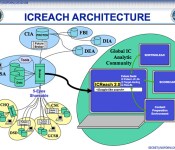
The NSA’s search tool is a Google for the world’s communications data

If sharing really is caring, then the NSA must care a lot. That’s the thrust of a new report from The Intercept that pulled back the curtain on a search system called ICREACH — launched in 2007, the system allows members of more 20 different US agencies to quickly sift through the communications metadata of both foreigners and citizens on US soil. And the reason for all this? Well, the stated goal was to allow members of these government agencies to identify persons of interest and help agents monitor the activities of “intelligence targets” at home and abroad. Putting aside its ability to crawl through some 850 billion metadata records (and growing), one of ICREACH’s greatest assets might be its straightforward interface. It’s referred to in internal documentation as being “Google-like” and allows researchers to dig into metadata records by punching in simple “selectors” like email addresses and phone numbers.
This isn’t the first time the name ICREACH has been made public knowledge (barring all the Google search results for job openings for people fluent in intelligence tools like it). Glenn Greenwald’s book No Place To Hide included a slide among its myriad documents that highlighted the some of the metadata types that were accessible through ICREACH:

According to The Intercept’s Ryan Gallagher, it’s that bit about foreigners that affords ICREACH much of its immunity from congressional oversight. The system was designed to cull information primarily from foreign communications networks (which is kosher thanks to President Reagan’s Executive Order 12333), though The Intercept asserts that the system also contains “millions of records on American citizens who have not been accused of any wrongdoing.” The metadata itself — the sender and recipient of a call or message, identifying information about the device used, etc. — might not seem terribly troubling, but in aggregate it could provide a fairly comprehensive picture of what a given person was doing when, and where. All told, it’s a scarily powerful bit of tech at the disposal of multiple agencies, and since much of the information released was based on documents that are years old, it’s not clear how ICREACH’s, well, reach has shifted or expanded since.
Source: The Intercept
.CPlase_panel display:none;

The Big Picture: How EA captured player faces for Madden NFL 15

If you’ve ever wondered how video game studios transform real-life people into their multi-pixeled personas, here’s one method. SB Nation’s Sarah Kogod recently made the trip to Baltimore where EA was set to capture facial images from the Ravens’ players for Madden NFL 15. There, she encountered the developers new “mobile” rig that leverages a dozen DSLRs situated in two rows of six each in order to snap all of the close-up details. The frame is part TV stand and part wheel chair lift that allows the entire thing to be positioned just so from a connected laptop. In fact, three teams, each outfitted with one of the multi-camera rigs, set out this summer to capture player images from all 32 NFL teams during OTAs and training camp. Before now, artists have had to work from stock photos in order to create a player’s virtual counterpart, and accuracy suffered. The folks at EA say that as games become increasingly more life-like, that gamers notice “any blemish that’s off… people catch that.”
[Photo credit: Sarah Kogod/SB Nation]
Filed under: Gaming
Source: SB Nation
.CPlase_panel display:none;
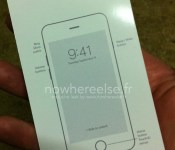
Likely Fake iPhone 6 Box Insert Surfaces [iOS Blog]
While we’ve seen dozens of images depicting iPhone 6 elements that are likely to be real versions of parts that will make their way into the finished device, we’ve also been seeing quite a few iPhone 6 mockups, iPhone 6 clones, and other fake iPhone 6 parts as we creep closer to the device’s launch date.
French site Nowhereelse.fr [Google Translate] has today shared what it believes may be a genuine iPhone 6 box insert (or quick start guide) that “confirms” the launch date of the iPhone 6 as Tuesday, September 9, but MacRumors believes the insert to be fake based on several different design elements.
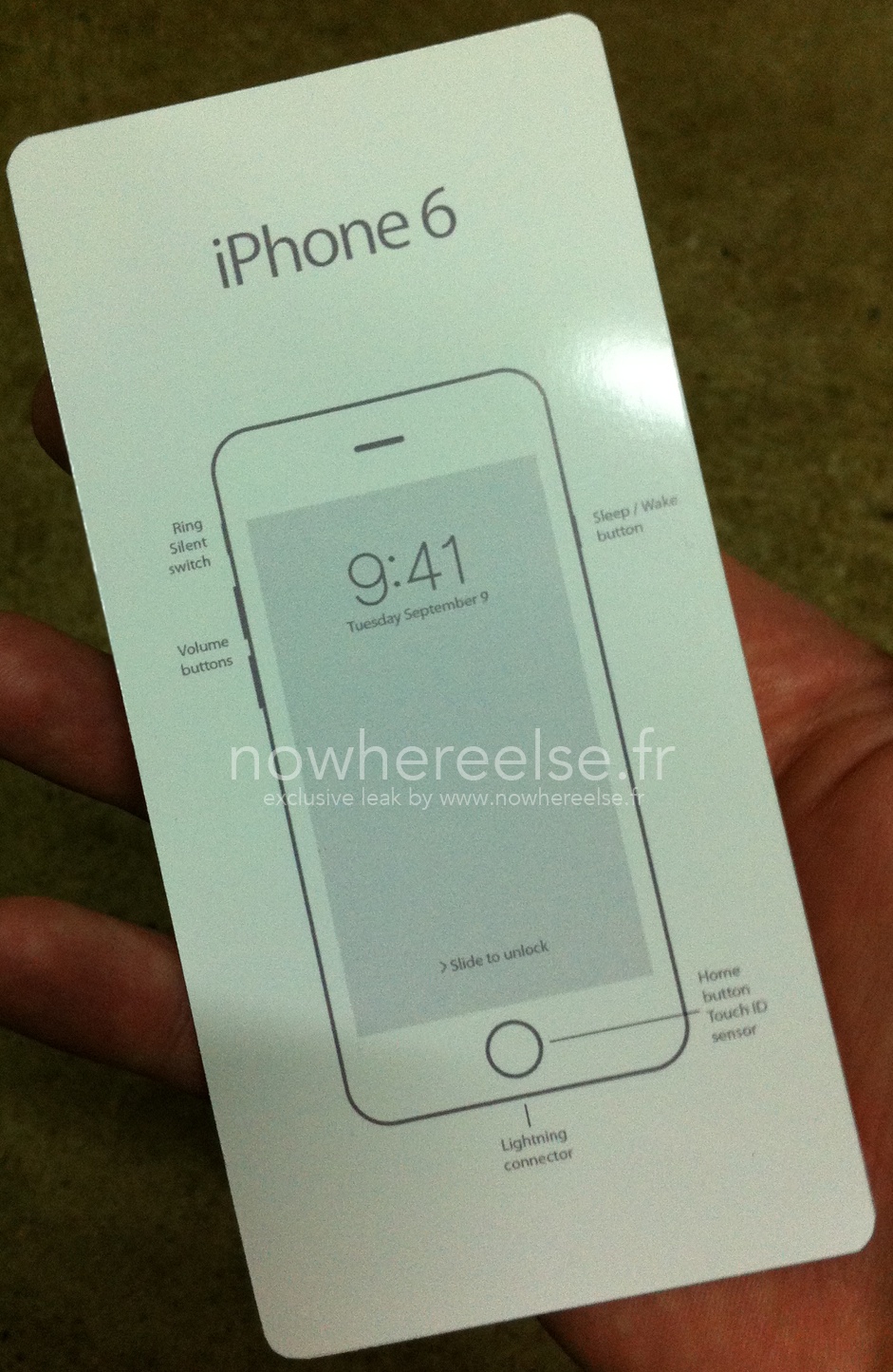 (Click for Full Size)
Nowhereelse.Fr compares the September 9 date listed on the fake insert to the “10″ date on the calendar icon of the original iPhone 5s card as proof the iPhone 6 insert is real, but the site erroneously assumes that the date on the iPhone 5s insert referred to the Tuesday, September 10 unveiling of the iPhone 5s.
The “10″ date actually corresponds to the date when iOS 7 debuted, Monday, June 10. Therefore, the iPhone 5s card did not depict the phone’s debut date, which means an actual Apple quick start card for the iPhone 6 would be unlikely to display “September 9″ over the iOS default date.
Additionally, the design of the card also lacks slashes between the Ring/Silent switch and Home Button/Touch ID sensor, and the font of the time is not quite in line with Apple’s style. Nowhereelse.Fr claims that Apple has opted for a more simple insert design that does not show the actual device to explain its difference from the iPhone 5s insert, but it is unclear whether that is factual. Even when poised as a possible rough draft for a finished quick start guide, the glaring errors on the card continue suggest that it is indeed a fake and not representative of the actual insert card that will be included with the finished iPhone 6.
Apple is expected to introduce its iPhone 6 on Tuesday, September 9 at a media event. The device is rumored to come in two variations, 4.7 inches and 5.5-inches, but it is unclear if both models will ship at the same time as production issues are said to be plaguing the larger iPhone 6.
.CPlase_panel display:none;

Happy accident: Sphero makes the move from toy to teaching

Orbotix, now simply known as Sphero, had the world in awe when it introduced its smartphone-controlled, ball-shaped toy back in 2010. Back then, we were still getting used to the concept of “connected” things. Today, nearly four years after making its debut at the Consumer Electronics Show, Sphero is one of the most popular peripherals around, on iOS and Android alike. But while the robotic ball may have started off as a knickknack for kids, or adults, to play with, it has recently started to break into another, more serious field: education. In an effort to boost that, Sphero launched an initiative called SPRK about five months ago, with the goal of letting schools adopt its product into education curriculum. Simply put, kids could not only learn about programming, but also have fun doing so.
The SPRK program, short for Schools Parents Robots Kids, is divided into two main segments: Core and Stem. Core is a series of lessons designed to help kids build their coding skills, both visual- and text-based. Stem, on the other hand, is the next step up for those who have mastered Core, offering a number of different challenges that let students experiment and build contraptions for Sphero. To assist with this, Sphero has two programming applications, available for iOS and Android; MacroLab uses visuals to get kids started with the learning process, while orbBasic is a more advanced, text-based language tool. By using MacroLab and orbBasic, students can, for example, program the Sphero ball to follow a number of custom commands, among other things.

Naturally, SPRK isn’t only about the young ones, as parents and teachers also play a big role in the program. “Any teacher can teach this, even if they don’t know robotics,” Ross Ingram, Sphero’s community manager, told Engadget. “It’s easy for teachers to adopt it into a curriculum. It’s instant gratification for kids — they are able to see their progress instantly.” And although SPRK is geared for third, fourth and fifth graders currently, Sphero’s idea is to expand beyond those levels, all the way up to high school and college. As Ingram puts it, “Sphero can grow up with them. There’s an SDK for iOS, Python, Ruby, so they can keep coding as they grow up.”
“Any teacher can teach this, even if they don’t know robotics.”
At the moment, 250 schools have integrated Sphero as part of their education syllabi, both here in the US and around the world. One of the reasons so many schools have decided to do so is because they can buy Spheros in bulk for a low cost — the company says it can sell them “at a cost of goods,” which is likely a lot less than the $80–$130 each sphere costs via retail channels, depending on which generation it is. “We’re already making money through our consumer channel, so it’s easy for Sphero to explore,” Adam Wilson, founder and chief software architect, explained. “As a robotics company, we can create other things to integrate them with this educational program. Our main goal is to teach kids stuff. This isn’t our main line of business.”
“It was a happy accident. We want to make a difference.”
Sphero told us there were never any plans to make its robot an educational tool, but the approach from many parents paved the way to eventually follow that path. Essentially, the grown-ups thought it would be a great idea to take advantage of Sphero’s fun attributes and, consequently, turn it into a training tool for robotics and programming. With SPRK now underway, Sphero wants to just embrace it, grow it and use it to make a dent in the educational world.
“It was a happy accident. We want to make a difference,” said Wilson.
[Image credits: Sphero Education; Edgewater Echo]
Filed under: Peripherals, Robots, Internet, Software, Alt
.CPlase_panel display:none;
 AIVAnet