


PlayStation Network goes down following cyberattacks

Sony may be experiencing a few unpleasant flashbacks this weekend. Both the PlayStation Network and Sony Online Entertainment (SOE) are slowly recovering from a denial of service attack that flooded their server connections, kicking many gamers offline. The group claiming responsibility, Lizard Squad, reportedly started out bombarding servers run by Blizzard (World of Warcraft), Grinding Gear Games (Path of Exile) and Riot Games (League of Legends) before swinging its attention Sony’s way.
The motivations are fuzzy at this point — the attackers don’t take themselves too seriously — but you likely won’t have to worry about your account being compromised like you did back in 2011. As SOE’s John Smedley explains, the culprits are simply trying to overwhelm Sony rather than break in. That won’t be much comfort if you wanted to squeeze in a few rounds of Killzone before the weekend was over, but it hopefully means that you can get back to playing without worrying that your data is vulnerable. In at least SOE’s case, some services are already back up and running — give it a try and let others know how it’s going in the comments.
Network update: our engineers are aware of the issues and are working to resolve them. We’ll keep you posted – sorry for the inconvenience
– PlayStation (@PlayStation) August 24, 2014
Services will be gradually restored. For some it’s up now. For others the route they take may be flooded so they can’t log in yet.
– John Smedley (@j_smedley) August 24, 2014
Source: PlayStation (Twitter), LizardSquad (Twitter)
.CPlase_panel display:none;

Apple’s Reversible USB-Lightning Cable Unlikely for iPhone 6, but New Adapter Possible
Amid rumors of a new Lightning cable with a reversible USB connector and a redesigned power adapter from Apple, third-party vendor Moca.co is claiming that while the adapter may be ready for launch alongside the iPhone 6 next month, Apple is not yet ready to debut its new Lightning cable. Moca.co says that it is an MFi-certified vendor working with Apple’s primary Lightning cable provider and that Apple has not yet placed any orders for the new cable.
We are informed by the Official Appointed Manufacturer of Apple that the new Reversible USB Cable will not be released together with upcoming iPhone 6 and Apple has not placed any order with them yet. Apple fans will not be able to get the MFi version of this revolutionary cable from Apple this year but that is not the end of the story.
According to Moca.co, the manufacturing partner has sent samples of the Lightning cable with reversible USB connector to Apple for approval, but Apple has yet to move forward with manufacturing orders. Even once it does, it will reportedly be several months before the cables are ready.
The redesigned power adapter may, however, be ready to launch with the iPhone 6, as Moca.co tells MacRumors the design has been confirmed and mass production is already underway. According to the report, the new adapter supports up to 2A of current, twice that of the current adapter shipping with the iPhone. The new adapter will reportedly be able to power all iPhone, iPod, and iPad mini models, with the redesign likely driven by the higher power requirements of the larger iPhone 6 models.
Moca.co’s prototype adapter and cable based on Apple’s designs
Moca.co is planning to offer its own versions of the cable and adapter from its MFi-licensed manufacturing partners, and is currently taking pre-orders with plans of October delivery if it can obtain a sufficient number of pre-orders to initiate production.
.CPlase_panel display:none;

IRL: Tracking bike rides with the Garmin Edge 510

I’m all about minimizing the amount of stuff I need to carry with me, which is why smartphones have been great — they can double as a camera and even a portable gaming handheld. But when it comes to riding my bike, I still prefer a dedicated device. This is why I picked up a Garmin Edge 510, and now I don’t think I’d ever go back to using a smartphone to track my workouts.
For me, the big draw was knowing I could get all the benefits of a fitness app in a small package without worrying about the battery. When I’m 30 or 40 miles from home, the last thing I want is to be stranded without a phone should I need to call my wife to pick me up or, worse, if I’m in an accident. By leaving my phone running with the screen on, pulling data from sensors and recording via GPS, I knew I’d eventually be out riding and need to use my phone, only to pull it out of my pocket to find it in the red. The first longer ride I did with the Garmin was a joy simply because I didn’t have to worry about the longevity of the Edge 510. In general, the battery is pretty darn good. During a charity ride a few months ago the device lasted just over seven hours — something my phone would have not been able to pull off.
The addition of a color LCD display on the 510 is a big step up from the previous generation Edge 500. This seems rather trivial, but the Edge 510 is capable of giving you turn-by-turn directions. All that color is helpful, too; it’s less of a struggle to make out directions now that roads and arrows aren’t rendered in monochrome. Now, don’t get too excited about seeing turn-by-turn directions. It’s nothing more than an audible tone to alert you of an upcoming turn with an arrow pointing on a small section of a map. That’s it. If you want more detailed GPS data then you have to go up to the more expensive Edge 810 or Edge 1000 which allow you to download more robust maps.
Perhaps the best feature of the Edge 510 is one that doesn’t even benefit me specifically. You see, as great as cycling is for your health, it can also be pretty dangerous. My wife used to worry when I was riding solo, but now she doesn’t, thanks to a feature called LiveTrack. Before I head out, I simply enable LiveTrack and she gets an email with a link to follow me on a map. There’s no more worrying — she can just can open the map to make sure the little dot (me) is still moving along. And to my surprise, this isn’t too much of a burden on either device’s battery. I’ve been able to use LiveTrack for close to three hours before seeing a battery warning for either my phone or the Edge 510.
I must admit, I do have one issue: the touchscreen display. At times when I’m trying to navigate around, I feel as if I’m using a cellphone from 2007. Moving through pages can be frustrating, often requiring me to swipe from off the screen or else it doesn’t register the action at all. Sure, I can just leave it on one page, but Garmin lets me have up to five and I like to have ones set up for different workouts. And let me tell you, when I’m riding up a 7 percent grade hill, having to fight with an unresponsive screen is the last thing I want to worry about. In colder months I don’t even bother with the display — it’s even less responsive when I’m wearing full-finger gloves. I recognize the Edge 510 is the company’s lower-end cycling device, and I have adapted to its temperamental nature, but I just wish something costing me $300-plus offered a better touchscreen.
As much as I like the Edge 510, it’s probably overkill for a lot of riders. I personally like having my cadence and heart rate synced into Strava, but not everyone may care about that. In those cases, sticking with a traditional bike computer and just using your phone will work fine. If you are of the data recording group but find the $330 price point to be too high, you can probably snag the discontinued Edge 500 on a good deal. You won’t get LiveTrack or a color touchscreen, but you could also save over $100.
Filed under: Transportation
.CPlase_panel display:none;

Inhabitat’s Week in Green: Renovo Coupe, transparent solar panels and the Lego house

Wind power isn’t confined to massive turbines found in the middle of cornfields; a Polish company has developed a 3D-printed, foldable wind turbine that can generate up to 300W of clean electricity — enough to power your smartphone. And best of all? It fits in your backpack. We’re also one step closer to having phones that charge themselves — Michigan State researchers unveiled a crystal-clear solar panel that can be integrated into smartphone displays, windows and other transparent surfaces.
Portable renewable energy has real benefits beyond fighting climate change. Case in point: A new type of solar-powered mobile technology is being used in India to help prevent prenatal deaths. The device can deliver health information about patients in remote areas to doctors, alerting them to possible pregnancy complications. In other green energy news, NASA scientists have created a new type of solar array that unfolds like an origami flower. A human mission to Mars is still a few years off, but that isn’t stopping designers from dreaming up housing options for the red planet. Noah Hornberger recently won NASA and MakerBot’s Mars Base Challenge with a series of 3D-printed honeycomb homes that could be used on Mars. And for the ultimate luxury kitchen accessory, Dutch designer Robert Kolenik created an amazing aquarium/table that would be a guaranteed discussion piece at any dinner party.
Tesla is about to shake up the electric vehicle landscape again as it prepares to release a pair of new models, but it’s actually one of the automaker’s older cars that hit the news this week. The company announced that it would provide a battery upgrade to Tesla Roadster owners, giving the electric car a 400-mile driving range. In other automotive news, Renovo unveiled a sexy, all-electric supercar with the body of a Shelby CSX 9000, and a team of researchers at MIT has come up with plan to turn old car batteries into durable solar panels. The team sees it as an opportunity to keep e-waste out of landfills while storing clean energy. There isn’t as much newsprint in circulation as there once was, but a team of scientists from Tulane University has found a way to run a car on old newspapers. The process uses a bacterial strain called TU-103 that turns newspapers into butanol, which in turn can be used to power a car. And a brilliant team of engineering students created the world’s first unstealable bike!
It would be a gross understatement to say that Pritzker Prize-winning architect Shigeru Ban is at the top of his game. The Japanese designer recently completed the new Aspen Art Museum, and he quickly followed that up by unveiling a solar-powered community center for children in Fukushima. The Lego Group, which produces one of the most identifiable children’s toys around the world, was started in Denmark. So it makes sense that Danish starchitect Bjarke Ingels was hired to design a large Lego complex known as the Lego house at the Lego Group’s birthplace in the Danish city of Billund. Not surprisingly, the structure will be built out of stacked rectangular volumes that resemble giant Lego bricks. Lego has also inspired several building technologies over the years, the latest of which is Kite Bricks, a set of large interlocking bricks that allow for faster, cheaper and more precise construction than conventional building methods.
Washing clothes is among the most water-intensive processes in the home, but it might not be for long. Researchers in Hong Kong have developed a self-cleaning textile that can clean itself when exposed to sunlight for 24 hours straight. In other green design and tech news, Japanese designer Ryosuke Fukusada has designed a lightbulb made from wood. The LED bulb is wrapped in a thin layer of pine, which makes it look like a solid piece of wood when it’s turned off. When it’s switched on, it emits a warm glow. Lighting designer Hilden and Diaz has created a new lamp that is inspired by drawings made by German biologist and naturalist Ernst Haeckel. The lamp, which looks like a bundle of twisted roots and sticks, projects forest shadows when it’s lit. And on the mobile front, someone has actually created a device that tracks sexual performance. The SexFit is basically a Fitbit for your man parts; it measures calories burned, thrusts per minute and has vibration modes to, you know, enhance performance.
.CPlase_panel display:none;
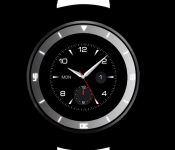
Is this the LG G Watch 2? LG confirms it will be launching a round-faced smartwatch at IFA 2014 with a teaser
 Just a week ago, we heard a rumour that suggested that LG was already preparing a successor to its LG G Watch, what was being called the LG G Watch 2. We were dismissive of the rumour given that the LG G Watch has only been on the market for 2 months, but is seems we might have been wrong to assume that. LG has release a teaser for a new wearable, one that it refers to simple as the “R” (presumably standing for “round”), depicting a smartwatch with a round face, not unlike that of the Moto 360. Check out the teaser below:
Given the timing of this new “R” smartwatch, it seems likely that LG has been working on the watch even before launching the LG G Watch and decided to launch the original G Watch to accompany the launch of Android Wear. Now, it seems LG’s real hand has been shown, and its latest wearable adopts the round form factor that many of us have been pining for. The teaser ends suggesting an announcement will be made at IFA 2014 next month, and we absolutely can’t wait to see what the actual smartwatch ends up looking like.
What do you think about LG launching a round face smartwatch at IFA 2014? Let us know your thoughts in the comments.
//<![CDATA[
ord = window.ord || Math.floor(Math.random()*1E16);
document.write('‘);
//]]>
The post Is this the LG G Watch 2? LG confirms it will be launching a round-faced smartwatch at IFA 2014 with a teaser appeared first on AndroidSPIN.
.CPlase_panel display:none;

LG will reveal a circular smartwatch next week to compete with the Moto 360

Of the three Android Wear smartwatches introduced at Google’s developer conference in June, the Moto 360 was by far the crowd favorite; its circular watchface gives it a classic, elegant look, and a stark contrast to the squarish Samsung Gear Live and LG G Watch. It turns out that LG wasn’t very excited about its first Wear watch either: It’s going to introduce a round-faced sequel — called the LG G Watch R — next week in Berlin, shortly after Motorola officially launches its new timepiece.
The teaser, provided to us by a trusted source, is currently unlisted on LG Mobile Global’s YouTube channel and embedded above. Plenty of details are left out — gotta leave something for the big reveal, of course — but you can clearly see a circular display (we’re assuming R stands for Round) with several new watchfaces. And unlike the original G Watch, the R comes with a button on the side. We also caught a few brief glimpses of a digital step counter, distance meter and compass. Finally, the teaser proclaims that we’ll learn more at IFA 2014 next week.
The short turnaround between G Watches (2.5 months) is indicative of LG’s strategy. A typical product development cycle spans the course of several months, and depending on the device, could take up to a year or more. This means the G Watch R was in development alongside the original, so the square model was likely a proof of concept; something to satisfy the early adopters and work out bugs while the stylish version wrapped up development. In other words, the R is the marquee smartwatch LG’s really banking on, and the fact that it’ll be introduced just hours after the 360′s launch means that all of the momentum and hype Motorola has spent months building up may quickly vanish. Whether it was a stroke of luck or brilliant timing on LG’s part, it shows either way that the competition will be heating up next week.
LG’s not the only manufacturer coming out with a new watch soon. ASUS will launch one at IFA as well (though its shape is square in its teaser); HTC has something in the works for later this year; Samsung could easily launch another Gear or five for the holidays; and let’s not even get into the Apple watch speculation. The Moto 360 is still the best-looking smartwatch we’ve seen thus far, but the space is becoming much more crowded than it was two months ago, and it may not retain that top-dog status for long after it finally gets released.

Filed under: Cellphones, Wearables, Wireless, Mobile, Google, LG
Source: LG Mobile Global YouTube
.CPlase_panel display:none;

Data breaches compromised the info of US undercover investigators

Data theft is normally pretty bad all on its own, but a recent breach at US Investigations Services (a background check company) may have created some extra-strong headaches for the US government. Reuters understands that the intrusion exposed personal information of 25,000-plus Department of Homeland Security workers, including “some undercover investigators.” There’s no certainty that the attackers stole those agents’ information, but there’s a real chance that their identities are out in the wild — a big problem if suspects can double-check identities and avoid getting caught. The concern is exacerbated by the nature of the attack, which USIS believes might have been “state-sponsored.”
The potential for future damage is limited. Homeland Security has frozen its work with USIS for the next while, and the FBI is already investigating what went wrong. Until it’s clear just what happened and who’s at risk, though, there are going to be a lot of nervous officials — they won’t necessarily know which new hires they can trust.
[Image credit: Sean Gallup/Getty Images]
Filed under: Internet
.CPlase_panel display:none;

Coin makes up for its delayed smart card launch with an expanded beta test

Not happy that Coin said it was only shipping a beta version of its Bluetooth credit card this fall, rather than the finished product it originally promised for the summer? You’re not alone — and the company is aware that it needs to make amends for angering early adopters. The fledgling payment firm has apologized for both the delay and lack of transparency by significantly expanding the reach of its beta program. It’s planning to run a nationwide test for beta backers at “no cost,” and it will expand the initial number of slots in that dry run from 10,000 to 15,000 — not a perfect solution, but definitely more accommodating. It’s also hoping to increase the number of slots over time, so you may not have to wait for the finished product if you miss out on the first wave.
Of course, this olive branch to customers wouldn’t be very helpful if the startup weren’t tackling the issues that miffed so many in the first place. It’s promising more updates on its progress in the future, and hopes to boost the card’s compatibility beyond the 85 percent claimed today; that’s part of what the beta is for, after all. You can get a refund if Coin’s antics still rub you the wrong way, although the company is clearly hoping that you’ll give it a second chance.
Filed under: Peripherals, Internet
.CPlase_panel display:none;

You can steal data from a computer by touching it

Normally, breaking a PC’s security involves either finding security exploits or launching brute force attacks, neither of which is necessarily quick or easy. However, a team at Tel Aviv University has come up with a potentially much simpler way to swipe data from a computer: touch it. If you make contact with a PC while you’re wearing a digitizer wristband, you can measure tiny changes in electrical potential that reveal even stronger encryption keys (such as a 4,096-bit RSA key). You don’t even have to touch the system directly in some cases — researchers also intercepted keys from attached network and video cables.
Don’t worry about overly grabby strangers stealing your data just yet. The technique primarily focuses on GnuPG’s encryption software, which already has a patch to limit the effects. Thieves also have to monitor the electricity while decryption is taking place, so they can’t just grab info on demand. However, the very nature of the technique makes it difficult to stop completely — unless you’re a fan of insulation and Faraday cages, someone with physical access to your system may always have an opportunity to peek into your most sensitive content.
Filed under: Science
Source: Tel Aviv University
.CPlase_panel display:none;

Is Android L’s official name going to be ‘Lemon Meringue Pie’?
 With each new build of Android comes the game where we try and guess what the official name of the build is going to be. For this next build, which we currently only know as Android L, we’ve had assertions that it called ‘Lollipop’, however the answer might actually lie in the Android L preview code, and its name could be “Lemon Meringue Pie“. According to Android Police, the Android SDK refers to the preview builds for Nexus 5 and Nexus 7 as the “lmp-preview-release”:
<!– From: file:/usr/local/google/buildbot/repo_clients/https___googleplex-android.googlesource.com_a_platform_manifest.git/lmp-preview-release/frameworks/support/v7/cardview/res/values/colors.xml –>
<eat-comment />
<color name=”cardview_dark_background”>#FF202020</color>
<color name=”cardview_light_background”>#FFFAFAFA</color>
<color name=”cardview_shadow_end_color”>#03000000</color>
<color name=”cardview_shadow_start_color”>#37000000</color>
<!– From: file:/usr/local/google/buildbot/repo_clients/https___googleplex-android.googlesource.com_a_platform_manifest.git/lmp-preview-release/frameworks/support/v7/cardview/res/values/attrs.xml –>
<eat-comment />
<declare-styleable name=”CardView”>
<!– Background color for CardView. –>
<attr name=”cardBackgroundColor” format=”color” />
<!– Corner radius for CardView. –>
<attr name=”cardCornerRadius” format=”dimension” />
</declare-styleable>
<!– From: file:/usr/local/google/buildbot/repo_clients/https___googleplex-android.googlesource.com_a_platform_manifest.git/lmp-preview-release/frameworks/support/v7/cardview/res/values/dimens.xml –>
<eat-comment />
<dimen name=”cardview_default_radius”>2dp</dimen>
<dimen name=”cardview_elevation”>2dp</dimen>
<dimen name=”cardview_shadow_size”>2dp</dimen>
<!– From: file:/usr/local/google/buildbot/repo_clients/https___googleplex-android.googlesource.com_a_platform_manifest.git/lmp-preview-release/frameworks/support/v7/cardview/res/values/styles.xml –>
<eat-comment />
And in yesterday’s leak of the HTC Nexus’ Wi-Fi certification (see the leak here), we can clearly see “LMP” as part of the firmware version for the device. So it seems pretty likely that “LMP” actually refers to the Android build name, which we’re guessing stands for Lemon Meringue Pie. Keep in mind though that the last build of Android, which we now know as Android KitKat, was actually called KLP, or Key Lime Pie, in the Android SDK and it seems it was a relatively last minute deal by Google to partner with Nestle for the launch.
Do you think LMP, or Lemon Meringue Pie, is the real name of the next Android build? Let us know your thoughts in the comments below.
Source: Android Police
//<![CDATA[
ord = window.ord || Math.floor(Math.random()*1E16);
document.write('‘);
//]]>
The post Is Android L’s official name going to be ‘Lemon Meringue Pie’? appeared first on AndroidSPIN.
.CPlase_panel display:none;
 AIVAnet