



Germany accidentally spied on phone calls from Hillary Clinton and John Kerry

Germany may be upset with the US over its eagerness to spy on national leaders (and seemingly everyone else), but it turns out that Germany itself isn’t completely above reproach. Der Spiegel has revealed that the country’s BND intelligence agency accidentally scooped up calls from US Secretaries of State Hillary Clinton (in 2012) and John Kerry (in 2013) while spying on Middle Eastern terrorist targets. The German agents reportedly destroyed the intercepted calls as soon as they realized what they had, but they also kept the discovery hush-hush.
The news isn’t likely to trigger alarm bells like the NSA’s surveillance of foreign government officials, which was deliberate. However, there is a concern that Germany isn’t being as accountable as it should be. BND’s current policy is to have agents delete “chance finds” on sight without telling senior officials. That may let insiders create illegal copies of calls without any acknowledgment that the call data even existed. One of the spies with this power was recently arrested for allegedly being a CIA double agent — there’s a real worry that he may have relayed important conversations to the US.
[Image credit: AP Photo/Kevin Lamarque]
Filed under: Cellphones, Internet, Mobile
Via: The Verge
Source: Der Spiegel (translated)
.CPlase_panel display:none;
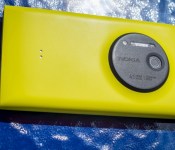
IRL: Nokia Lumia 1020 (one year later)

A year later, and strangers still ask.
“Is that the Lumia with the crazy camera? How do you like it?”
And, after a year, I still offer up the same basic response.
“Great camera, solid phone.”
But after 12 months, and with a slew of new handsets on the way, it’s time to reevaluate if my bright yellow Lumia 1020 is still the best choice as my daily driver. Is being great good enough?
The camera, of course, is the first thing waiters and passers-by ask about. That 41-megapixel sensor is still impressive and I don’t hesitate to sing its praises. The Lumia 1020′s rear shooter is certainly the main reason I decided to return to the Windows Phone ecosystem.
There’s plenty I still love about this phone and, particularly, its camera. The xenon flash is properly powerful (and can trigger my external flashes if I wanted). Its low-light performance makes it the go-to shooter if I’m among friends in a dark restaurant or bar. Nokia’s camera software, with its suite of manual controls, is also a highlight, even if the UI can be a bit fiddly at times.
Meanwhile, the phone itself remains a solid performer, dutifully carrying out nearly all the tasks I need from a smartphone. While the still camera gets most of the attention, the 1020′s audio-recording chops are also astounding. Clips taken at live concerts have clear, full sound, whereas other smartphone mics seem easily overwhelmed. The recent 8.1 update also brings some great new features I’m still exploring.
And yet…
You knew that was coming, right? As much I’ve enjoyed the past year, it hasn’t exactly been a trouble-free experience. That feature-packed camera software I love so much can take ages to load on the 1020′s Snapdragon S4 Plus-based hardware.
And by “ages,” I mean six to nine seconds from icon press to shutter snap, which is plenty of time for impromptu moments to come and go. For comparison, a colleague’s HTC One M7 can snap a pic within three seconds and my wife’s Nexus 4 manages similar times. Microsoft’s default camera app loads quicker, but I prefer the manual options in Nokia’s offering. Of course, camera specs and apps are different among phones, but the main takeaway is my 1020 can take impressively detailed images — if I’m willing to wait.
Beyond the sluggish responsiveness, I’m not even sure I need such a capable shooter on my phone anymore. Two years ago when the 808 PureView first piqued my interest, my main shooter was a bulky Nikon DSLR that weighed close to 1kg with a battery and lens. Having a crazy-good camera attached to my phone had a lot of appeal at that point in my life. These days, my Fuji X-E2 weighs a bit less and is much more discreet. In short, my phone’s picture-taking abilities aren’t quite as important now that my main camera isn’t such a chore to carry around.
And despite the ongoing ecosystem improvements and additions found in Windows Phone 8.1, there are still a few missing features and apps I would love to see for both work (HipChat) and play (Fujifilm’s WiFi image-transfer app, a whole list of games).
Overall, though, I’ve few regrets one year later. Having been an early adopter of WP7, I knew what I was getting myself into by picking up the Lumia 1020. I got a solid smartphone that’s capable of excellent image and audio capture, all wrapped in a can’t-miss-it shade of banana yellow polycarbonate. I’ll still be closely examining the upcoming range of smartphones to see if one of them makes more sense for me now, but these past 12 months have been time well spent.
Filed under: Cellphones, Mobile, Microsoft, Nokia
.CPlase_panel display:none;

VizeraLabs reupholsters furniture with the power of light

Looking for the perfect chaise longue? That’s no easy feat even on the best days, but the process is made even trickier since stores rarely seem to have their full collections on display. That’s precisely the problem a San Francisco startup called VizeraLabs is trying to tackle, and its team has built a curious little projector to help. You see, instead of displaying reruns of Doctor Who on your wall, it’s used to project different fabrics and finishes onto whatever surface it’s pointed at, be it a wall or an armchair.
This whole thing might sound a little kooky at first, but Vizera just might be onto something here. If things go their way, furniture stores will be able to cut back on the headaches that come with filling the show floor with samples, while potential buyers get to see the full assortment of patterns and materials (controllable from a connected tablet, no less) without having to schlep through a warehouse. Granted, a fancy projection will only ever help your shopping decisions so much (especially when you can’t actually feel the finish), but who knows — a little whiz-bang taste of the future might get more geeks gearing up to crack the home decor code. For now, VizeraLabs’ tech is geared toward making sure you get exactly the recliner you want, but the team is on the brink of branching out into wallpaper for your home and exteriors and interiors for your next car purchase.
Via: TechCrunch
Source: VizeraLabs
.CPlase_panel display:none;

UK spies have scanned the internet connections of entire countries

You may know that the UK’s GCHQ intelligence agency pokes its nose into people’s internet service accounts, but it’s now clear that the spy outfit is mapping the internet connections of whole nations, too. Heise has obtained documents showing that a GCHQ system, Hacienda, can scan every internet address in a given country to see both the connection types in use (such as web servers) as well as any associated apps. The scanning platform is looking for relevant targets and any exploitable security holes; if a target is running software with known vulnerabilities, it’s relatively easy for agents to break in and either swipe data or set up malicious websites that trick suspects into compromising their PCs. Poring over this much data would normally be time-consuming, but there’s a companion system (Olympia) that makes it easy to find useful information within minutes.
The technology itself isn’t shocking; anyone can do this, if they don’t mind incurring the wrath of internet providers and law enforcement. However, the global scale of Hacienda is bound to raise eyebrows. Agents had scanned 27 whole countries as of 2009, along with parts of five others — it’s clear that the goal is to have complete national network maps on demand, whether or not they’re really needed for investigations. GCHQ can also hand its findings over to the NSA and other intelligence groups. There are ways to thwart this probing, such as the early version of an internet stealth protocol (TCP Stealth), but it could be a while before you’re completely off the radar.
[Image credit: UK Ministry of Defense, Flickr]
Filed under: Networking, Internet
Source: Heise Online
.CPlase_panel display:none;

Recommended Reading: Healthcare.gov, Edward Snowden and Square’s struggles
Recommended Reading highlights the best long-form writing on technology and more in print and on the web. Some weeks, you’ll also find short reviews of books that we think are worth your time. We hope you enjoy the read.

The Billion Dollar Web Site You Paid For
by Larry Seltzer, ZDNet
By now, you’ve likely heard details surrounding the botched rollout of Healtchcare.gov meant to expedite the process of US citizens signing up for the Affordable Care Act. Well, the government has sunk a billion dollars into the site so far, and a recent Government Accountability Office report took an in-depth look to see exactly what went wrong. Of course, the project was slated to wrap up on launch day last October, but is now said to be in development until the end of the year.
|
Back to Square One Twitter co-founder Jack Dorsey took the payments space by storm when Square launched back in 2010 with a reader capable of accepting credit or debit card payments on a phone or tablet. Despite reaching a $5 billion valuation this year, the company lost $100 million in the last 12 months, showing that processing those mobile payments didn’t generate loads of income and forcing the CEO to rethink strategy. Pocket!function(d,i)if(!d.getElementById(i))var j=d.createElement(“script”);j.id=i;j.src=”https://widgets.getpocket.com/v1/j/btn.js?v=1″;var w=d.getElementById(i);d.body.appendChild(j);(document,”pocket-btn-js”); |
The Internet’s Original Sin Ah, web ads. They can be quite the nuisance, especially in pop-up form. In fact, the folks responsible for that revolutionary bit of internet advertising are offering an apology for creating the headache. But as frustrating as they may be, ads keep a lot of sites going. The Atlantic’s Ethan Zuckerman dives into how we may be able to change up the narrative, and in turn, tidy up the web. Pocket!function(d,i)if(!d.getElementById(i))var j=d.createElement(“script”);j.id=i;j.src=”https://widgets.getpocket.com/v1/j/btn.js?v=1″;var w=d.getElementById(i);d.body.appendChild(j);(document,”pocket-btn-js”); |
|
The Most Wanted Man in the World You might’ve heard something about Edward Snowden at this point. The man responsible for blowing the lid off of the NSA’s surveillance programs has been eluding the US government for months, and Wired had an in-depth profile and interview of the former contractor turned whistleblower who’s holed up in Russia. Pocket!function(d,i)if(!d.getElementById(i))var j=d.createElement(“script”);j.id=i;j.src=”https://widgets.getpocket.com/v1/j/btn.js?v=1″;var w=d.getElementById(i);d.body.appendChild(j);(document,”pocket-btn-js”); |
Corporate America Hasn’t Been Disrupted You might think that the rise of startup culture has put pressure on larger companies to keep things fresh in order to maintain their market share. Well, as noted stats outfit FiveThirtyEight found out, that’s far from the case and firmly rooted businesses have yet to be “disrupted.” Pocket!function(d,i)if(!d.getElementById(i))var j=d.createElement(“script”);j.id=i;j.src=”https://widgets.getpocket.com/v1/j/btn.js?v=1″;var w=d.getElementById(i);d.body.appendChild(j);(document,”pocket-btn-js”); |
[Photo credit: Mark Wilson/Getty Images]
Filed under: Misc
.CPlase_panel display:none;
More Photos Point Toward 1,810 mAh Battery for 4.7-Inch iPhone 6
Last month, a photo surfaced showing what looked very much in line with Apple’s usual iPhone battery design but with a capacity of 1,810 mAh, higher than the 1,560 mAh battery found in the iPhone 5s. Speculation naturally pointed toward the new battery being for the 4.7-inch iPhone 6, with a number of observers being disappointed in the modest capacity increase considering the larger display slated for the device.
Just last week, an analyst report claimed the 4.7-inch iPhone 6 will actually include a 2,100 mAh battery, giving hope to those looking for a more substantial increase but lacking any evidence to support the claim.
New photos shared by Nowhereelse.fr [Google Translate] now provide additional support for the original 1,810 mAh claim. The photos offer a good look at the batteries, which appear to contain the full set of regulatory and specification text as well as an Apple logo, with one photo showing the batteries in trays for shipment.
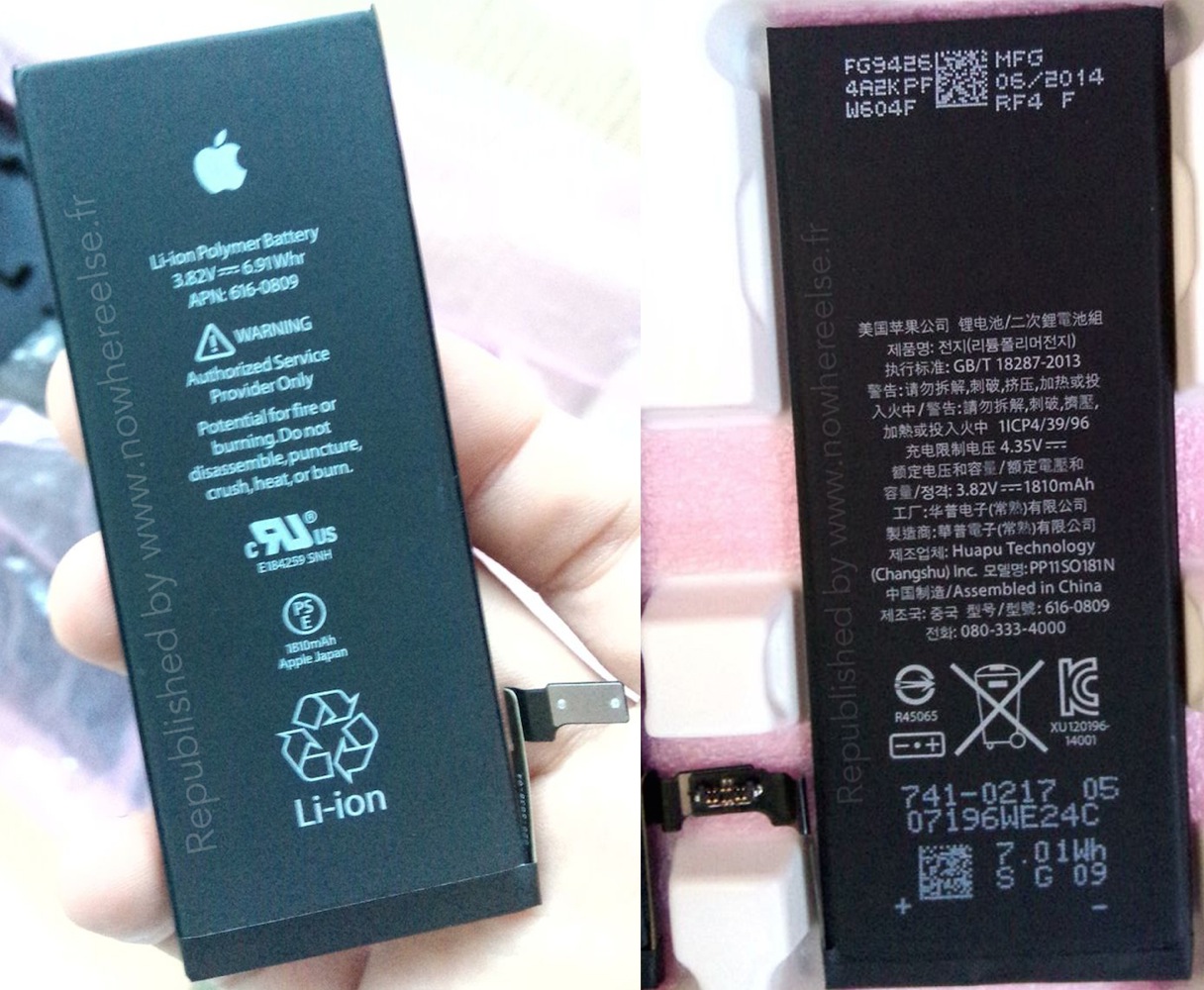 (Click for larger)
The one battery shown in closeup does include a manufacturing date of June, making it several months old, while the original leaked battery had a more recent manufacturing date of July. Still, the growing evidence for the 1,810 mAh battery suggests the analyst claim of a 2,100 mAh battery may indeed be incorrect.
These new photos of the rumored 4.7-inch iPhone 6 battery come just after other photos surfaced from a different source allegedly showing the battery for the 5.5-inch iPhone 6. That battery checks in with a capacity of 2,915 mAh, potentially offering a significant increase in battery life depending on how much more power the device draws than its smaller sibling.
.CPlase_panel display:none;

ModCloth leads the charge against Photoshopped models

What’s the quickest way to lose 5 pounds? Why Photoshop, of course. If you’ve picked up a magazine anytime in the last 15 years, you’ve probably been treated to a digitally manipulated parody of the human form. The practice of photoshopping flaws out of models, celebrities and musicians has become so commonplace, we almost don’t think about it — but the unrealistic expectations set these visual falsehoods creates artificial (and unobtainable) standards of beauty. Now, the Brave Girls Alliance is fighting back, asking advertises to take a “Hero’s Pledge” to not alter the shape of size of their models or, if they do, to clearly mark the altered images as photoshopped and unrealistic. The first company to sign up? ModCloth, a popular online clothing retailer.
“It’s easy for us to sign on to something celebrating real people,” ModCloth CMO Nancy Ramamurthi told Forbes. “When you see in the public this kind of change in attitude of embracing a company that does what’s right, companies will make the shift.” While the company admits on its official blog that some of its models have been photoshopped, these images will be properly labeled as altered going forward. The retailer’s customers are mostly supportive of the pledge, though a few comments on the company’s site explain that not all photoshop work is bad, citing minor fixes in color correction or arm positioning.
It’s true that not all photoshopped images are equal, but advertising does have a tendency to go overboard. Want to see how bad it can get? Check out the video below: a completely different body-type is just a few clicks away.
[Image credit: ModCloth]
Filed under: Misc
Source: Forbes, ModCloth, Brave Girls Alliance
.CPlase_panel display:none;

Wally: Wallpaper app with Material Design [App of the Day]

Like many of you, I’m pumped for Android L and the refreshed design language that will come with. Developers have been given a taste as to what Android’s next design principles are with the Android L Developer Preview, which mainly highlights Material Design. Only a handful of apps have updated to this design, and… Read more »
The post Wally: Wallpaper app with Material Design [App of the Day] appeared first on AndroidGuys.
.CPlase_panel display:none;

Cars may soon know when you’re on the phone behind the wheel

Word to the wise, kids: do not muck around with your phone while driving. Some of you probably won’t be able to help it (tsk tsk), but a team from Santa Catarina State University in Brazil just might have the solution — according to MIT Technology Review, they’ve cooked up an in-car hardware/software combo that can detect when you’re on the phone and behind the wheel.
Here’s how their system works: a tiny camera embedded in the dashboard quietly records clips of a test driver, which then get cropped closely around the driver’s face. Once that’s done, the algorithm can chew on each of those three second clips in search of what appear to be hands entering the frame near the driver’s face — the more prominent the hand, the more likely it is the algorithm will think you’re driving mid-gab. Of course, building that algorithm is only half the battle — the team hasn’t built a way to alert the driver once he or she has been caught in the act (though it’s not for lack of imagination). Crafting a system like this is noble, worthy work, but we can’t help but wonder if a little dose of common sense might not be a more effective deterrent. Then again, no one’s figured out a way to sell that yet, so expect systems like this to become more common as time marches on.
Source: MIT Technology Review
.CPlase_panel display:none;

Moto X+1 Compared to the Moto X! Moto 360 Needs to be on My Wrist! – The ManDroid Show

Happy Friday my Android friends, the actual ManDroid Show is here. CHanged things up a little bit this week, by introducing the ManDroid Daily to our channel. I figured it was better to have a video everyday of the work week to keep the news flowing to you guys, and the Friday video will be the full on ManDroid Show. The Moto X+1 made the news today, and if they are putting front-facing speakers on that device, I am up for that. Enjoy the show!
Android News
Moto X+1 front panel
Monday ManDroid Daily
Tuesday ManDroid Daily
Wednesday ManDroid Daily
Thursday ManDroid Daily
//<![CDATA[
ord = window.ord || Math.floor(Math.random()*1E16);
document.write('’);
//]]>
The post Moto X+1 Compared to the Moto X! Moto 360 Needs to be on My Wrist! – The ManDroid Show appeared first on AndroidSPIN.
.CPlase_panel display:none;
 AIVAnet