



Apple Releases Employee Diversity Report, 7 out of 10 Workers Are Male, 55% White
Following in the footsteps of several other major tech companies, Apple has released a diversity report on the sex and race of its employees (via Re/code). As is common in the tech industry, the majority of Apple’s workforce is male — only three out of 10 employees around the globe are female. Broken down, males compose 65 percent of non-tech workers, 80 percent of tech workers, and 72 percent of Apple’s leadership.
In the United States, across tech, leadership, and non-tech, Apple’s workers are 55 percent white, 15 percent Asian, 11 percent Hispanic, and 7 percent Black. Nine percent of workers declined to state their ethnicity, one percent selected other, and two percent listed more than one race.

According to CEO Tim Cook, he is unhappy with Apple’s diversity numbers and says Apple is working to improve them.
Apple is committed to transparency, which is why we are publishing statistics about the race and gender makeup of our company. Let me say up front: As CEO, I’m not satisfied with the numbers on this page. They’re not new to us, and we’ve been working hard for quite some time to improve them. We are making progress, and we’re committed to being as innovative in advancing diversity as we are in developing our products.
During his tenure as CEO, Cook has taken steps towards improving Apple’s diversity by boosting Apple’s female leadership. Cook hired Angela Ahrendts as the head of retail and Susan Wagner was recently added to Apple’s board, joining existing female board member Andrea Jung. Cook has also overseen the hire of Lisa Jackson, who oversees the company’s environmental affairs, and the promotion of Denise Young Smith to head of human resources. Apple is a sponsor of the National Center for Women & Information Technology, which aims to get women involved in technology.
In its report, Apple suggests that its company diversity beliefs go beyond race and gender, pointing to its involvement in the Human Rights Campaign. Under Cook, Apple has supported the Employment Non-Discrimination Act, which lobbied to add lesbian, gay, bisexual, and transgender individuals to the U.S.’s existing nondiscrimination law. Apple also recently participated in San Francisco’s Gay Pride event and the company has long had protections for its LGBT employees.
Note: Due to the political nature of the discussion regarding this topic, the discussion thread is located in our Politics, Religion, Social Issues forum. All forum members and site visitors are welcome to read and follow the thread, but posting is limited to forum members with at least 100 posts.
.CPlase_panel display:none;

Full ‘Skylanders Trap Team’ Game Coming to iPad With Bluetooth Controller, Energy Portal [iOS Blog]
Upcoming Skylanders game Trap Team will see a simultaneous release on both consoles and tablets, according to Activision. The full Skylanders Trap Team game will be available on the iPad when it is released in North America on October 5, marking the first time a complete Skylanders game has been made available on Apple’s tablet.
Trap Team on the iPad will offer the same gameplay experience as the console version, with high-quality graphics and a dedicated Bluetooth controller that will be sold alongside the app in a Skylanders Trap Team Tablet Starter Pack. The Traptanium Portal controller will come with a built-in tablet stand, two Skylanders characters, two Traps, and a display tray that “lets Portal Masters keep track of the Traps they’ve collected and which villains they have trapped.”

While the game has been designed to take advantage of the included controller, players are also able to play Trap Team using on-screen touch controls. Third-party controllers will work with Trap Team as well.
As described by our sister site TouchArcade, the Skylanders line of action-adventure oriented games meld toys with virtual games, asking players to purchase little plastic figurines that sport NFC chips. These chips allow the physical characters to be imported into the video game through a plastic mat called the “Portal of Power.”
Trap Team takes place after Skylanders: Swap Force, with players taking on the role of Portal Master to use Trap Masters and traps to re-capture all of the villains that escaped during the previous game.
The Skylanders Trap Team Tablet Starter Pack will be available beginning on October 5, and will retail for $74.99. It can also be pre-ordered from Amazon.com.
.CPlase_panel display:none;

Manchester United won’t let you take laptops or tablets into its stadium

Don’t plan on taking your iPad or Nexus 7 to Manchester United’s next home match any time soon. The football team (soccer, for you Yanks) has banned laptops, tablets and other big devices from Old Trafford’s grounds. Man U says that the crackdown reflects the “latest security intelligence” used by UK airports — it’s protecting fans from hidden explosives in devices that could do substantial damage. All but the largest smartphones should be fine, however, so you can still capture that van Persie goal without fear of being kicked out.
As you might imagine, there’s a side benefit to this extra security — banning tablets also means that supporters won’t have their view blocked by people trying to record every moment on their slates. In that sense, it’s harkening back to a brief decision by the New York Yankees to ban iPads. The stadium crew makes no mention of these annoyances, but it probably doesn’t mind improving the experience for spectators who are there to watch the game with their own eyes, rather than hide behind a screen.
[Image credit: Paolo Camera, Flickr]
Via: The Verge
Source: Manchester United
.CPlase_panel display:none;

OM Audio’s levitating Bluetooth speaker can be yours for $179

We’ve seen levitating pens, levitating lamps, levitating loungers and even levitating fish — now there’s a Bluetooth speaker to add to the mix. OM Audio, maker of such respectable audio accessories as the Inearpeace earphones and Mantra speakers, has taken a bold leap into the world of novelty products with the OM/One. The compact sphere can be used with or without its magnetic base (which requires an AC adapter), and includes an integrated battery with up to 15 hours of continuous play. There’s also a microphone on board, so you can use the OM/One as a speakerphone as well.
We had a chance to check out an early prototype, which you can see in action after the break. Sound quality was fine — not fantastic, but on par with other compact Bluetooth speakers. You can improve the experience by adding a second OM/One, which pairs with the first to produce stereo audio. The levitating effect is interesting to look at, but it also reportedly helps produce better audio with a lower-power driver, since nearby objects won’t absorb sound. You can pre-order it today in black, white or “disco ball” on OM’s site for $179. OM reps expect to ship the first batch in December.

Filed under: Home Entertainment
Source: OM Audio
.CPlase_panel display:none;
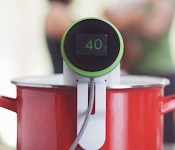
The first WiFi-connected immersion circulator makes sous vide meals easier

I stood in front of a nondescript iron gate in the heart of San Francisco’s Mission District and rang the doorbell. The scent of bacon-wrapped hot dogs and grilled corn on the cob from sidewalk food carts filled the air, seducing my senses as I waited patiently for someone to let me through. Soon, the door behind the gate opened, and Abe Fetterman, Nomiku’s co-founder, escorted me in. We walked down a narrow hallway and up a skinny flight of stairs, making pleasantries and exchanging small talk to relieve the awkwardness. When I emerged from the steps, I was welcomed to the office by Nomiku’s other co-founder, Lisa Q. Fetterman. There, in a small modest office surrounded by boxes, laptops and wires, she introduced me to one of the most recognized food science writers in the country: acclaimed author of On Food and Cooking, Harold McGee.
Of course, I was invited here not just to meet McGee, who happens to be one of Nomiku’s advisors, but also to learn all about the all-new Nomiku, a brand new immersion circulator that not only promises to make perfectly cooked food via sous vide, but also to let you do so wirelessly via an app. That’s right, the new Nomiku is the first and only immersion circulator in the world to have built-in WiFi. Not only can you use the app to set and monitor the temperature of the water, but you can also view recipes from the app right on the new Nomiku’s 2.4-inch IPS LCD display. What sort of recipes? Well, recipes such as sous vide sticky ribs from Top Chef Master Chris Cosentino and sous vide halibut from Hugh Acheson, another well-known name in culinary circles. Oh yeah, and if you’re concerned about the old Nomiku being made in China, this new WiFi-enabled Nomiku will be manufactured right here in the Bay Area.
But let’s back up a little here for a bit of history. We first saw the original Nomiku a couple years ago at a HAXLR8R event in San Francisco. The curiously-shaped tubular device was the first immersion circulator we saw that we could actually envision ourselves using in our own home. All you needed to do was to clip it to a pot you already own, fill it up with water, and you could cook via sous vide — a method of cooking vacuum-sealed food in a water bath at a precise temperature — just like the professionals do on Iron Chef. “Circulators are wonderful,” McGee tells us. “They provide really precise temperatures … they’re like slow cookers, only better and more versatile.”
Most immersion circulators at the time cost anywhere around $500 to $2,000, so at $299, the original Nomiku was a bargain. Since the initial Kickstarter success of the original Nomiku, there’ve been a slew of copy cats, like the Anova and the Sansaire, which Lisa interpreted as a flattering sign that they were onto something special. Besides, because the Nomiku was so much smaller than the competition, it gained fans amongst professionals such as Cosentino and other restauranteurs, who valued its smaller footprint and portable form factor.

After spending months traveling back and forth to Shenzen, China and learning how to create one of the original Nomiku circulators from scratch — they actually lived right next to their factory during the process — the Fettermans grew more confident that they could build a version of the circulator without having to make it in China. Abe tells us that making it in China wasn’t terribly ideal, as you typically had to order a huge production of everything. “If we wanted to change something, it was really difficult,” he says. “In the end we just wanted to do everything ourselves.”
They initially wanted to get the new version of the Nomikus manufactured by Factorli, an initiative founded by Jen McCabe to build hardware for startups in the US. Unfortunately at the very last minute — we’re talking late yesterday afternoon — they found that Factorli had closed its doors. The new gameplan? To rent a warehouse in the Bay Area and plug away there instead. It’s an audacious idea, but it’s one that Lisa is extremely gung-ho about. “We’re so excited to manufacture in the Bay Area,” she wrote to us in an email. “Let’s bring it back to the Bay!!”
As for the design of the new Nomiku, it’s actually one that they came up with way back in 2012, during the launch of the original model. Why didn’t they just make it then? For a few reasons: they weren’t entirely confident of the product just yet, they needed more testing, and they simply weren’t sure if a front-clip design would fly. Now, of course, they think the front-clip design is much better. “You no longer have to reach over a pot of hot water to change the temperature,” says Lisa.

Indeed, the new Nomiku’s design is better than the old in many ways. Not only is it clipped on the front for easier access, it has that aforementioned much wider 2.4-inch touch-screen LCD, a rotating outer dial for manual temperature control, a removable bottom for easy cleaning, a minimum water level of only 1.5 inches (it was previously 3.5 inches), an improved temperature stability of 0.01 degree Celsius and a much more powerful 1200W PTC heater which Lisa says will ensure faster heating and the ability to cook more food at the same time. And that WiFi connectivity we mentioned earlier? It’s actually powered by Spark Core, an open-source WiFi effort that symbolizes the Nomiku’s roots in hardware hacking (the Nomiku’s predecessor was a DIY sous-vide kit called The Ember).
Unfortunately, however, I wasn’t able to see the new Nomiku in action, as it’s still in prototype stage. And therein lies the catch: Just like the original Nomiku, the new one needs some crowdfunding love before it can take off. It launched a 30-day Kickstarter campaign just a few hours ago, with a goal of $200,000 to make it all happen. The reasoning for this is to gauge whether or not there really is a big enough demand before the company commits to making it.

McGee happened to be an early fan of the original Nomiku, so he immediately agreed to come on board as an advisor several weeks ago when the team asked. Cosentino is another advisor of the new Nomiku. One of the reasons the Fettermans brought McGee on board as an advisor was to gain additional insight as to what they could do with the new circulator. “The wired aspect of it, the fact that it connects to the internet … makes it more than just a simple appliance,” says McGee. “It opens up a whole other venue of possibilities.”
One of those possibilities, as we mentioned, is that of a connected app that’ll control the temperature remotely. Called Tender, the app also lets you scour recipes from professional chefs as well as those posted by the Nomiku community. You’re encouraged to come up with your own recipe by taking pictures and posting your instructions to the app as well. Similar to Tumblr, you can repost recipes from others and augment them with your own comments. Another advantage of having the app, Lisa says, is that you can get tips and tricks from the community. Want to know if a 64 degree egg is better than a 63 degree one? You can dig in and find out.
And, who knows, perhaps some day you can send a message to Harold McGee himself and have a specific cooking question answered. Since I was right there in front of him, I asked if it was better to use a cast iron pan or a blowtorch to sear sous vided meats. His answer was that either would work, but he prefers to use a pan for meats he’s cooled down in the refrigerator so that the meat could have some time in the pan to build flavor without overcooking. The blowtorch, on the other hand, is best for a quick browning when you want to enjoy it there and then. Oh, and another hot tip? In order to quickly heat up a cast iron pan, simply put a shiny side of aluminum foil on its surface. It should get up to the desired temperature in just a minute or two.
“Conventional cooking can give good results, of course,” says McGee. “It’s just really difficult and you have to babysit it … Immersion circulators like the Nomiku is really kind of a no-brainer. It’s the only appliance you can really trust. It’s the best possible combination of a stove and an oven.”
If all of this makes you feel like getting a sous vide machine of your very own, there’s good news: the new Nomiku is more affordable than the original. The final version is set to retail for $249, but if you get in on the Kickstarter early enough, you could get one for as low as $129. And that, as McGee tells us, is cheaper than both a toaster oven and a cooktop.
Filed under: Household
Source: Kickstarter
.CPlase_panel display:none;

Live from Sony’s PlayStation event at Gamescom 2014!

At the game industry’s annual United States trade show, the Electronic Entertainment Expo, the big three console makers battle it out for your attention. At Gamescom — the world’s largest gaming trade show which draws around 350K people — it’s kind of Sony’s show. Sure, Microsoft has an event. And hey, this year there were some pretty big announcements at Microsoft’s event. But Europe is Sony territory, and this is the show where PlayStation is wont to make some big waves. Join us right here at 1PM ET for the whole event as it unfolds, live from Cologne, Germany.

Filed under: Gaming, Software, HD, Sony
.CPlase_panel display:none;

Siri Co-Founders Building Viv, a Next-Generation Flexible Virtual Assistant
When Apple acquired Siri in 2010, several members of the team behind the technology joined Apple to continue development of the virtual assistant. As iOS evolved and the vision for Siri changed, co-founders Dag Kittlaus and Adam Cheyer left Apple to pursue other opportunities. This liberation led to their reunion and the formation of Viv Labs, which is now working on new virtual assistant software that may change how we interact with our devices. Writer Steven Levy takes a close look at Viv in a lengthy profile on Wired.

Viv Labs is building a virtual assistant that is capable of more than just pre-programmed answers in response to a question. Viv expands further into the realm of artificial intelligence with a codebase that can interpret the question, make connections across a variety of services and apps and even generate code on the fly if needed to formulate an answer. Team members describe Viv as a “global brain” that can learn about its users and adapt to their preferences.
Take a complicated command like “Give me a flight to Dallas with a seat that Shaq could fit in.” Viv will parse the sentence and then it will perform its best trick: automatically generating a quick, efficient program to link third-party sources of information together—say, Kayak, SeatGuru, and the NBA media guide—so it can identify available flights with lots of legroom. And it can do all of this in a fraction of a second.
Unlike Siri, which was targeted at the iPhone even before its acquisition by Apple, Kittlaus and his team hope to license the technology and bring Viv to a variety of devices including TVs, cars and other Internet-connected devices.
“I’m extremely proud of Siri and the impact it’s had on the world, but in many ways it could have been more,” Cheyer says. “Now I want to do something bigger than mobile, bigger than consumer, bigger than desktop or enterprise. I want to do something that could fundamentally change the way software is built.”
Viv is an ambitious project that is still in the early stages of development, but the vision is revolutionary. “If this team is successful, we are looking at the future of intelligent agents and a multibillion-dollar industry,” said AI expert Oren Etzioni of the Allen Institute for Artificial Intelligence to Wired.
It’s unclear whether Apple will be interested in the technology and what kind of relationship the two companies might have given their history with Siri, but what is clear is that Siri’s inventors have much broader ambitions in mind.
.CPlase_panel display:none;

Apple Once Again Offering $25 iTunes Gift Card With Apple TV Purchase in iTunes Festival Promotion
Ahead of its London iTunes Festival in September, Apple is promoting its Apple TV with a bundle deal offering a $25 iTunes gift card with each Apple TV purchase (via 9to5Mac). The gift card can be used to purchase apps, music, and movies available in the iTunes Store, and the promotion is valid through September 30.

Earlier this year, Apple offered a similar $25 gift card promotion that sparked speculation about a possible imminent launch of an updated Apple TV. These rumors turned out to be false, and Apple is still selling the same third-generation model that saw its last substantial update in early 2012. Though this latest promotion offers a $25 gift card, the Apple TV still retails for its original $99 price tag.
The current crop of rumors suggests a 2015 update for Apple’s television-related hardware, with delays to a rumored set-top box interfacing with live and on-demand content reportedly due to ongoing negotiations with cable companies. Rumors have indicated the next-generation Apple TV may include an App Store, support for wireless game controllers, Siri integration and more, although it is unclear whether Apple plans to split the television lineup between the full-featured set-top box and an improved Apple TV or if everything will be bundled into a single Apple TV product.
.CPlase_panel display:none;

‘Forza 5’ will be the first racing game with a Formula E electric racer

Turn 10 has just revealed that it’ll bring the hum of electric power to ‘Forza 5′ with the Spark-Renault SRT-01E racing car. That’d mark the first EV from the fledgeling Formula E racing series in any game — in fact, the real e-racing series won’t launch until September 13th in Beijing. The Spark-Renault SRT-01E was the first car to be homologated by the FIA for Formula E, and features a 200kW (270 bhp) motor and 888KG (2,000 pound) curb weight. In case you were wondering, it also produces about 80 decibels at full power — that’s more than your car, but far, far less than the 140 pedal-to-the-metal decibels of a Formula 1 vehicle. There’s no word on when the new racer will arrive to ‘Forza 5,’ but it would make sense to launch it next month along with the Formula E series in Beijing.
Filed under: Gaming, Microsoft
Source: Turn 10 (Twitter)
.CPlase_panel display:none;

Alienware’s ‘Alpha’ is a half-step toward Steam Machines

When PC gaming juggernaut Valve announced its Steam Machines initiative in Fall 2013, it was unveiled as such:
“Entertainment is not a one-size-fits-all world. We want you to be able to choose the hardware that makes sense for you, so we are working with multiple partners to bring a variety of Steam gaming machines to market during 2014, all of them running SteamOS.”
Not long after, at CES 2014, Valve revealed a full line of Steam Machines from 14 different companies. Chief among them was Alienware, Dell’s gaming PC arm, which showed a teensy $550 box called the “Alpha.” Alienware was a standout not just due to name recognition, but because the company proposed a launch window for its “game console”. The Alpha won’t ship with any of the promises of the Steam Machines initiative: no Steam OS and no Steam Controller. Valve’s delayed both, but Alienware’s pushing on nonetheless with a fall launch.
That’s all to say one thing: While the Alpha is still a “Steam Machine” in size and horsepower, it isn’t a Steam Machine. The Alienware Alpha is a weird gaming PC.
Alienware held an event last week in New York City to show off the Alpha. We were given time to play games on the system, sure, but the focus of the event was on the custom operating system that Alienware’s built to get around the fact that Valve’s initiative isn’t ready.
According to Alienware, Valve president Gabe Newell sees the Alpha as the “ideal Steam Machine.” It’s hard to see how, at least at the moment: It runs Windows 8.1, it ships with an Xbox 360 wireless gamepad, and it requires a USB-based wireless dongle to make that gamepad function. Alpha is $550 — $50 more than the most expensive new game console — and it’s lacking in the horsepower department. Which GPU is inside? A “custom” NVIDIA Maxwell GTX. How about processing? Handled by an Intel i3.
In so many words, the Alpha is roughly as powerful as the Xbox One and PlayStation 4, only it costs more and is nowhere near as accessible.
THE ALPHA UI

In place of Steam OS, Alienware’s got a custom user interface that allows you to skip the Windows 8 desktop. It’s non-ironically called the “Alpha UI,” which is fitting given how vacuous it feels. We weren’t actually able to use it; instead, Alienware guided media through a slideshow of its features. Those features are sparse: play games, adjust a small handful of settings, and a button combination that helps players escape the pitfalls of playing PC games.
Ever go to play a Ubisoft game, only to have the UPlay dialog box pop up? Not such a big deal if you’re sitting right in front of your computer, keyboard and mouse in-hand, but quite a frustration if you’re playing a PC game using a gamepad from your couch. The Alpha gets around this issue by offering a kill command for offending software.
Ever play a Steam game that advertises “partial controller support?” Alienware reps say they’re working with Valve to test every single game and update all those listings. For now, however, workarounds like the kill prompt will have to do.

Let’s be clear: the Alpha is a system of workarounds. No Steam OS? Alienware built a bare bones OS to shepherd consumers from a Windows 8 experience to Steam’s living room-friendly Big Picture Mode. No Steam Controller? Alienware’s straight up buying Xbox 360 wireless gamepads and dongles to ship a controller with each Alpha.
Unfortunately for Alienware and folks excited for the Alpha, another word for “workaround” is compromise. Alienware says you’ll be able to upgrade to Steam OS and the Steam Controller whenever Valve’s got those ready. For now, though, the Alpha feels undercooked — a rushed product which serves Alienware’s bottom line and little else. We’re reserving full judgement until we’ve got a final unit this November when it ships to customers, but color us worried as of late Summer.
Edgar Alvarez contributed to this report.
Filed under: Desktops, Gaming, Software, HD, Dell
.CPlase_panel display:none;
 AIVAnet