


Apple’s secretive internal training program praises Picasso, has full-time faculty

The Apple University, as the company’s training courses have been called, was established by Steve Jobs in an effort to get employees acquainted with how Apple does things. Courses there are not mandatory, but getting employees to enroll is apparently never an issue, according to Brian X. Chen’s investigations in the New York Times — which is worth reading in full. It’s an unsurprisingly secretive setup, and no pictures of the classrooms (or their contents) have ever surfaced. Chen talked to three employees who have taken classes, and the courses are apparently unequivocally Apple: polished and planned to the finest detail. (“Even the toilet paper in the bathrooms is really nice”)
It has a full-time faculty (plucked from Yale, Harvard, MIT, Pixar and more) that create and teach courses, with recent classes including one on how to blend resources from recently acquired companies into Apple. Others focus on important decisions in the company’s past: the move to offer iTunes on Windows PCs is given as an example, a decision that turned out to be a big success. The university also touches heavily on design philosophy: one course shows a slide of The Bull, Picasso’s famous deconstruction of a bull drawn in 1945. “You go through more iterations until you can simply deliver your message in a very concise way, and that is true to the Apple brand and everything we do,” said one student. Examples of what not to do also come up. In the case of TV remotes, Google’s own 78-button remote is compared unfavorably to Apples’s stripped-down iteration.
Filed under: Cellphones, Home Entertainment, Tablets, Wearables, Software, Apple
Source: New York Times
.CPlase_panel display:none;

Apple’s Secretive Internal Training Program Detailed in New Profile
A new profile of Apple’s internal training program published by the New York Times has shed new light on how the company teaches its vision and practices to select new employees. Originally established by Steve Jobs and Apple’s Vice President of Human Resources Joel Podolny, the-so called “Apple University” is a year-round, in-house program that allows employees to enroll in a number of classes with instructors coming from universities like Yale, Harvard, Stanford, M.I.T., and more.

Apple’s internal training programs are taught at the company’s Cupertino, California campus, with rooms being described as being “well lit” and formed in a trapezoid shape with elevated seats so employees can clearly see their instructors.
Interested individuals sign up on an internal Apple website, as classes are taught to employees based on their positions at the company and work backgrounds. Some courses teach employees about vital business decisions in the history of Apple, with one employee citing a case study on how Steve Jobs chose to make the iPod and iTunes compatible with Windows after being opposed to the idea. Even classes for founders of recently acquired companies are available:
One class taught founders of recently acquired companies how to smoothly blend resources and talents into Apple. The company may also offer a course tailored specifically to employees of Beats, perhaps including its founders, Dr. Dre and Jimmy Iovine. Neither Apple nor Beats would comment.
Another course, titled “Communicating at Apple”, focuses on being able to convey products and ideas to others and is taught by the former Dean of Pixar University Randy Nelson among others. A detailed overview of the course given by an employee shares how Apple used the works of Picasso to explain its vision:
In a version of the class taught last year, Mr. Nelson showed a slide of “The Bull,” a series of 11 lithographs of a bull that Picasso created over about a month, starting in late 1945. In the early stages, the bull has a snout, shoulder shanks and hooves, but over the iterations, those details vanish. The last image is a curvy stick figure that is still unmistakably a bull.
“You go through more iterations until you can simply deliver your message in a very concise way, and that is true to the Apple brand and everything we do,” recalled one person who took the course.
Another class taught by Nelson, titled “What Makes Apple, Apple” gives lessons on how the company executes its design principles with precision and simplicity in time. To convey that idea to employees, Nelson showed a comparison of the Apple TV remote that has three buttons and the remote from a Google TV, which features 68 buttons. The instructor explained that Apple designers included just what was needed, while the Google TV remote resulted in a complicated device because its designers “got everything that they wanted.”
Finally, the article describes a course called “The Best Things”, which teaches employees to be proactive in a high-caliber work environment so they can perform their best work. An example relayed to employees by course teacher and Stanford professor Joshua Cohen pointed out New York City’s Central Park, which was transformed from a rocky swamp into an area that made residents feel comfortable with nature. The goal of the class was to teach employees how to make intricate computer technologies feel natural, which was a main philosophy of Jobs.
.CPlase_panel display:none;

Verizon adds Push to Talk Plus feature to select smartphones

If you think it’s been too long since you’ve used a walkie talkie, you may be in luck. Verizon Wireless, America’s most loved/hated carrier, is adding “push to talk” functionality to some of their smartphones. They’re calling it Push To Talk Plus, and it basically does what you’d hope it to: use your phone like… Read more »
The post Verizon adds Push to Talk Plus feature to select smartphones appeared first on AndroidGuys.
.CPlase_panel display:none;
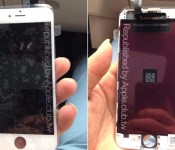
Front Panel from 4.7-Inch iPhone 6 Once Again Said to be Depicted
Taiwanese Apple news website AppleClub (Google Translate, via 9to5Mac) shares new photos of the supposed front panel from the 4.7-inch iPhone 6, including the device’s display and its insides.

The images are consistent with prior leaks of the iPhone 6′s front panel, showing a larger screen, a thinner bezel, rounded edges, and a cutout for the Touch ID home button. The panel depicted also features the front-facing camera and the ambient light sensor located on the left and at the top respectively, which is similar to the design of the iPhone 4.
It is not known whether the display shown is made of sapphire, which was once rumored to come with the 4.7-inch iPhone 6. However, recent rumors have suggested that the smaller iPhone 6 will not come with a sapphire display, as rigorous scratch tests may instead hint at a more durable glass screen. Sapphire panels may come to the larger 5.5-inch iPhone 6, which is reported to feature a number of other differentiating factors including a faster processor and a camera with optical image stabilization.

Apple’s next-generation iPhone will be revealed at an event on September 9, with sales likely commencing roughly a week and a half afterward. It is likely that the 4.7-inch iPhone 6 will launch first, as the 5.5-inch model is said to be experiencing production issues that may lead to a delayed release.
.CPlase_panel display:none;
 AIVAnet