


Disney Research’s latest tech will accurately 3D print your mullet

Printing in three dimensions allows for a ton of really cool (and life-saving) stuff, but one area it apparently hasn’t conquered just yet is realistically reproducing human hair. The masterminds at Disney Research think they have a solution for that conundrum. Instead of trying to capture individual strands of someone’s coif, the team is taking a similar approach to that of Michelangelo, and attempting to capture an overall “essence” of a person’s hairstyle by fitting it on a bust like a helmet. And while the applications for most of what Walt’s science department cooks up are a bit ambiguous, it seems pretty likely this tech’ll be found in the myriad souvenir shops lining The Magic Kingdom. Disney says that the ultimate goal is to make more realistic (and possibly nightmare-inducing) figurines that accurately capture the subject’s personality. What’s more, the outfit has pointed out that it’s even capable of accurately capturing facial hair. I might be a tad biased, but here’s to hoping that means sideburns too.
Source: Disney Research (1) (PDF), (2), (3), (4)
.CPlase_panel display:none;

First satellite with high-resolution public imaging launches on August 13th

If you’ve been wondering just when a company would take advantage of the US’ relaxed rules for accurate satellite imaging, you now have a date to mark on your calendar: Lockheed Martin has set the launch of DigitalGlobe’s high-resolution WorldView-3 satellite for August 13th. You won’t see results from it right away, but its creators can start selling extra-sharp pictures (with detail down to the 10-inch level) six months after the craft is up and running. The data should lead to much nicer imagery in online mapping services from companies like Google and Microsoft (both of which are DigitalGlobe customers), although it’s not just cosmetic. Higher-res photos will help track large farms, spot mineral deposits and otherwise deliver a clearer view of our planet that has previously been limited to the government — don’t be surprised if it’s easier to spot landmarks on a map without using markers.
Filed under: Science, Internet, Microsoft, Google
Source: DigitalGlobe
.CPlase_panel display:none;

Xiaomi issues fix amid privacy scare over its cloud messaging service

Earlier this week, Finland’s F-Secure looked into claims that Xiaomi was secretly sending data from its MIUI-powered phones back to its servers, and it turned out to be true. Despite having not added any cloud accounts, F-Secure’s brand new Redmi 1s — Xiaomi’s budget smartphone — still beamed its carrier name, phone number, IMEI (the device identifier) plus numbers from the address book and text messages back to Beijing. Worse yet, the data was unencrypted, thus allowing F-Secure and potentially anyone to, well, get to know your Xiaomi phone very easily. Fortunately, today the Chinese company is issuing a patch to address this booboo.
According to Xiaomi VP and ex-Googler Hugo Barra, the aforementioned data link is part of MIUI’s cloud messaging service, which helps determine whether it can route your text messages over the Internet for free. Think Apple’s iMessage. Alas, Xiaomi had this is turned on by default and there’s no prompt about this for the user, which explains it all. With today’s ROM update, users of fresh or factory-restored Xiaomi devices will have to manually enable the cloud messaging function, meaning there should be no more stealthy connections back to Beijing. More importantly, the same update will also add encryption to the phone numbers sent to the servers, should users wish to keep using MIUI’s cloud messaging to avoid texting charges.
Kudos to Barra, his Google+ post goes to great lengths to explain what happened. It’s just as well since the latest findings have made his earlier post regarding privacy somewhat obsolete. Anyhow, the exec emphasized that his company doesn’t permanently store the data sent to its cloud messaging servers:
No phonebook contact details or social graph information (i.e. the mapping between contacts) is stored on Cloud Messaging servers, and message content (in encrypted form) is not kept for longer than necessary to ensure immediate delivery to the receiver.
Still, this raises the question: Shouldn’t the communication be encrypted in the first place, anyway? Sounds like someone deserves a big spanking at Xiaomi HQ this weekend, for both overlooking this issue and hindering the company’s global efforts. The last thing an expanding Chinese technology company needs is a privacy scare like this one, as the likes of Huawei and ZTE can attest to; though that’s not to say Western companies are entirely innocent, either.
[Image credit: Xiaomi]
Filed under: Cellphones, Mobile
Via: The Next Web
Source: Hugo Barra (Google+), F-Secure
.CPlase_panel display:none;

Inhabitat’s Week in Green: Naturbad pool, Dyson’s river vacuum and Legos lost at sea
Each week our friends at Inhabitat recap the week’s most interesting green developments and clean tech news for us — it’s the Week in Green.

This week, Tesla CEO Elon Musk announced that the automaker would deliver 100,000 electric vehicles in 2015. That’s a big jump up from the 22,000 EVs the company currently produces, and the news sent Tesla’s stock soaring. In other green transportation news, the Texas Central Railway is planning to develop a 200MPH bullet train that will connect Houston to Dallas. The project is expected to cost about $10 billion, and it will be funded entirely with private money.
A recent Royal College of Art grad has developed a bike that can charge your gadgets as you pedal around town. The designer hopes the bike could foretell a future transportation system that would use resonant inductive coupling to power electric bikes. And for minimalist cyclists, Lucid Design has created a full-size bike that breaks down and fits into a tiny circular backpack. A team of NASA scientists recently conducted successful trials of a propellant-free microwave thruster that was previously thought to be impossible. If it proves to be a viable technology, microwave thrusters could remove the need to carry fuel on spaceships.
The dog days of summer are upon us, and there’s no better place to be than at the pool. Swiss architecture firm Herzog & de Meuron’s drool-worthy Naturbad pool in Switzerland ditches the chlorine in favor of all-natural biological water filtration techniques. The gorgeous pool uses water lilies and irises to naturally filter and absorb bacteria and other compounds. China’s Shanghai Tower, soon to be the world’s second-tallest building, is nearing completion. Although it won’t top the Burj Khalifa in height, it will have better green credentials — the LEED Gold tower will feature state-of-the-art wind turbine technology, a rainwater-recycling system and geothermal energy. On the green energy front, scientists have figured out a way to create efficient, affordable spray-on solar cells. The new technology could make solar production quicker and more affordable. Lego bricks are a favorite toy of both children and adults, but the plastic pieces aren’t as popular with environmentalists these days: Millions of Legos were lost at sea in 1997, and they’re still washing up on beaches in the UK, harming wildlife and the environment. And in an effort to clean the world’s waterways, James Dyson designed a river barge that uses his vacuum technology to remove trash from rivers and canals.
This time of year, few people in the Northern Hemisphere are thinking about snow — except for Norway-based Koen Olthuis and Dutch Docklands, who have announced plans to build a five-star floating hotel off the coast of Norway that is shaped like a snowflake. With a glass roof, the hotel will be perfect for viewing the northern lights. The popular tourist town of Brighton will soon be getting a pod-like lookout tower designed by Marks Barfield. From the top of the 450-foot tower, visitors will be able to see for 30 miles in every direction. The Russian design studio Radugadesign recently unveiled an impressive brain-shaped sculpture that’s tricked out with lights and sounds at Moscow’s New Media Night Festival. And Slovenian design studio Allergutendinge built a tiny off-grid house in the middle of an apple orchard in Germany. The minimalist two-story structure features a kitchen on the ground floor and a bed and deck on the upper levels.
Elsewhere in the world of green design and innovation, Inhabitat talked to Yves Béhar, creator of the Jawbone Up, the Jambox and the Sodastream Source, about green design and information overload. The US Army is developing 3D-printed custom uniforms for its soldiers. The technology will enable the Army to integrate critical features like armor, wicking materials and waterproof elements. Sitting is the new smoking, so a pair of MIT graduate students recently came up with a design for an attractive standing desk made with a CNC router that can be assembled like a jigsaw puzzle in just a few minutes. An Indian entrepreneur created a clay refrigerator that keeps food cool without using any electricity. And in Colorado, Daily Tous Les Jour has designed a musical swing set that lights up and emits sound as people rock back and forth. The musical swings are currently set up at the Green Box Arts Festival in Green Mountain Falls, and after the festival ends, they’ll go on the road, making stops across the country.
Filed under: Misc, Transportation
.CPlase_panel display:none;

Watch the ISEE-3 lunar flyby live, beginning at 1:30PM ET

A few months ago, the ISEE-3 Reboot Project managed to raise $160,000 to bring the spacecraft back to Earth after 36 years roaming outer space. The team behind the campaign successfully took control of the spacecraft and reactivated some of its scientific instruments, but they found it impossible to reignite its thrusters, so it’s sadly never going to make its way back home. That doesn’t mean you’ll never be able to see the ISEE-3 for yourself, though — on August 10th, Google will be hosting a Hangout session to livestream the spacecraft’s lunar flyby as it passes the dark side of the moon. The tech giant will broadcast from McMoon’s, an abandoned McDonald’s near the NASA Ames Research Center, and you can tune in through a website built for this occasion called A Spacecraft for All.
If you visit the website now, though, you’ll also be able to relive ISEE-3′s journey from the time it launched in 1978 through graphics made using Chrome’s WebGL technology (thus, it’s optimized for the browser — we weren’t even able to load it on Firefox). This website also provides access to the data gathered by the remaining onboard instruments, as well as to the spacecraft’s current position and trajectory. ISEE-3, which stands for International Sun/Earth Explorer 3, was originally sent to space to measure particles, waves and plasmas. It was eventually repurposed to study the interaction between solar winds and comets until it was decommissioned. While it won’t make it back to Earth, the four instruments that the Reboot Project managed to revive will be sending data through ground radio dishes for a whole year. After that, the ISEE-3 will continue its journey around the solar system and won’t be this close to our planet again until 2029.
Filed under: Transportation, Science, Google
Source: A Spacecraft for All, Google Chrome
.CPlase_panel display:none;

Smart collar turns your cat into a WiFi hacking weapon

Forget Trojan horses — it’s the cats you have to worry about. Security engineer Gene Bransfield has developed WarKitteh, a tech-laden collar that turns feline companions into scouts for WiFi hackers. The innocuous-looking accessory hides a Spark Core board that maps wireless networks and their vulnerabilities wherever the pet wanders. If used in the field, the technology would be pretty sneaky; the cat stalking mice in your backyard could represent the prelude to an attack on your wireless router.
Thankfully, Bransfield doesn’t plan to weaponize the Siamese next door any time soon. WarKitteh was developed on a lark, and it isn’t getting much more exposure than a panel at the Defcon hacking conference. However, the experiment in pet-based network penetration also serves as a friendly reminder to lock down your home’s WiFi access point. The engineer discovered that many of his neighbors were either using weak security, or none at all — it wouldn’t have taken much for someone with more sinister intentions to either “borrow” those connections or spy on their users.
[Image credit: Gene Bransfield]
Filed under: Household, Wearables, Networking
Via: Wired
Source: Defcon
.CPlase_panel display:none;

One of HTC’s first 64-bit phones is a budget model for Sprint

Qualcomm teased us with the prospect of powerful 64-bit smartphones arriving in late 2014 and early 2015, but it looks like you’ll have to dial back your expectations for the first wave of devices. New tipster @upleaks has posted details and photos of HTC’s A11, a starter smartphone in the Desire line that reportedly uses the more modest (if respectable) 1.4GHz Snapdragon 410 for its 64-bit processing. Other elements are modest, too; you’re looking at a 4.7-inch 854 x 480 screen, plain speakers (sorry, no BoomSound here) and both a 5-megapixel rear camera as well as a front 0.3-megapixel shooter. No great shakes, then, although hints of a Sprint launch suggest that you’ll see it in the US. There’s no word on when the A11 will ship, although it’s believed to run the existing Sense 6 interface on top of Android 4.4 KitKit — that suggests that HTC may deliver its first 64-bit phone well before its usual spring refresh.
Filed under: Cellphones, Mobile, HTC, Sprint
Via: GSMArena
Source: @upleaks (Twitter 1), (2), (3), (4)
.CPlase_panel display:none;

Disney tech auto-edits your raw footage into watchable video

More and more people are starting to record their daily lives, whether by traditional video cams or first-person live-loggers attached to glasses, headsets, necklaces or even handbags. Since a group of people (say, at a party) are bound to capture videos of the same event from multiple points of view, Disney Research has developed a method to easily splice together footage taken by different cams. Disney’s algorithm chooses the most interesting aspect of a single event based on how many cameras are focused on it, then it chops the videos and chooses parts with best quality, lighting or angle for the final cut.
Since Disney Research touts it as an easy way to create watchable video clips, the system’s also capable of following basic cinematographic guidelines without human input, such as avoiding jump shots between cameras. In fact, the team believes it could aid even experienced editors in processing hours upon hours of raw footage. The whole process still takes several hours, but not as long as the average time (20 hours) it usually takes to make a few minutes of edited video.
Wondering about the quality of video clips the algorithm can produce? Disney Research member Ariel Shamir says, “The resulting videos might not have the same narrative or technical complexity that a human editor could achieve, but they capture the essential action and, in our experiments, were often similar in spirit to those produced by professionals.” Disney’s researchers plan to present the technology at SIGGRAPH 2014 in Canada on August 10th to 14th, but you can also watch the video below to get an idea of how it works.
Filed under: Misc
Source: Disney Research
.CPlase_panel display:none;

How would you change Nokia’s Lumia 520?

Like Samsung, Nokia’s smartphone strategy has always been focused around choice. Sometimes this results in products that are so very similar that it’s impossible to tell the difference. That’s not an issue with Nokia’s Lumia 520, the ultra-budget device that was totally swallowed in the shadow of the 620. Sharif Sakr swaddled the phone in derision, criticizing its poor performance, bad camera, unevenly-lit display and poor build quality. For many of you, we imagine you wound up getting this handset for price reasons alone, so the question that we have to ask is simple: what did you like, what did you hate, and what would you have changed? You can shoot the breeze in our forum, or why not write a review of the phone yourself?
Filed under: Cellphones, Mobile, Microsoft, Nokia
Source: Engadget Product Forums, Lumia 520 Hub
.CPlase_panel display:none;
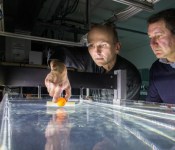
‘Tractor beam’ for water can pull boats in any direction

It can be difficult to get waterborne objects to go in the right direction — just ask any boat captain who has had to fight waves on a choppy sea. However, researchers at the Australian National University have developed a “tractor beam” (really, a wave generator) that would make it trivial for you to float anything to its intended destination. The system creates complex 3D waves that have their own currents, letting you pull a target simply by adjusting the waves’ frequencies and sizes. In fact, you can produce any flow you like; scientists in the lab made vortices on demand.
A generator like this wouldn’t be useful when dealing with big cargo ships in the open ocean, but the team sees it as very handy for controlling many other objects. You could bring small boats into port, for instance, or contain oil spills without using barriers, burns or chemicals. The invention could be used to simulate challenging sea conditions, too. Any practical uses won’t be ready for a while, but there could be a day when you don’t have to worry about crashing into the docks (or other boaters) after a sailing expedition.
Filed under: Transportation, Science
Via: Phys.org
Source: Australian National University, ARXIV (PDF)
.CPlase_panel display:none;
 AIVAnet