



Apple and Samsung agree to drop all their patent lawsuits outside of the US

So much for fighting to the bitter end — Apple and Samsung have just announced an agreement that will see them end all patent lawsuits against each other outside of the US. For those not keeping score, that means they’re dropping cases in Australia, France, Germany, Italy, Japan, the Netherlands, South Korea and (phew!) the UK. The two tech companies aren’t automatically buddy-buddy after this, however. Besides continuing their existing American cases, they aren’t pursuing any licensing deals or other pacts that would avoid trouble in the future. Still, if you’ve been hoping that Apple and Samsung would finally make nice and focus on beating each other in the marketplace instead of the courtroom, you’re much closer to getting your wish.
Filed under: Cellphones, Mobile, Apple, Samsung
Source: Bloomberg
.CPlase_panel display:none;

Apple and Samsung Agree to End Non-U.S. Patent Disputes
Apple and Samsung have issued a joint statement today announcing an agreement to drop all patent lawsuits against each other outside of the United States, according to Bloomberg.

“Apple and Samsung have agreed to drop all litigation between the two companies outside the United States,” the companies said in the statement. “This agreement does not involve any licensing arrangements, and the companies are continuing to pursue the existing cases in U.S. courts.”
The move is yet another signal that the long-running patent dispute between Apple and Samsung may be winding down, as it was reported in June that the two companies were trying to find “common ground”. The two also agreed to drop their cross-appeal rulings on the ITC ban of older Samsung phones around the same time.
In May, it was reported the two were looking to negotiate an out-of-court settlement. And earlier this year, it was reported that Tim Cook sat down with Samsung Electronics CEO Oh-Hyun Kwon in a mediation session. However, the two sides did not come to an agreement at that time.
Apple has already settled patent disputes with other companies, like Google / Motorola Mobility in May of this year and HTC back in 2012.
.CPlase_panel display:none;

Note the Date: Samsung schedules Unpacked event for September 3

The next-generation of Galaxy Note is less than one month away Confirming rumors from earlier in the week, Samsung has officially sent out invitations to an Unpacked event for September 3. With it, of course, comes all but final confirmation of a Galaxy Note 4 announcement. You’ll see the whole “Note the Date” blurb that accompanies with… Read more »
The post Note the Date: Samsung schedules Unpacked event for September 3 appeared first on AndroidGuys.
.CPlase_panel display:none;

Image-editing technique lets 2D objects get flipped, turned upside-down

Sure, Photoshop and other image editors are becoming increasingly good at transforming elements of a photo, but most of those tweaks are limited to two dimensions (resizing, rotating, repositioning, etc.). Researchers at Carnegie Mellon are pushing into the third dimension, using a technique that compares the 2D objects in a regular photo with 3D models freely available online. The result? The ability to manipulate part of photo as if it were a real, three-dimensional object, even exposing angles and sides that weren’t visible in the original image.
The new technique takes advantage of the growing number of publicly available 3D models online (the researchers, for example, call out TurboSquid and 3D Warehouse, in particular). First, a user selects part of a standard image, like a chair or a banana. Then they search online repositories for a 3D model that’s a close match. Once imported into the image, a three-dimensional mesh is rotated and tweaked until it closely matches the 2D element (after all, not every banana curves the same way and not every pear is the same size). At that point, the technique estimates lighting based on the rest of the photo and uses data from the 3D model to guess at parts of the object that can’t be seen in the original pic.
Check out the video below to see some of what’s possible, like changing the angle of WWII planes to face the viewer, closing the lid of a laptop or setting upright a knocked-over chair. While the team admits the technique isn’t perfect (it still has issues with translucency), and further development will likely include automating the search process, the potential is already pretty apparent.
Filed under: Science, Software
Source: Carnegie Mellon University, Carnegie Mellon University (2)
.CPlase_panel display:none;
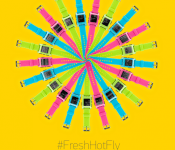
Pebble says “Be Fresh, Hot and Fly” with new neon coloured Smartwatches
 Did you ever think that the Pebble watch‘s colours, black, red, white and grey, were a bit dull? Well, good news as Pebble has announced a limited selection of colours that will get your hearts racing. Launched with the slogan “Be Fresh, Hot and Fly”, the new Pebbles adopt three new colours: Fresh (green), Hot (pink), and Fly (blue). And to help celebrate this new line, Pebble put together a very neat video:
Despite these new colours being limited edition, Pebble is still offering these new watches for the standard Pebble price of $150 USD. That’s probably also because there have been no internal changes to the smartwatch apart from the new neon exterior. The timing of this release is questionable seeing as the northern hemisphere is about to enter Autumn and these are very summer-y colours, but if you’ve been holding out for a Pebble in a colour that’s more suited to you, now may be the time to pounce. Pebble hasn’t said howl long it expects these new colours to be available, but if you have the inkling, it’s probably best to pull the trigger before they’re all gone.
What do you think about the new Fresh, Hot and Fly colours for the Pebble? Let us know your thoughts in the comments below.
Source: Pebble
//<![CDATA[
ord = window.ord || Math.floor(Math.random()*1E16);
document.write('’);
//]]>
The post Pebble says “Be Fresh, Hot and Fly” with new neon coloured Smartwatches appeared first on AndroidSPIN.
.CPlase_panel display:none;

LG annual sales to hit 60 million smartphones worldwide

When it comes to Android, people often end up thinking about smartphones from Samsung, but there’s another big Asian manufacturer that we are missing. 2014 was probably the best year for LG so far, as it is reported by Kiwoom Securities and Korea Investment that LG is expected to sell roughly 60 million smartphones in sales this… Read more »
The post LG annual sales to hit 60 million smartphones worldwide appeared first on AndroidGuys.
.CPlase_panel display:none;

BlackBerry’s rebirth: how a fallen smartphone giant plans to remake itself

BlackBerry has stopped bleeding — officially, at least. In a memo leaked to Reuters, CEO John Chen tells staff that three years of job cuts are over, and that the former mobile legend can start building itself back up rather than salvaging what’s left of its smartphone empire. But how did it get to this point? And more importantly, how does it plan to bounce back in an era when even many of its corporate customers have moved on to Android and iOS? As you’ll see in our gallery below, BlackBerry is only getting to this point after some grave errors and painful decisions — but it last appears to have a strategy that, while imperfect, at least acknowledges a difficult reality.
[Lead image credit: AP Photo/Achmad Ibrahim]
Filed under: Cellphones, Mobile, Blackberry
.CPlase_panel display:none;

Sprint reportedly withdraws its bid to buy T-Mobile

Softbank-owned Sprint has reportedly changed its mind about buying T-Mobile US, according to the Wall Street Journal. It seems a bit surprising, given the amount of time and energy Softbank CEO Masayoshi Son has put into pursuing the fourth-largest wireless carrier in the US — committing to buy the company for as much as $40 billion. That said, the alleged reasons behind the decision to withdraw a bid make sense: Sprint faces too much of a challenge getting the deal over the necessary regulatory hurdles. The company likely came to this conclusion after a long series of meetings with government officials, who reportedly expressed concern that such a deal would take a toll on competition in the US wireless industry. Sprint declined to comment, but the Journal reports that the carrier plans to make an announcement early tomorrow.
The report also states that a competing bid for T-Mobile, made by French company Iliad, wasn’t considered for very long; the company’s $15 billion offer simply wasn’t enough for Deutsche Telekom to give it any serious thought. For now, it appears that T-Mobile will continue on its own for quite some time — and judging by its current growth, it won’t be too long before it overtakes Sprint as the third-largest carrier in the US.
What do you think about Sprint’s reported end to its quest for T-Mobile?
Filed under: Cellphones, Wireless, Mobile, Sprint, T-Mobile
Source: WSJ
.CPlase_panel display:none;

Samsung is helping golfers keep up with the PGA Championship

While a lot of people in the US are getting ready for the NFL regular season to start, there are indeed other sports out there. Which is to say, the other football, basketball, baseball and, well, you get the point. For golf fans, these next few days will be rather interesting, with the PGA Championship due to begin on Thursday, August 5th. Naturally, Samsung saw an opportunity and found a way to help golfers who won’t be there to experience it live, by introducing a smart TV app filled with content from the tournament — the only caveat is you’ll have to own one of the company’s 2013 or 2014 sets. Aside from that, there will be a ton of stuff for you to enjoy, including different broadcast modes (from CBS and TNT); a second-screen feature that can display leaderboards and highlights on an Android device; and live voting for different things during the PGA event. Once the Championship is over, Turner Sports, a Samsung partner on the launch, tells us the smart TV app is expected to have the same features for the Ryder Cup, which tees off on September 23rd.
Filed under: Home Entertainment, HD, Samsung
Source: PGA
.CPlase_panel display:none;

Lenovo’s new flagship features Quad HD screen, metal body and huge battery

Lenovo isn’t exactly well-known for its smartphones this side of the Pacific, but it’s got a solid following in Asia. Now, Motorola’s soon-to-be parent company is showing off more of its mobile chops with a six-inch Quad HD (2,560×1,440) flagship device called the Vibe Z2 Pro. Besides the super high-res display, the Pro’s not lacking in other features: For starters, it’ll come with a metallic brushed-weave unibody frame and 4,000mAh battery, which is more than generous even with the phone’s large chassis (to compare, the Samsung Galaxy Note 3 is 3,200mAh and the HTC One Max is 3,300).
At 7.7mm, the Pro is reasonably thin (and hopefully not so thin that it’s difficult to hold, like on the Sony Xperia Z Ultra), and it weighs 179 grams (6.31 ounces), which isn’t out of the ordinary for a metallic phone of this size. The Android 4.4 device will pack a 2.5GHz quad-core Snapdragon 801 chipset, along with 3GB RAM and a 16MP rear camera with dual LED flash and optical image stabilization. It comes with dual-SIM capabilities, but doesn’t offer a microSD slot; 32GB internal storage is all you get here.
The pro will come in titanium, gold and black color options and will be available starting in September. Lenovo hasn’t specified pricing or availability, but we’re guessing that the flagship won’t wander too far away from Asia.
Filed under: Cellphones, Wireless, Mobile, Google, Lenovo
Via: GSMArena
Source: Lenovo (G+)
.CPlase_panel display:none;
 AIVAnet