



Apple Releases iOS 8 Beta 5 to Developers
Apple today released the fifth beta of iOS 8 to developers, two weeks after releasing the fourth beta update and two months since introducing the new mobile operating system at the Worldwide Developers Conference.
The update, build 12A4345d, is available through Apple’s over-the-air updating mechanism on iOS devices and can also be downloaded via the iOS Developer Center.

iOS 8 introduces a range of new features, including improved integration with OS X through Continuity, a Health app, Family Sharing features, interactive notifications, a new QuickType Keyboard and improvements to several apps like Safari, Mail, and Messages.
Each beta update thus far has brought refinements and additional features to iOS 8, with beta 4, for example, bringing a new Tips app and a redesigned Control Center, among other improvements.
Currently, iOS 8 is only available to registered developers, but the operating system is expected to be released to the public this fall after several beta iterations. We may be getting close to the end of the beta testing period, however, as one rumor has suggested iOS 8 beta 5 may be the final beta version while another indicates it’s the second-to-last beta before a golden master.
.CPlase_panel display:none;

Apple Releases OS X Yosemite Developer Preview 5
Alongside iOS 8 beta 5, Apple today released a new version of OS X Yosemite to developers, two weeks after releasing the fourth Developer Preview and two months after unveiling the new desktop operating system at its annual Worldwide Developers Conference.
The update can be downloaded from the Mac App Store or through the Mac Developer Center.

OS X Yosemite brings a flatter, more modern look to OS X, with an emphasis on translucency and redesigned dock, windows, and more. It also includes a multitude of new features, such as improved integration with iOS 8 through Continuity, a new “Today” view in Notification Center that offers integration with third-party apps, a retooled Spotlight search with new data sources, and several new features for apps like Mail, Safari, and Messages.
Over the course of the beta testing period, each Developer Preview has added new features and refined the look and performance of OS X Yosemite. DP 4, for example, added a revamped version of iTunes with a streamlined design and support for Family Sharing, while an earlier beta introduced a new Dark Mode.
Today’s Developer Preview is limited to registered developers, but last week, Apple made a version of OS X Yosemite available to the public as part of a wide-ranging beta test. The pre-release version of Yosemite available to those participating in the public beta program is not expected to receive as many updates as the developer version.
.CPlase_panel display:none;
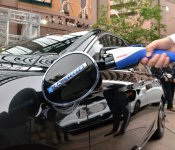
What you need to know about hybrid and electric cars

Nearly a hundred years ago, a deal between Henry Ford and Thomas Edison to make electric cars fell apart because 1914 battery technology wasn’t up to the job. From then on, cars ran almost exclusively on gas, driving us straight into our current global warming mess. Now, Ford has joined companies like Tesla and Chevrolet to finally build electric vehicles en masse. Toyota started the craze with its gas-electric hybrid Prius, while Tesla’s Elon Musk ditched hydrocarbons altogether with the all-electric Model S. Plug-in hybrids, meanwhile, are a shotgun marriage between the two — but Toyota’s plug-in Prius hybrid is drastically differently than Chevy’s Volt. So why all the different technology? Let’s go for a tour of the latest in electric and hybrid car tech.
WHAT IS IT?

Electric cars go way back to the early 1800s, but the first practical one was invented by English tram magnate Thomas Parker in 1884. EVs had a mini golden age at the turn of the century, peaking in 1912 when 34,000 were produced in the US alone — about equivalent to the entire hybrid/electric production of 2002. Such cars were popular in cities due to their simpler operation and limited range, and were often marketed to women. With the discovery of large petroleum reserves and the development of highways, however, longer-range gasoline cars took over. By the middle of the 1910s, most companies stopped making EVs except for niche applications like forklifts or golf carts.
After that, development on electric cars virtually stopped, despite a few stunted attempts like the Henney Kilowatt. Some research and development did continue, and an early attempt at building a hybrid-electric car was AMC’s Amitron in 1967: the first car to use an energy regeneration brake. The idea was to recharge the car’s battery using braking energy, and was later pursued in several experimental vehicles from Audi, Volvo and others.

Stuffing the gasoline genie back in the bottle hasn’t proven easy, even though modern electric cars are superior in nearly every way. EV drivetrains are infinitely simpler, since they don’t need complex transmissions, liquid cooling and other accessories. EVs are also far more efficient, using around 90 percent of the power stored in their batteries, compared to 30-35 percent for a gas vehicle. In fact, EVs could be built for a fraction of the cost of gas cars, except for one problem: the batteries, which are pricey and can only store 5 percent of gasoline’s energy by weight.
The best batteries for cars today are lithium-ion models (similar to what you find in many laptops), which have decent energy density, but are expensive and highly flammable. For instance, it’s estimated that the Tesla Model S battery runs about $15,000, about a fifth of its $70,000 purchase price. (Tesla wants to get that down to $8,000 with its upcoming Gigafactory.) New tech to make batteries more efficient and cheaper is tantalizingly close, but still hasn’t been commercialized.
WHO ARE THE EV AND HYBRID PLAYERS?

Toyota started the hybrid craze with the Prius, which launched with fanfare to the Japanese market in 1997 (seen above next to the very nervous-looking, then-Toyota President Hiroshi Okuda). The car was a rousing success in its home country, exceeding Toyota’s expectations with sales of 18,000 units in the first year alone. Meanwhile, other carmakers launched all-electric EVs in the US between 1997 and 1999, but they sold poorly and were quickly dropped. Honda was actually first to the US with a hybrid in 1999 — the two-door Insight — while Toyota’s Prius hit US shores the next year.
With the Insight and Prius sporting 61 and 52 mpg (EPA) in the city, respectively, hybrids became the go-to cars for the green set. Prius sales topped the 2 million mark in 2009, and most other manufacturers subsequently launched hybrid-electric cars, including Ford, Chevy, Volkswagen and even Porsche.

Meanwhile in 2004, PayPal magnate Musk launched Tesla’s all-electric Roadster, the first production car to use lithium-ion batteries. Though the company didn’t even build the chassis (it was based on a Lotus Elise), other manufacturers like Chevy said the Roadster inspired them to pursue their own commercial EVs. As a result, the Chevy Volt (a hybrid EV) and Nissan Leaf (a pure EV) were both launched in 2010, followed by Volvo’s C30 Electric, the Ford Focus Electric, BMW’s ActiveE, the Toyota RAV4 EV and others. Tesla itself launched the Model S in 2012, arguably the most famous electric car of them all (above).
HOW DO HYBRIDS WORK?
All hybrid and electric vehicles use regenerative braking to recover braking power and store it in the battery. But there are several hybrid drivetrains used in modern hybrid and EVs. Parallel hybrids, like Honda’s Civic and Insight, are gas-powered cars with a small electric motor connected in parallel with the internal combustion engine (ICE) to the transmission. Such vehicles operate efficiently at highway speeds, but less so for stop-and-go driving.

The Chevy Volt (above) is an example of a “series” plug-in hybrid vehicle. The car’s drivetrain is purely electric, and the gas engine merely recharges the battery via a generator. Because of the efficiency lost during recharging, series hybrids are less efficient on the highway, but better for stop-and-go city driving. Lastly, cars like the Toyota Prius use a combination of series and parallel systems to operate efficiently at both city and highway speeds — but cost more due to the extra parts.
Plug-in hybrids like the Chevy Volt or Toyota Prius Plug-in Hybrid are hybrids with a charging port and battery large enough to allow for all-electric motoring over longer distances. The Prius, for instance, can go 11 miles on a three-hour charge from a regular outlet, while the Volt can do 38 miles on a 10- to 16-hour charge.
HOW ABOUT EVS?

EVs are simpler, but the drivetrain, battery and charging designs vary widely. The Tesla Model S is a rear-engine, rear-wheel-drive vehicle with a single electric induction motor, while the Nissan Leaf is a front-engine, front-wheel-drive vehicle with a synchronous electric motor. At the extreme end, the Mercedes-Benz SLS AMG Electric Drive (the gorgeous car above) has four electric motors, one at each wheel, producing 740 horsepower total.
Most EVs can be charged to a near-full battery overnight from a standard socket, or charged in about half that time at 240 volts. The Tesla Model S has an optional dual charger that produces 58 miles of travel per hour of charge. Tesla also offers free Superchargers that can charge a battery half-full in 20 minutes at 103 stations around the US, with many more planned. Also, with Tesla again, the battery can be replaced in 90 seconds with a full one at select service stations.
WHY SHOULD I CARE?

Fossil-fuel powered cars have played a huge role in rising temperatures, acidification of oceans and other nasty environmental side effects. They’ve also given the US a heavy foreign oil habit, and the sellers aren’t always friendly countries.
But even if you don’t care about geo-politics, greener cars have numerous benefits. Certain hybrid models are now cheaper to run than their non-hybrid counterparts, according to the US Department of Energy. EVs can be made quieter than gas cars, thanks to the lower weight and lack of internal combustion. The entire front of an electric car can be a crumple zone, making them safer in collisions. And you can often legally drive an EV or plug-in hybrid in an HOV lane, even if you’re alone.
Pure electric cars and plug-ins have much higher prices (those big batteries again), making savings harder to come by. You can, however, get federal tax credits of $7,500 for most EVs and some plug-in hybrids like the Chevy Volt, with states like California kicking in up to $2,500 for EVs and $1,500 for plug-in hybrids as well (that’s on top of the US government’s tax credits). For instance, Nissan’s Leaf runs about $30,000, but that price can tumble to $20,000 after federal and state rebates. And Nissan says you’ll save about $4,000 in gas over a five-year period, making the effective price around $16,000. And maintenance? It’s hard to say since EVs haven’t been on roads for long, but the vehicles are much simpler and should eventually become cheaper to keep up.
WHAT’S THE ARGUMENT?

There are some sticky issues with electric and hybrid vehicles. The batteries don’t last forever, are hard to dispose of and expensive to replace. The Nissan Leaf’s heat-resistant battery packs (above) are $5,500, for example, while Tesla’s Model S battery is estimated to cost $12,000-15,000 to replace. Both of those cars have eight-year warranties on the batteries, but the charging capacity diminishes considerably after several years. Due to their immaturity, both hybrids and EVs are (currently) expensive to maintain. Finally, depending on where you live, the eco-friendly aspect of EVs is questionable. If your electric grid is powered by coal, and you’re charging an EV from that grid, you’re still contributing to global warming. Nuclear plants have a whole other set of pollution issues.
As the number of hybrid/electric vehicles on the road increases, the prices for both batteries and maintenance is falling. Tesla plans to reduce the price of its Model S battery to $8,000 or so at its Gigafactory with Panasonic. New battery science — like recent lithium anode advances — will eventually be commercialized, reducing weight and cost. In only a few years, EVs and hybrids have evolved considerably, with better batteries, endurance and power. All that has come about because regulations, rebates and competition have motivated carmakers to push the state of the art. Prices will continue to fall, and eventually be cheap enough that government EV incentives can be dropped altogether. When that happens, everybody wins.
WANT EVEN MORE?

You can’t touch your keyboard without tripping on a website about EV and hybrid vehicle tech, thanks to sky-high levels of interest. But there are a few standout sites: our sister blog Autoblog has its Autoblog Green site, detailing all things EV and hybrid. There’s also Green Car Reports, Clean Technica and Hybrid Cars. Most car builders have both hybrid and EV models nowadays, as well, but a few standouts are Nissan’s Leaf, the Ford Focus Electric and Fusion Hybrid SE, the Chevy Volt and the Tesla Model S. To find out if you can actually afford any of those, the US Department of Energy’s hybrid calculator is pretty handy and there’s a list of federal rebates for EVs and plug-in hybrids. The Plug In America coalition has a handy map of state tax rebates. Lastly, check right here: We cover hybrid and especially electric vehicles galore.
[Image credits: (Honda Plug-in Hybrid): Yoshikazu Tsuno/AFP/Getty Images, (Toyota Prius Launch 1997): AP/Tsugufumi Matsumoto, (Tesla Model S): Tesla Motors, (Volt drivetrain): Chevrolet, (SLS Mercedes AMG Electric Drive at Paris Auto Show): Wikipedia/Lebubu93, (Nissan Battery Pack): Nissan Motors, (BMW i3 Electric): BMW]
Filed under: Transportation
.CPlase_panel display:none;

AT&T will sell the G Pad 7.0 for 99 cents — if you buy an LG phone to go with it

We can’t say for sure how great a tablet the new LG G Pad 7.0 is — we haven’t had the chance to try it out yet. But if you were already planning on buying the G3 smartphone on AT&T, you may as well pick up the G Pad too: Starting on Friday, Ma Bell will throw in the tablet for just 99 cents extra. Now, before you get too excited, there is of course a catch. To qualify for that insane 99-cent price, you’ll have to purchase either the G3, G Flex or last-generation G2, and you’ll need to either sign a new two-year service agreement or renew your contract through AT&T’s “Next” early upgrade plan. Again, you’d have to really want one of these phones — and you’d also have to really like AT&T.
If perchance you don’t want one of those handsets, you can also get the tablet for $150 with a two-year contract, or for $12.50 a month for 20 months, with no money down up front. You could even buy it contract-free for $250, but at that point, we’d encourage you to take a closer look at the specs. For $250, you get an Android KitKat tablet with a 1,280 x 800 screen, 5-megapixel camera and quad-core processor. That’s not bad, per se, but for the same price or less you can find similar alternatives, like the Samsung Galaxy Tab 4 7.0; that’s going for $170 (down from $200), with mostly the same specs, save for a lower-res camera. That’s not to say you shouldn’t buy the G Pad — just that you should do your homework first.
Filed under: Tablets, Wireless, Mobile, AT&T, LG
Source: AT&T
.CPlase_panel display:none;

You’ll soon get the chance to buy Teague’s e-bike of the future

If you saw the Teague X/Sizemore “Denny” e-bike last week and voted for it in the Oregon Manifest design contest, pat yourself on the back — it just won. As a result, what was merely a design experiment will now become an actual retail product built by Fuji Bikes, available to buy in 2015. To bring you up to speed, the Seattle-inspired cycle grabbed our attention with its removable handlebar locking system and electric drive pedal assist. Other techie features include an automatic gear shifter, removable battery, minimalistic “fenders,” integrated storage and a full set of lights. Along with the clean lines, that helped it best four other formidable entries and launch it as a product. There’s no word on pricing yet, but Fuji said it has “exactly the kind of innovations we hoped would come from (the contest)” and expects it to sell well.
Filed under: Transportation
.CPlase_panel display:none;

EE’s NFC payment app now works on London buses

Last week, EE said its Cash on Tap NFC wallet app would soon work with Tube barriers when they start accepting contactless payments next month. Today, the carrier’s announced you don’t have to wait to try travelling the NFC way, as Cash on Tap can now be used to pay fares on London buses. The capital’s bus network has taking contactless payments from sources other than Oyster cards since December 2012, but EE’s claiming it’s the first to implement NFC support. Daily fare caps for multiple bus journeys work with any contactless payment method already, just like if you were using an Oyster card, but today Transport for London has introduced a new weekly fare cap for bus travel paid this way. A weekly fare cap will also be introduced on the Tube when contactless payments go live in September.
Unfortunately, hopping on the bus with nothing but your phone in hand is only something a minority of people can enjoy — you have to be an EE customer and posses one of the few phones that Cash on Tap is currently compatible with. Contactless payments on the London transport network has been a hot topic of late, though, so we probably won’t be waiting long before someone comes up with a more inclusive solution that gives all NFC-enabled handsets that same functionality.
Filed under: Cellphones, Software, Mobile
.CPlase_panel display:none;

The BRAVEN BRV-BANK review: built for the outdoorsman

Power banks are a dime a dozen, and with only a handful of phones out there that last through a full day’s use, it looks like they will be around for a while. After sifting through the endless number of power banks at my favorite online retailer, it seems that it will take a power… Read more »
The post The BRAVEN BRV-BANK review: built for the outdoorsman appeared first on AndroidGuys.
.CPlase_panel display:none;

T-Mobile and MetroPCS add waterproof and rugged Kyocera Hydro Life

T-Mobile and MetroPCS have announced the upcoming availability of the Kyocera Hydro Life, a waterproof and rugged Android smartphone. Arriving at the Un-carrier’s door on August 8, the handset features a 4.5-inch impact-resistant display, a 5-megapixel rear camera, front-facing 2-megapixel shooter, and 2000mAh battery. Other details include protection against drops and shock, water, dust, and… Read more »
The post T-Mobile and MetroPCS add waterproof and rugged Kyocera Hydro Life appeared first on AndroidGuys.
.CPlase_panel display:none;

5.5-Inch iPhone 6’s A8 Processor May Be More Powerful Than in 4.7-Inch Model
Cowen & Co. analyst Timothy Arcuri claims the 4.7-inch and 5.5-inch iPhone 6 will differ in more than just display size, reports AppleInsider. According to Arcuri’s supply chain checks, the 5.5-inch iPhone 6 may include a more powerful processor and a different touch module than the 4.7-inch model.
 A7 transistor die photo from Chipworks
Details on the degree of processor difference between the two models were not provided, but the report suggests it may be more than a simple difference in clock speed as seen in the A7 used in the current iPads and iPhone 5s. The A7 in the iPad Air is clocked at 1.4 GHz, while the same chip in the Retina iPad mini and iPhone 5s is clocked at 1.3 GHz.
Arcuri suggests the processor in the faster 5.5-inch iPhone 6 may actually have a larger die than the version found in the 4.7-inch model. This architectural change may hint at an A8 processor with a different graphics processor or possibly a new process for the fabrication of the chip.
Besides two different processors, Arcuri also believes the two iPhone 6 models may ship with different touch modules, with TPK as the likely manufacturer.
Apple is expected to unveil the iPhone at a September event with the 4.7-inch model possibly arriving first and the 5.5-inch following up to several months later.
.CPlase_panel display:none;

Flappy Bird returns in Amazon Fire TV exclusive ‘Flappy Birds Family’

Six months ago, the only game that anyone wanted to talk about was Flappy Bird.You couldn’t go anywhere without reading some story about how many downloads the game had or how it was generating buckets of money. You probably also saw the Vine clips of people smashing their phones in anger. Suddenly, it disappeared and… Read more »
The post Flappy Bird returns in Amazon Fire TV exclusive ‘Flappy Birds Family’ appeared first on AndroidGuys.
.CPlase_panel display:none;
 AIVAnet
