


Moto G now available through Boost Mobile
Just a quick heads up that the Moto G smartphone is now available through Boost Mobile. Priced at a mere $129, the smartphone runs Android 4.3 Jelly Bean (4.4 KitKat guaranteed) and features a 5-megapixel rear camera. Internally you’ll find a 1.2GHz quad-core processor, 3G connectivity, Bluetooth 4.0, and a 2070mAh battery.
To pick up the Moto G through Boost Mobile you’ll need to head to boostmobile.com; retail presence begins on January 20.
Boost Mobile Reunites with Motorola to launch Smart and
Stylish Moto G with NextRadio
The Moto G is available TODAY, Jan. 14 at www.boostmobile.com and select Boost Mobile exclusive retail stores nationwide starting Jan. 20. This represents the first Motorola handset on Boost Mobile since 2011.
Priced at only $129.99, Moto G packs the features consumers want at a price that won’t break the bank, all without an annual contract. The affordable 3G smartphone comes with an impressive and highly durable 4.5-inch HD screen made with scratch-resistant Corning® Gorilla® Glass and sports a super-fast 1.2 GHz Qualcomm® Snapdragon™ quad-core processor. Moto G is loaded with Android 4.3 Jellybean with a guaranteed upgrade to Android 4.4 KitKat expected as early as February, making the Moto G the most up-to-date Android of any phone in its class. Customers also have the freedom to express themselves with a variety of colorful interchangeable backs, available from Motorola directly.
Moto G will come preloaded with the free interactive FM radio application NextRadio®. With NextRadio, listening to FM radio on smartphones is a new type of interactive radio listening experience. When compared with streaming, NextRadio consumes about three times less battery life than other music apps. That’s because the audio is coming through a built-in FM tuner instead of over the Internet.
For extra protection, Moto G has a water-repellent coating on the outside, meaning that a little rain won’t get in the way when taking a call. In addition, customers get an extra 50GB of Google Drive storage for two years and, as with all Android devices, Moto G owners have access to more than 1 million apps and content in the Google Play Store.
Additional key features of the Moto G include:
- 5MP-enhanced camera with panoramic and continuous shot
- All-day battery, 2070 mAh
- Stereo Bluetooth 4.0 capable
To entice consumers to switch to Boost Mobile, Moto G is offered on Boost’s no-contract $55 Monthly Unlimited plan. Boost Mobile rewards its customers for simply making on-time payments. Unique from the competition, for every six on-time payments, the cost of the Boost Mobile Monthly Unlimited plan shrinks by $5 to as low as $40 per month for unlimited nationwide talk, text and data[1]. Payments do not need to be consecutive to qualify for the next savings milestone.
The post Moto G now available through Boost Mobile appeared first on AndroidGuys.

Next-gen strategy game engine lets you control an army of 5,000 units at one time

Every real-time strategy game has some kind of population cap, limiting the number of units that can be placed simultaneously on a player’s terrain. This limit can stem from the designers’ need to balance competition between armies, but ultimately it’ll also have something to do with the underlying hardware in a PC or console, because a processor will slow down if it’s asked to simulate too many independent, physical 3D objects at once. Some RTS games set the limit at 50-70 units, while others can cope with as many as 500, but a new demo game called Star Swarm takes things to a new level: it uses AMD’s Mantle programming tool to speed up communication between the CPU and GPU, allowing up to 5,000 AI- or physics-driven objects (i.e., not mindless clones or animations) to be displayed onscreen at one time. Coming up, we’ve got a 1080p video of what this looks like, plus an explanation of how Oxides Games, the company behind Star Swarm, made this possible.
As you’ll hear from the video’s narration, Star Swarm is a demo game that is built to show off Oxide’s new engine, Nitrous, which is being licensed to other developers. At least three Nitrous-based RTS games are currently in production and Oxide believes that these games will represent a major leap forward for real-time strategy genre thanks to the “epic scale” permitted by the high population limit.
“It’s a difference of at least an order of magnitude,” says Oxide founder Dan Baker (who was previously Graphics Lead for Civilization V). “Take the most complex scene you’ve ever seen in StarCraft II and multiply it by ten.”
There are a couple of ingredients that are essential for delivering these huge 5,000-unit spectacles. Firstly, you need a robust CPU, since processing this quantity of AI and physics relies on general computing power just as much as on graphics. Unlike many games on the market, Star Swarm is designed to use many CPU cores at the same time. The configuration in the video includes a aging but powerful six-core Intel Core i7 980.
“Take the most complex scene you’ve ever seen in StarCraft II and multiply it by ten.”
Secondly, to allow for both scale and enhanced visual effects such as motion blur, the graphics-side of the system must contain a recent AMD GPU that supports the Mantle programming tool. As we’ve reported before, Mantle brings hardware-specific (read: brand-specific) programming to PC games, because it allows developers to code directly for AMD’s Graphics Core Next architecture rather than going through fluffy, hardware-agnostic middlemen like Microsoft’s DirectX drivers. In this instance, Mantle speeds up the communication between the CPU and GPU, allowing multiple CPU cores to talk to the GPU at the same time without causing a jam. (For deeper technical detail on this, check out Oxide’s presentation at APU13.)

Star Swarm is actually the first hard evidence we’ve seen of what Mantle can do, and the numbers speak for themselves: with everything else being equal, enabling Mantle increased the demo’s frame rate by nearly 300 percent, from an unplayable 13 fps to a buttery 44 fps. AMD promised as much when it launched its Kaveri APU earlier today, adding that Star Swarm will run at playable frame rates even on low-power 65-watt versions of the APU (versus 95-watts for a regular desktop chip).
More Info
Separately, AMD claims that a forthcoming Mantle update for Battlefield 4 will boost performance in that title by as much as 45 percent. We’ve also heard some gossip that the PC version of Sniper Elite 3 will support Mantle, likely reflecting the fact that its developer, Rebellion, is making PS4 and Xbox One versions of the first-person shooter and is therefore already accustomed to optimizing its code for AMD’s architecture. All in all, if these games leave up to the precedent set by Star Swarm, it could well be worth having some Mantle juice in your gaming rig in 2014.

China Mobile Stocks 1.4 Million iPhone 5s Units Ahead of Friday’s Launch
Apple’s iPhone 5s assembler Foxconn has shipped roughly 1.4 million iPhone 5s units to China Mobile in advance of Friday’s launch for the carrier, according to a report from The Wall Street Journal. After several years of negotiations, Apple finally announced last month that the iPhone would be coming to the world’s largest carrier on January 17.
While the initial shipment volume doesn’t represent the total sales at China Mobile for January, the figure helps to gauge early demand for iPhones from China Mobile, the world’s biggest carrier by subscribers with more than 760 million customers. China Mobile began taking preorders for iPhones since Dec. 25.
“Shipping one million or more iPhones to a single carrier per month is substantial. But we have limited visibility beyond this month as Apple hasn’t informed Foxconn of the volume for the next shipment to China Mobile,” said the person.
China Mobile will also launch the iPhone 5c on Friday, but early shipment numbers for that device have not been revealed. Pegatron serves as Apple’s primary assembly partner for the iPhone 5c.

Estimates of Apple’s potential iPhone sales on China Mobile have varied widely from 10-30 million units this year, with some suggesting that sales may be lower than expected due to demand having been partially satisfied through the country’s other two carriers, China Unicom and China Telecom, and waning enthusiasm for the iPhone amid increased smartphone choices in the country.
On the other hand, China Mobile already has tens of millions of iPhones operating unofficially on its network but unable to take advantage of the fastest speeds due to technological incompatibilities between older devices and the carrier’s network. As a result, there is already a substantial base of iPhone users on China Mobile who may be looking to upgrade in the near future.
     |

Apple’s Back to School Promo Kicks Off in Australia and New Zealand [Mac Blog]
Apple has launched its annual back to school promotion in Australia and New Zealand, offering education customers free gift cards for the company’s digital content stores with the purchase of a new Mac, iPad, or iPhone. Gift cards can be used in the App Store, Mac App Store, iTunes Store and iBookstore, and are available in the following amounts:
– Purchase a new Mac except Mac mini or Mac Pro: AU$ 100 or NZ$ 125 gift card
– Purchase a new iPad or iPhone: AU$ 50 or NZ$ 65 gift card

The gift card offer comes on top of Apple’s education pricing, which discounts Macs by up to several hundred dollars. Eligible customers include faculty and staff of K-12 and higher education students, as well as students and parents of students at higher education institutions. The program runs through March 20, and all purchases must be made direct from Apple through the company’s online store for education or by phone. Australian customers may also make their purchases at Apple retail stores in the country.
Apple offers its Back to School promotion offerings in a number of countries around the world, staggering their timing to match the respective school calendars. The largest version of the program is typically offered in the July-September timeframe for North America and Europe.
| |

iPhone 6 Fingerprint Sensor Production Set to Gear Up in Q2 with Increased Efficiency
 Apple’s iPhone fingerprint sensor supplier TSMC is preparing to begin production on sensors for the iPhone 6 in the second quarter of this year, according to a report from Digitimes. The report claims that TSMC will be shifting to a larger 12-inch fab from the current 8-inch fab, a move that should increase production efficiency. TSMC will also handle the packaging process for the sensors itself rather than contracting out to other firms, centralizing control over the component.
Taiwan Semiconductor Manufacturing Company (TSMC) reportedly will begin producing fingerprint sensors for Apple’s next-generation iPhone at its 12-inch fab using a 65nm process in the second quarter of 2014, according to industry sources. […]
TSMC has been fabricating the fingerprint sensors for iPhone 5s at its 8-inch fabs, while outsourcing the backend services to Xintec, China Wafer Level CSP and Advanced Semiconductor Engineering (ASE).
The Touch ID fingerprint sensor was reported to be the primary factor contributing to very tight supplies of the iPhone 5s at its launch last September, with low yield rates at packaging firm Xintec and iOS 7-sensor integration slowing production. With several of those issues now ironed out and TSMC able to get an earlier start on sensor production for the next-generation iPhone, that bottleneck on launch supplies appears likely to be solved.
| |
Moto X coming to UK, France and Germany on Feb. 1, lacks Moto Maker customization
Motorola’s pride and joy, the Moto X, has been a U.S. exclusive up until today, when the company announced availability in the UK, France and Germany.
Coming Feb. 1 for £380 sim-free or £25 on contract from Phones 4u, Carphone Warehouse, O2, Amazon and Techdata, the device will lack Moto Maker customization and will be available in black. White will be exclusive to Phone 4u for three months.
Besides that, the device will have the same specs as its American cousins.
For a refresher, it packs Android 4.4 Jelly Bean, 4.7-inch AMOLED (RGB) / HD 720p display, Snapdragon S4 Pro 1.7GHz dual-core processor, Motorola X8 Mobile Computing System, 2GB of RAM, 2200 mAh battery, 10 MP rear-facing Clear Pixel camera and a 2 MP front-facing camera.
Moto is holding a press conference today, so we should have full details later. Any of our friends across the pond can preorder the device now by following the Motorola source link below.
via Motorola, +Motorola, ZDNet
The post Moto X coming to UK, France and Germany on Feb. 1, lacks Moto Maker customization appeared first on AndroidGuys.

Visualized: a closer look at an HTC One prototype

Shortly before a flagship smartphone is announced to the general public, companies like HTC will often send a prototype version of the upcoming product to tight-knit partners and developers. We got an exclusive close look at one such prototype of the M7 — the codename for the HTC One — which as you can see in the above image and gallery below, looks very little like the final version. That doesn’t mean the plastic casing shouldn’t look oddly familiar to you; this particular device was leaked in the latter half of last January. But this goes to show the importance companies like HTC place on secrecy — the more hands that are in the pot, the more likely it is that leaks will pop up. In this way, HTC was very successful at keeping the final product away from prying eyes (well, aside from a few accurate renders, that is).
Upon taking a look at the once-top-secret device, we noticed a couple things that especially stood out to us. First, we peered into a completely empty void where a camera should have been; despite the fact that the chassis left a spot open for the rear camera module, none was to be found. If we were to guess, we imagine the UltraPixel setup simply wasn’t ready by the time this prototype was made, so the company shipped it without one. Additionally, just as the leaked images show, there are three icons for capacitive buttons, even though there are only two on the final version. The prototype threw in an icon for recent apps, but interestingly enough, it’s not a functional button whatsoever. Perhaps HTC had been toying with the idea of keeping a three-button setup instead of the two-button layout it finally settled on.
We’ve included a small gallery of images below so you can take a closer look at the phone that many originally thought would become the HTC One. Frankly, we’re pretty happy about which version HTC eventually used, but it’s still fun to take a look behind the scenes. And think about this: it’s quite possible that right now — at this very moment — those same partners are playing with the next HTC flagship’s prototype in much the same way as they did with this one.

Appeals court strikes down key parts of the FCC’s net neutrality rules

If you were hoping that the FCC’s net neutrality rules would survive the many legal challenges thrown in its path, think again. A Washington appeals court has voided the anti-blocking and anti-discrimination requirements in the FCC’s Open Internet Order, arguing that they go beyond the agency’s mandates.
Developing…
Filed under: Networking, Internet
Source: GigaOM
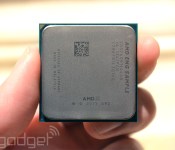
AMD says its next PC chip trumps Intel with 12 ‘compute cores’ and smoother gaming

A decade ago, AMD brought us the first dual-core x86 processor. Then, starting in 2008, the company came out with tri-core and quad-core designs in quick succession, leading up to octa-core chips in 2011′s FX range as well as in the latest AMD-powered game consoles. Today, we’re looking at a fresh leap forward, albeit one that will take a bit of explaining: a desktop and laptop chip called Kaveri, which brings together up to four CPU cores and eight GPU cores and gives them unheard-of levels of computing independence, such that AMD feels justified in describing them collectively as a dozen “compute cores.”
Marketing nonsense? Not necessarily. AMD is at least being transparent in its thinking, and besides, if you’ve been following our coverage of the company’s HSA project, and of GPU compute in general, then you’ll know that there’s some genuine technology underpinning the idea of GPU cores being used for more than just 3D rendering. Nevertheless, even if you don’t go for the whole 12-core thing, AMD still makes some down-to-earth promises about Kaveri’s price and performance — for example, that it matches up to Intel chips that cost a lot more (the top Kaveri desktop variant costs just $173, compared to $242 for a Haswell Core i5), and that it can play the latest games at 30fps without the need for a discrete graphics card. These are claims that can — and will — be put to the test.
“Compute cores”

Let’s start with the theoretical stuff, even though it’s largely academic until more software comes along that can make use of it. The reason AMD calls the GPU cores inside Kaveri “compute cores” is that they’re said to be fundamentally different to the GPU cores in other PC processors. This difference lies in the fact that they’re able to function as equal citizens: instead of relying on the CPU to orchestrate their workload, they can access system memory directly and take on tasks independently — almost like a CPU core does. The only difference is that they can’t take on the same types of tasks as a CPU, as they’re better suited to simple parallel chores rather than complicated serial processing.
As things stand, software developers are already able to exploit the GPU for general computing using tools like OpenCL, which can be used to accelerate anything from Photoshop to big spreadsheets. But OpenCL requires reams of code and a lot of inefficient to-ing and fro’-ing between the GPU and CPU — all of which, AMD says, will be drastically reduced if developers latch onto HSA. That’s a big “if,” of course, but now that AMD has recruited a bunch of partners into its HSA Foundation, and now that it has managed push its silicon into millions of households via next-gen games consoles, developer interest looks more likely, and Kaveri’s compute cores at least bring it some future-proofing as a result.
Gaming

Bearing in mind that we’re mostly reliant on AMD’s in-house test results for now, until independent reviewers put their graphs online, let’s look at that basic claim about Kaveri undercutting Intel as a gaming processor. The chart above shows a top-end Kaveri A10-7850K pitted against Intel’s Core i5-4670K for games being played at 1080p with max settings (or at least close to max settings — there’s a bit of ambiguity there, but it doesn’t affect the comparison). In each case, the processor is paired with a discrete graphics card, AMD’s mid-range Radeon R9 270X, presumably because most enthusiasts would still avoid relying solely on integrated graphics. As you can see, Intel is slightly ahead in a number of games, but never by a significant margin, suggesting that spending $70 more on Intel’s chip doesn’t add much to the experience.
Power efficiency and onboard graphics

In addition to Kaveri’s suitability for gaming when paired with a separate graphics card, the slide above suggests the chip also has an advantage over a Haswell Core i5 on certain synthetic benchmarks, likely due the fact that it has a bigger GPU than you’d find on an Intel processor. Kaveri’s built-in GPU accounts for 47 percent of all transistors in the chip (over a billion in total), and is potentially meaty enough for it to run games without the need for a discrete graphics card, thereby saving energy and money while also allowing for much smaller PCs. In practice, we played through a level of Bioshock: Infinite at 1080p with low settings, with Kaveri running beneath a little third-party cooler, and we experienced a steady frame rate of 30fps. This is something AMD claims is also possible in other big titles like Battlefield 4, which it’s bundling free with high-end boxed Kaveri chips, but again, you have to be prepared to accept low detail settings.
For the sake of balance, it’s important to point out that an Intel’s chip is likely to be more power-efficient in its own right. Haswell has fewer transistors (1.4 billion instead of Kaveri’s 2.3 billion) and its transistors are also significantly smaller (22nm instead of 28nm), which should equate to reduced power draw — something that’s especially when you think about notebook or hybrid/tablet versions of these chips, particularly ones that don’t need to focus on 3D graphics (or, equally, which delegate all such tasks to a separate GPU).
Mantle and TrueAudio

Speaking of Battlefield 4, we arrive neatly at Kaveri’s other big claim to fame — and it’s a claim that requires a much smaller leap of faith than HSA does. You see, Battlefield 4 is one of a growing number of games that will take advantage of an AMD-tailored programming tool called Mantle, which promises big boosts in performance even on lower-power (e.g., HTPC and laptop) versions of the chip. Mantle runs on any AMD graphics card that contains the newer Graphics Core Next (GCN) architecture, and since Kaveri’s graphics processor is based on GCN, it can run Mantle-optimized games and applications too, resulting in claimed performance increases of up to 45 percent in BF4 (once it gets its Mantle update later this month) and as much as 300 percent in real-time strategy games running on the new Star Swarm game engine. (For more on Mantle, read this.)
Finally, in addition to Mantle, Kaveri also brings another feature across from AMD’s latest graphics cards: TrueAudio. This is a dedicated, programmable audio processor that sits on the chip and helps to improve the audio in games by decoding data about location (giving sounds a feeling of directionality and distance) and also increasing the total number of voices and effects that can be heard at one time.
Wrap-up

Kaveri apparently took four years to develop, due to all the extra gubbins AMD has squeezed onto it, including HSA, Mantle and TrueAudio. This also explains why Kaveri chips are priced significantly higher than their predecessor, Richland: the lower-specced A8-7600 will start at $119, rising to $152 for the A10-7700K and, as we’ve mention, $173 for the flagship A10. Will they be worth the money? We’ll wait to round-up independent reviews from specialist sites before we make any final judgement, but it certainly looks like AMD has brought some clever additions to this generation that could boost its value. It looks good as a traditional gaming processor right now, especially if you intend to pair it with a Radeon graphics card in order to enable Dual Graphics (with the GCN cores in Kaveri’s GPU and in the discrete GPU effectively being added together), but we’ll need to see more Mantle- and HSA-enabled software before we’re ready to believe it can tackle Intel on general computing.

Huawei launches 5.5-inch B199 in China with a battery for hire

Huawei recently outed the Ascend Mate 2 with a colossal 4,000mAh battery that can actually charge other devices, and it’s now brought that tech to a mid-range handset. The 5.5-inch B199 is a successor to the A199, and packs similar specs: a 720p screen, 2GB of RAM, 16GB of storage (expandable via MicroSD slot), dual sims (3G only) and a quad-core processor. The new model, though, has a Snapdragon, rather than a Huawei K3V2 CPU and also carries a much larger battery: 3,000mAh instead of 2,100mAh. Huawei says that’ll power the phone through long browsing sessions and even let you charge other devices — though it’d be odd to be packing another cell phone when you already have one with two sims. And given those dual-sims, we’d not expect the $330 phone to be available outside China and similar markets.
Filed under: Cellphones, Mobile
Via: Engadget Chinese (translated)
Source: Huawei
 AIVAnet