


Apple Details iOS User Interface That Compensates for Device Motion
Apple has received a patent — originally filed for in 2007, when the original iPhone was only months old — that allows an iOS device to adjust its screen to make it easier for users to interact with the touchscreen when it detects movement (via AppleInsider).
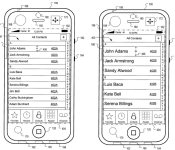
For example, play and next/previous track buttons on the lock screen, or listings in the Contacts app, could get larger if the iPhone detects that the user is jogging. It could also have items like app buttons on the home screen move themselves slightly to give the illusion of stability.
Apple proposes using the gyroscope, proximity sensor, accelerometer and other sensors to detect movement and the angle of the display, with the iPhone then adjusting user interface elements to prevent touch errors. It also learns about how the user touches the display, allowing it to better correct for errors in the future.

In general, one aspect of the subject matter described in this specification can be embodied in methods that include the actions of detecting a pattern of motion of a device; and adjusting a graphical user interface of the device in response to the detected pattern of motion. Other embodiments of this aspect include corresponding systems, apparatus, devices, computer program products, and computer readable media.
In general, another aspect of the subject matter described in this specification can be embodied in methods that include the actions of detecting a motion of a device; comparing the detected motion to a predetermined signature of motion; and adjusting a graphical user interface of the device based on the comparing. Other embodiments of this aspect include corresponding systems, apparatus, devices, computer program products, and computer readable media.
Particular embodiments of the subject matter described in this specification can be implemented to realize one or more of the following advantages. Loss in accuracy of a user’s interactions with a touch-sensitive display of a device or user mistakes with respect to the selection of user interface elements on a touch-sensitive display, due to movement of the user and/or the device, is mitigated. A device user interface can be adjusted to provide better visibility or usability.
The patent was originally filed for back in 2007 and Apple has not yet implemented the design into iOS. Apple frequently files for patents on inventions that it never uses commercially, but something similar could appear in iOS in the future.
     |

New ‘Umoove Experience’ iOS Game Demos Face and Eye Tracking Technology
Umoove, an Israeli startup developing mobile-based face and eye-tracking technology, today released a new game that demonstrates its current work on tracking using the iPhone’s front-facing camera.
Umoove Experience: The 3D Face & Eye Tracking Flying Game is a simple app that allows users to fly through a village using gentle head movements that are detected by the camera. The goal is to collect potion bottles scattered throughout the landscape by turning and moving up and down with head movements. The game also incorporates touch gestures at the same time for an all-encompassing gaming experience, with the touches used to control flight speed.

Enjoy the 3D flying experience and test your skills by collecting the purple magic potions, which will give you more energy to continue exploring the village.
The Umoove Experience is only the beginning! Think about the potential of this technology on other app and gaming experiences such as first person shooters, driving games, and other flying or running gaming experiences.
Umoove has been developing its head and eye-tracking technology since 2010, and the current game serves as a simple demo highlighting the ways the system could be used in other apps and games in the future. As in the game demo that combines head movements with touch, Umoove’s goal is to supplement traditional touchscreen controls rather than replace them.
In an interview with TechCrunch, Umoove CEO Yitzi Kempinski notes that the addition of head-tracking to standard touch controls is meant to mimic real-world experiences.
“We’re talking about adding another layer on top of touching, similar to what the mouse did with the keyboard — they didn’t throw out the keyboard, it actually added suddenly the ability to have another layer of interaction, so it’s the same sort of thing here,” says CEO Yitzi Kempinski.
“It’s supposed to be something that mimics real-world experience. I’ll give you an example… if you think of a first-person shooter, those games you play and you have to shoot, and then you have the joystick to move around and you have to drag the screen to move around the room. Basically what we do is simple: based on where you face that’s where you’re aiming.”
Umoove is currently offering indie developers a free SDK to incorporate face-tracking into their own apps and games. According to Kempinski, Umoove is also talking with OEMs about adding the technology into future devices.
Motion tracking using the iPhone’s camera has been explored in the past, with two French researchers detailing a system for head tracking using an iOS device’s camera back in 2011. Apple has expressed interest in similar technology in the past, with a 2009 patent detailing face-controlled 3D displays, and it has implemented accessibility options in iOS 7 allowing iPhone users to control their devices using head movements.
Umoove Experience: The 3D Face & Eye Tracking Flying Game can be downloaded from the App Store for free. [Direct Link]
| |
Galaxy S5 rumored to have a big ol’ rapid charging battery
With the Samsung Galaxy S5 rumors in full-swing, some more speculation emerges with talk of the battery.
In a few months, we’ll know just how many of these rumors are true. In the mean time, let’s talk about what’s arguably the most important feature of the phone: the battery.
It is rumored that the new Samsung flagship will sport a 2900mAh battery, and will feature some new “rapid-charging technology.” The rumored capacity of the battery isn’t all that absurd… it is a normal jump up from the company’s 2013 flagship, the GS4. It will use a silicon anode instead of graphite, leaving the battery more compact. The rapid-charging technology is something to think about, though. The new technology could charge your phone in around 2 hours, which is huge.
From the “confirmed” specs of the S5 a few days ago, it seemed that the battery was the only thing missing. If these rumors are true, this new technology will begin changing batteries for the better. Let’s hope the rumors prove true in the next few months.
Via: Gigaom
Source: Phonearena
The post Galaxy S5 rumored to have a big ol’ rapid charging battery appeared first on AndroidGuys.
Moto G Google Play Edition now offered in Google Play Store
Take a trip to the Google Play Store this afternoon and you’ll find yet another smartphone listed under the Google Play Edition devices. Indeed, Motorola’s Moto G is the latest device to get the Pure Google treatment. Priced at $179, the unlocked handset works on either AT&T or T-Mobile’s 3G networks.
There’s hardly much difference between this version and the one offered directly from Motorola. Already running a stripped down build of Android, this one will not look or feel all that different from other Moto G’s. Nevertheless, we suspect it will get a higher priority in receiving updated releases of Android. Not that Motorola has been slouching in that department, mind you.
Moto G 8GB Google Play Edition
Moto G 16GB Google Play Edition
The post Moto G Google Play Edition now offered in Google Play Store appeared first on AndroidGuys.

Radionomy acquires Winamp and Shoutcast to boost its streaming efforts

There were rumors that Winamp would find a rescuer following its shutdown, and today that rescue is official. Online radio platform provider Radionomy has acquired both WinAmp and Shoutcast from AOL (Engadget’s owner) for an undisclosed amount. The deal is primarily a play for market share; now that Radionomy owns Shoutcast, it’s powering roughly half of all internet radio. The company also plans to improve Winamp, making it “ubiquitous” across multiple platforms that include mobile devices and car infotainment systems. It’s doubtful that Winamp will reclaim the prominence it had during its heyday, but the acquisition should at least give it (and Shoutcast) a new lease on life.
[Image credit: Theis Kofoed Hjorth, Flickr]
Filed under: Internet, Software
Via: Tech.eu
Source: PR Newswire

European researchers have created a hive mind for robots and it’s being demoed this week

RoboEarth isn’t as sinister as it sounds. It’s not a special interest group advocating for a new world order with robots at its core — not yet, anyway. The project, which is backed by the European Union and brings together researchers from universities in Germany, the Netherlands and Spain, is actually more benign than that; it’s being described as a “world wide web for robots.” We know what you’re thinking: What does that even mean? And what would a robot-curated Tumblr look like? The implications are ridiculous, but the reality is not. Simply put, RoboEarth is a four years in the making, cloud-based hive mind for robotics that aims to store and share knowledge amongst (you guessed it) robots. The end goal being that single-tasked robots will become a thing of the past. And now, its many collaborators are ready to show off what RoboEarth can realistically do this week.
This initial RoboEarth demo, set to take place on January 16th at Eindhoven University in the Netherlands, will highlight the system’s ability to offload real time computational tasks in the cloud and then disseminate that knowledge to four networked robots working in a mock hospital. According to the BBC, these robots will be tasked with serving drinks to patients, assisting in navigation by uploading maps to the cloud and even helping to open pill boxes. The benefit of all of this shared data being that no one robot is limited to a specific task — any robot can become multi-purpose.
But there’s another upside to this cloud processing that could impact the reality of assistive technology in the home and that’s the potential for cheaper to produce and longer-lasting commercial robots. With much of the data computation being offloaded the cloud, manufacturers won’t need to create robots with top shelf components, making them more affordable long term investments for consumers. Which, in turn, means you’ll be able to hold onto Rosie just long enough to consider her a member of the family.
Filed under: Robots
Via: BBC
Source: RoboEarth

Moto G Google Play edition now available for $180

The Moto G now has an official Google Play Edition. The device, which just popped up on the Google Play Store, is available for $180 (8GB) or $200 (16GB). Just like we’ve seen on other Google Play edition devices, the Moto G will offer the same specs as the GSM version along with a stock version of Android 4.4 KitKat. It’ll be compatible with AT&T and T-Mobile here in the US. We’re still waiting to hear details about its availability in other parts of the world. Head to the source link to grab one of your very own.
Filed under: Cellphones, Wireless, Mobile, Google
Via: Android (Twitter)
Source: Google Play Store
Wearable craze adds skin sensitivity to the list of considerations for gadget buyers

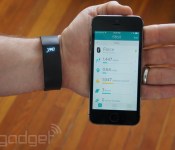
We were quite impressed with Jawbone Up24 when we reviewed it. But, a few weeks later, things soured a bit when an editor developed a rather unpleasant rash from the device. Turns out it’s not all that uncommon a reaction. While the usual list of concerns for gadget buyers focuses on specs, features and in certain cases portability, with the advent of the wearable, consumers need to start worrying about their own skin sensitivity as well. Are you particularly susceptible to bacterial infections? Are you allergic to nickel or latex? Then that’s something that you’ll have to take into consideration when it comes time to pick out a fitness tracker or smartwatch.
In addition to our anecdotal experience, the Engadget forums are alive with reports of sores and rashes associated with the Fitbit Force. While a sensitivity to nickel would be the most immediate suspect in cases like this according to dermatologist J. Todd Williams, M.D., it appears something else is to blame. The Force does contain trace amounts of the metal in the surgical-grade stainless steel used on its body, but the position of the rashes would seem to rule out it out in many cases. The same would be true of Up users, as only the cap emblazoned with the Jawbone logo contains nickel plating. And since the Up is coated in a hypoallergenic rubber and the Force forgoes latex as well, it seems an allergy to that particular polymer isn’t the culprit either.
Instead, it appears that trapped moisture and bacteria are the most likely causes of discomfort. Wrist-worn devices like the Up, Force and Flex tout their ability to shrug off water and many users simply never take them off, even in the shower. As Dr. Williams explained, “there is one type of dermatitis called ‘irritant’ dermatitis that just comes from irritation from water/sweat etc…” Essentially, a build up of moisture (which can also encourage bacterial growth) against the body can cause sores and rashes on those with particularly sensitive skin. People commonly experience similar reactions to watchbands, bracelets and rings. For instance, Dr. Williams says, newly weds often complain of irritation from water being trapped under their rings while washing dishes.
While the solution might be as simple as cleaning your wearable regularly with antibacterial soap and taking it off while you shower, Fitbit is taking the complaints seriously. If customers feel they’re experiencing an allergic reaction to their tracker, the company is offering either a refund or a replacement device. And, obviously, it will foot the bill for all shipping costs and refund any difference in price, should you choose to replace your Force with a Zip, for instance. Fitbit insists it tests all its materials thoroughly and meets a variety of international standards for safety, but there’s no accounting for the unexpected. Jawbone representatives have told us they’re looking into the issue, and we’ll update this post if we receive a statement from the company.
Filed under: Wearables
Source: Engadget forums, Consumerist

CyanogenMod Releases GalleryNext and are Looking for Betas Testers

The boys of CyanogenMod want to change the photo gallery experience on your device, by releasing their very own gallery app called GalleryNext. The stock Gallery app will probably soon be phased out by the Google+ Photos app, but CM felt like that shouldn’t be the case.
- View all your pictures in one centralized location
- Cloud services integration with Flickr, Picasa (G+), Facebook, and Dropbox
- Moments support (automatic grouping and classification of media based on metadata)
- Video playback support
- Gif support
- Deduplication in ‘All’ view
GalleryNext actually kind of looks similar to the Google+ photos app, but they have added some spice to it. The slide-out navigation style looks awfully tasty, and you can look at your galleries in mini gallery compilations. Cloud service integration has been added for such apps as, Flickr, Dropbox, and Facebook, and has GIF playback support. There is also something added called “moments”support, and they are giving you the option to beta test right now. Hit the link provided down below to join the G+ community page. Let us know how it runs.

Google Glass app DriveSafe Turns Glass into a Warning System
 We have all been there more than once. Those times where you have been working all day and have to still make the trip back home. Or those long trips where you just want to get as far as possible before you pull over for the night. While it is unsafe and potentially deadly, it still happens. Pair that up with the issues that driving with Google Glass has caused over the last few months and you might be in for some troublesome times. While there isn’t much of a solution for driving with Glass on, there is a new app for those that still brave the roads wearing their gear. A new app, DriveSafe, is now available for those of you that Glass up while on the road.
DriveSafe is currently in alpha testing mode, but is aiming to help drivers be safer on the road. Giving users of the app an alert in the heads up display if it thinks you might be nodding off behind the wheel. Of course, if your eyes are closing a visual pop-up won’t do much good. DriveSafe goes a step further though and will also trigger an audible tone and then uses voice input to help you find a safe place to rest.
While we don’t suggest you solely rely on DriveSafe to keep you awake at the wheel, it is an interesting use of Glass and an argument for their benefits in a vehicle over the distracted driving issues. You can go pick it up at Drivesafeforglass.
Source: 9to5Google
 AIVAnet