


Hershey and 3D Systems join forces to create printable confections

You may no longer have to settle for getting your chocolate in teardrop, bar or seasonal-bunny form. The Hershey Company has signed an agreement to develop printable treats with 3D Systems, which announced its own chocolate-equipped printer at CES last week. That yet-to-be-released machine will fall under the ChefJet line, and also supports printing 3D objects with sugar. With ChefJet’s release still months away, it’s unlikely that thousands of the machines are already plugging away at a secret factory in Hershey, Pennsylvania, but you better believe we’ll be first in line when the custom-printed delights hit stores.
Filed under: Household
Source: 3D Systems
Google Now for Desktop Available in Chrome Canary Builds [Mac Blog]
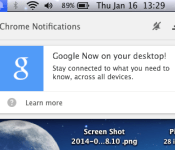
Google Now is a personal assistant service that is considered to be Google’s counterpart to Siri. Available on iOS and Android devices, the service is now making its way onto the desktop via Chrome Canary, the experimental build of Google’s Chrome web browser.

As reported by the Google Operating System blog, the latest build of Chrome Canary allows users to receive Google Now cards directly in the browser’s notification system. Canary users on the Mac can enable the personal assistant by turning on the correct flag in the browser. Users should go to “chrome://flags/#enable-google-now” and then switch the settings from “Default” to “Enabled.” A final click on the “Relaunch Now” button will turn on the feature.
Users who are signed into Chrome will receive a Google Now notification and a list of available cards. According to a Google support page, Google Now on the desktop will support weather, sports scores, commuter traffic and event reminders. Some of these desktop cards will sync with Google Now if it is enabled on a mobile phone. These mobile-synced cards will display relevant information using location data pulled from the mobile device.
Google Now for the desktop is still in the experimental stage, but it will likely land in the consumer version of Chrome for the Mac. 
     |

Task-Oriented Email App ‘Mail Pilot’ Now Available for Mac [Mac Blog]
Originally a 2012 Kickstarter project, Mindsense’s long awaited Mail Pilot email client is now available from the Mac App Store following a beta testing period that began in June. Mail Pilot focuses on the idea that email is action-based, providing users with a number of ways to deal with email messages.
Taking a cue from most standard email apps, Mail Pilot organizes emails into a two column design. A complete list of inbox messages is displayed on the left side of the screen while full email messages are displayed in the right column when an email is selected.
All incoming messages are marked as incomplete and can be dealt with using the following actions from the bottom menu bar: Complete, Remind, Set Aside, and List. While Complete marks an email as read and instantly archives it, the other included functions give users new ways to deal with their messages.

Remind allows emails to be dealt with on a specific date, which the developers suggest is useful for emails about bills and meetings. Set Aside files emails until later, a useful function for emails that require more time than a simple read through, and the List button aggregates related emails together, useful for wishlists, read it later lists, and collecting information on a specific event. Delete and folder options are also available.
At the top of the app, various inboxes can be accessed from a tabbed menu. There’s a standard inbox, along with an inbox that displays messages received in the last day, and two inboxes for emails filed as Set Aside or Remind.
Emails added to lists are accessed from the separate and collapsible “Sources” menu bar, which also houses a list of archived, sent, and deleted messages. Composing an email is also done in a separate popup window that includes a text box with simple formatting options.
Mail Pilot is the email client reimagined from the ground up. We ignored all notions of common email clients, and we focused on how an email client could fit modern email workflows and uses. Realizing that all email messages are action-based, we developed Mail Pilot and its feature-set to empower users to use email in an intuitive and productive way.
Many companies have aimed to reinvent email in recent years with apps like Dropbox’s Mailbox, but there remain few highly rated email apps for the Mac. While Mailbox does include much of the same action-oriented email functionality found in Mail Pilot, it is limited to iOS. Mail Pilot, while newly released on the Mac App Store, has been available for the iPhone and the iPad since April of 2013 and is able to offer a multi-device experience.
According to the developers, Mail Pilot works with Google, iCloud, Yahoo, Outlook.com, AOL, and standard IMAP/Exchange with IMAP email accounts, but App Store reviews indicate that iOS users have had issues getting some email accounts to work properly.
Mail Pilot for Mac can be downloaded from the Mac App Store for the introductory price of $9.99. [Direct Link]
| |

Apple Widens Lead Over Samsung in U.S. Smartphone Race in 2013
Research firm NPD today announced the results of its latest Connected Home Report, showing that Apple increased its share of the U.S. smartphone installed user base by seven percentage points, from 35 percent in the fourth quarter of 2012 to 42 percent in the same quarter of 2013. Second-place Samsung increased its share of the market by a smaller margin from 22 percent to 26 percent, while other major manufacturers saw their shares drop.

NPD’s data, which is based on a survey of roughly 5,000 consumers, is in close alignment with recent data from comScore that showed Apple with 41.2 percent of the market and Samsung at 26.0 percent in the September-November period.
Both firms track installed user base rather than sales, offering a more realistic picture of real-world usage but which is slower to react to shifting market trends given typical handset lifespans. Apple has shown steady increases under these studies over the past several years, even as Android has experienced significant growth. One recent study of trends by Asymco’s Horace Dediu has predicted that Apple’s share of installed user base in the U.S. will peak at 68 percent in 2017 when the smartphone market hits a saturation point at 90 percent of the country’s population.
While Apple’s performance remains strong in the U.S. and several other countries, Android has had more success attracting customers in many other markets around the world. Data from Kantar Worldpanel for the August-October period pegged Apple’s share of the market in many European countries and China in the 15-20 percent range, with iOS barely registering in some countries such as Spain.
| |

UK Court Allows Activists to Sue Google Over Safari Tracking [Mac Blog]
A UK Court will allow a group of privacy experts to sue Google over the company’s circumvention of privacy settings in Apple’s Safari browser, reports Gigaom. Following this ruling, the activists can pursue a tort claim that alleges Google misused their private information. The Honourable Mr Justice Tugendhat writes in his decision:
“I am satisfied that there is a serious issue to be tried in each of the Claimants’ claims for misuse of private information… The Claimants’ application to rely on ground (9) in relation to the DPA [Data Protection Act] claim is allowed… the Claimants have clearly established that this jurisdiction is the appropriate one in which to try each of the above claims.”
This case stems from Google’s former practice of installing cookies in Safari even when the web browser blocked that practice. Google circumvented the browser’s default privacy settings by tricking Safari into thinking a web page was a trusted page. Google did this through code embedded in its ads that made Safari think the user was submitting a form. When a user fills out a form, Safari makes an exception in its privacy policy and allows a cookie to be installed on a user’s device, and Google exploited this exception to install cookies without the permission of the user.
 Graphic from The Wall Street Journal
Google halted this practice in 2012 after it was reported by The Wall Street Journal, but consumers and regulators pursued the case through several investigations and lawsuits. The company was fined $22.5 million by the U.S. Federal Trade Commission for this privacy violation and paid a $17 million settlement in a case filed on behalf of Thirty-seven states and the District of Columbia.
| |
Not out yet, Panasonic rumored to return to smartphone fray
After bowing out of the smartphone game back in September 2013, Panasonic is reportedly set to introduce a new handset in 2014. Details are light at this stage, but the phone is said to feature a 5-inch display and offer some degree of rugged protection. Likely shock resistant, it sounds like the type of device that would best be suited for construction sites and places that literally take users out into the field. According to Asahi Shimbun Digital (Japan), Panasonic has already started working with carriers to bring the device to the United States.
Mobile World Congress gets started at the end of February; Panasonic could introduce this smartphone at the event.
The post Not out yet, Panasonic rumored to return to smartphone fray appeared first on AndroidGuys.

Samsung unveils Galaxy Tab3 Lite (7”)
Samsung, for reasons unclear, has introduced its latest Android tablet less than one week after CES wrapped. Nevertheless, we’ve got a new 7-inch experience to look forward to in the Galaxy Tab3 Lite (7”).
Offered globally in black or white, the tablet features a 7-inch (1024×600) display, a 1.2GHz dual-core processor, 1GB RAM, and 8GB internal storage. The tablet runs Android 4.2 Jelly Bean with Samsung’s TouchWiz and also provides a 2-megapixel rear camera, microSD expansion, and 3600mAh battery. In terms of software, the Tab3 Lite features Samsung Apps, Samsung Link, Smile Shot, Shoot & Share, and Panorama Shot.
There’s no word on what pricing will be for the Tab3 Lite but we’re hoping for something that falls between $150-$200. Look for launch details in the coming weeks.

The post Samsung unveils Galaxy Tab3 Lite (7”) appeared first on AndroidGuys.

Jawbone’s second-gen Era headset is 42 percent smaller, comes with its own charging case

Wearables may have been the talk of the town at CES, but given that Jawbone just released the Up24 a month ago, chances were slim it was going to announce another fitness tracker so soon. Instead, then, the company is going back to its roots: it just announced a new version of its Era Bluetooth headset, with a markedly smaller design, a 10-hour battery and a bundled charging case. In particular, the new Era is 42 percent more compact than the last-gen model (see the comparison pic after the break), with a new earpiece that’s said to fit more securely. On the audio front, Jawbone moved to tiny MEMS microphones and also overhauled its Noise Assassin noise cancellation technology with support for wider-band audio. You can also use voice commands to order Siri around, assuming you have an iDevice. It’s on sale today in four colors starting at $100, though if you want that charging case, you’ll need to shell out $130 for the bundle.

Filed under: Wearables
Google Now comes to Chrome on the desktop in experimental form

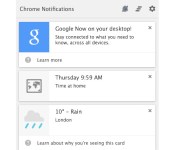
You may not have to reach for your phone to check Google Now in the near future. The latest build of Google’s experimental Chrome Canary browser introduces the context-aware notifications to the desktop; toggle a flag and you’ll get alerts from the menu bar (Mac) or taskbar (Windows). Google Operating System notes that it’s not quite a seamless experience. You’ll have to use Google Now on your mobile device first, and location-sensitive cards like weather are tied to that device’s location, not your computer. Even with those caveats in mind, it may be worth downloading the unfinished software for the added convenience.
Filed under: Internet, Software, Google
Via: The Next Web
Source: Google, Google Operating System

Apple Investigating iBeacon-Assisted Mobile Payment Methods
Apple’s iBeacon technology based on the Bluetooth LE standard is being installed in Apple Stores and other retail outlets to assist customers and send them promotions while shopping, but as noted by Patently Apple, a newly published patent application suggests this technology could also be used to send secure mobile payments while making purchases.

Patent application number 20140019367, filed in September 2012 and published today, describes a method that would send payment data through various wireless interfaces without compromising the user’s data. The method uses two links — one connection to a point-of-sale device to establish the initial connection and a second, secure connection that sends the payment information. This payment information is then processed by a backend server, which uses a shared secret to verify that the connection was secure before it authorizes the payment.
In one or more embodiments, a method of performing a commercial transaction is provided. The method includes establishing a first secure link over a first air interface by a purchasing device, the first secure link between the purchasing device and a point of sale device, identifying a second air interface different from the first air interface, establishing a second secure link over a second air interface, the second secure link between the purchasing device and a backend server, and conducting, using the second air interface, a secure commercial transaction between the purchasing device and the backend server using payment data secured by a shared secret known to a secure element in the purchasing device and to the backend server.
The payment method described in the patent may use NFC as well as Bluetooth and Wi-Fi to connect the mobile device to the point-of-sale terminal. Though iBeacon is not directly named in the patent, it is easy to see how the technology could be used as the conduit for the secure Bluetooth connection. Apple even notes in the patent that NFC “is less desirable for longer transactions,” while Wi-Fi or Bluetooth has “more desirable characteristics for maintaining the link over time than NFC.”
The use of Apple’s iBeacon technology, rolled out alongside iOS 7, is expected to increase over the coming year as other retailers such as Macy’s have begun piloting the Bluetooth LE technology. Most recently, the Consumer Electronics Association used iBeacons for a scavenger hunt at CES 2014, while Major League Baseball will be bringing the technology to stadiums.
| |
 AIVAnet