


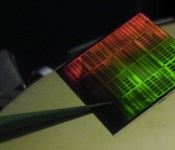
IBM’s speedy graphene chip could lead to super-efficient mobile devices

Chips with graphene inside are theoretically quicker than plain silicon designs, but they’ve been slow in practice; the manufacturing process often damages the graphene, stripping away its speed advantage. That won’t be a big problem with IBM’s prototype radio receiver, though. The company inserted graphene transistors into the new chip only after it finished assembling the mostly silicon design, keeping the more exotic material intact. The resulting integrated circuit is about 10,000 times more powerful than previous parts, IBM claims. The test unit hasn’t done more than send a text message so far, but it could lead to future wireless radios that are both faster and consume less power. If you eventually get a graphene-powered smartphone with great data speeds and a long battery life, you’ll know who to thank.
Filed under: Cellphones, Wireless, Science
Source: Nature
Microsoft will reportedly name enterprise chief Satya Nadella as CEO

Microsoft still hasn’t announced who will succeed Steve Ballmer as CEO, but Bloomberg News is reporting that the company is on the verge of naming a replacement. Satya Nadella, the current enterprise chief, will reportedly take over the chief executive job; additionally, Microsoft is considering replacing Bill Gates as chairman, according to Bloomberg‘s sources.
If true, the report would end speculation that Microsoft was leaning toward a chief executive with more consumer-facing experience (ex-Nokia chief Stephen Elop and Ford CEO Alan Mulally were once said to be on the short list). Indeed, Nadella has spent his 22 years at Microsoft focused on the company’s core business customers: before taking over the company’s enterprise and cloud business, he ran the servers and tools unit and was vice president of the Microsoft Business Division. While it might be fun to speculate what Microsoft’s future will be if it ends up being led by a seasoned enterprise vet, it’s probably still worth waiting for an official announcement: Bloomberg adds that although Microsoft is preparing to name Nadella as CEO, “the plans aren’t finished.”
Image credit: David Paul Morris/Bloomberg via Getty Images
Filed under: Microsoft
Source: Bloomberg
Yahoo Mail accounts breached through third-party database hacking

An unidentified number of Yahoo email accounts were recently breached, the company revealed this afternoon. Affected users have already been notified, and Yahoo says it’s doing everything it can to both track down the perps responsible and re-secure breached accounts (not to mention everyone else’s). Rather than breaching Yahoo’s servers directly, email addresses and passwords were “likely” lifted from a third-party database (read: Netflix, Gmail, Facebook, etc. — some other service with a login), according to Yahoo. “We have no evidence that they were obtained directly from Yahoo’s systems,” the company said. The software used to secure the stolen information accessed users accounts and attempted to sweep for “names and email address from the affected accounts’ most recent sent emails.”
We asked Yahoo how many accounts were affected and were told the company can’t share any specifics due to an ongoing criminal investigation. Like its messaging from today, a rep told us:
“Users can help keep their data secure by adopting better password practices. They should change their password regularly, use different variations of symbols and characters, and make it a habit to never to use the same password on multiple sites or services. Using the same password on multiple sites or services makes users particularly vulnerable to these types of attacks.”
Filed under: Internet, Software, Mobile
Source: Yahoo

Amazon may raise Prime subscription pricing in the US

Amazon Prime has cost $79 per year since it became available — a bargain given that it covers both speedy shipping and a whole host of media services. Unfortunately, that low pricing might not last for much longer. During a conference call discussing its fourth quarter earnings, the retailer said that it might raise the yearly price of an Amazon Prime subscription in the US by $20 to $40. It’s simply getting too expensive to offer everything at the current rate, Amazon says; shipping costs have gone up, and people are using the media services much more often. There’s no guarantee that we’ll see a price hike, but it’s pretty clear that those future Prime Air delivery drones won’t pay for themselves.
Source: Amazon
What does national security have to do with the Lenovo-Motorola deal?

Lenovo’s planned acquisition of Motorola’s mobile phone business will likely be reviewed by the Committee on Foreign Investment in the US (CFIUS), the government agency that makes sure foreign investments don’t impact national security. Though the deal will inevitably be heavily scrutinized, few experts expect the agency to scuttle it. That doesn’t, however, mean Lenovo’s deal will be rubber stamped.
When Lenovo bought IBM’s PC division in 2005, members of Congress openly fretted that the Chinese company would use its new asset to spy on American rivals – and the US government. One concern: IBM was (and still is) a major supplier of computers to the government. “Why would the US government be reliant on a Chinese company whose major shareholder is the Chinese government?” Rep. Don Manzullo told The Wall Street Journal. “That in itself sends a chill up and down the spines of members of Congress.”
Similar issues have been raised over Lenovo’s plans to buy part of IBM’s server division. However, as with IBM’s ThinkPads before them, the company’s x86 servers are already being made in China. “If you worry about penetration via your low-end server, you’re going to have to figure out a way to monitor all servers, not just say kick the Chinese company out and we’ll be safe,” says Professor Theodore Moran, a senior fellow at the Peterson Institute for International Economics.
Moran says there are three specific issues the CFIUS looks at, and none of them seem likely to affect the prospect that Lenovo will be able to go ahead with the Motorola deal. The first, having to do with allowing a foreign company or government to manipulate supply, doesn’t apply, he says, because Motorola “represents a very small part of the market.” The CFIUS also checks to make sure no sensitive or advanced technology is being leaked. “They’re not even top-of-the-line cellphones,” says Moran. Finally, there’s the risk of the technology being used to allow foreign companies or governments to infiltrate US government or military systems via backdoors or spyware, something Moran also sees as a minimal risk, given Motorola’s small market share.
In gaining approval for both the IBM server deal and the Motorola acquisition, Lenovo also has history on its side. Earlier fears that Lenovo might pose a threat have gone unrealized. After nearly a decade as the owner of the most venerable brand in the PC business, the company has become a staple of corporate purchasing managers, building on IBM’s long history in enterprise sales. “It doesn’t give them a free pass, but it weighs in their favor,” says Jason Waite, an international trade and regulatory attorney with Alston & Bird in Washington, DC. “How could it not?”
That doesn’t mean it’s smooth sailing for all deals involving Chinese companies. Today, although China and the US are more interdependent than ever, mistrust between the two nations remains high, and it extends in both directions. The NSA’s global spying operation has allegedly included Chinese computers among its targets, while the US accuses China of cyber-attacks on American computers. According to a new report, the number of investments reviewed by the CFIUS has grown in recent years, and in 2012 Chinese companies topped the list of deals reviewed by the agency; that same year, one deal resulted in a rare Presidential ban, after the CFIUS recommended rejecting the purchase by a Chinese firm of a wind farm located near a military facility.
Lenovo itself reportedly lost a bid to buy BlackBerry last year, after the Canadian government vetoed it based on national security concerns. However, Motorola, despite having a long history of supplying telecommunications technology to the US government and military, doesn’t have the kind of ties to Washington that BlackBerry does to Ottawa, and doesn’t enjoy the same kind of ubiquity among government users that BlackBerry once had. “It could be helpful that Motorola isn’t in widespread use in government,” says Waite.
Government pressure has also forced some Chinese companies to scale back their US ambitions. Huawei dropped at least two planned deals amid charges the company was a threat to national security because its networking gear could be used to spy on the US government and feed that info back to its masters in China. ZTE has faced similar accusations. Both companies have denied the charges. “You can get so much anti-Chinese bad press that a deal gets withdrawn,” says Moran, who serves on Huawei’s International Advisory Council. “Huawei didn’t do a good job” projecting an image of transparency in its congressional testimony, according to Waite. Even if Congress holds hearings on the Motorola deal, Lenovo is likely to fare better, he says. “Lenovo has been there before. They’re not going to make that mistake.”
In the end, most experts see the deal gaining approval — though it may face some bumps along the way. “I’m not saying some congressman won’t stand up tomorrow and say something nasty,” says Moran. “But I don’t see a regulatory problem here.” Adds Waite: “If Congress is going to hold hearings on Smithfield, I won’t be surprised to see them take on the sale of an iconic brand like Motorola.” That deal, in which a Chinese company sought to acquire pork processor Smithfield Foods for almost $5 billion, was later approved by the CFIUS.
(AP Photo/LM Otero)
Filed under: Google

ChargeAll’s Thinnest Battery Pack is Live on IndieGoGo
You should all know by now that I am a battery pack nut. I enough portable power sitting in a drawer to keep my phone, my wifes phone and both Lenovo tablets going for at least a week without needing any other power source. While I have lots of power, available, I don’t always have the pocket space to carry a bunch of it around. ChargeAll is looking to bring their take on the portable power battery packs to the world with your help in a recently launched IndieGoGo campaign.
ChargeAll has been featured on various news outlets and TV shows, so they aren’t just starting out with the thinnest battery pack. They actually have a number of charging stations, kiosks, universal chargers and accessories already out in the wild. They even have an app available (to the backers) that gives the locations where ChargeAll has things set up to give you a much needed boost of power for free across the nation.
The new product is looking like it could be a real winner for those that need some power, but don’t want the bulk that some battery banks have. There are actually going to be three different versions available, each with its own slim design and internal battery supply.
First is the Thinnest Battery Pack 2X

- 3.3 x 2.1 x 0.15 inches
- Battery button
- LED status indicator
- Micro USB charging port
- 1200 mAh battery
- USB out
Second is the Thinnest Battery Pack 3X

- 5 x 3.15 x 0.27 inches
- Battery Button
- LED status indicator
- Micro USB charging port
- USB out port
- Built in USB to Micro USB cable
- 5000 mAh battery
Last we have the Thinnest Battery Pack 7X

- 6.7 x 3.9 x 0.27 inches
- Battery Button
- LED status indicator
- Micro USB charging port
- USB out
- Built-in USB to Micro USB cable
- 10000mAh battery
Each one has a smudge -resistant matte finish, which is cool, but not a huge worry to many. Where ChargeAll is adding a little more value to the Thinnest Battery Pack is the customization ability. Being able to choose a colored, metallic or a patterned skin to add to the battery pack to make it a little more unique to match your style and your device.
As with all IndieGoGo campaigns, there are a number of levels to choose from if you want to back the project. So go take a look at see if it is up your alley or not.
Apple Hires Chief Medical Officer From Pulse Oximetry Company Masimo, Possibly for iWatch Team
Over the course of the last year, Apple has made several hires from the medical and sensor field, presumably to bolster the team of experts working on its much-rumored smart watch project, and MacRumors today learned of another high-profile sensor expert that has joined the company.
Michael O’Reilly, M.D., formerly the Chief Medical Officer and EVP of Medical Affairs at Masimo Corporation, left his position in July to take on a role at Apple, possibly on the iWatch team. News of O’Reilly’s employment at Apple was first leaked to MobiHealthNews last week and when contacted for comment earlier today, Masimo told MacRumors it “could not dispute” what had been reported.
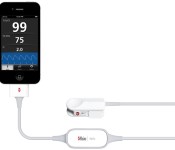
While O’Reilly was at Masimo, the company developed several cutting edge pulse oximetry devices, including the iSpO2 Pulse Oximeter that connects to the iPhone and gives readings via an accompanying app. The iSpO2, which takes its readings from a finger, is designed to measure both oxygen saturation in the blood and pulse rate, with technology that allows it to take readings during movement and with low blood flow.
 The iSpO2 Pulse Oximeter for iPhone
While it is not clear what position O’Reilly holds with Apple or how his pulse oximetry expertise will be used by the company, he does join a number of other hires in the medical field that have reportedly been recruited for the iWatch team. In 2013, Apple hired several scientists and executives from notable sensor companies like AccuVein, C8 MediSensors, and Senseonics, and two weeks ago, another report pointed to two additional hires in the sensor field.
Reports have suggested that Apple’s smart watch project, the iWatch, could focus heavily on health sensors and biometrics, possibly including features like a pedometer and a heart rate monitor. Apple’s multitude of hires in the health field does suggest, however, that the company could include even more advanced sensor technology in the iWatch or in a future product.
With the addition of O’Reilly, Apple has now hired employees with expertise in pulse oximetry, vasculature visualization (vein finding), non-invasive glucose monitoring, blood chemistry monitoring via microneedle, heart/breath rate monitoring, and fitness. Notably, several hires have also had experience with low-profile, non-invasive biosensor devices.
On his LinkedIn page, O’Reilly is also listed as both an Adjunct Associate Professor of Anesthesiology at the University of Michigan and a Professor of Anesthesiology and Perioperative Care at the University of California, Irvine.
     |
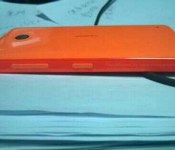
Nokia X Spotted in Orange

The Nokia X, aka Nokia Normandy, has been spotted once again in low-resolution photos, this time dawning an orange casing. Last week, we got our first leaked photos of the Nokia X showing off that it will come in multiple colors. We have also gotten the specs for this Android powered Nokia phone, and a lot of people went, “Really?”


- 4-inch display
- 5 MP camera
- 1500mah battery
- 512 mb of RAM
- 4 gb of storage
Very mid-ranged, border lined low-ranged. It is Nokia’s first attempt in the Android eco-system, and hopefully it won’t be the last. The images came from a French site named NoWhereElse, and they couldn’t verify if they were legit or not. Seems to be, given the phone looks similar to the other leak images, only the color is different.
Source: NoWhereElse
Via: Techno Buffalo

New Notifications, UI and More with Latest Google Wallet Update
Google Wallet is gaining a new update that appears to have started rolling out yesterday. The update is offering up quite a bit of new goodies that not only helps make Wallet a little easier to use, but also helps you shop a little smarter on the go.
- Scan the barcode of your Loyalty Cards to add them to your Wallet Account
- New notifications based on your location and loyalty cards to help you “shop and earn rewards.”

 At least that is what the Google Wallet posting on G+ said. However, this function has been available since the last release. (as pictured above). The implementation of it has changed though. Now when you are adding in a Loyalty Card it automatically launches your camera to scan the barcode and you have to tap the wording to add it manually. Images below.

 Other than that, near as I can tell, the update just gave a nice new UI slideouts and some adjustments to icon locations.

Before Update

After Update
If you are looking to pick up the APK and not wait on the Play Store to deliver the update to you, you can pick it up over at GappsEarly. 

US HTC One Misses Scheduled Android 4.4 KitKat Update
While the KitKat update process for the European HTC flagship has already initiated, US based owners will have to wait a little bit longer.
Carrier-banded handsets will not be receiving the update by the end of January, as previously promised by the company. Jason Mackenzie, President of HTC America, announced yesterday that the delay is due to carrier certification, which he hopes won’t take long. In fact he assumes that the whole procedure won’t last longer than a fortnight.

Props to HTC though for giving us some heads up instead of leaving us frustrated and wondering why our handset wasn’t seeded with the actual update.
European readers of AndroidSPIN. Let us know your first impressions of KitKat running on your HTC One. How do you like it so far? Sound off in the comments below.
Source: HTC
 AIVAnet