



OnePlus Smartphone Promises Best Specs Running CyanogenMod

A former executive over at Oppo has established himself a new company, with plans on blowing all our minds with a new flagship phone. This company that he established is called OnePlus, and they want to pair up with CyanogenMod to create a flagship that has the best specs. The image above illustrates such a declaration, as they posted it on their Facebook page.
Details about this phone have not been given quite yet, but if they are promising such things as best specs, you can imagine a phone that is buttery smooth and fast, with a vibrant screen that we will not be able to stop staring at. Once we hear more about this phone with the “best specs”, we will surely let you know.
Source: Techno Buffalo

Google wants you to know what you’re clicking on

Google knows a lot, both about its users and about the internet in general. Today, the team in Mountain View has found a new way to share more of its vast knowledge of the web with us by providing background info on sites that show up in search results. You see, site information is gleaned from Google’s Knowledge Graph, and for every site we’ve checked thus far, that means the data’s coming from Wikipedia — so don’t go thinking that this new cursory background check is 100-percent accurate. Google’s not providing the extra info about all sites, either, just those that are “widely recognized as notable online” according to the company’s blog post announcing the new capability. Still, it’s a nifty addition that should give netizens some peace of mind before clicking search-provided links, and Google’s promising that as the Knowledge Graph grows, so too will the amount of information this new feature can provide.
Via: The Next Web
Source: Inside Search

World’s most precise atomic clock will still be spot-on in 5 billion years

Most of us only pay attention to time when it’s causing headaches, but the same can’t be said of a team of researchers working out of the University of Colorado at Boulder. Led by National Institute of Standards and Technology fellow Jun Ye, they’ve crafted an atomic clock that can keep precise time for billions of years, a world record.
This hefty new timekeeper can tick off the seconds with the same unflinching regularity as the best of them, but it’ll be about 5 billion years before it experiences its first temporal hiccup. For the morbidly curious, that means the clock will still be precise when the sun starts ballooning into a massive red giant. That may not sound like a huge deal now, but when our descendants start laying in escape routes to some more pleasant planets they’ll be glad for that extra precision.
How does the thing work? Well, strontium atoms are held in “traps” formed by lasers, and researchers are able to track how often they oscillate by using that laser light to get them moving. It’s hardly a new technique, but you can’t argue with the results: The new clock is 50 percent more precise than the last record-setter, and Ye says that there are plenty more breakthroughs to come.
Via: The Verge
Source: NIST.gov

DJI’s Phantom 2 Vision takes a stabilized camera to the sky, we go hands-on (video)

You may not have come across DJI before, but this brand is no stranger in the world of hobbyist drones. Even production studios use the company’s gear for aerial videography, but that involves a lot more money than the average consumer can stomach — DJI’s three-axis camera gimbal alone can cost up to $3,500, on top of about $3,000 for its latest six-rotor aircraft. And this is before you include a camera plus a remote control. Fortunately, we now have a more affordable option that still comes with camera stabilization: the Phantom 2 Vision.
With a $1,199 price tag, this all-in-one package is aimed at prosumers who are looking for something more serious than, say, Parrot’s AR.Drone series. While the latter’s designed for entertainment, the Phantom 2 Vision gives you a taste of the advanced maneuverability and camera features from DJI’s pro-level products. The relatively light 1.16kg drone features a built-in 14-megapixel camera (with a 1/2.3-inch sensor), which is mounted on a tilt-axis gimbal under the belly. The only bits that need to be installed are the four self-tightening propellers, along with a swappable 57.72Wh battery that lasts up to 25 minutes (but takes from one to two hours to fully charge when depleted).
The package comes with its own remote control. This is powered by four AA batteries and features spring-centered sticks, with the left one taking care of height and yaw, and the right one for moving horizontally. To take off, hold both sticks down toward the bottom-center of the controller until the propellers are active. Doing the same when they’re spinning kills the motors, or you can just hold down the left stick until the propellers are idle. We initially found the controls to be quite sensitive, but over time we got the hang of it and managed to fly the drone without accidentally speeding — the top speeds are 15m/s for flight (beating the AR.Drone 2.0′s 11.11m/s) and 6m/s for ascent or descent, both of which are quite impressive. If needed, the sticks’ sensitivity can be adjusted through the drone’s desktop assistant software.
Now, in order to take advantage of the drone’s camera, you’ll need to install DJI’s app on your iOS or Android phone, and then mount it on the controller using the bundled clamp — it just about managed to fit our HTC One Max. As the phone will rely on the drone’s WiFi hotspot instead of the controller’s 5.8GHz radio, you’ll also need to mount the included WiFi range extender onto the controller to get the 300m reception range (we’ve managed to go up to about 500m). With the iOS or Android app installed, you can get a live stream of the drone’s view, as well as the ability to adjust the camera’s various parameters (tilt angle, field of view, resolution, ISO, white balance, exposure compensation, sharpness and more) and get live feedback for the drone’s bearing, altitude and speed.
Here’s the clever bit: If the drone goes out of range or somehow loses contact, it will attempt to head back to its takeoff point and land, provided that its GPS is active in the first place. Another fail-safe mechanism is that when the battery level goes below 15 percent, the drone will start to descend and land automatically, so be sure to start bringing the device closer to home when you get the first battery alert at 30 percent power (especially when you’re flying over water!).
Image and video capture are toggled in the app, and while you get a live stream on your phone, the content is actually stored on a microSD card inserted in the back of the drone’s camera. On a related note, the app also lets you browse the memory card’s contents, but you can obviously take it out for quicker access via a card reader. By default, the soundless video is recorded at 1080p/29.97 fps with a data rate of just under 13 Mbps, meaning the bundled 4GB card can store about 40 minutes of HD footage. We intentionally left the fish-eye distortion in the above raw footage compilation and our sample stills, but you can also download the Phantom 2 Vision’s Adobe lens profile to fix the distortion in Photoshop. Yes, Photoshop can fix both stills and video!
Video quality-wise, you can expect something close to that of any good smartphone camera these days, but due to the basic single-axis gimbal, the video captured can be slightly shaky due to even a light bit of wind. Software stabilization can only do so much. Alternatively, if you don’t mind forking out €415 (about $560), you can try Dronexpert.nl’s dual-axis, brushless gimbal kit for the Phantom 2 Vision.
The photos we took during daytime varied between 2MB and 4MB each. The image quality under the default settings is again comparable to that of smartphone cameras; it just requires some retouching afterwards. We also recommend trying the “hard” sharpness setting, as well as switching to RAW mode if you need more flexibility. The only notable problem is that normal photos taken at night are severely underexposed, so you’ll have to tweak the exposure settings in the app, rather than relying on the default values.
In summary, the Phantom 2 Vision impressed us with its ease of use, advanced camera features, flight performance, battery life and fail-safe features. The only thing that’s struggling to justify the $1,199 price is the occasional video shakiness. But on the bright side, some companies are starting to offer simple gimbal modding kits to help fix that problem on this drone, so there’s at least a fun — albeit pricey — upgrade option that doesn’t require too much technical knowledge.

Facebook’s targeted ads set to appear in apps other than Facebook

If you’ve ever been creeped out by those eerily targeted ads on Facebook, get ready for more of the same in other mobile apps as well. The popular social network has announced today that it’s testing a new ads platform with a select few advertisers and partners that will push those ads beyond Facebook’s walls. It’s a lot like Google’s AdSense network, except Facebook is focusing on mobile apps, and not the web. Sriram Krishnan, who works on the mobile and ads platform for Facebook, said in a blog post that “we’ll be extending Facebook’s rich targeting to improve the relevancy of the ads people see, provide even greater reach for Facebook advertisers, and help developers better monetize their apps.” What does this mean for you? Well, it likely means that you might end up seeing those behaviorally targeted ads in pretty much any app that signs up for Facebook’s ad network. And here we thought those autoplay video ads were annoying enough.
Filed under: Internet, Mobile, Facebook
Via: Wired
Source: Facebook Developers Blog

iPhone 5s Owners Using 20% More Cellular Data Than Last Year’s iPhone 5 Owners
Owners of the iPhone 5s, Apple’s latest flagship smartphone, are using significantly more data than iPhone 5 owners consumed last year — twenty percent more, according to a new research report from JDSU (via TechCrunch), in what the writer of the study called an “unprecedented increase” in uplink and downlink data demands.
The report examined data usage in both developed and developing markets, across more than a million mobile device users. iPhone 5s and fourth-generation iPad owners used the most data, with the Android-based HTC Sensation and the Sony Xperia SP coming up closely behind.
Users of the latest iPhone 5s consume more downlink data than any other smartphone users in both markets under study, consuming almost seven times and twenty times as much as the benchmark iPhone 3G users. This is consistent with the trend seen over the past three years where users of the flagship iPhone devices were the most data-hungry smartphone users. As in past years, we are not in a position to directly identify the root causes of this data consumption.

The study also found that iPhone 5c and iPad mini owners used less data than owners of Apple’s more expensive devices — though no easily-determined causal link can be drawn to those findings.
It noted that the top 1 percent of cellular users consume more than half of all downloaded data, with the top 10 percent of users consuming 90 percent of downloaded data. The company notes that this is broadly consistent with trends from the past two years. In addition, LTE data users, unsurprisingly, consume more data than users on slower data networks.
     |

TiVo reportedly lays off industrial design team, sees its future in DVR software

According to a rumor from Wired, the network DVR prototype TiVo showed off at CES is much more than a dream, and could be a big part of its future. The unnamed internal sources claim TiVo laid off 5 employees that make up most of its hardware team (which just celebrated its four Emmy awards), leaving just two engineers to handle support for its current devices, and those yet to come from third parties. We contacted TiVo and received the same response as Wired (available in full after the break), saying it’s going to “allocate resources where strategic growth opportunities exist…we expect growth in the cloud-based delivery aspects of TiVo’s business.”
TiVo has talked up the possibility of delivering a cloud-based DVR experience since last fall. After releasing the highly-regarded Roamio line, it’s possible the company feels there’s little growth left in set-top box DVRs, especially considering the current state of FCC regulations and CableCARD. Microsoft’s Media Center project appears to be over, and very few new third-party devices have shipped recently. We pinged investor Sam Biller for ideas on what other plans TiVo might have, and he pointed to a lack of detailed forecasts for the company’s nearly $1 billion in cash, seeing the possibility it could acquire another company to build hardware. Whatever TiVo does from here, it’s finally delivered on the promise of a capable do-it-all box with the Roamio — hopefully that essence remains in future products.
TiVo:
We continue to balance appropriate levels of staffing and expertise necessary to support our existing hardware business and continue our innovation in hardware platforms and accessories with the need to allocate resources where strategic growth opportunities exist – and there is no doubt that we expect growth in the cloud-based delivery aspects of TiVo’s business.
Filed under: Home Entertainment, HD
Source: Wired
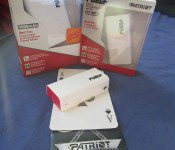
New Patriot FUEL+ battery banks bring 2.5A out charging to Mobile [Review]
Patriot isn’t a name you would typically associate to the mobile space. Many of you tech junkies out there are probably aware of Patriot and their PC offerings. They have been in the PC space for quite some time. Now they are starting to take their technological intelligence and apply it to the mobile sphere with a myriad of new offerings that any Patriot fan is sure to appreciate. On my side of the coin I have acquired the new line of FUEL+ battery banks.
The Patriot FUEL+ battery banks come in seven different offerings. On the smaller side you have the 2200mAh and 3000mAh single USB out offering. Then you have the 5200mAh and 6000mAh dual-port USB out version. Then they jump up to the 7800mAh and 9000mAh packs. Finally, there is a small 1500mAh one which has an Apple Lightning tip directly on it for those iOS guys out there.
In this overview/review we will be looking at the 9000mAh, 6000mAh and the 5200mAh. More so lumping them together in one big review, but hey, we have all three sitting here for photo ops and we don’t see any need to make them separate.
 With the exception of the Lighting 1500mAh and the smaller single USB port 2200 and 3000, the rest of the line looks identical. On the outside they have the FUEL+ branding right on the top, with the Patriot logo on the side. The outer casing is white plastic that gives like a turtle shell cover over the red main body of the battery bank.

 On the same side as the Patriot logo you find a slightly recessed power button and 4 LED lights. Each light indicates 25% charge remaining in the battery bank, pretty typical in the industry really. Interestingly enough though, they chose to use blue lights for this. Not that I mind, I like blue, I just would have expected red to go with the main casing of the battery. The lights do not remain on while charging, put a quick tap of the power button will illuminate them so you can see approximately how much power is left.
 On the same side as the power button, but on the back, is where you find the micro USB charging port. Easily labeled with “input”. On the opposite side you find the dual USB ports. There is a good reason for this design and I will explain it in just a minute, but first, look at what the port on the left says. Yup, these battery banks have 2.5A and 1A outs. I have seen a number of battery banks that hover in the 2.1A range and some even getting up to 2.4A. To the best of my knowledge though, Patriots FUEL+ batteries are the first to push 2.5A.

 I ran each through a simple 30 minute charging test to see how quickly the 2.5A out port would charge my Sony Xperia Z. I have been exclusively using Battery Monitor Widget from 3C for all these tests so that you can see as much relevant information as possible. Take a quick look over the results from start, to 15 minutes to 30 minutes.


 As you can see I charged up from 51% to 63% in 15 minutes, and 51% to 76% in 30 minutes. I gained 25% charge in 30 minutes. That translates into 1% charge for every 1.2 minutes. This was also conducted on a FULLY charged FUEL+ battery bank. Each one performed identical. I did this with my phone on, connected to cell and Wi-Fi plus Bluetooth active. I used the supplied short USB charging cable that came with the battery banks too. Individual results may vary depending on device, internal battery size and what is going on with the device at the time. Compared to some of the other battery banks on the market, the FUEL+ did charge up my device a little faster. For instance, the Ventev gave me 20% in 31 minutes under similar conditions. In a world where power for our devices is always needed, the FUEL+ like is certainly one you should get your hands on.
I told you that I would also explain the design reasonings behind why the charging port and USB out ports are on opposite sides of the battery banks. Patriot didn’t do this to be different. Many of the battery banks we have showed you over the years have the charging port and out ports right with each other. In the case of the FUEL+ banks, these are opposite each other because of another feature built into the product. They can Simultaneously charge your device and the battery bank when plugged in. Hence the opposite plugs. Simply plug your wall charger into the batter bank, then the battery bank into your phone. One seamless inline charging solution. (both images below are during the dual-charging from the wall through the battery to my phone.)

 To top it all off, put the icing on the cake if you will, each battery bank is also made using the highest standard of battery on the market, specifically, the technology found in your laptop batteries.
FUEL+ mobile rechargeable batteries have built-In protection against over charge, over current, over temperature, under discharge, and short circuit to ensure efficient and safe charge cycles.
What about size? Over the years battery banks have gotten much smaller with more power inside. The 7800 and 9000 are in the same housing and measure in at 3.7 x 4.5 x 1 inches and weighs 6.4 oz ( according to Amazon) . The 5200 and 6000 are also in the same housing and measure in at 3.7 x 1.7 x 1 inches and weigh in at 4.8 oz (also according to Amazon). While I don’t have a physical scale here to double check, the 5200 and 6000 do feel the same, or at least close enough that it doesn’t make much difference.
 With this much technology built in, the high-standard batteries used, the pass-though charging and the 2.5A output port, one would think that the FUEL+ battery banks would be a bit more on the pricy side of the spectrum for portable power. Considering all that you are getting, the price points of each battery is very competitive. Here, take a look at pricing details (at the time of posting via Amazon) of each below.
Patriot FUEL+ Pricing
- 9000mAh – $69.64
- 7800mAh – $52.98
- 6000mAh – $50.99
- 5200mAh – $44.40
- 3000mAh – $29.98
- 2200mAh – $29.99
- 1500mAh – $40.98 (That is the Lightning tipped Version)
Patriot has a heck of a line up going for them with the FUEL+ battery banks. If the standard 2.1A and 2.4A battery banks just don’t seem to give you enough juice quick enough, you might want to give one of these a try. Feel free to head to Amazon and choose your perfect battery size.
Patriot FUEL+ Battery Banks all models on Amazon.com

More info at Patriotmemory.com



Get an additional week of free tunes if you sign up for Beats Music soon

With just how popular Beats headphones are, we can’t say we’re surprised that Dr. Dre’s similarly named music service has had a hard time coping with a flood of users during launch. As such, Beats Music isn’t accepting any new subscribers until the kinks are worked out, but there is a silver lining. So long as you download the app and reserve your username this week, you’ll get an additional seven days to trial the service. Once the issues are worked out, you should get an email giving you the all clear — hopefully that’s before its Windows Phone launch in a few days.
It’s not like you have to live your life in silence until then, though. Last we checked, Rdio, Spotify, Music Unlimited and Xbox Music were all working just fine.
Filed under: Cellphones, Mobile
Source: Beats Music

Yahoo search gets safer with automatic encryption

Just as Marissa Mayer promised, Yahoo has started plugging security holes ahead of its self-imposed Q1 2014 deadline. From now on, all of your searches done via the internet giant’s home page will be automatically routed through a secure server. However, this appears to only be in place for the US site, as the the UK and Japan versions still conducted our queries through insecure means. We’ve reached out to Yahoo and will update this post if we hear back about international availability. Hopefully this move is strong enough to keep prying eyes — or anyone’s besides your own — out of your search history.
Filed under: Internet
Via: Marketing Land
Source: Yahoo (Tumblr)
 AIVAnet