


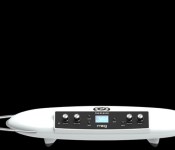
Moog’s Theremini suits all skill levels with adjustable scale correction for its space-controlled tunes

Sure, Moog is known to many for cranking out stellar analog synthesizers, but the outfit also has a knack for building a stable of Etherwave Theremins. In fact, founder Bob Moog started tinkering with the space-controlled instruments back in 1954. If you’re a bit unfamiliar with the devices, theremins use two metal rods to control pitch (vertical) and volume (horizontal) based on the proximity of the user’s hands to each end, without ever touching the unit. At NAMM 2014, the North Carolina-based company unveiled a prototype of the Theremini: a $319 offering that has assertive pitch control built in for all skill levels. This feature allows you to dial up or down the scale correction, making it impossible to play a wrong note in when it’s turned up to the max. For more advanced users, turning that dial all the way down offers no assistance. There’s also a tuner for visual feedback of each note, displaying how it stacks up to the perfect spot.
Inside, an analog heterodyning oscillator is paired with Moog’s Animoog engine and built-in stereo delay for creating the range of tones. On-board presets allow you to choose from a library of patches, store scales, set ranges and create patch-specific delay settings. To enable playing just about anywhere, a speaker is tucked inside the Theremini with headphone jack and audio outputs alongside connections for pitch, gesture and MIDI control. Unfortunately, there’s no word on when the device will ship, but if you’re in a hurry to grab a theremin now, there’s always the DIY route.
Filed under: Misc
Source: Moog
Stratasys’ new 3D printer creates multicolored flexible materials

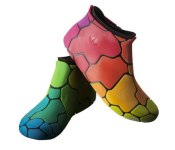
Stratasys‘ has a new $330,000 3D printer, but this one has the potential to do a whole lot more than monochrome figurines. In fact, the company says it’s the first machine able to create objects in colored, flexible materials. The Objet500 Connex3 3D printer uses rubber and plastic as base materials, although according to Stratasys (the company which now owns the MakerBot series) material combinations will be able to offer different levels of rigidity, transparency and opacity. Colors, meanwhile, are produced by the same mix of cyan, magenta and yellow you’ll find on your inkjet printer at home — it even comes with six palettes of rubbery “tango” colors, if you’re perhaps looking to channel your ’90s tastes into some tasteful flexible booties, as seen above.
At the technical level, the printer can go as fine as 16-micron layers, offering a high level of detail and finish, and can pump out around 30kg of resin (that is, base material) per run. Talking to the BBC, a Stratasys spokesperson said the advanced printer could cut down industrial design prototyping times by 50 percent, although he was talking about the time from prototype to market, not printing time itself. The Objet500 Connex3 launches today, although those flexible color printing materials won’t be available to buy until Q2 later this year, so hold on to those neo-boot dreams for now.

Switched On: The next steps for digital wellness, part one
Each week Ross Rubin contributes Switched On, a column about consumer technology.

Some of today’s leading wearable devices are, at their core, little more than souped-up pedometers. Their once-dim monochrome LCD screens have migrated from atoms to bits that connect to the internet, allowing them to display information in a more engaging way and track it over time. They have been a big win for output, but with essentially the same input.
Indiegogo in particular has been a fertile launchpad for alternative wearables for the fitness enthusiast. One has been the Push band, which measures things such as force, power and velocity for activities like weightlifting. And the impact of that might be measured by the Skulpt Aim, which tracks muscle health. Another alternative to run monitors in development is the Atlas, which includes a digital footprint of 30 different exercises for more intelligent exercise analysis.
But even the most sophisticated and accurate exercise monitoring provides insight into a very small picture of our overall wellness. To provide greater insight into our quantified health, far more needs to be considered.
Nutrition
For the common problem of obesity, changing eating habits is likely to have a bigger payoff than the daily difference of a few thousand steps. And while there are many apps that allow people to input their food manually or even take photos of it, that is almost the equivalent of having us manually count the number of steps we take in a day.
Some of the earliest efforts in this space have come from the HAPIfork. It measures the speed and frequency with which one shovels food into one’s mouth, but it can’t distinguish between lettuce and butter-infused mashed potatoes. Then there’s TellSpec, a spectrometer that offers to analyze the nutrient and allergen content of your food. Given, that’s an order taller than a stack of Big Macs, and it’s been met with a large dose of skepticism.
Stress
Stress, and how one deals with it, can be a key factor in determining one’s level of wellness. It’s easy to detect the signs of stress such as a faster heartbeat, and many gadgets like the Basis watch can measure that. What’s more difficult is determining stress itself. Perhaps some guesses could be made about factors such as noise levels, late hours and scheduling. Companies such as Helicor, with its StressEraser, and HeartMath have developed biofeedback devices to help with relaxation and stress reduction; the latter has released a version that connects to iPhones via cable.
Environment
At CES, a couple of companies showed off app-connected air quality monitors. These included the centralized Alima air quality monitor and the tiny, distributed CubeSensors that won the TechCrunch Hardware Battlefield competition. Both do for indoor air quality what The Weather Channel reports on in terms of outdoor air quality.
The next Switched On will discuss some of the less volatile factors that have an impact on our health and wrap up with some thoughts on how we all might benefit if we can find a way for them to come together intelligently.
Ross Rubin is principal analyst at Reticle Research, a research and advisory firm focusing on consumer technology adoption. He shares commentary at Techspressive and on Twitter at @rossrubin.
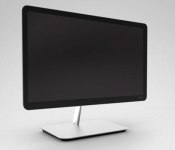
How would you change Vizio’s 24-inch All-in-One?

Vizio! Out of nowhere, the budget TV maker emerged with a laptop and desktop combination that earned plenty of sideways glances and praise. When we pulled the company’s 24-inch All-in-One desktop into our labs, we found that form had taken too much precedence over function. Yes, it looks gorgeous, but we couldn’t say the same about the flaky trackpad and painful keyboard. For $800, it was certainly cheap enough that you could splash out on a replacement keyboard and mouse, but was that too much for your blood? Share your thoughts on our forum thread and let’s give Vizio’s designers something to think about.
Filed under: Desktops
Source: Engadget product forums
KGI Research predicts Samsung Galaxy S5 specs, suggests there will be 2 Configurations
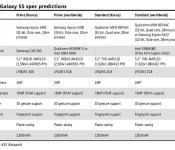
 With MWC 2014 and the expected announcement of the Samsung Galaxy S5 bearing down on us, it’s only natural that there is going to be a flurry of rumours and predictions to come over the next few weeks. KGI Research is the latest to take a stab at Samsung Galaxy S5 specs and has come up with the table that is pictured above. Most notable is that KGI has suggested there will be two configurations of the S5, both a ‘Prime’ version along with a ‘Standard’ version.
KGI suggests that the difference between the Prime and Standard versions will be the processor, RAM and screen: on the Prime version, it’s expected that it will have Samsung‘s own octa-core Exynos 5430, 3GB RAM and WQHD AMOLED screen, whereas the Standard version will get either a quad-core Qualcomm MSM 8974AC chipset or octa-core Exynos 5422, 2GB RAM and settle for a FHD AMOLED screen. KGI says that the remaining hardware will be the same, however does also predict that the rumours regarding a fingerprint scanner and improved gesture support at true and will make it to the final product. It will definitely be interesting if this prediction comes true as it will potentially add more confusion to Samsung’s already slightly confusing product line.
What do you think about Samsung having two configurations of the Galaxy S5? Let us know what you think in the comments.
Source: 9to5mac via Android Ice Cream Sandwich

Google reportedly buying artificial intelligence startup for $400 million

According to reports (and confirmed by the internet company itself), Google has bought Deepmind: a relatively small AI company from London. Re/code broke the news, stating that Google had sunk $400 million into the purchase — a figure that the company hasn’t yet confirmed. The startup’s placeholder site outlines its work on “general purpose learning algorithms,” with its first projects encompassing games, e-commerce and simulations. It sounds like the team might be working in a separate direction to Google’s recent robotics purchases, but the company (unsurprisingly) is plenty interested in the future of artificial intelligence: it teamed up with NASA to launch an AI research lab just last year.
Source: Recode
[LEAK] The Nokia Normandy will actually be called the Nokia X
 It’s suffice to say that the proverbial ‘Bigfoot’ of the Android world right now is the Android-based Nokia smartphone that we have heard so much about the last few weeks, the Nokia Normandy. Maybe Nokia will show it to us at MWC 2014 next month, maybe we’ll never see it out in the open, but until the day that Microsoft finalizes the deal to acquire Nokia, we’ll keep dreaming. This latest leak about the Normandy refers to the name of the phone, which evleaks says is going to be officially called the Nokia X:
Project Normandy = Nokia X
— @evleaks (@evleaks) January 23, 2014
It’s interesting that Nokia is going back to the ‘X’ nomenclature seeing as the last time they used it they were still making feature phones (i.e. phones with keypads and keyboards), but seeing as they don’t really have a line for this type of phone anyway, why not? Personally, I like the idea of the Nokia X; sure, its specs aren’t going to set the world on fire, but its existence at all is certain to pull a few nostalgia strings, such as my own.
What are you thoughts about the Nokia X: Would you considering getting one if it were ever released? And do you think it’s going to be announced at MWC 2014? Let us know your 2 cents in the comments.
Source: Twitter

Alt-week 01.26.14: Hawking says there are no black holes, and a 3D printed liver could be on the way
Alt-week takes a look at the best science and alternative tech stories from the last seven days.

Science. What good is it if the end result is Robosapien and a sweet 3D printed phone cases? Thankfully, there are great minds at work to put it to far better use. Like robo-legs and 3D printed body organs. The best part? The technology is almost ready for prime time. This is alt-week.
We know it’s a bit of a stretch to call it “wearable,” but a newly developed robo-ankle is way more useful than getting tweets on your wrist/eyeball, we think you’ll agree. Developed by Yong-Lae Park at Carnegie Mellon University, the devices works by combining a shoe, ankle brace and knee strap along with four pneumatic tubes acting as the muscles. The pneumatics not only provide the “muscular” contraction, they have also been designed to mimic the anatomical configuration of the human lower leg. The purpose isn’t to serve as a full prosthetic however, rather to help train and strengthen the legs of patients with conditions such as cerebral palsy — though Park also suggests it could be used to help with injuries too. The video above shows it in action, and we’re curious to see that the Vibram five-finger craze is catching on in the lab as much as the local park/mall.

One of physics’ biggest names is proposing a new theory that takes on one of astronomy’s biggest characters — black holes. The problem with black holes is that they cause two of physics’ top theories — relativity and quantum — to butt heads. Hawking applied quantum theory to black holes, and calculated some radiation should be emitted, eventually causing them to shrink and die — something that, again contradicts the popular belief that they are immortal. The key issue is that of event horizons — the boundary beyond which there is no affect to the outside observer. Hawking theorises that these should be reframed as “apparent horizons,” where a surface can trap light, but also release it during slight changes in their shape. Is this going to usher in a new understanding, a new standard model for black holes? The paper — at two pages, fairly short in physics terms — is still pending full peer review, and Hawking’s been wrong before, but at the very least, the hope is a fresh perspective could provide at least some new understanding of the sky’s most mysterious object.

If you thought that 3D printing was mostly about creating trinkets and key fobs, then you’d be right. But, that won’t remain the case for long as the technology advances to include metal, medicines and… body parts. In fact, according to a recent report, we could see 3D printed organs (of the body, not musical, variety) as soon as this year. San Diego-based company, Organovo, is claiming its bio-printing technology could deliver a working liver tissue, and has overcome the tricky part of a working vascular system to boot. Any tissue produced will be for lab use only, and will have to go through extensive checks before it’s let anywhere near a needy recipient. Either way, should Organovo prove successful, the proof of concept that living tissue can be printed, and kept alive long enough for testing (and theoretically, human application) is a giant step forward.
Seen any other far-out articles that you’d like considered for Alt-week? Working on a project or research that’s too cool to keep to yourself? Drop us a line at alt [at] engadget [dot] com.
Google and Samsung agree to license each other’s patents for 10 years

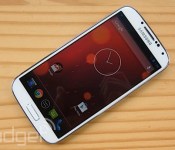
It’s no secret that Google and Samsung need each other given that Samsung dominates Android device sales. It only makes sense, then, that the two companies have just struck a deal to license each other’s patents for the next 10 years. In addition to accelerating product research, the agreement should reduce the chances for future patent lawsuits; anyone attacking one company now has to consider the other company’s licensing arrangements. The move also suggests that Samsung isn’t keen on burning any bridges — even if it starts drifting away from Android, it should remain in Google’s good books.
Filed under: Cellphones, Mobile, Samsung, Google
Via: TechCrunch
Source: Samsung Tomorrow

Original Macintosh Team Gathers to Celebrate 30th Anniversary with Stories, Demos and Laughter [Mac Blog]
Last night, over 100 members of the original Mac team gathered to celebrate the Mac’s 30th anniversary in De Anza College’s Flint Center, where Steve Jobs first introduced the Macintosh 30 years ago. The event was focused around three separate panels: the conception of the Mac, the building of the Mac and the third-party developers who built software for the Mac.
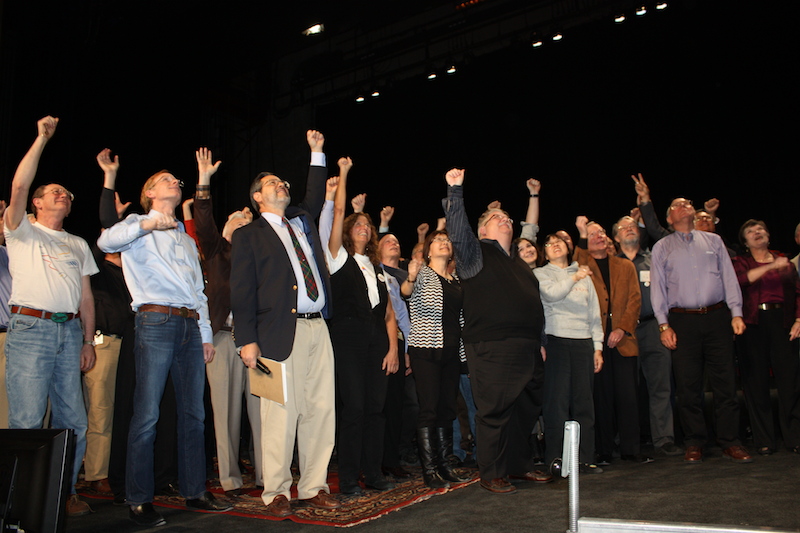
The evening began with video of both Jobs’ introduction of the Macintosh in the Flint Center and a couple minutes of the 90-minute Macintosh presentation at the Boston Computer Society, which was made public for the first time last night. Master of Ceremonies and Apple employee #4 Bill Fernandez then introduced the first panel of the night: the conception of the Mac.
Moderated by New York Times writer John Markoff, the panel included Mac team members Larry Tesler, Daniel Kottke, Ron Holt, Jerry Manock and Mark LeBrun. While introducing themselves, Manock himself recalled that he initially thought he was going to be fired due to a defect on the Apple III’s design that was seen as his fault. Manock states that he was called into Jobs’ office while trying to fix the design and, instead of being fired, was given a job to design the Macintosh.
Later, when asked what carried over from Jeff Raskin’s version of the Macintosh project and Steve Jobs’ version of the Macintosh product, Holt, who developed the power supply for the Apple II, said the main difference was that the computer became a product the team themselves wanted, echoing Apple’s current product philosophy.
From an abstract, it became a reality. But it was the sum of its parts, but the parts were all what people wanted. And that enthusiasm, you see, people put themselves into that computer. It’s the same thing that happened with the Apple II. Everyone worked on that Apple II because they wanted that Apple II. This process of invention was very unusual. I think that this world could use a lot more of that.
The second panel, moderated by Wired’s Steven Levy, focused on the creation of the Mac and included Mac team members Bill Atkinson, Caroline Rose, Andy Hertzfeld, Bruce Horn, Steve Capps, George Crow and Randy Wigginton. During the introductory part of the panel, which detailed how each employee joined the Mac team, Wigginton, who created MacWrite, said “I feel like I’m listening to a bunch of lies, because according to the Ashton Kutcher documentary…” referencing Ashton Kutcher’s Steve Jobs biopic Jobs and drawing a roar of laughter.
The panel then discussed how difficult it was to ship the Mac on time, noting that some of them worked up to 90 hours a week to fix things and get them as good as they could be for shipment. Levy then asked the group about their work with Microsoft, noting Bill Gates’ claim that Microsoft had more people working on software for the Mac than Apple did. Wigginton quickly responded, saying “If they had more people than us then it doesn’t speak very highly of the quality of the people they had,” which drew massive applause and laughter.
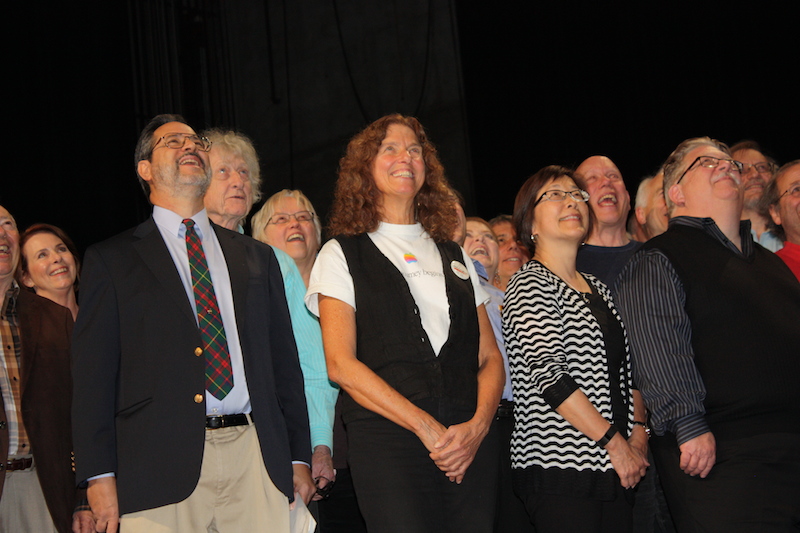
Hertzfeld, who was a software designer on Macintosh, then jumped in, noting Microsoft was the first company that got a Mac and ended up helping shaping the Mac, creating three programs to accompany Apple’s MacWrite and MacPaint to give its young ecosystem a boost. Further, he also noted one of Microsoft’s systems architects kept asking how the internals of the software worked. Hertzfeld said he was curious as to why they kept asking, but eventually assumed why. “I quickly thought ‘maybe they were trying to copy the Mac?’ And sure enough, in 1983, they announced Windows. We were kind of shocked by that.”
Capps, who helped create Finder with Horn and worked at Microsoft from 1996 – 2001, then mentioned that well into 2000 he would be in a product meeting and Gates, when he didn’t like any of the ideas that were presented to him, would say “What would Apple do?” He said that Apple’s ethos and product environment were burnt into his psyche and inspired Gates. Horn then noted the curiosity around Apple still exists today.
Everybody looks at Apple and says ‘what would Apple do?’ and everybody is copying Apple. So something that Steve did and all the people who he hired made Apple have a particular way of thinking and particular passion for the user of the product that is here today for years and years so I think that’s amazing.
Atkinson then said making the Mac was more about creating art for them as opposed to doing work. This mentality, Atkinson stated, was why Jobs made the team have their signatures on the inside of the Mac, because “artists sign their work” and Jobs wanted them to be proud of what they built.
Later on, Caroline Rose, who wrote the Macintosh’s technical documentation, said the team had tears in their eyes and became depressed when it was announced the price of the Mac was raised from $1,995 to $2,495 to offset the massive marketing costs, because the people they built the computer for wouldn’t be able to purchase it.
Apple CEO Mike Markkula then came on stage and thanked the entire Mac team for their accomplishment. Fernandez then symbolically presented Markkula with a plaque that had a trophy on top of it with six arms holding up a Mac, which said: “Apple and Macintosh would never have happened without you. Your participation changed the world.”
After bringing out an original Macintosh and re-demoing the original demo Steve Jobs conducted at the product’s introduction in 1984, Steve Hayden, the copywriter behind many popular Apple ad campaigns, including the famous “1984” commercial, gave a presentation on the history of Apple’s advertising.
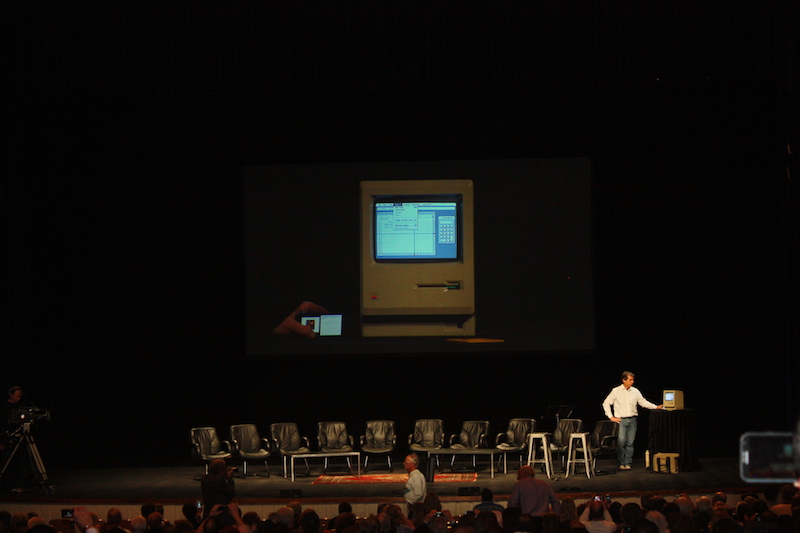
Hayden recounted the early development of “1984″ to the 20-page inserts he helped create to explain how to use a Mac to the “Computer for the rest of us” tagline to the failure of the “Lemmings” Macintosh Office commercial to the resurgence of Apple advertising with the iMac’s “Three Steps” ad.
In the final panel of the evening, CNET’s Dan Farber moderated a panel that included third-party developers Mark Canter, Charlie Jackson, Jim Rea, Heidi Rozen, Ty Roberts, David Bunnell, Maryline Delbourg Delphis, Adam Hertz and Steve Jasik, focusing on how developing for the Mac changed their lives, echoing Apple’s recent efforts to highlight how developing for the App Store and iPad has changed people’s lives today.
Bunnell, who founded MacWorld, remembered how he had worked with Steve Jobs and Apple to develop MacWorld magazine in secret. Jobs initially didn’t want to be on the famous first cover for MacWorld, but was talked into it. Jobs later changed his mind, telling Bunnell he didn’t want to be on the cover anymore, but Bunnell lied and told him it was too late and the magazine was already printed.
Finally, Jerry Manock, Caroline Rose and Patti Kenyon came on stage to read a letter from the Mac team to the Macintosh, and to the various Apple employees that attended the event:
Dear Mac, today you are celebrating your 30th birthday. Here are some things we wanted you to know as you enter your fourth decade. Your early family really loved you. We had lots of fun being pirates and working very hard together, before you were born. You were a cute, chubby little baby who has grown up to be as slender as a No. 2 pencil with the power of an NFL middle linebacker. You were writing and drawing sketches at a very early age, who would have guessed that you’d now be making movies all by yourself and sharing it with people around the world.
Your list of accomplishments is truly astounding. We are very, very proud of all the tasks you have mastered. Many more than we could have ever imagined! Never forget that your parents wanted you to always be respectful of the individuality of your users. And we hope that you will continue to help them communicate their uniqueness to each other.
You can’t let vanity and compliments about your beauty stop you from always remembering your core purpose: fostering innovation and creativity. Finally, don’t forget to keep your sense of humor. True artist not only ship, but laugh! Don’t forget about the little Mac Man who used to run across the desktop every once in a while. So, have an insanely great happy birthday. We all wish you continued success in your next 30 years, helping pilot the Mothership.
Sincerely yours, members of the 1984 Macintosh Development Team.

     |
 AIVAnet
