



Google Glass gets prescription glasses: four styles, $225 each (video)

Remember when Google said its wearable would work perfectly fine with prescription glasses? Well it’s finally delivered, offering a $225 upgrade option for current Google Glass Explorers. Crafted from titanium (whatever else?), the designs are pretty unassuming and classy: they look like glasses frames you’d see at an optometrist. There’s four styles to choose from — Curve, Thin, Split, Bold — making the selection sound more like font categories than frame categories. Google Glass then attaches to the frame through several screws. More styles (in other materials and shapes, possibly) are incoming, but the team behind this launch range (the designs were all done in-house at Google) said their aim was simplicity — it helps that the extra frame-age also helps to obscure the still rather conspicuous Google eye-piece. Early adopters will be able to shop around for frames starting this afternoon and VSP, the largest optical health insurance provider in the US, is working with Google to offer subsidized frames and lenses for those that qualify.
Introducing the Titanium Collection, 4 new frames for #googleglass… and 2 new shades as well http://t.co/6izKSdACKL pic.twitter.com/UXp5n8H3NW
– Google Glass (@googleglass) January 28, 2014
Filed under: Wearables, Google
Source: Google Glass (Google Plus)
Smartphone sales may have topped 1 billion in 2013, depending on who you ask

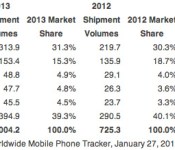
You once had to look to the broader cellphone market to see more than a billion phones ship in one year. Well, times have changed… at least, if you ask the right analysts. IDC now estimates that smartphone shipments topped one billion for the first time in 2013. However, Strategy Analytics begs to differ — it reckons that shipments fell just short, at 990 million. Whether or not the industry hit its symbolic milestone, the roughly 40 percent increase over 2012 data shows that the smartphone market had plenty of room to grow last year. Samsung led the pack with 31.3 percent of the the market, while Apple dipped to 15.3 percent as both Samsung and Chinese manufacturers (including Huawei and Lenovo) chipped away at its second-place position.
As for what happened in the fourth quarter? Both analyst groups say that Samsung was once again the top vendor, although they note that the Korean firm’s share was largely flat at 29 percent. Not that Apple fared any better, as its record-setting iPhone shipments weren’t enough to prevent a slide to 18 percent share. Huawei, LG and Lenovo were the real victors — each of them typically gained a point or more of share in the past year. IDC chalks some of this up to the rise of very low-cost smartphones, which are quickly taking over developing markets like China and India. Companies which focus on more expensive handsets, such as Apple and Samsung, have the most to lose in these areas.

Filed under: Cellphones, Mobile, Apple, Samsung, LG, Lenovo
Source: IDC, Strategy Analytics

Fujifilm’s weather-resistant X-T1 camera ships next month for $1,300

Fujifilm shooters, get your wallets ready — the camera maker’s latest compact interchangeable-lens camera is about as full-featured as they come in this price range. The X-T1 is the latest X-Mount cam in the company’s lineup, which includes models such as the X-M1 and X-E2, and it’s compatible with the same suite of Fujinon XF and XC lenses. It’s set to ship next month for $1,300 body only, or $1,700 with an 18-55mm f/2.8-4 kit lens. The banner features here include a 16.3-megapixel APS-C X-Trans CMOS II sensor, a large 2.36M-dot OLED viewfinder, a refreshed UI and an EXR Processor II, which enables a half-second start-up time, 0.05-second shutter lag and a half-second shooting interval, along with an 8 fps burst mode that includes tracking autofocus.
Another significant addition, of course, is the weather-resistant build. When paired with a weather-resistant lens, the X-T1 can hold up to dust and water, and it’s freeze-proof to 14°F (-10°C), should your latest assignment bring you to the arctic tundra in the dead of winter. Additionally, the 3-inch, 1.04M-dot tilting LCD is reinforced with tempered glass, but assuming you’re using a neck strap properly, there’s no excuse for letting your X-T1 collide with the earth. Finally, it’s the first of its kind to support the new SDXC UHS-II format, which yields write speeds double that of a traditional SD card. There’s also WiFi connectivity, with instant transfers and remove shooting via the Fujifilm Camera Remote app. Three new weather-resistant lenses, including an 18-135mm f/3.5-5.6, a 16-55mm f/2.8 and a 50-140mm f/2.8, will launch as well, though we don’t have pricing and availability information to share at this point.
Filed under: Cameras
Android 4.2.2 gains approval for AT&T HTC One X, slated for 1/29

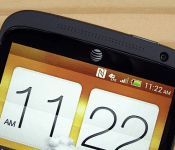
Looks like everyone still sporting a stock HTC One X on AT&T’s network will finally see their update to Android 4.2.2. The update has passed through AT&T’s technical team and has been certified for delivery to their customers. The Update obviously brings a much needed update to the device in terms of Android OS version. It also brings along the Sense 5 UI overlay as well. You guys can expect to find Blinkfeed and a few other additional software enhancements. All of which can be perused at the AT&T update support page.
HTC AT&T One X customers – We have received Technical Approval for the MR with Sense 5 + OS 4.2.2. The OTA is targeted for 1/29. Thanks!
— Mo (@moversi) January 28, 2014
Don’t forget though, this WILL BE the last update that will be pushed out to the device. There could be a smaller one later on if any major bugs are discovered upon delivery, but don’t expect any more OTA updates to move you up a notch in the Android OS versions.
Via HTC Source
Android 4.4 for the HTC One Almost Here! Sense 6 Spotted on Graph. – Device Updates

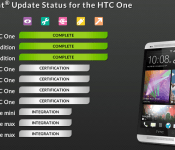
Device Updates is coming at you in this Monday night. We didn’t have much this week. Everyone with an HTC One will be happy to hear that Android 4.4 is right around the corner. We will let you know when carriers start rolling it out.
Device Updates
Android 4.4 for HTC One waint for certification
Other HTC devices show up on update graph as well as Sense 6
The 12 Most Desirable Cars of 2014

1. There is one automobile that tops most of the “I Love Cars More than Anything Else in the World” lists and it is the awesome and fast 2014 Alfa Romeo 4C. One of the things that Americans can thank Fiat and Chrysler for, if they love fast, expensive, well-made cars, is the alliance they made in 2009, to keep Chrysler afloat, which allowed American car enthusiasts to have cars like the Alfa Romeo.
Ask an Alfa owner what’s so great about an Alfa and he is likely to say that it resulted in the making of the Ferrari, since Enzo Ferrari was an employee for Alfa Romeo before he created his own masterpiece. But, more often than not, Alfa owners are poetic when they describe their cars. The Alfa Romeo has a personality, a human-ness, they will say, that has been processed out of other luxury cars.John Moore an Alfa Mechanic at Sell My Car San Diego states “It is not a cookie-cutter car, but remains unique”. Other say it is the Italian touch that makes the Alfa beautiful, fun, and, yes, passionate.
2. The Aston Martin Vanquish Volante 2014 has been much anticipated by car lovers. Some say that owning an Aston Martin puts the owner in the most exclusive club in the world. Being the car that James Bond drives and that Prince William left his wedding in may be enough for some. Again, there is a visceral reaction to this luxury car. The 2014 Vanquish Volante costs roughly $300,000, but it is not for the cost that makes people love this car. At one point Aston Martin was raising its own cattle to make its own leather for its cars’ interiors. It is the appointments, and the beauty, and the ambience, and the inside umbrella holder with its own umbrella. Really, what more would one want?
3. The 2014 BMW 4 Series only costs $40,000, but still sets motor enthusiasts’ hearts aquiver. The styling is beautiful and technically it is a superior car. But, most owners say that to understand what is so great about a BMW a person has to drive it. It shines when it is on the open road. Words like “connected to the road” and “exhilarating” are often used to describe the attributes of a BMW. The 2014 boasts a powerful four-cylinder motor, which should continue the highly-praised performance of the BMW quite nicely.
4. This car is a continuation of a car that was designed in 2009 by Cadillac, but was never produced. Many of the ideas in the first design are used in the ELR, 2014. The automobile has an electric engine in combination with a gas engine that can potentially cover a 300 mile range. The lavish interiors remain, as always, along with an in-car service which can assist in knowing when to recharge or make hotel reservations for its owners.
5. Muscle car, maybe, but luxurious, yes, the Chevrolet Camaro Z/28 for 2014 will not disappoint. Going on sale for approximately $55,000, this is not your grandma’s Chevrolet. With an LS7 V8 engine, it will have over 500 horsepower and will be lighter and faster than before. Hot-rodders rejoice.
6. Ferrari LaFerrari 2014 can get up to 217 miles per hour, possibly because of its 949 horsepower engine. The driver’s seat in the newest Ferrari does not adjust; the steering wheel does, however. The car’s pedals are also adjustable. This outstanding gem of an automobile may be ordered now and will be constructed in batches of 499 cars at a time. The cost will be $1,000,000.
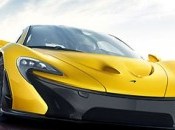
7. A hybrid has made it to the list of most desirable cars of 2014. It is the McLaren P1. English made and costing about $1.2 million dollars, this car looks and performs as a luxury car should. The car is not only beautiful to look at, but is also economical, fast, and ostentatious.
8. The new Porsche is the 2014 Porsche 918 Spyder. Why so desirable? Three words will tell why Porsche lovers are so addicted, they are: speed, excitement, and quality. At a mere $ 850,000, many predict there will not be many manufactured, and they will sell out of these cars rapidly. When Porsche owners are asked what makes Porsche so great, they usually answer, “If you have to ask, you won’t be able to understand.”
9. Some may not agree, but for Corvette lovers 2014 is a red letter year. The new Corvette Stingray is out. Redesigned and with a 6.2-liter V8 engine, it goes from 0 to 60 in 3.8 seconds. One of the most anticipated features is a Drive Mode Selector which allows the driver 12 choices in performance based on driving conditions.
10. The 2014 Jaguar F-Type is curvaceous, a convertible, and a two-seater. A 495 horsepower version is available and it has 0 to 60 capabilities in about 4 seconds. Can you hear sports car fans cheering?
11. Believe it or not, many have rated the 2014 Kia Cadenza as one of the best luxury cars of the year. Its sticker price is $45,000. It isn’t a sports car, but it does have enough bells and whistles to warrant being voted one of the best.
12. The Lexus IS, on the other hand is a sports sedan, coming in at about $40,000. It has 204 horsepower and can go from 0 to 60 in a respectable 7.7 seconds. It has a 3-D Navigation system, a traffic news system, and standard weather reporting system. The Lexus may be the step-sister luxury car, but she is a very pretty step-sister.
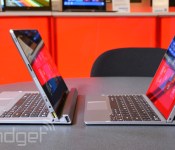
Lenovo’s 10-inch Miix 2 convertible tablet goes on sale early, starting at $699

You won’t have to wait until March to get your hands on Lenovo’s 10-inch Miix 2; much to our surprise, the budget-friendly convertible tablet is already on sale. Just be prepared to pay extra for early access. The company is offering only higher-end versions of the Windows 8.1 slate, which currently starts at $699 for a WiFi model with 128GB of storage. The promised $499 variant isn’t listed on Lenovo’s site as of this writing. While it’s hard to complain too much about the higher price given the unexpectedly quick launch, those who want the cheapest edition of this mid-size Miix 2 will have to be patient.
[Thanks, Augustus]
Filed under: Laptops, Tablets, Lenovo
Source: Lenovo
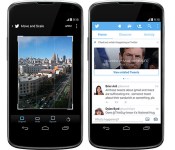
Twitter update now lets you crop, rotate photos on Android

Love sharing photos on Twitter? If you’re an Android user, it just got a little easier. The microblogging service’s latest app update adds a simple photo-editor that allows users to crop and rotate images without the aid of a third-party program. It also flashes a reminder to @mention friends whenever you upload pics with people in it, emulating Facebook’s photo-tagging feature. Pulling down on the timeline reveals other new features: if there aren’t any tweets to load, the app will show recommended tweets, trending topics and will suggest users to follow. In the US, that list also includes news, sports, TV and events updates. While these new additions to the Twitter feed are only available for Android right now, the company promises that they’ll soon arrive on iOS.
Source: Twitter

Daily Roundup: flexible 3D-printed material, Lenovo ThinkPad Yoga review and more!

You might say the day is never really done in consumer technology news. Your workday, however, hopefully draws to a close at some point. This is the Daily Roundup on Engadget, a quick peek back at the top headlines for the past 24 hours — all handpicked by the editors here at the site. Click on through the break, and enjoy.

Lenovo ThinkPad Yoga review
Lenovo’s latest addition to its Yoga line is the ThinkPad Yoga. Starting at $999, this heavyweight convertible packs a Core i3 processor, 4GB of RAM and a 1,366 x 768 display. Click the link for our review.

New 3D printer creates flexible material
Since acquiring MakerBot, 3D-printing company Stratasys has been hard at work. Its new $330,000 Objet500 Connex3 3D printer claims to be the first with the capability to create objects with multi-colored, flexible materials. Follow the link for more information.

SkyDrive gets ‘OneDrive’ name change
Microsoft reluctantly renamed its cloud storage service to “OneDrive” today after losing a trademark dispute with British satellite TV provider BSkyB last July. Click the link for details.

NSA reportedly scouring apps for user data
Yet another leak from Edward Snowden indicates that the NSA can access user data from apps like Angry Birds. The agency may even be able to unearth more information than the apps alone can provide. Click through for the entire story.
Apple’s next cash cow could be your fingerprint

The mobile payments arena may not seem so big right now, but make no mistake: we’re just seeing the beginning of an exponentially growing trend. Some estimates we’ve seen from market research firms put the future mobile payment market in the US alone at around $90 billion spent in 2017. Compared to that, the $12 billion spent in 2012 is just pocket change underneath the couch cushions. Apple’s very much aware of the revenue potential in this category, and it’s taking the possibility seriously.
“Mobile payments in general is one [area] that we’ve been intrigued with, and that was one of the thoughts behind Touch ID.”
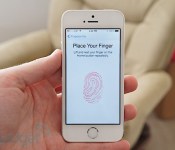
On today’s quarterly earnings call, Apple CEO Tim Cook stated that people love to buy content using Touch ID, the fingerprint reader featured on the iPhone 5s. “Mobile payments in general is one [area] that we’ve been intrigued with, and that was one of the thoughts behind Touch ID,” Cook said. “We’re not limiting ourselves just to that.” This is the first direct confirmation that mobile payments were at least on the table in some form when Apple began developing Touch ID. This wasn’t a promise from Cook that anything will happen in the near future, but it seems as though Apple would be leaving a lot of money on the table if it sat on the opportunity.
As soon as smartphone makers began adopting Near-Field Communication (NFC), the concept of using the tech to facilitate wireless payments began to bloom. Not coincidentally, Apple found itself receiving criticism for not adding the standard into the iPhone. Because of this, mobile payment tech has become a hot-button issue for critics who argue that Apple isn’t keeping up with the rest of the smartphone industry.

Two days ago, however, The Wall Street Journal reported that iTunes and App Store chief Eddy Cue personally met with unnamed industry executives to talk about getting involved with handling payments for goods and services. Whether or not this directly involves NFC remains to be seen, but it at least indicates that Apple is working on moving forward with mobile payments in some shape or form. The publication also reported that the company is shifting some of its executives into roles that will help build some sort of payment business; this isn’t the first time we’ve heard whispers that Apple was looking into the industry, and it’s much more likely to rapidly expand going forward.
Tie these rumors in with Cook’s declaration that mobile payments were a driving force behind Touch ID (Cook didn’t specify how much of a force, but the topic was at least a part of the discussion), and then consider Apple’s inclusion of services like Passbook and iBeacon location sensors, and everything starts to make sense. The company has been hard at work providing a foundation for a possible mobile payment option, and Touch ID is just another logical part of the framework.
The company has been hard at work providing a foundation for a possible mobile payment option, and Touch ID is just another logical part of the framework.
Combining biometrics with wireless payments seems like a natural match, but security and privacy are still significant hurdles that the company needs to jump over before it can become accepted by the masses. Apple is convinced that Touch ID is more secure than any other method of identity verification. Much of the public, however, was not as easily persuaded when the iPhone 5s was announced. The response from the public was mixed, varying anywhere from praise to skepticism and in some cases, to anger; Senator Al Franken even got involved in the discussion, sending Cook a letter addressing the potential privacy concerns involved.
Part of the solution is simply waiting for the right time to dive in. As more Touch ID-enabled iPhones are sold, the feature will continue to become more used and accepted, and most concerns will be soothed. More and more people will start using Touch ID to pay for iTunes purchases as they get comfortable with the feature. Given that iTunes made more than $2 billion this past quarter, it’s not too hard to visualize the benefits of Touch ID progressing into other money-making ventures for Apple.
Even though today’s statement by Tim Cook wasn’t an official guarantee that his company is diving into mobile payments, it’d be silly to expect Apple to just sit idly by in the coming years. With features like Touch ID, Passbook and iBeacons laying the groundwork for a future service, it’s pretty clear that this is an area of intense interest for the company. The next step is to determine when and how to slice up its piece of the pie.
Filed under: Cellphones, Wireless, Mobile, Apple
 AIVAnet