


Solar-Powered Laptop with Dual-Sided Display Detailed in Apple Patent
Apple has been awarded a patent by the U.S. Patent and Trademark Office (via AppleInsider) detailing an “electronic device display module” for a laptop that would include the ability to act as a secondary rear display featuring touch controls. The patent also details a photovoltaic system located in the display unit which could power the device with solar energy.
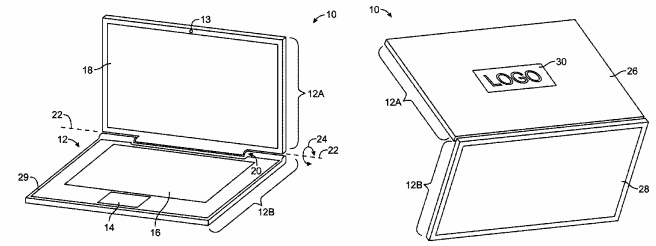
The patent, which was originally filed in 2012, details a portable computer that would encompass both upper and lower housings, consisting of materials such as metal, ceramic, carbon fiber, and glass. The rear housing of the computer would feature a logo similar to Apple’s current line of MacBooks, but would be made of a patterned ink layer instead of a plastic material.
The electrochromic glass that could be integrated into the rear display is also detailed, as the glass would receive signals from light sources with the ability make itself opaque or translucent depending on user input. In theory, this would allow the rear display to remain hidden from view when not in use, which would assist in preserving battery life and privacy.
The display may be controlled using timing and control circuitry on a display driver board. The driver board may be mounted within a clutch barrel that contains the hinges. The driver board may be mounted within the clutch barrel so that it lies perpendicular to the plane of the display or may be oriented at other orientations such as orientations that are within plus or minus 10.degree. or 20.degree. from perpendicular, orientations that are parallel to the plane of the display, or other orientations.

Furthermore, Apple also proposes that the computer include photovoltaic cells located under the rear panel, with the cells producing power when activated by an external light source. The cells could also have the option to store the power or use it immediately, and would receive energy from light when the display and electrochromic glass are in the translucent mode. 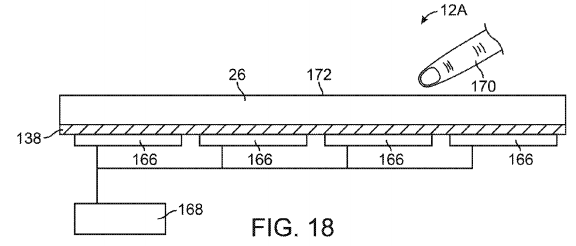
Lastly, the touch controls found on the rear display would allow the user to do a number of things, including the ability to input passcodes, control media playback, and unlock the magnetic latch of the computer by touching a certain region. The patent also states that the touch sensors may include capacitive, acoustic, optical, or pressure-sensitive properties to allow different methods of input, and could be located on a centralized rear structure.
It is unknown whether Apple plans to create such a product or not, but the company has researched similar technology before. A patent in August 2012 detailed significantly enhanced iPad Smart Covers with secondary displays and solar cells, and a patent in 2008 showed the company’s interest in producing solar LCD powered iPods, iPhones, and laptops.
Other reports on Apple’s interest in solar-powered devices have also popped up on numerous occasion throughout the years, though it is unclear as to whether Apple is ready to make a serious attempt at integrating the technology into its products or is still focused solely on researching methods.
     |

Vox Music Player Updated with Redesigned Interface, Gapless Playback [Mac Blog]
Coppertino’s Vox music player today received a new update, bringing a refreshed design that displays album art and hides playback controls until needed, along with new features such as gapless playback and improved searching across devices and file locations. The update also features improved multi-device support and bug fixes addressing previous issues with radio stations and general stability.

Well known in the Mac community for delivering gorgeous sound, intuitive user features and flexible file support, VOX 2.0’s most exciting update is the completely redesigned smart interface, which now slickly displays album art; seamlessly tucks away controls until needed, and offers perhaps the most lightweight, flexible, modern music player available for OS X. Additionally, Mac fans asked and Coppertino listened. VOX 2.0 now features gapless playback that eliminates pauses between audio tracks.
VOX 2.0 updates include:
– New playlist formats for export;
– Smarter searching across all devices and file locations;
– Improved multi-device support via the Audio MIDI;
– Several bug fixes address some minor issues that occurred when changing radio stations, stability when handling high loads and with services support.

Originally launched last August, Vox is designed to be a replacement for playing music within iTunes, and supports a wide variety of audio formats including MP3, FLAC, AAC, Musepack, Ogg Vorbis, WAV, and more. Vox can import an existing iTunes library with metadata, and also offers offers a built-in equalizer as well as internet radio connectivity, which is available as an in-app purchase.
Vox 2.0 is available in the Mac App Store for free. [Direct Link]
| |

New Video Shows ‘iOS in the Car’ Functionality from iOS 7.0.3 in Action
Last week, app developer Steven Troughton-Smith shared a series of screenshots of what seemed to be Apple’s “iOS in the Car” feature announced by Apple as “coming soon” to iOS 7 devices. The feature is intended to allow an iOS device to take over the in-dash display of a car, providing access to navigation, phone functions, messages, and music.
Troughton-Smith has now posted a video showing iOS in the Car in action, via a barebones implementation that is actually present in the already released iOS 7.0.3 but not accessible by default. The video shows the feature being run in the iOS Simulator software for developers, with the in-dash display represented by a separate 800×480 window.
In notes posted alongside the video, Troughton-Smith points out that the iOS in the Car feature supports multiple resolutions of external displays, touch input and hardware controls, and voice input.
– Supports Multiple Resolutions
– Supports touchscreens (presumably single-touch?), hardware buttons, wheels and touchpads
– Does not support multitasking – car display will always show same current on-screen app as iPhone (which can be locked/asleep)
– Whitelisted to specific Apple apps – no public API for developers [yet?]
– Has no keyboard UI – voice recognition as input
– UI clearly subject to change
– Missing functionality in video is due to iOS Simulator not containing all the stock iOS apps
 iOS in the Car from iOS 7.1 (Source: Twitter)
Troughton-Smith does also point out that the user interface is subject to change, and while the demo shown in the video resembles the screenshots shown on Apple’s site, his earlier screenshots and a Twitter response indicate that the overall look has indeed seen a redesign for iOS 7.1, bringing more of the blue text and overall feel of iOS 7 to the in-vehicle display.
| |
European carriers and Google Fiber are leading the IPv6 charge

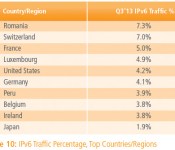
The advanced IPv6 standard reached the internet well over a year ago. But who’s really using it? Mostly Europeans, if you ask Akamai. The content delivery firm is now tracking IPv6 adoption as of its latest State of the Internet report, and it found that European nations represented seven of the top ten countries using IPv6 in the third quarter of 2013. The US was more modest in embracing IPv6 with 4.2 percent of all traffic relying on the newer technology, while Asia was relatively slow on the uptake. Adoption varies widely from provider to provider, though. More than half of Google Fiber’s traffic was based around the protocol, while more established companies like Deutsche Telekom and Time Warner Cable still leaned heavily on old-fashioned IPv4.
There are a handful of other revelations in the report. Denial of service attacks dropped for the first time since the end of 2012, with China passing Indonesia to once more become the biggest source of incursions. Broadband speeds were also clearly on the way up — Akamai notes that use of high-speed internet access (over 10Mbps) jumped 31 percent quarter-to-quarter to to hit 19 percent worldwide. These increases primarily came from South Korea, the Netherlands and other countries that already have high average internet speeds. Not that Americans can complain too much. The US mostly kept pace with a typical internet speed of 9.8Mbps, or enough to make it the eighth fastest country on Earth.

Filed under: Networking, Internet
Source: Akamai

Rumors suggest Amazon’s game console project is still alive

No matter how many times Amazon denies that it’s developing a set-top box, the rumors continue to pop up once every six months or so. VG 24/7 is reporting that the company is still working on an Android games console that’ll retail for “below $300.” Based on gossip from game publishers, the latest indication is that Amazon’s product team, Lab 126, has designed a grey oblong similar in size to the PSOne, designed to play both games and Instant Video / Lovefilm content to your HDTV. With rumors of a pay TV service and a future product that’s “bigger than Kindle” currently swirling around, we can see how this looks plausible. That said, $300 seems an unlikely price for Amazon to target, when Apple TV and the Roku 3 are so much cheaper, and when other Android consoles are showing only lukewarm demand, so there’s still plenty of room for skepticism.
Filed under: Home Entertainment, Internet, HD, Amazon
Source: VG 24/7

Google finally launches prescription Google Glass with the Titanium Collection
 We’ve known for some time that Google has been working on prescription Google Glass for some time now, and while we’ve only had sneak peeks whenever they pop up, Google has finally officially launched prescription upgrades for Google Glass Explorers to purchase from tomorrow. Called the Titanium Collection, it includes 4 different titanium frames which can be married with the existing Google Glass and 2 additional sunglasses designs which can also be chosen. Check out Google’s introduction video to the Collection:
Each of these prescription frame designs – Split, Thin, Bold and Curve – can be purchased for $225 USD each (check them out at google.com/glass), though Google is said to be working with VSP, the largest U.S. optical health insurer, to worked out subsidies for Explorers who qualify under their umbrella. However, if none of these styles take your fancy, Google also promises that there is more to come.
As a perpetual glasses wearer, I can’t say that any of the styles particularly jumps out at me as they look quite, for lack of a better description, hipster, but that will probably vary depend on your predisposition; what do you think about these new prescription Google Glass frames?

British government reportedly tracking YouTube and Facebook data without permission

While the NSA has been busy scouring the Angry Birds leaderboards, newly leaked documents report that its British counterpart — the GCHQ — has been monitoring the flow of social media in real-time. The General Communications Headquarters can apparently keep track of YouTube traffic, which links are liked on Facebook and even which Blogger or Blogspot pages are visited. This all comes via documents taken by Edward Snowden that were obtained by NBC News. NBC‘s sources also say that the British spies have been able to physically tap the lines carrying global web traffic to extract key data about specific users as well. This initiative, called Squeaky Dolphin, intends to put broad data trends into context with world events and give the intelligence community a heads up for future anti-government happenings — not for spying on a person-by-person level. What’s more, the GCHQ reportedly shares this information with the US.
The GCHQ has issued a statement claiming that all of its work is carried out within the limits of the law, while the NSA says that it’s only interested in the communication activities of valid foreign intelligence targets. For their part, Google and Facebook say that the spying on unencrypted information was done with out their respective knowledge, and neither company had given the UK government permission to access the data — something we’ve heard before.
Filed under: Internet, Google, Facebook
Source: NBC News (1), (2) (PDF)

Pinterest now recommends pin-worthy things based on your interests

It hasn’t been easy to browse Pinterest for pin-worthy things without the help of your friends — not unless you’ve been willing to search entire categories, anyway. That hunt should be much easier now that the social network has rolled out its Interests tool on the web. The section recommends relevant items based on what you’ve pinned in the past. Look for tourist hotspots in a distant city, for example, and Interests will suggest places you might have missed. Pinterest’s new advisor isn’t yet available worldwide or on mobile devices, but it should reach every member in the near future.
Filed under: Internet
Via: CNET
Source: Pinterest Blog

Check Out The Simpsons Take on Google Glass

Google Glass has seen its fair share of parody work throughout YouTube, and even on Saturday Night Live. Now the classic animated show that we all know and love, The Simpsons, have taken to Google Glass in their very own way.
The episode aired last Sunday, and it was cleverly titled, “Specs and the City”. It starts off with Mr. Burns fitting all his employes with what they called “Oogle Goggles”, and Homer being Homer, the hilarity ensues with all he sees with the goggles on. You can give yourself a preview of the episode if you have not seen it yet, and if you want to watch the entire episode, click the Hulu link provided below, and let us know what you think of The Simpson’s take on this wearable piece of technology.
Hulu link:The Simpsons: Specs and the City
Source: Phandroid
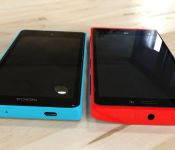
Specs for the Nokia X Get Leaked

So the mythical creature that is the Nokia X (Nokia Normandy) has gotten it’s guts spilled out on social media by evleaks tonight. The leak master just posted supposed specs for the first Android-powered Nokia phone, and the specs are very mid-ranged, borderline low-ranged. Nothing to complain about given that this is the very first phone Nokia will have that has Android running on it, but a lot of you might question the RAM.
Nokia X: 2 x 1GHz Snapdragon, 4″ WVGA, 512MB / 4GB / microSD, 5MP, 1500MAh, Nokia Store + 3rd party, dual-SIM, 6 colors.
— @evleaks (@evleaks) January 28, 2014
512 mb…what? I had to read the tweet about 4 times to make sure I was reading it right. That is super low, but then again, we did hear that Android 4.4 KitKat was able to run on devices with such low memory. We already got word that the Nokia X was going to come in multiple colors, and judging by these specs, it should be a budget friendly phone. Let us know your thoughts about these specs.
Source: @evleaks
 AIVAnet