


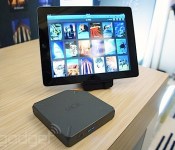
LaCie Fuel brings 1TB of wireless streaming storage to your Apple devices for $199

We’re quite familiar with LaCie’s reputation for stellar storage devices, and here at CES 2014, the outfit is expanding its territory. The company has just outed Fuel: a 1TB portable repository for that media library, offering wireless streaming to your Apple arsenal. With no internet connection required, Fuel acts as a WiFi hotspot for on-the-go streaming to iPad, iPhone and Mac (up to five devices or three HD streams at once) while claiming 10 hours of battery life. The peripheral is accessed just like an external drive and — as you might expect — allows file transfers sans cords with Dropbox integration in tow. For times when a cable is absolutely necessary, there’s a USB 3.0 port for handling those tasks. Streaming stored media on those mobile devices is sorted via the Seagate Media app and the unit plays nice with AirPlay-compatible devices and Apple TV. In a spot with connectivity? Fuel will allow you to share it with that handful of gadgets as well. If all of that sounds too good to pass up, you can snag one when they hit shelves “soon” for 200 bucks.
Filed under: Home Entertainment, Storage, HD

Lenovo’s Beacon media hub can house up to 6TB of video and photos, streams to PCs and Android devices

Lenovo makes a lot of laptops. And tablets. And a few phones. But amid its exhaustive PC range, there’s also the eye-catching Beacon. Priced at $199, although lacking any storage out of the box, it tries to strike a balance between personal cloud storage and media server. It comes preloaded with XBMC, while dual HDD bays will support up to a heady 6TB of storage. The Beacon, powered by a dual-core (unspecified) Atom processor can then stream whatever you put inside it to multiple devices at once — we saw it in action, and it managed to output to both a PC and Android phone without a hiccup. You can use your hand-held smart device as a remote (replete with mouse cursor), which makes digging through piles of photos and videos at least a little bit easier.
On the back, alongside HDMI, there’s Ethernet and twin USB ports, meaning it’ll be happy to link up to PCs and TVs for big-screen viewing. Once linked to the respective app, pics and videos captured on your phone can be automatically (or manually) uploaded. As you can see, it’s also not the typically unassuming (read: dull) storage hub either and will launch in orange, blue, gray and black finishes this April.
Richard Lai contributed to this report.
Filed under: Cellphones, Home Entertainment, Tablets, HD, Lenovo
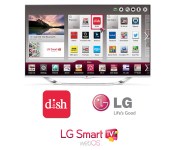
Dish’s ‘Virtual Joey’ is a streaming app for smart TVs that takes the place of a set-top box (video)

Assuming you’re not a home-theater gear head, we’ll start this post by giving you a quick history lesson. Back at CES 2012, Dish Network announced a whole-home DVR setup, including the Hopper DVR and a multi-room extender, called the Joey. Then, at last year’s CES, Dish introduced a version of the Hopper with Sling built in, allowing you to send both live and recorded shows to a mobile device. This year, Dish is turning its attention back to those Joey boxes except, well, it doesn’t necessarily have any hardware to show for it.
The company just announced the “Virtual Joey” a smart TV app that will come built into select LG televisions, and which will take the place of a physical Joey extender. To be clear, you’ll still need a Hopper DVR to anchor the whole experience, but this would at least mean you have one less piece of hardware taking up space in your house. According to company reps, the app will come to 2013 and 2014 LG smart TVs, though it’s working to ink deals with other manufacturers as well. We hope to get an in-person demo here at CES, so hang tight for some hands-on!
Filed under: Home Entertainment, HD, LG
Source: Dish
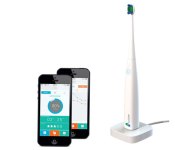
Here’s a smart toothbrush that’ll show you how clean your teeth are

One of the current trends in technology right now is inventors jamming wireless radios in objects that you wouldn’t expect to find ‘em. For instance, the HAPIfork, a smart fork that sent your eating speed to your phone in an attempt to get you to chew your food more slowly, became an unexpected hit at last year’s CES. Kolibree hopes to recreate that success with its connected toothbrush. Yeah. Once you’ve cleaned your teeth (in the usual fashion), the Kolibree pushes your stroke count to your smartphone, telling you if you did a good job and showing which parts of your gob still need some attention. Naturally, the company will request your cash via Kickstarter at some point in the summer, where you’ll be able to pick up a model priced somewhere between $100 – $200.
We were able to spend some time with both the Kolibree prototypes and the device’s founder, Thomas Serval. Serval is an ex-Googler who went back to hardware design after several years with the software giant, was inspired to build the device after getting tired of asking his children if they’d brushed their teeth. Containing an accelerometer, magnetometer and gyroscope, the hardware builds a model of the inside of your mouth and then offers you a percentage score of how well you’ve done in keeping it clean. The model is built in two ways: firstly, when you get the device, you can calibrate the hardware by showing it around your gob, but also the company has a dentist-supplied list of measurements that help it understand the size of your mouth compared to your age and gender.
Hold the hardware in your hand and the prototype is surprisingly light, despite the built-in battery that is re-juiced on a wireless charging plate. It’ll push the data over Bluetooth to your smartphone or tablet, and you can monitor your family’s statistics with a league table that, it’s hoped, will encourage kids to out-do their parents. That same data can also be shared with your dentist, should you wish them to know how well (or not) you’re doing in the oral hygiene stakes. Depending on the hardware you’re buying, an individual Kolibree will set you back between $100 – $200, but the company will offer discounts for family packs when it’s finally ready for public consumption.
Filed under: Misc

Parrot’s MiniDrone climbs walls, rolls across the ceiling, is really, really small

Parrot’s been offering up relatively small updates to its AR.Drone line each year at CES, and while the quadcopter is, without question, one of the most immediately recognizable in the space, we’ve been waiting to see a genuinely fresh take on the product. The MiniDrone delivers — and then some. It’s exceptionally small and light, so far as these consumer drones go. It’s quick, nimble and fairly user-friendly thanks to on-board autopilot and myriad built-in sensors, controlled via smartphone or tablet via low energy Bluetooth.
Size aside, however, the coolest thing about the product may well be the removable wheels, which let you drive the ‘copter across the ceiling and up walls. And if the demos we got ahead of tonight’s CES Unveiled event are any indication, the little drone is quite a bit more rugged that it looks. The MiniDrone will be available at some point later this year for an undetermined price.
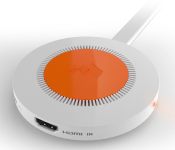
InAir Smart HDMI adapter overlays the web atop television content with a custom user interface

Televisions are no longer simply screens for viewing video content: Folks want to have the internet on them, too. SeeSpace is a startup building a device called the InAir Smart HDMI adapter that plugs in-line between your set-top box and TV to deliver web content to your big screen. The system then overlays an intelligent layer atop your video feed that analyzes what you’re watching and supplies relevant web and social content as well. InAir’s UI is controlled by a companion app (for iOS and Android) that turns your phone or tablet into a trackpad that lets you navigate by swiping and scrolling on the screen. Additionally, interested developers can use an API to build new features for the platform. As is the case with so much of what we see at CES, the InAir adapter won’t be available until the second half of the year and when it does land, it’ll cost $99. Wanna see what your dollars will buy? A demo video awaits after the break.
Filed under: Home Entertainment, HD
Source: SeeSpace

LaCie partners with Christofle on Sphère: a silver-plated limited-edition hard drive

Last year at CES, LaCie unveiled the Philippe Starck-designed Blade Runner to grab the attention of those who prefer their storage gadgets to be extra dapper. This time around, the outfit has teamed up with French silversmith Christofle on Sphère. The globe-influenced external hard drive is silver-plated and touts a 1TB capacity. File transfers are sorted via a USB 3.0 connection that doubles as the device’s power supply. Just like its predecessor, the shiny Sphère is going to be in short supply when it arrives later this quarter with a $490 price tag, ready to upgrade the look of that workstation.
We were able to take a closer look at the Sphère just ahead of the proper start of CES 2014. Despite what appears to be a weighty silver shell, the drive is quite light. The shiny exterior may double as a mirror in a pinch, but mucking it up with fingerprints will happen quickly. Aside from the branding inscriptions on the front and the iconic blue light, there aren’t any other details aside from a cable slot around back on the unit’s black base. Of course, less is more definitely applies here.
Filed under: Storage
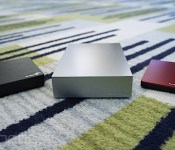
Seagate’s Backup Plus line expands with Slim, Fast and desktop external drives for appropriately named file storage

We’ve been familiar with Seagate’s Backup Plus line for quite some time now, and the company has just announced three new offerings under that moniker here at CES. The storage outfit has pulled the wraps off of Backup Plus Slim, Fast and desktop external hard drives, living up to each of those names with both automatic and scheduled backups. First, Fast is being touted as the first 4TB portable drive with dual 2TB drives in RAID 0. The unit is bus-powered at the hands of its USB 3.0 connection and claims speeds of 220 MB/s with a metal-topped plastic enclosure. It’s set to ship for $300. Join us on the other side of the break for details on the rest of the group.
Next, the Backup Plus Slim has been labeled by Seagate as the slimmest (12.1mm, to be exact) portable drive on the market with 500GB, 1TB and 2TB capacities. This option is also powered by USB 3.0 transfers and sports the same plastic shell with a solid aluminum top. If color coordination is your thing, black, silver, red and blue paint schemes can be yours for the taking at prices ranging from $100 to $180. Last but not least, for those that don’t mind keeping their storage repositories at a workstation, the Backup Plus desktop serves up 2TB, 3TB and 4TB capacities inside a metal housing. This option is larger than the other two, as its meant to be left at home rather than stuffed in a jacket pocket. Pricing for the trio has been set at $130, $160 and $230, respectively, and the entire new Backup Plus line ships next month.
In addition to the new hardware, Seagate has also updated its Dashboard app that’s used with all of its Backup drives. The software still acts as a PC backup and allows for social sharing, but this time around, mobile-device backup has been added. Apps for taking advantage of the update will be available for both iOS and Android, however the Apple-flavored version will only back up the Camera Roll. The option for Google’s OS protects pictures, videos, contacts, messages and your call log in case of a gadget failure. For a closer look at the whole lot, visit the gallery above for a quick gander.
Michael Gorman contributed to this report.
Filed under: Storage
Okidokeys smart locks let you manage your front door remotely

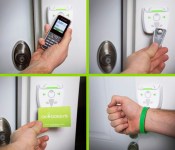
There are goofy product names, and then there’s Okidokeys, a moniker that achieves new levels of silliness. All said, however, the company seems to take its line of smart locks pretty seriously. Its parent company, OpenWays Group, already provides smartphone-based door lock solutions to hotels. The company’s leveraging the 256-bit AES cryptology security it’s used in those products for Okidokeys, home locks you control with an Android or iOS handset via Bluetooth. There seems to be a pretty wide array of options here, letting you enable a hands-free unlock when you’re near the door or associating objects like an RFID card, in case your smartphone should run out of juice. Using the company’s online portal, you can manage accounts, giving people limited access to the door so, say, your babysitter can only get in during a designated time, and if anyone tries to break in, you’ll get an alert on your phone. You can also unlock the door from afar, should someone forget their key. The line of locks starts at $179. Pre-orders open up this month, with the product is set to ship in the spring.
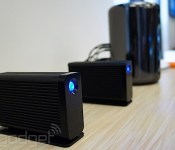
LaCie Little Big Disk Thunderbolt 2 wields dual 500GB SSDs, Intel’s latest port tech

When Intel officially ushered in Thunderbolt 2 back in June, it promised that we’d see devices sporting those blazing-fast speeds soon. It seems LaCie was one outfit poised to embrace the tech as the storage company has just announced the Little Big Disk Thunderbolt 2. The successor to the original model, version 2.0 touts transfer speeds of 1,375 MB/s, thanks to Intel’s port, and a new all-black paint scheme on its aluminum shell. Inside, two 500GB PCIe Gen 2 SSDs in RAID 0 can wrangle 4K and 3D video edits — power that should properly arm the creative lot for hefty fieldwork. That interior space has also been designed to properly handle heat distribution so that the virtually silent, thermoregulated fan need only kick on every now and then. There’s no word on pricing just yet, but the storage gadget is set to arrive later this quarter.
We were able to see the new Little Big Disk in action in order to catch a glimpse of its speeds. During our time with the unit, we observed write speeds of 1,200 MB/s and read marks at 1,300 MB/s — transferring a 300GB file in about four minutes. Thankfully, the drives that were set up ahead of our arrival, and had been sorting files for some time, remained at nearly room temp. With two of the Thunderbolt 2 drives set up in RAID 0, we witnessed 2,000 MB/s write speeds and 2,600 MB/s read numbers. Although the front plate of the new unit is glossy, the entire enclosure is still metal and the black paint job looks quite nice beside a new Mac Pro.
Filed under: Storage
 AIVAnet