


NVIDIA announces Tegra K1 with 192 cores and Kepler architecture

In what’s becoming a yearly tradition, NVIDIA came to its CES press conference with tidings of its next-generation mobile processor which will begin gracing devices in 2014. The chipset maker officially announced Tegra K1, the first 192-core processor based on the Kepler architecture. As you can imagine, NVIDIA is bringing its graphics chops to the new chip, and it packs a serious punch — so much so, in fact, that it will come with support for Unreal Engine 4. In the company’s usual form, we were treated to demos of the new chip’s power compared side-by-side with a Tegra 4, and the difference was quite noticeable; the K1 offers real-time computing, global illumination, higher dynamic range and greater detail like reflective surfaces, dripping water and other realistic physically-based rendering.
Developing…

NVIDIA K1 chip adds Unreal Engine 4 support

The Unreal Engine’s latest iteration, Unreal Engine 4, is adding support for NVIDIA’s latest Tegra chip, the K1. Epic Games’ ubiquitous engine powered much of last-generation games with Unreal Engine 3, and Epic’s promising even more with the next generation. NVIDIA CEO Jen-Hsun Huang announced as much tonight during the company’s CES 2014 press conference, and he made sure to note the much shorter gap between Unreal Engine running on next-gen consoles/PC and mobile devices.
With Unreal Engine 3, Infinity Blade was the first mobile game running on Epic’s game tech — demonstrated on-stage during an Apple keynote for a new iPad. Unreal Engine 4, however, scales both up and down right out of the gate, apparently. “We can take absolutely anything that runs on PC or high-end consoles and run it on Tegra…I didn’t think that we’d be at this level on mobile for another three to four years,” Epic Games head Tim Sweeney said of the news. Color us unsurprised — we expect to see Unreal Engine 4 running on anything that plays games in the coming years.

Here’s a WiFi-enabled Russian Doll that’s designed to replace your mother

When doom-mongers portend that technology is destroying human relationships, plenty of ‘em will use this as exhibit one. Mother is the brainchild of Rafi Haladjian, the mind behind the Nabaztag, and is a device designed to monitor the objects, creatures and people in your home. The white plastic Russian Doll connects to a series of sensors, called cookies, that measure motion and temperature, and will alert you when it notices a change. For instance, if you strapped a cookie to the door where your meds are kept, but one day forgot to open it when you were due, the device would nag you until you remembered — just like your own mother.
Of course, that’s a reasonably simple example, and the company has cooked up 14 different ways in which the cookies can be used to monitor your home. Another example is if you strapped a cookie to your door, Mother will send an alert and make a noise every time it’s opened — which is useful when you’re on holiday and worried about unwanted intruders. Speaking of which, the cookies themselves can be used for up to a year before you have to replace them and you can connect up to 24 at one time — but be warned, buying and replacing those things can be pricey, as it’s $99 for four. The Mother hardware reminds us a little of Eve from Wall-E, although its facial expressions are limited to blinking to show that its connecting to WiFi. It’ll begin shipping between February and March, with one Mother and four cookies retailing for $222.
Jamie Rigg contributed to this report.
Source: sen.se
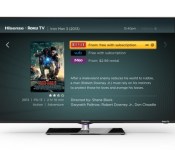
Roku renews bid for the living room with streaming-ready Roku TVs

Up until now, Roku’s bid for the living room has mainly come in the form of its puck-like streaming players and sticks. These devices, priced at below $100, are a cheap way for consumers to augment existing HDTVs and make them “smarter.” But now Roku’s getting into the TV hardware business directly. It’s partnered up with six manufacturers, of which Hisense and TCL are the first to be announced, to produce a line of Roku TVs that come pre-loaded with the company’s streaming software. These sets aren’t planned to hit retail until sometime later this fall, but at CES 2014, we’ll be getting a first look at what’s in store.
Roku’s shift from a provider of streaming players to that of branded TVs isn’t as far-reaching as it sounds. The company’s aiming to leverage its streaming software as a smart TV platform; something to license out to TV manufacturers that can’t compete with the handful of vertically integrated titans like Samsung, Apple and LG. In other words, Roku wants to supply the brains of the set and leave the design particulars mostly up to its partners.
As Jim Funk, the company’s SVP of Product Management, put it, Roku’s seeking to make a “TV for the way TVs are used by people today.” That is, a hassle-free, streaming-ready set that does away with the need for extraneous dongles, players or video game consoles. It’s ironic considering the company built itself on such peripherals, but you can’t fault Roku for accepting the inevitable. As consumer reliance on streaming becomes more and more the norm, so too will the availability of streaming-ready sets. Streaming peripherals are very nearly a thing of the past.
In keeping with its emphasis on simplicity, Roku TV’s UI is staying mostly unchanged from what’s running on current-gen products. So you’ll still find a navigable grid of streaming providers and browsable categories, but you won’t find any web browser or guide overlay for cable when you turn these sets on. That said, inputs for Blu-ray players, gaming consoles and cable boxes will all be present from atop the UI, making switching between devices far simpler.
For the first run, Roku TVs will arrive in a range of sizes from 32 to 55 inches and feature the company’s branding on the bezel. It’s not yet known if any of these initial Roku TV sets will ship with remotes capable of audio output, though they should look similar to the current setup. Design decisions like those, it seems, are entirely up to each manufacturing partner. So far, Roku’s only named TCL and Hisense as two of its six set-makers, but further partner announcements, as well as details on pricing, are planned for later this year.
Filed under: Home Entertainment, Software, HD
Source: Roku
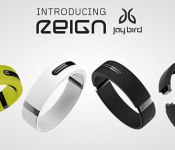
Jaybird’s Reign fitness wearable promises to tell you when you want to work out

Because there might not be enough fitness wearables, Jaybird has announced its own wristband — Reign. Health-centered (just like the company’s recent Bluetooth headphones), we’re promised activity and sleep monitoring, separating out users’ movements by specific physical activity and sport. Details are otherwise pretty scant at this point: It will work with iOS, but we’re waiting to confirm Android compatibility and we’re looking to hear more details about “Go-zone,” which will apparently read when your body “wants” to exercise and then remind you to do so. We’ve still got a lot of questions left to answer, but we’ll be hunting down the band at CES for the rest of the answers.
Google acquires Bitspin, makers of Timely Alarm Clock
Google has acquired the software developers behind the insanely gorgeous Android app Timely Alarm Clock. It’s not clear how much money was involved or in what capacity Bitspin will work with Google. Surely we aren’t the only ones who would love to see more of this look in the overall Android aesthetic.
We’re thrilled to announce that Bitspin is joining Google, where we’ll continue to do what we love: building great products that are delightful to use.
For new and existing users, Timely will continue to work as it always has. Thanks to everyone who has downloaded our app and provided feedback along the way; we truly appreciate all your support.
In the meanwhile, you can now pick up one of the sharpest apps ever free of charge.
The post Google acquires Bitspin, makers of Timely Alarm Clock appeared first on AndroidGuys.
NVIDIA outs Tegra K1 chipset with 192 cores
32-bit devices due in first half 2014, 64-bit devices arrive later in year
 Because octa-core is apparently already a thing of the past, NVIDIA has just taken the wraps off its latest processor, the Tegra K1. And, rather than making the linear jump from Tegra 4 to Tegra 5, this one bridges the gap of desktop graphics cards almost as much as it does mobile CPU’s.
Powered by a ridiculous “192 cores”, the Tegra K1 is based off of the Kepler architecture and is termed a “super chip”. Ultimately, this lessens the burden for game developers who don’t have to worry about completely rewriting titles or dumbing them down for mobile. What’s more, it also eliminates the gap of time from bringing top games from desktop and consoles to smartphones or tablets. Speaking of which, Unreal Engine 4 is already lined up for Tegra K1.
We brought the heart of GeForce and the soul of Tesla to the Tegra family.
The new chip delivers considerably more realistic physics simulations, multiple rendered targets, more lifelike images, and an exponentially better experience. Gone are polygons and triangles and in its place are pores, hairs, and true-to-life flesh.
Tegra K1 is also the first mobile processor to deliver the same graphics features as the next generation of consoles (Xbox One, PlayStation 4) and faster performance than current generation consoles (Xbox 360, PlayStation 3), all in the palm of your hand.
The Tegra K1 will be offered in two versions: 32-bit and 64-bit. The 32-bit version is expected in devices in the first half of 2014, while the 64-bit version is expected in devices in the second half of the year.
To learn more about the Tegra K1 chip, head to NVIDIA’s page.
The post NVIDIA outs Tegra K1 chipset with 192 cores appeared first on AndroidGuys.

CES 2014: LaCie Announces 1TB ‘Fuel’ Wireless External Hard Drive for iOS/Mac Devices [iOS Blog]
LaCie today announced the Fuel, a wireless hard drive designed to work with the iPad, the iPhone, and Mac computers. With 1TB of storage, the Fuel is able to wirelessly stream to any Apple device, serving as a portable storage unit for extensive media libraries.
Fuel, which does not require an internet connection, functions as a Wi-Fi hotspot able to stream HD content to up to three devices at once, with five devices able to access files on the drive at one time. Media on the drive is accessed on iOS devices using the Seagate Media app, and AirPlay functionality is also available.
The LaCie Fuel creates its own Wi–Fi network, just like your home router. So up to 5 devices can access its storage at the same time. You can even stream an HD movie to up to 3 devices simultaneously. Family road trips, long commutes, and airport layovers just got a lot better.
And while the LaCie Fuel doesn’t need Internet to work, it can connect to nearby Wi–Fi hotspots. It can then provide Internet access to up to four of your wireless devices.
While file transfers are available via USB 3.0, the drive does function wirelessly, transferring content without a cord. It also has Dropbox compatibility and a 10 hour battery life.
LaCie’s Fuel will be available soon and is priced at $199.99.
     |
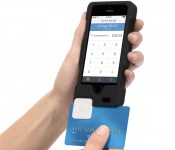
CES 2014: Square and Griffin Announce ‘Merchant Case + Square Reader’ for iPhone 5s and iPhone 5 [iOS Blog]
Credit card processing company Square and accessory manufacturer Griffin today announced the Merchant Case + Square Reader, a specialized case that integrates itself with the popular mobile card payment system for added convenience.

The case itself is made from a non-slip silicone material, and provides a custom fit to the included Square Reader. The card reader can also detach itself from the case and can be stored in the back of the accessory for easy access.
Compatible with the iPhone 5s and iPhone 5, the Merchant Case + Square Reader is now available for pre-order from Griffin’s website for $19.95 and ships in 1-2 weeks.
| |
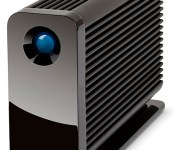
CES 2014: LaCie Debuts ‘Little Big Disk Thunderbolt 2’ With Transfer Speeds Up to 1375 MB/s [Mac Blog]
LaCie today announced the Little Big Disk Thunderbolt 2, one of the first external hard drives that will support Intel’s new Thunderbolt 2 specification to deliver transfer speeds of up to 1375 MB/s, significantly faster than USB 3.0 drives.
Little Big Disk includes two 500 GB PCIe solid state drives from Samsung in a Raid–0 configuration and is able to support mobile streaming and editing of both 4K and 3D video. The drive features a fully aluminum enclosure with a Mac Pro-style black finish along with an optimized interior design that improves cooling efficiency.

The drive includes a thermoregulated fan that turns on only when necessary, producing little to no noise, and it also ships with an included Thunderbolt cable and a three year warranty.
AnandTech has posted a mini review of the Little Big Disk Thunderbolt 2, and in testing, found 1400 MB/s in sequential read speed along with 1100 MB/s write speed. Engadget saw similar results at CES, observing write speeds of 1200 MB/s and read speeds of 1300Mb/s. A 300 GB file transferred in approximately four minutes.
Thankfully, the drives that were set up ahead of our arrival, and had been sorting files for some time, remained at nearly room temp. With two of the Thunderbolt 2 drives set up in RAID 0, we witnessed 2,000 MB/s write speeds and 2,600 MB/s read numbers.
The LaCie Little Big Disk Thunderbolt 2 will be available during the first quarter of 2014 from LaCie.com. Pricing has yet to be announced.
| |
 AIVAnet