


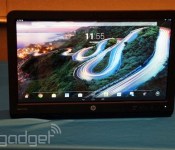
HP rolls into CES with a bunch of business PCs, including an Android-powered all-in-one

Never mind that it’s CES, short for Consumer Electronics Show. Pretty much everything HP is showing off this week in Vegas is aimed at enterprise users — or rather, the IT guys tasked with outfitting employees. Out of everything HP announced today, the most interesting thing might be the Slate 21 Pro, an Android-powered all-in-one tailored for business users. Granted, this isn’t even HP’s first Android AiO (that would be the original Slate 21), but it is the first time HP’s tried it for the corporate set. And hey, if HP isn’t going to announce any consumer products, the next best thing are products that are at least consumerfied, right?
At any rate, the big story here is the software: In addition to all the usual Google services (e.g., Gmail and Drive), HP is pre-loading the thing with Kingsoft Office, Evernote, Skype, HP Classroom Manager, 50GB of lifetime Box storage and Citrix Receiver for remote Windows access. To be sure, one could use all these apps in the office, if only on a secondary display, but HP also imagines this guy being used in classrooms, computer labs, public kiosks and maybe hospitality settings (think: business centers at hotels). And given that it runs Android 4.3, the owner can use the restricted-profile feature to make it so that guests can only use certain apps (the web browser, for example). It’s available now for $399, keyboard and mouse included — not that you’re likely to buy one of these yourself.
Additionally, HP announced the Pro x2 410, an 11-inch detachable laptop, and its first hybrid for the business market. All told, it seems like the business version of the Split x2, in that it runs a Core i3 or i5 processor and rocks a modest 1,366 x 768 display with no pen input. That will ship this month “at or around $899,” according to a company rep. Also, in addition to the Slate 21 Pro Android all-in-one we just told you about, HP unveiled two other AiOs — the ProOne 400 and the HP 205, both of which run Windows. Starting with the 400, it’s actually available in two screen sizes: 21.5 inches if you want touch, and 19.5 without. Either way, you get a choice of Haswell processors, though screen resolution varies depending on the model; the touch version goes up to 1080p, while the non-touch is capped at 1,600 x 900. Those are available today, starting at $799 with touch and $649 without. Meanwhile, the HP 205 is an 18.5-inch machine with low-end specs (1,366 x 768 display, dual-core AMD Kabini APU) and a budget price to match ($449 and up).
Finally, HP outed a new laptop series, the 300 line, which includes 14- and 15-inch models with spill-resistant keyboards, anti-glare panels and fingerprint readers, but not the premium software add-ons you’d get on the existing 400 series. That will go for $399 and up. And there you have it! Enjoy the press shots, if by chance you’re itching for a closer look.
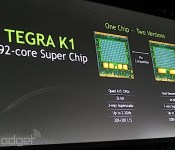
NVIDIA reveals second Tegra K1 with 64-bit support, dual 2.5GHz Denver CPUs

Ever since the introduction of Apple’s A7 chipset on the iPhone 5s, 64-bit has become somewhat of a buzzword for manufacturers like Qualcomm, NVIDIA, Samsung and MediaTek. The former has already followed in Apple’s footsteps with 64-bit support on the Snapdragon 410, an SoC destined for budget devices and emerging markets, but we were anxiously awaiting word on NVIDIA’s next-gen aspirations at tonight’s press conference. And now we have it — the company just announced a second version of the Tegra K1 introduced earlier, this time with a dual-core 2.5GHz Denver CPU (yes, that Project Denver) and 64-bit support. We’re still waiting to hear specific availability, but NVIDIA tells us to expect more details in the coming months, so the extra boost in performance will require a bit of patience.
Filed under: Cellphones, Wireless, Mobile, NVIDIA

LG teases webOS for most of its smart TVs, Life Band Touch with Android, iOS sync

LG has already shown quite a bit of its hand ahead of CES (105-inch curved LCD; OLEDs OLEDs and more OLEDs; Ultra HD televisions of all sizes) but with its press conference now just hours away, it’s showing off a bit more. Now we have an official pic or two of the webOS interface on a TV, and LG’s blog indicates it should appear on more than 70 percent of the smart TVs it’s releasing in 2014. The webOS launcher is teased as offering all the voice search and gesture recognition features we’ve seen on LG TVs in the past few years, and enhanced multitasking between apps and live TV. There’s even an animated “Bean Bird” character to walk users through initial setup and pair the magic remote.
That’s not all that’s new however, as LG also confirmed it will launch the Life Band Touch. Similar to Nike’s FuelBand, this wearable (pictured after the break) promises far more features powered by its ability to sync with both Android and iOS devices over Bluetooth 4.0. It has touch controls for music playback and incoming calls on the synced device, and can be used with special heart rate monitor earbuds. There are a few other products mentioned as well, check back tomorrow at 11AM ET for all the information from CES as we liveblog LG’s press conference.

Filed under: Displays, Home Entertainment, Wearables, HD, LG
Source: LG Korea, Korea Newswire

NVIDIA seriously made a crop circle for marketing its new Tegra K1 chip

You know that new NVIDIA Tegra K1 chip? And you know that crop circle that popped up and then disappeared? Yup, that was an advertisement for the new chip. Yes, seriously.
Filed under: NVIDIA
Source: NVIDIA Blog
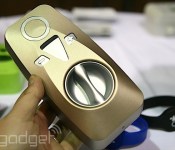
Okidokeys gives you more options than you could ever possibly need to open your front door

We first got word of the Okidokeys smart lock system roughly an hour ago, and just now got a chance to see the thing in action – well, we got a chance to see it in various states of disarray on a table at tonight’s CES Unveiled event. The primary module hooks up to the lock on the inside of door, with no trace of the mechanism visible from the outside. Trigger it via your mobile device and it rotates to unlock the door. There’s also a large button you can use to unlock it sans smartphone from the inside. The system starts at $179.
There’s also a bundle priced somewhere in the mid-$200s, which will get you an RFID reader. The reader doesn’t attach directly to the module, so you can put it anywhere on the exterior of the house to unlock via a bracelet or card you keep in your wallet. Or, if you’re so inclined, you can still use your old fashioned key. Using the Android or iOS app, you can also unlock the door remotely and grant access to users. The sets are available for pre-order now, with shipping set for spring. The company was also showing off a garage door module that works with its proprietary app. No word on pricing for that yet.
Filed under: Household

CES 2014: Keep Track Of What We’re Seeing At CES Via Our Social Media
 The International Consumer Electronics Show (CES) 2014 has not officially started yet, but our team has already been on the floor at CES Unveiled getting an early preview of just a few of the things to expect over the next few days. Since most of our team is here in Las Vegas to cover CES 2014, we might not always have the time to complete full articles, but if you follow us on our social media outlets, we’ll definitely be making an effort to put up what we can when we can.
NVIDIA announces 192-core K1 processor in 32 and 64 Bit Versions
 NVIDIA had a late little press conference this evening and certainly bringed the rain with their announcement. They unveiled the new Tegra K1. The new chip is a 192-core super chip that features the same NVIDIA Kepler architecture that that powers the NVIDIA GeForce GTX 780 Ti . It is some serious power. Check out the press release below.
NVIDIA Unveils Tegra K1, A 192-Core Super Chip That Brings DNA Of World’s Fastest GPU To Mobile
Kepler GPU Architecture in GeForce GTX 780 Ti Morphs Into Mobile Graphics Powerhouse; Available in 32- and 64-Bit Versions
LAS VEGAS, NV – CES – NVIDIA today unveiled the revolutionary Tegra® K1 mobile processor, a 192-core super chip featuring the same NVIDIA® Kepler™ architecture that powers the fastest GPU on the planet, the NVIDIA GeForce® GTX™ 780 Ti. For the first time, next-generation PC gaming will now be available on mobile platforms.
The Tegra K1 processor sets new mobile standards by supporting the latest PC-class gaming technologies, enabling it to run sophisticated gaming engines like Epic Games’ Unreal Engine 4. It delivers advanced computation capabilities to speed the development of applications for computer vision and speech recognition. And its extraordinary efficiency delivers higher performance than any other mobile GPU at the same power level.
“Over the past two decades, NVIDIA invented the GPU and has developed more graphics technologies than any other company,” said Jen-Hsun Huang, co-founder and CEO, NVIDIA. “With Tegra K1, we’re bringing that heritage to mobile. It bridges the gap for developers, who can now build next-gen games and apps that will run on any device.”
Tegra K1 is offered in two pin-to-pin compatible versions. The first version uses a 32-bit quad-core, 4-Plus-1™ ARM Cortex A15 CPU. The second version uses a custom, NVIDIA-designed 64-bit dual Super Core CPU. This CPU (codenamed “Denver”) delivers very high single-thread and multi-thread performance. It is based on the ARMv8 architecture, which brings the energy-efficient heritage of ARM processor technology to 64-bit computing.
Both versions of Tegra K1 deliver stunning graphics and visual computing capabilities powered by the 192-core NVIDIA Kepler GPU. The 32-bit version is expected in devices in the first half of 2014, while the 64-bit version is expected in devices in the second half of the year.
Simply Unreal:Setting Stunning New Gaming Standards
Tegra K1 provides full support for the latest PC-class gaming technologies — including DirectX 11, OpenGL 4.4 and tessellation. These capabilities will enable PC and console game developers to finally bring their stunning, visually rich titles to mobile devices.Such features enable Tegra K1 to run the world’s most advanced game engine, Unreal Engine 4. Unreal Engine is the most successful commercially licensed game engine, powering hundreds of games on high-end PCs and consoles.
Tegra K1 is also the first mobile processor to deliver the same graphics features as the next generation of consoles (Xbox One, PlayStation 4) and faster performance than current generation consoles (Xbox 360, PlayStation 3), all in the palm of your hand.
“With the introduction of this revolutionary processor, we can take applications that run on PC or console and run it on Tegra,” said Tim Sweeney, founder of Epic Games and developer of Unreal Engine. “From here onward, I think we’re going to see the performance and feature gap between mobile and PC high-end gaming continue to narrow to the point where the difference between the platforms really blurs.”
Computationally Advanced:Delivering New Creative Capabilities
Tegra K1 is the first processor to bring advanced computational capabilities to mobile — leveraging its advanced GPU to deliver new mobile experiences.It is also the first mobile processor to support NVIDIA CUDA® — the world’s most pervasive parallel computing platform. Developers have downloaded CUDA more than 2 million times to create cutting-edge GPU-accelerated applications for computer vision, advanced imaging, speech recognition, video editing and more.
Stunningly Efficient: Establishing New Benchmarks
In addition to its graphics and compute capabilities, Tegra K1 delivers breakthrough efficiency. The Kepler GPU at the heart of Tegra K1 is 1.5 times more efficient than other mobile GPUs. This results in faster performance in the same power envelope and a better experience for gaming and GPU-accelerated applications.(1)Kepler – first introduced in desktop and notebook systems, and later brought to workstations and supercomputers — is the world’s fastest and most energy-efficient GPU architecture. Tens of millions of Kepler-based graphics cards and systems have been shipped, including theGeForce GTX 780 Ti.
“Kepler powers all 10 of the world’s most energy-efficient supercomputers,” said Linley Gwennap of the Linley Group. “By scaling this technology down, NVIDIA has set the new standard for what’s possible in mobile devices.”
More details about the Tegra K1 are available at www.nvidia.com/object/tegra-k1-processor.html.

To Keep Current on NVIDIA:
- Like NVIDIA on Facebook.
- Connect with NVIDIA on LinkedIn.
- Follow @NVIDIA on Twitter.
- View NVIDIA videos on YouTube.
- Keep up with the NVIDIA Blog.
- Use the Pulse news reader to subscribe to the NVIDIA Daily News feed.
ASUS Padfone X Announced for AT&T Tomorrow? [CES 2014]
ASUS Padfone X launching for AT&T tomorrow.
— @evleaks (@evleaks) January 6, 2014
ASUS has been teasing us like crazy with their little brief videos, with the date of their CES 2014 live stream. Obviously this just means they have new devices that are going to be unveiled, and not too long ago, the ASUS Padfone X showed up in a benchmark. Now it seems that leak king, evleaks, has confirmed that they will announce the Padfone X, and that it will be exclusively for AT&T. He is usually right about leaked information, but we will have to wait until tomorrow to see if he is right. We will try to keep you posted on what is unveiled tomorrow at their event.
Source: @evleaks
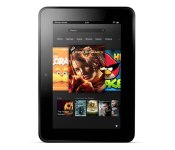
How would you change Amazon’s Kindle Fire HD (7-inch)?

Amazon’s second-generation Kindle Fire arrived with a revamped design, excellent display and stereo sound. For all of these plus points, however, our reviewer’s single objection was the same that it’s always been. The Kindle Fire is less of a tablet and more of a Trojan Horse, a way to keep the Amazon catalog sandwiched between your hands at all times. If you can ignore that issue then it’s a perfectly fine device, albeit one that couldn’t topple the first-generation Nexus 7 as our Android tablet of 2012. The question, therefore, is what did you think of the Kindle Fire HD? Head on over to our forum and speak your brains.
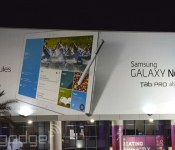
Samsung ad outs Galaxy Note Pro and Galaxy Tab Pro ahead of CES

In the days leading up to CES, there are always a few unfortunate products that are prematurely outed by banners being put up over night. In this case, the victims are Samsung’s upcoming Galaxy Note Pro and Galaxy Tab Pro, as shown by this massive ad at the South Hall of Las Vegas Convention Center. Stylus and SIM card slot aside, it’s hard to tell what else the pictured Galaxy Note Pro has to offer. Its screen size is also a mystery here, though rumors are pointing at 12.2 inches, which would make it Samsung’s largest mobile tablet to date. According to an earlier report by SamMobile, the Galaxy Tab Pro will come in two smaller sizes: 8.4 inches and 10.1 inches. All shall be revealed at Samsung’s press conference in Las Vegas tomorrow afternoon, so stay tuned.
 AIVAnet
