


SteelSeries ‘Stratus’ Wireless Gaming Controller Now Available for Pre-Order
Following the release of the Logitech Powershell and MOGA Ace Power, gaming peripheral company SteelSeries today announced its Stratus iOS 7 gaming controller. Unlike the other two controllers, the Stratus is a completely wireless accessory that connects through Bluetooth instead of using the Lightning port on an iOS device.

Featuring console-style controls such as a directional pad, two analog sticks and four pressure sensitive face buttons, the Stratus’ Bluetooth capabilities allows connectivity for up to four controllers. The device also includes a protective cover that doubles as an extended grip.
Our sister site TouchArcade had the opportunity to spend some extended time with the SteelSeries Stratus, and has provided a detailed review outlining the strengths and weaknesses of the controller. While the device was given high marks for being useable with any iOS 7 device and an impressive battery life of over ten hours, criticisms centered around the high price tag and the comfort issues that the controller’s small design creates. Despite those criticisms, TouchArcade stated that the SteelSeries Stratus is “without a doubt the best controller out there.“
Another positive aspect of the SteelSeries Stratus was its ability to work well with Apple’s Lighting Digital AV Adapter while gaming:
Also, obviously, this begins to open the door to the strange new world that is treating your iPhone like a portable game console hooked up to your TV. You could technically do this with the Moga Ace Power and Logitech Powershell, but it required beaming your video output via AirPlay, which arguably is the least ideal of all possible solutions given the significant amounts of nearly unplayable lag AirPlay introduces. Wiring your iPhone or iPad direct to your TV via the Lightning Digital AV Adapter significantly mitigates this.
Currently, games such as Dead Trigger 2, Asphalt 8: Airborne, and Bastion offer controller support, with additional developers pledging to build controller support into their apps now that the hardware is available to consumers.
The SteelSeries Stratus sells for $99.99 and is available now for pre-orders.
     |

Google to bring Android to cars with a little help from Audi, GM, Hyundai, Honda and NVIDIA

Already with more than one billion activations on mobile and media devices, Google’s Android is set to make an impact on another major industry: automobiles. Following rumors that the search giant was working with Audi to embed its open-source OS inside its cars, the company confirmed today it has teamed up with five automotive and technology companies (with more expected in the future) to form the Open Automotive Alliance. Alongside Audi, Google will be joined by General Motors, Hyundai, Honda and chip-maker NVIDIA, which will all work to bring Android to cars starting this year. The coalition aims to create a common platform that will drive innovation and in turn make cars “safer and more intuitive for everyone.” With Apple and Nokia already pushing hard to bring their own software to cars — Apple already counts Honda, GM and Hyundai as Siri Eyes Free partners — 2014 could be a big year for connected cars.
Filed under: Transportation, Software, Google
Source: Open Automotive Alliance

Netatmo reveals designer bracelet that helps to protect your skin from sun damage

Netatmo’s adding a dash of fanciness to this year’s parade of wearable announcements at CES. The firm, known for its thermostat and weather monitor, unveiled the June bracelet: a wrap around piece of arm candy with a gem stone-like sensor that measures sun exposure. Since it was designed by Louis Vuitton and Harry Winston collaborator Camille Toupet, it looks a lot chicer than most wearables out there. The downside, however, it that it doesn’t have its own display. Instead, it syncs with an iOS app, which not only displays how much sun you’re getting, but also tells you what SPF number your sunscreen should have and when to wear shades or a hat. When it starts shipping in the second quarter of the year (or so the firm hopes), it’ll come with a $99 price tag and will be available in platinum, gold or gunmetal. That sounds expensive for something that fills an extremely specific niche, but if you usually pay more than that for jewelry, we imagine it might be a worthy investment.
Filed under: Peripherals
Via: Mashable
Source: Netatmo
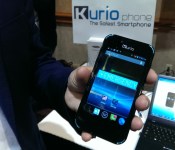
Kurio Phone – Kids Android Phone with Parental Control [CES 2014]

Straight from CES 2014 from the Mandalay Bay at CES Unveiled, Techno Source and KD Interactive unveiled their latest device aimed for kids, the Kurio Phone. The Kurio Phone comes from a lineage of kid-specific Kurio products, and brings a level of parental control that’s refreshing to the concerned parent.

Kids are getting smart phones at younger and younger ages. Would you want your 13 year old having an SGS4? How about your 7 year old? That’s where Kurio Phone steps in. It’s a fully-functioning 4.2 Jelly Bean Android phone with Google Play and works just as you’d expect an Android phone to. Specs are low-end at best including a 480×800 4″ LCD display, dual cameras, 1GB RAM, 4GB storage, removable battery, and a more-than-likely dual-core processor, but has all of the usuals too including 3G (GSM), WiFi, FM radio, SD slot, removable battery. Specs on this device aren’t the point though, its selling point is that pretty much every aspect of the phone can be controlled, locked, filtered, or tracked by watchful parents. Kids can have a fully-functioning Android smart phone and still be safe.
A full list of controls includes:
Contact Management
Parents can manage a child’s contacts, allowing or blocking certain contacts. If parents choose to maintain a safe list of contacts, kids may add contacts to their device, but they won’t be able to call or message them until mom or dad adds them to the list of allowable numbers
Primary Contacts
Parents can create up to five primary contacts that aren’t subject to any restrictions and can also receive alerts. For example, mom, dad, grandma, grandpa and older siblings.
Phone Use
Parents can set daily, weekly or monthly call-time limits and also limit the child’s number of text messages. They can also access the child’s call log, text message and Internet browsing history. In order to respect the child’s privacy, the content of MMS and text messages is not displayed. Though, Kurio Genius will provide tools to control message content.
Application Management
Parents can choose which applications are allowed, blocked or restricted by the calendar. Newly downloaded applications are blocked by default.
Calendar
Parents can set restricted times by day of week during which calls, SMS messages and restricted applications are to be blocked.
Geolocation
Using Kurio Phone’s GPS tracking technology, parents can monitor their child’s position every 15, 30 or 60 minutes, including his or her current position or last known position.
Geofencing
Parents can also pre-define secure and danger zones on a map, and set the days and times when these zones are activated. If the child leaves a secure zone or enters a danger zone, the parent will receive an alert.
In Case of Emergency (I.C.E.)
Parents can store the child’s information, including date of birth, allergies, blood type, as well as doctor’s name and phone number, which can be accessed on the device in case of emergency. A child can alert emergency services and their primary contacts in case of emergency, and also trigger a silent alarm by repeatedly pressing the “power” button when in danger.
Theft/Loss
In the event of theft or loss, parents can remotely trigger an alarm on the device, block the phone completely so that it cannot be used, erase the device’s data, set it to take a picture at phone start up, display a message on the device’s screen, and even track the device’s current location.
Other Alerts
Parents can also receive alerts via SMS or e-mail notifying them when the child’s phone is turned on/off, when it has a low battery, or even when the device’s SIM card has been changed.

Coming in under $200, the Kurio Phone is a perfect child companion for the concerned parent. It adapts to what would be appropriate for a 13 year old or a 7 year old; each parent can customize the Kurio Phone to their child’s needs. It can be controlled from a web interface or mobile app, all subscription free.

CES 2014: Orbotix Announces ‘Sphero 2B’ Smartphone-Controlled Robotic Toy [iOS Blog]
Orbotix, the company behind the smartphone-controlled robotic ball Sphero, today announced its next-generation toy, the Sphero 2B. Unlike the original Sphero, which was spherical in shape, the Sphero 2B features a rugged, tubular two-wheel design.
According to Orbotix, the Sphero 2B is able to move up to 14 feet a second, making it twice as fast as the Sphero 2.0, which debuted in August 2013. At 14 feet a second, the Sphero 2B can travel a mile in just over six minutes. Like the first Sphero, the Sphero 2B will connect to an iOS device via Bluetooth LE, and is controlled with an iOS app.
The Sphero 2B will offer customizable tires and accessories for a personalized driving experience, and along with an array of multiplayer games, the 2B is fully programmable.
Thanks to its design, it is also able to make quick turns, pull off tricks, and tumble over uneven terrain. Much like the Sphero, developers will be able to create a variety of apps and games that will interact with the Sphero 2B.
Sphero 2B will be available in the fall of 2014 for $100.
| |
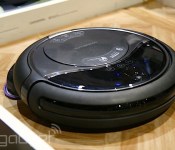
Moneual’s combo vacuum/mop ‘bot does a number on marker and wine messes

It’s always nice to find out that a device is more than just a press render. We caught wind of this cool combo vacuum/mop several hours ago and lo and behold, here it is in the robotic flesh. Moneual was showing off its RYDIS H68 at CES Unveiled by mopping away magic marker statements off a linoleum floor with help from spilled wine (what real-world scenario might have led to that combination of factors, it’s hard to say). Granted, it was a bit loud on the floor, but what struck us immediately about the H68 was just how quiet it was. It also did a pretty admirable job cleaning up the strange mess.
As noted earlier, this is the company’s second vacuum/mop in a few months. The primary hardware difference between the two is the inclusion of a water tank, which sort of juts off the side of the device a bit (it’s 25 percent larger than the competition’s, according to the company), as opposed to the H67 which just has a pad on the bottom that you need to dampen. There’s also a camera on the top, which apparently takes a reading of the room by projecting up to the ceiling, determining its best route. Oh, and pricing, which we didn’t catch earlier, is $499, which puts it in the same ballpark as a Roomba or Scooba. That includes one wireless gate to keep it from going into the wrong room.
Nicole Lee contributed to this report.
Filed under: Household
Eton’s rukus Xtreme and rukus II solar-powered speakers see the light of day

That pair of new solar-powered speakers from Eton that we told you about today just had their public unveiling at CES Unveiled, here at Vegas. So, you’re no doubt asking, what makes the Xtreme so Xtreme? Ruggedness, of course. The speaker is water-resistant and can be dropped from a height of 3.3 feet. The wedged-shaped speaker is a pretty nice-looking thing and feels solid in-hand, even with those rubberized edges. As for sound, well, quality seems halfway decent, though the speaker doesn’t get particularly loud. In this crowded room, we had to get pretty close to hear things clearly.
If the sun’s not doing it for you, you can charge it up via USB. There’s speakerphone functionality built-in, as well as NFC pairing for phones that support it — no auxiliary out here, however. The smaller rukus II, meanwhile, also has NFC pairing and a new speakerphone feature, along with Bluetooth 4.0. That one will run you $130, with the Xtreme coming in at $100 more.
Nicole Lee contributed to this report.
Filed under: Portable Audio/Video

Fujifilm’s X100S camera now comes dressed in black

If you’ve been waiting for Fujifilm to release a darker-hued X100S to match the X100, wait no longer. The company has revealed the X100S Black, which does exactly what it says on the tin — it’s the same high-end, retro-styled camera as before, just in a sober (if rather eye-catching) new color. We’re told that the blackened model will cost the same $1,299 as its silver counterpart, and it should hit shelves in February.
Filed under: Cameras
Source: Fujifilm
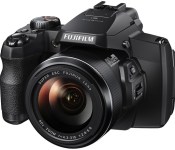
Fujifilm reveals the FinePix S1, a weather-ready 50x superzoom camera

Fujifilm is launching a quintet of point-and-shoots at CES, and one of them may be just the ticket for those who want both extreme zoom and weather resistance in a single camera. Its new FinePix S1 (above) packs a 50x (24-1,200mm) f/2.8-5.6 lens, yet is tough enough to survive the dust and rain; you can take that close-up concert photo even if you’re stuck in lousy weather. The 16-megapixel shooter also offers WiFi image sharing, 10fps burst shooting, 1080p video, a 920,000-pixel electronic viewfinder and a tilting 3-inch LCD. The S1 will ship this March for $500.
The remaining FinePix models all share that 16-megapixel resolution, but sacrifice the S1′s do-it-all design in the name of price. The S9200 and WiFi-equipped S9400W both share the 50x lens and 10fps burst mode, but lose the weather-hardened design and step down to a 200,000-pixel viewfinder. The entry S8600 moves to “just” a 36x (25-900mm) lens, 720p video and AA battery power. Photographers who need a truly rugged camera can pick up the XP70, a waterproof compact cam with 5x (28-140mm) optics and 1080p movie making. All four of these designs also arrive in March, with prices starting at $230 for the S8600 and XP70; the S9200 costs $330, while the S9400W is slightly costlier at $350.
Filed under: Cameras
Source: Fujifilm
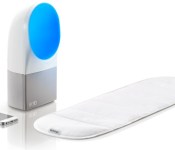
CES 2014: Withings Shows Off ‘Aura’ Smart Sleep Tracking System [iOS Blog]
Withings, the company behind the Smart Activity Tracker and the Smart Body Analyzer is showing off its newest health monitoring device, the Aura Smart Sleep System. Aura, which consists of a bedside device with an ambient light, a sleep sensor, and an app, is designed to monitor and improve the sleeping experience.
The system’s bedside device records information like noise pollution, room temperature, and light level, while the sleep sensor, which goes under a mattress, monitors sleep patterns, breathing cycles, and heart rate. The sensor is able to pick up the tiniest of movements, even under thick mattresses.

Withings Aura is comprised of a soft and discreet sleep sensor that slips under your mattress and works in synchronization with the sensitively designed bedside device. Together, the two units record and monitor an array of factors to offer you a deep understanding of your sleeping experience. The sleep sensor focuses on personal patterns (body movements, breathing cycles and heart rate) and the bedside device screens your bedroom environment (noise pollution, room temperature and light levels).
In addition to recording information, the bedside device is able to offer customized light and sound to improve sleep, along with alarm clock functionality and personalized wake-up and fall-asleep programs.
For example, the multi-color LED in the bedside device is able to regulate melatonin, and sound programs are able to replicate the frequency and pattern of the circadian rhythm to stimulate users upon waking and relax them when sleeping.
The accompanying app allows users to visualize and compare their sleep cycles from night to night, monitoring triggers that cause poor sleep, and it also allows user to program their individual sleep programs.
Withings’ Aura sleep system will be available in the spring of 2014 for $299.
| |
 AIVAnet