


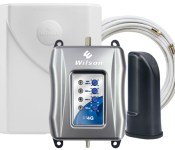
Wilson Electronics’ new 4G signal booster doesn’t care about carriers

Wilson Electronics is only interested in one thing: boosting cellular signals for those starved of bars. The company’s also quite fond of Vegas, and for the third year running has made the trip to CES with fresh hardware in tow. Previously, Wilson’s boosters have been able to enhance the signal from a couple of carriers at the most, but the new DT4G doesn’t care what device you’re using, nor which network bills you at the end of the month — all it cares about is making sure you’ve got all the 4G, 3G or 2G airwaves you need. It’s touted as the very first carrier-agnostic booster, and will be ready to cling to walls “soon” for around $400.
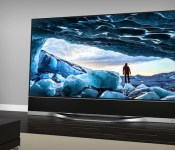
Vizio’s HDTV plans for 2014 focus on Ultra HD, in sizes going all the way up to 120 inches

We took a peek at Vizio’s CES 2014 booth and came away impressed with not only its current mainstream HDTV lines, but also what it’s planning for the future. The current E- and M-series are rolling out now with features like smart apps (cribbed from its Co-Star LT platform) and local LED dimming backlighting that are usually reserved for higher end HDTVs. It’s also readying a number of new audio products, from those Android-packing Bluetooth speakers to its current soundbars and even an upcoming sound plate device that you can sit your TV on. Still, the models we think most will be the most interested in are Vizio’s upcoming Ultra HD televisions.
The P-Series holds its mainstream approach, with 64 zones of LED backlighting and built-in CPU with two CPU cores and four GPU cores in sizes of 50-, 55-, 60-, 65- and 70-inches. The custom Vizio design handles all the processing and per-pixel tuning needed to work at that high resolution, and the TVs even support the latest wireless tech like 802.11ac, and 4K streaming from sources like Amazon and Netflix when it’s available. Vizio’s most striking assault however, is planned at the extreme high end with its Reference Series. Consisting of two models — a 65- and 120-inch version — they promise all the features of the others, plus an upgraded 384 zones of local dimming, Dolby HDR tech for unprecedented lighting and color quality, and an integrated 5.1 soundbar (with wireless subwoofer). We don’t have prices or release dates for Vizio’s 4K ready TV lineup yet, but the company reminds us of its groundbreaking pricing history. That’s enough to have us interested and thinking these may be some of the first cheap Ultra HD TVs worth purchasing — assuming they debut in the second half of the year as planned.
Filed under: Home Entertainment, HD
Source: Vizio CES
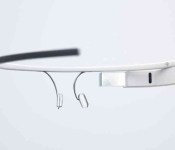
Harman integrates Google Glass into smart mirror concept, eyes safer driving with wearables

Automakers and in-car infotainment outfits have begun to make a play for Google Glass alongside vehicles and tech. Hyundai has already outed plans for using Google’s headset for unlocking doors, and now Harman is looking to enhance driver safety with the device. At CES, the audio and infotainment company will show off its advanced driver assistance services (ADAS) engine, One Harman, integrated with Glass. The smart mirror concept leverages the ADAS tech and cameras in order to analyze real-time data, map lanes and calculate potential road hazards. Warnings and alerts can then be sent directly to the driver’s headset, allowing the focus to remain on the open highway. Of course, Harman will still have to sell lawmakers on the new safety regimen before it can become a mainstay.
Filed under: Transportation, Wearables
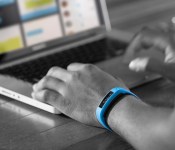
Garmin takes on Fitbit with Vivofit, a fitness band that nags your weight away

Garmin’s been doing the workout thing for a while now in the form of those big fitness-tracking watches. In celebration, no doubt, of the many miles we’ll all be walking this week in Vegas, the company’s edging in on Fitbit territory with the Vivofit. The band’s got a curved display that’ll greet you each morning with a daily goal based on your activity level, adjusting accordingly as you hit different milestones. Given Garmin’s area of expertise, it’s only natural that the device also tracks your progress, including distance, steps and calories — it’ll also send you a friendly reminder when it’s time to get off your butt. The Vivofit arrives in Q1 of this year, priced at $130.

Dolby Vision imaging finally comes home this fall with Netflix and Xbox Video as partners

Dolby’s TV image-enhancement tech has been in development for a long time, and today the company is finally ready to show you when and where you’ll find it. What we saw in December has been graced with the Vision name, and the outfit has promised we’ll see TVs with it baked in this fall. What’s more, Sharp and TCL have compatible hardware on display in their respective CES booths this week, and Amazon, Netflix, VUDU and Xbox Video are stepping up as content providers. Hit the Dolby link below for more information, and be sure to check back later this week for our latest impressions.
Filed under: Gaming, Home Entertainment, HD
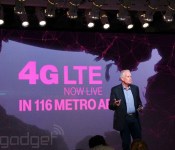
T-Mobile promises better coverage after spending $2.4 billion on spectrum from Verizon

T-Mobile has just made a big move to improve its coverage by purchasing a large swath of 700MHz A-Block spectrum from Verizon for nearly $2.4 billion in cash. T-Mob — which has been in a buying mood lately — said the deal will will help improve its coverage for 158 million people in 21 of the top 30 US markets, including New York, LA, Atlanta and Dallas. The so-called low-band spectrum has a greater range than more common high-band frequencies, which will be particularly useful for T-Mob in the surrounding areas of large cities. As part of the deal, it’ll also transfer $950 million worth of spectrum to Verizon in several markets, mostly in northern California and Atlanta. Don’t get excited about having better 4G coverage just yet, though — the deal’s still subject to regulatory approval from the FCC and DoJ, which could take some time.
Filed under: Wireless, Internet, Mobile, Verizon, T-Mobile
Via: Business Insider
Source: T-Mobile

Nintendo forced to pay a share of every 3DS sale to another company

While Nintendo’s Wii U console sales may continue to frustrate, its handheld gaming business offers hope of a better future. But even as its 3DS and 3DS XL consoles continue to outsell their rivals, Nintendo will have to come to terms with sharing a percentage of each sale with another company. In December, the company was told it must pay 1.82 percent of the wholesale price of each 3DS sold after it was found guilty of infringing on patented camera technology owned by Tomita Technologies. It means that Nintendo could pay up to $3 for each unit, for as long as it continues to sell the console. Given it sold 2 million 3DS and 3DS XLs last quarter, putting the current lifetime total at 35 million, demand for the handhelds is still strong. Nintendo’s already paid Tomita a $15 million damages award, but it faces the prospect of sending Tomita smaller payments well into the future.
Via: Kotaku
Source: Law 360
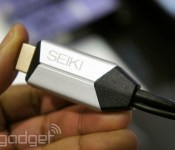
Seiki U-Vision HDMI cable promises to squeeze 4K upconversion out of 1080p video

Known for suddenly coming on the scene last year with some of the cheapest Ultra HD televisions around, Seiki is getting into the accessories game with its new U-Vision HDMI cable. The $40 HDMI cable packs Technicolor 4K-certified video processing that it claims promises the best edge restoration, noise reduction and other tweaks available, all performed by the USB-powered Marseille Networks VTV-1222 chip within. While we usually prefer that our signal pass to the TV unaltered, so far Seiki’s UHD TVs haven’t proven to pack the most sophisticated scalers within. Also helping its case are industry darlings like the Darbeevision Darblet that many are using to improve the quality of their HD video on passthrough. We saw the cable in action and while the demo seemed clean, the demo reel didn’t give us much of an opportunity to compare what it was actually doing. The cable will go on sale sometime in the first quarter of this year, and arrive as an adapter in Q2.
Dana Wollman contributed to this report.
Filed under: Displays, Home Entertainment, HD
Source: Seiki

NPR receiver gets closed-captioned radio emergency alerts for the hearing impaired

I’ll be the first to admit that I had a little trouble wrapping my brain around this one, but I think I’ve got it now. Sure the appeal of closed-captioned radio for the hearing impaired is clear, but what wasn’t immediately apparent was why, precisely, one would want a standalone box for such information if you could potentially get it just as easily through, say, the station’s website. This first iteration (which is very much still in the proof-of-concept phase) is intended for emergency relief organizations like FEMA and NPR and its partners are currently testing it out in the Gulf states. The box uses a tablet as a display, getting emergency information through the radio spectrum, so you can use it when the power is out and your WiFi isn’t working — assuming you’ve still got juice in your tablet, which powers the box.
At present, those emergency alerts are the only thing that are currently closed captioned, though NPR is aggressively looking at captioning most or all of its programming, so you could theoretically get the text narration through the box or through the public radio network’s site. Future iterations of the receiver will also be a fair bit smaller, perhaps eventually being built into radios with displays, so hearing-impaired public radio fans can still get their Terry Gross fix.
Nicole Lee contributed to this report.
Filed under: Portable Audio/Video
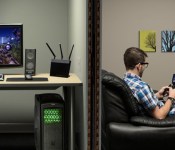
NVIDIA certifies PCs and routers that can stream games to its Shield handheld

If you’ve ever tried to stream a game from a PC (or PS4) to a mobile device over WiFi, then you’ll know the bandwidth requirements can be quite fussy. Attempt to remote play at 1080p and 60 frames per second, as NVIDIA promises with its Shield handheld and recently upgraded GameStream service, and things start to get seriously pinnikity. So, to help you pick the right hardware to go with your Shield (which is now going for $250 at Amazon, by the way), NVIDIA has started a certification program to label PCs and routers that are GameStream-ready. Expect to see the green logo on pre-built machines from the likes of Digital Storm and Maingear that have the necessary GeForce GTX graphical guts, as well as a number of dual-band and wireless-AC routers from ASUS, Buffalo, D-Link and Netgear. (You’ll find a full and current list of certified products over at the source link). Compatible routers will also support streaming from the cloud, via NVIDIA’s alternative GRID service, although of course you’ll also need a steady 10Mbps broadband connection before you even think about trying that.
Filed under: Desktops, Gaming, Handhelds, Mobile, NVIDIA
Via: IGN
Source: NVIDIA GameStream-ready products
 AIVAnet