


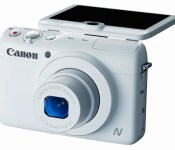
Canon PowerShot N100 sports modified design, WiFi, rear-facing camera

We weren’t quite sure what to think of Canon’s PowerShot N, an unusual-looking point-and-shoot with a large touchscreen and a square design that launched at last year’s CES. That model didn’t follow the traditional pocket camera form factor, and while we were happy to give Canon some props for innovation, we weren’t convinced the N would be a success. And now, well-received or not, the non-traditional cam is back. This year, it’s the PowerShot N100 — and Canon even had the chutzpah to price this thing higher than its 2013 equivalent, at $350. That sum will net you a 12-megapixel CMOS sensor, Canon’s latest DIGIC 6 processor, a 5x f/1.8-5.7 (24-120mm) optically stabilized zoom lens, and a 3-inch, 922k-dot touchscreen that flips up 90 degrees. There’s WiFi, like last year’s model, along with NFC, so you can tap the camera to a compatible Android smartphone for instant image and video transfers.
But the spec Canon is pushing most with the N100 is a secondary rear-facing camera. We’ve seen plenty of rear-facing cams on smartphones and even a few tablets, but this appears to be the first time a manufacturer is including one on a dedicated point-and-shoot. The intention here is that photographers will use this second camera to capture their own expression in still or video form alongside content coming in through the primary lens. We first experienced this concept with LG’s Optimus G Pro, and while it’s a bit gimmicky, we can see Dual Capture resonating well with Canon’s target demographic. There’s also a Hybrid Auto mode that snaps four seconds of video before each still photo, a Creative Shot mode enabling a handful of assistive options and a standard video mode for capturing clips at up to 1080p. The PowerShot N100, available in black and white, will run you $350 when it ships in May.
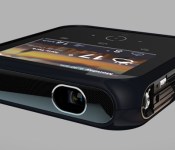
ZTE’s Android-powered Projector Hotspot dishes out 1080p video and US-native LTE

We’ve seen some pretty clever hotspots in our day, but ZTE is determined to trump them all with its new Projector Hotspot. As the name implies, it’s both a 1080p DLP projector (with HDMI and WiFi Display support) as well as an 8-device LTE hotspot, giving your mobile devices a big screen and internet access at the same time. However, it’s smart enough that you sometimes won’t need another device at all. This hotspot runs Android 4.2, folks — you can hop online through its 4-inch touchscreen and project content from any app or website. ZTE plans to bring the Projector Hotspot to the US sometime in 2014, although it isn’t yet saying which carriers (if any) are involved with the launch.
Filed under: Peripherals, Wireless, Networking, Mobile
Source: ZTE
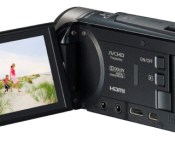
Canon’s app-controlled Pan Table lets you create pro-level effects for $100

We don’t typically pay much attention to camera accessories, but this one’s definitely piqued our interest. The Pan Table, available later this quarter from Canon, pairs with the company’s Android and iOS Camera Access Plus apps to enable some pretty cool panning effects. After mounting your camcorder, you can move the platform 200 degrees to the left and right as you shoot video. It can also tilt up and down by 20 degrees, but you’ll need to make those adjustments manually. Unfortunately, Canon is unable to share pictures of the device at this time, but once the Pan Table does materialize, it will operate for up to nine hours on a pair of AA batteries, or you can power it indefinitely using the bundled AC adapter. It ships in March for $100.
Filed under: Cameras, Peripherals, Canon

Get your CES 2014 liveblogs right here

We realize that not everyone can be at CES this year – after all, that Las Vegas Monorail only holds so many people at any one given time – but here’s the next best thing. As per usual, we’ll be liveblogging the week’s biggest press conferences, so you can follow the action from the comfort of your own computer. Speaking of making things a bit more comfortable for you, the reader, we’ve compiled links to all of our liveblogs for this year’s show just after the break.
Monday January 6th
- 11:00AM ET: LG CES press event liveblog
- 3:000PM ET: Live from ASUS’ In Search of Incredible event at CES 2014
- 4:00PM ET: Live from Intel’s CES 2014 press conference
- 5:00PM ET: Samsung CES 2014 press event liveblog
- 8:00PM ET: Sony CES 2014 press event liveblog
Filed under: Cellphones, Desktops, Laptops, HD, Mobile, Samsung, Sony, ASUS, LG, Intel

Alcatel to bring world’s fastest octa-core phone to Europe in Feburary

TCL’s already jumped the gun by launching its Idol X+ in China last month, but the same flagship device will be heading to Europe this February under the Alcatel brand. For those who missed the news first time round, this dual-Micro SIM, 7.9mm-thick Android phone packs MediaTek’s 2GHz MT6592, which is currently the world’s fastest true octa-core chipset. You’ll find the usual top-spec components around the Idol X+ as well, including a 5-inch 1080p IPS display, a 13-megapixel main camera (which supports 40-megapixel panorama and digital stabilization for video capture), a 2-megapixel front-facing imager, a 2,500mAh battery and dedicated audio amplifier chips by ESS. Internal storage starts from 16GB (with 12.3GB available to the user), along with microSD expansion of up to 32GB. The phone also comes with a pair of JBL earbuds, but there’s no word on whether the China versions’ Bluetooth activity tracker will be included as well — at least it won’t be called Boom Band, as it will apparently be a more refined version when it goes global.
We were left rather impressed by the Idol X+’s design and build quality. The solid plastic bezel features a brushed metallic effect, accompanied by a spin finish (achieved by in-mould labelling) on the back of the phone. Like the screen, the backside will also have a nano-coating treatment to minimise fingerprint smudges. Shoppers will be given a color option of either black or white when this 3G phone lands in Europe some time in February, and it’ll likely be sold for around the attractive $300 price point unsubsidized.
Brad Molen contributed to this report.
Filed under: Cellphones, Mobile

Are regular speakers too opaque? Check out the Clio

Does your speaker look a bit too, you know, speakery? ClearView’s got an interesting solution in the form of the Clio, a new product unveiled today that it’s deemed “the first invisible speaker.” That title’s a bit of a stretch, as you might have guessed. For starters, there’s the clearly visible base, which houses the electronics, controls and inputs. The phrase refers to the transparent, curved glass at top, which resonates to produce sound waves and certainly makes the system less conspicuous than most speakers out there.
So, aside from looking different, what benefits does such a technology provide? For starters, the sound waves disperse in 360 degrees, so if you put the speaker in the middle of a room, you’ll be able to hear clear sound on either side. Convinced? You can pick one up right now through the company’s site for $350.
Filed under: Portable Audio/Video

SteelSeries launches the Stratus, the first wireless iOS 7 gamepad

With its new gaming protocols in iOS 7, Apple opened the door for gamepads that make use of the iPhone’s Lightning connector to bring assortment of inputs to iOS titles. Recognizing that not all iOS gamers own an iPhone, accessory maker SteelSeries has unveiled its new Stratus controller, becoming the first wireless gamepad to support Apple’s latest iOS platform in the process. Unlike Logitech’s PowerShell and PowerA’s MOGA Ace Power, the Stratus connects to an iPad, iPhone and the iPod touch via Bluetooth 2.1, putting four pressure sensitive face buttons, four shoulder buttons, dual analog sticks and a 4-way D-pad in a design that reminds us a little of Sega’s Genesis/Mega Drive gamepad, at least in black. While you won’t be able to attach your iOS device to the Stratus and play on the move, it does mean you can set it aside and play against up to three other players on the big screen via AirPlay. Without that additional clutter, the Stratus comes in significantly lighter than rival controllers, giving you around 10 hours playtime on a full (USB) charge. SteelSeries has already made the Stratus available for pre-order on its website for $99.99 / €99.99, you can find the link in the source below.
Filed under: Gaming, Handhelds, Mobile
Via: SteelSeries Press
Source: SteelSeries Status

Philips’ 27-inch monitor with NVIDIA’s G-Sync tempts gamers with silky-smooth visuals

When NVIDIA unveiled its G-Sync tech that alleviates lag, screen tearing, and stuttering, it counted Philips among the companies that would make monitors with its secret sauce. Now that CES has rolled around, Philips has finally revealed a panel that uses the graphic titan’s technology. The panel (catchily dubbed 272G5DYEB) measures up at 27 inches, carries a resolution of 1,920 x 1,080, a 144Hz refresh rate, 1,000:1 contrast ratio and displays up to 16.7 million colors. If you’re fixing to connect the screen to your PC via HDMI, you’re out of luck as it only sports a DisplayPort. Enjoying the buttery visuals will drain your pockets of $649 when the monitor arrives this spring. Of course, if you can’t wait till then, a modified ASUS VG248QE is already available with G-Sync from a handful of boutique PC outfits.

Garmin’s latest GPS navigator has a backup camera for avoiding fender benders

Here’s a nice feature from the sometimes staid world of in-car GPS devices. The latest from Garmin features a wireless backup camera that’ll show what’s behind you on its 7-inch display. The ruggedized camera plugs into your vehicle’s rearview lights for power, switching on when they do, so you can toggle between that image and the standard navigation screen. The Nüvi 2798LMT package runs $400 and includes the standard Garmin features like voice-activated navigation and free traffic reports and maps.
Filed under: GPS
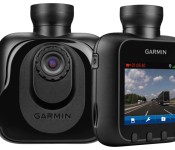
Garmin’s new dash cam will record your crash, man

In the grand scheme of things, $220 might be a small price to pay when it comes to accident liability. Or $250, for that matter. In addition to the rear-facing camera it announced today, Garmin’s also offering up a window-mounted dash cam. Where the other helps you avoid potential collisions in the first place, this one’ll record the incident if, god forbid, you do get in an accident. The camera records wide-angle video in 1080p, 720p or WXGA resolutions, turning on and off with your engine. The Dash Cam has an incident detector, saving relevant video to its 4GB of storage (a number you increase via expandable memory). The 2.3-inch display, meanwhile, makes it easier to position the cam correctly, and, if need be, you can pull the camera off the windshield to take snapshots. The footage is timestamped and, if you opt for the $250 GPS version, geostamped, so you know where incidents occurred. Both models are arriving next month.
 AIVAnet