


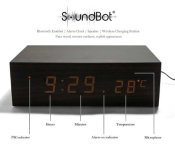
EyeCandis SoundBot SB1000 Bluetooth Qi NFC Alarm Clock Station review
The SoundBot SB1000 also known as the PowerBot SB1000 are both the same item with slightly different branding by parent company EyeCandis.
This feature packed alarm clock is a multimedia power station; available in both “Natural Wood” and “Dark Wood” color shades.

The alarm clock is packed with:
- Built-In NFC Tag
- Qi Wireless Charging for Qi Compatible Devices
- Awesome Bluetooth Speakers
- Temperature Sensor
- Built-In Microphone
- Built-In 3.5mm Audio Input
Bluetooth Wireless Speakers w/ Built-In Microphone
The Bluetooth stereo speakers (found on both sides) of the clock are great and provide great trebles and bass. I’ve been able to play audio, make and receive phone calls, parties can hear each other without a problem when in range of the microphone. Audio distortion is barely perceptible except when all devices on are their respective maximum volumes.
The volume range for the SoundBot SB1000 is decent for average household usage, but it’s not overwhelmingly magnificent. I have tested the speakers out with many genres of music, and they perform very well.
Pairing is simple but it can be a bit of a hassle the first time you connect to your device. On the top of the alarm clock you will find touch sensitive keys that allow uses to make and answer a call, pause/play music, change the speaker’s volume and more.
Alarm Clock
The main function of this device is to work as an alarm clock; the unit provides time with a large LED Display accurately once set. The alarm volume can be too low at times, however you can use your smartphone through the device’s speakers for a louder sound. But, without using a smartphone or tablet, I’m not quite sure this will always wake you up on its own.
Temperature Sensor
This alarm clock has a really neat temperature sensor. Set to Celsius by default, it can be switched to display in Fahrenheit. While the temperature sensor is very accurate, I had an extremely difficult time switching temperature formats due to a manufacturing issue with the unit during my testing.
Qi Wireless Charging
This device has a built in wireless charging pad built in to the top to charge your Qi compatible devices when placed in the proper position, the Qi Feature has functioned very well once activated. The positioning of your device and the qi charging pad is extremely sensitive, even without a case on your device, so make sure it’s in the right position before charging. Unfortunately, the Qi pad isn’t quite drop and go because of it’s sensitivity.
NFC
On the top left-side corner of the clock, there is a built-in empty NFC Tag so you can setup your own NFC commands with NFC capable smartphones and tablets.
Overall
This is a great Bluetooth speaker that shows the time, has NFC connectivity, excellent sound, and Qi charging. It might not, however, replace your alarm clock just yet. Due to a few quality control issues (temperature sensor, converting temperature, LED, and Bluetooth Pairing broadcast) When it all works properly, it’s an amazing device. Just note that some users have reported faulty products.
Pricing:
You can find the SoundBot Bluetooth Speaker Alarm Clock in Natural Wood and or Dark Wood at Amazon for $79.99.
The post EyeCandis SoundBot SB1000 Bluetooth Qi NFC Alarm Clock Station review appeared first on AndroidGuys.
Android comes to the open road with Open Automotive Alliance
Android connected cars coming from a variety of industry players
Android is coming to your cars, and in a big way. Today sees the official announcement of Google’s latest initiative, the Open Automotive Alliance.
Partnering other players in the space such as Audi, GM, Honda, Hyundai and Nvidia, the goal is to accelerate “auto innovation with an approach that offers openness, customization and scale”. Just like Google did with the Open Handset Alliance and smartphones, the Open Automotive Alliance should do for vehicles.
While we’ve seen some companies take a crack at integrating smartphones or tablets in the automobile, there are no standards yet. What’s more, it’s a wonky experience when it’s done. To say there’s room for improvement would be an understatement.
…Your favorite apps and music…safely with your car’s built-in controls and in-dash display…Working to enable new forms of integration with Android devices, and adapting Android for the car to make driving safer, easier and more enjoyable for everyone. …Enabling automakers to more easily deliver cutting-edge technology to their customers.
Let’s hope that other industry names join the fray and that innovation accelerates for the auto space as quickly as it has for smartphones. According to the OAA, we can expect to see the first cars with Android integration by the end of this year.
To learn more check out the official website of the Open Automotive Alliance.
The post Android comes to the open road with Open Automotive Alliance appeared first on AndroidGuys.

Netgear’s new 802.11ac WiFi range extenders laugh at walls, distances

The 802.11ac WiFi standard is a spring chicken no longer, making us curious as to why there’s a lack of range extenders supporting it — barring Amped Wireless’ efforts, of course. Looking to capitalize on the situation, Netgear’s launching a pair of such extenders at CES, starting with the AC750 (aka the EX6100). This wall-plug model bounces up to 750 Mbps of dual-band WiFi to underserved areas, as well as playing host to one Ethernet port. The beefier AC1200 (aka EX6200) looks more like a router, packs five Ethernet ports, one USB 3.0 port, beamforming capabilities, and can deliver up to 1200 Mbps. Both are available now for $90 and $130 respectively, putting Amped Wireless’ $200 option into fairly uncompetitive territory.
Filed under: Wireless, Internet
Source: Netgear (AC750), (AC1200)

Cube 3 3D printer brings user-friendly hardware, higher resolutions for under a grand

Like clockwork, 3D Systems is offering up a refresh to its entry level Cube line. The third iteration of the Cube line, introduced almost exactly a year after its predecessor, features a new, semi-enclosed body, speedier printing and resolutions of down to 75 microns. The ink cartridges have been redesigned, as well, for an experience that’s “easier than changing an ink cartridge. The printer features Bluetooth and WiFi connectivity, for printing from the Android / iOS Cubify app and a build volume of up to six-inches squared. You can also print with two materials (ABS and PLA, naturally) and two colors at the same time.
The Cube 3 is queued up for a Q2 launch, with a price starting at under $1,000.
Filed under: Peripherals
CubePro 3D printer does up to three colors, can create basketball-sized objects

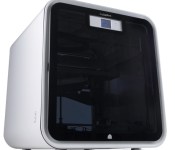
It’s hard to say whether “sub-$5,000″ really qualifies as consumer-level pricing. We suspect that whatever the final cost of the new CubePro ends up being when it ships in Q2, it’ll be priced at “prosumer” levels, at best. Still, the followup to the CubeX boasts some pretty enticing specs. Like its predecessor, the Pro can create prints the size of a standard basketball and can manage up to three colors at a time, with resolutions as fine as 75 microns. The printer itself is more enclosed than the last version, with a “controlled print chamber,” which helps maintain the integrity of the print. And there is, naturally, built-in WiFi, so you can use the printer with the new Cubify iOS / Android mobile app.
Filed under: Peripherals
Canon’s targeting new parents with VIXIA R52, R50, R500 camcorders

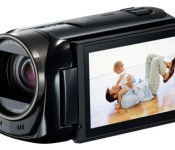
Your smartphone can shoot video; your tablet can shoot video; and, if you even still own one, your point-and-shoot can shoot video too. So why, then, might you pick up a mid-range camcorder? Fortunately for manufacturers, there are still a few perks to owning a dedicated video camera. If top-notch image stabilization is what you’re after, you’ll probably turn to Sony, but if you’re a new parent looking to document your young child’s early years, Canon wants your business. The company’s latest VIXIA camcorders sport a variety of family-friendly features, from livestreaming to your smartphone with the R52 and R50 (think expensive baby monitor), to an “Advanced Baby Mode,” which can register up to three babies and track their height, weight and age over months and years of shooting.
Internally, all three cams are quite similar. They include 3.3-megapixel CMOS sensors, 32x optical zoom lenses with optical stabilization and 1080/60p video capture. The $450 R52 and $400 R50 also include internal storage — 32GB on the pricier model and 16GB on the other — letting you capture footage simultaneously to the embedded storage and a standard SD card, with archival-quality AVCHD recorded on one and upload-ready MP4 on the other, if you’d like. The $300 RF500 excludes built-in storage, so you’ll need to add an SD card to store captures there. The pricer pair also packs WiFi, with support for livestreaming and recording directly on a connected smartphone or tablet. Finally, you can also use the R52 and R50 with Canon’s new Pan Table accessory, adding to their practicality as a home-security appliance. Expect all three VIXIA camcorders in stores this March.

Canon unveils WiFi-equipped PowerShot SX600 HS, ELPH 340HS point-and-shoots

It’s hard to get excited about an ordinary point-and-shoot after Canon just showed off its funky PowerShot N100, but if practicality’s the name of the game, this new duo will have you covered. The first model, the PowerShot SX600 HS, includes a 16-megapixel CMOS sensor, a DIGIC 4+ processor, an 18x 25-450mm, f/3.8-6.9 optical zoom lens and a 3-inch 461k-dot LCD. There’s also built-in WiFi and NFC, so you can pair the camera with an Android smartphone or tablet and transfer stills and video with ease. There’s a Mobile Device Connect button, enabling instant access to wireless features, such as app control and uploads. The SX600 includes a Hybrid Auto mode, which records four seconds of video before each still photo; a Smart Auto mode with 32 pre-defined shooting modes; and a dedicated movie button, giving you instant access to 1080p captures.
Next up is the PowerShot ELPH 340HS. This more portable cam will set you back 200 bucks, and includes a 16-megapixel CMOS sensor, a DIGIC 4+ processor, a 12x 25-300mm, f/3.6-7.0 optical zoom lens and a 3-inch 461k-dot LCD. It also sports WiFi and NFC, with the same functionality outlined above, along with the same Hybrid Auto, Smart Auto and video shooting modes. The 340HS is expected to hit stores in March for $200, available in purple, black and silver. The $250 SX600 HS will be available a bit sooner — it ships at the end of February in red, black and white.

India’s Micromax announces dual-boot Android/Windows 8.1 tablet

If you know Micromax at all, there’s a good chance you live in India — or maybe you’ve caught wind of one of those low-cost Canvas handsets. Turns out the company is the second-largest smartphone maker in its native country, on top of dabbling in the HDTV and tablet spaces (and really awful slogans like “Nothing Like Anything”), among others. Micromax is hitting CES this year with a pretty interesting offering: a dual-boot tablet. Targeted, perhaps, at the indecisive, the LapTab runs both Windows 8.1 and Android Jelly Bean, so you don’t need to permanently commit. The tablet’s got a 10.1-inch 1,280 x 800 display and front- and rear-facing 2-megapixel cameras. Inside is a 1.46GHz processor, 2GB of RAM and 32GB of built-in storage. The tablet goes on sale early next month with a wireless keyboard and an as-of-yet undetermined price.
Filed under: Tablets
Canon claims significantly improved audio quality with VIXIA Mini X camcorder

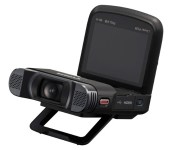
Canon’s instant-sharing VIXIA Mini camcorder lineup is welcoming a new model to the family. The Mini X, which will be available alongside the existing Mini, adds a handful of enhanced audio-capture features aimed at making the camera more attractive to pros. The X packs microphones that are 250 percent larger than its predecessor and Linear PCM audio encoding, along with a feature that automatically selects ideal audio settings depending on the scene, a mic input jack with manual audio level control, a headphone jack for monitoring, uncompressed HDMI output and embedded timecode, making it easy to merge footage (and audio) with output from other cameras.
On the imaging front, there’s an f/2.8 fisheye lens, a 12.8-megapixel high-sensitivity CMOS sensor and a DIGIC 4 processor. The lens is fixed, but the camera offers an option to shoot in either a wide-angle or close-up mode — with the latter, you can also take advantage of electronic image stabilization. You can shoot regular footage, along with slow- or fast-motion and interval captures, with 1080p output in either MP4 or AVCHD. Like Canon’s point-and-shoot lineup, the Mini X also includes WiFi, enabling live streaming and remote control when paired with an Android or iOS device. Additionally, there’s a 2.7-inch touchscreen with full rotation, letting you make adjustments and handle framing directly in the camera, if that’s how you like to roll. The VIXIA Mini X, which is also compatible with Canon’s Pan Table accessory, is expected in stores in March with a $400 MSRP.

ZTE’s 5.5-inch Grand S II lets your friends unlock the phone with their voice

After a brief tease last week, ZTE has at last revealed the Grand S II. The Android 4.3 smartphone has all the necessary ingredients of an early 2014 flagship, including a 5.5-inch 1080p screen, a 2.3GHz Snapdragon 800, a 13-megapixel rear camera and a 2-megapixel sensor up front. However, its real centerpiece is its voice recognition, which is more elaborate than ZTE hinted at a few days ago. The Grand S II will recognize multiple users’ voices; unlike the Moto X, you can let friends and family unlock the phone solely through speech. Other voice features are familiar, but welcome. You can take photos with spoken commands, and a My-drive mode tweaks the voice recognition for quicker hands-free control while in the car. We’re not big on the 16GB of built-in storage, but the hefty 3,000mAh battery should last longer than the 1,780mAh pack in the original Grand S. About the only mystery left is the Grand S II’s launch schedule, but we hope to learn more about that in the near future.
Filed under: Cellphones, Mobile
Source: ZTE
 AIVAnet