



CES 2014: Corning Announces Antimicrobial Gorilla Glass to Fight Germs on Mobile Devices
Following its announcement late last week regarding new “3D” curved Gorilla Glass for smartphones and other products, Apple’s glass supplier Corning today officially announced its antimicrobial Gorilla Glass, incorporating ionic silver into the glass to inhibit growth of bacteria and other organisms.
“Corning’s Antimicrobial Gorilla Glass inhibits the growth of algae, mold, mildew, fungi, and bacteria because of its built-in antimicrobial property, which is intrinsic to the glass and effective for the lifetime of a device,” said James R. Steiner, senior vice president and general manager, Corning Specialty Materials. “This innovation combines best-in-class antimicrobial function without compromising Gorilla Glass properties. Our specialty glass provides an excellent substrate for engineering antimicrobial and other functional attributes to help expand the capabilities of our Corning Gorilla Glass and address the needs of new markets.”
The new antimicrobial Gorilla Glass will be included in a new version of Steelcase’s RoomWizard conference room scheduling device, which is being shown at CES this week in Las Vegas, and the company says that it is working with “numerous manufacturers” to develop applications for the material. The company has also demonstrated that it can produce antimicrobial Gorilla Glass in high volumes needed for popular products such as the iPhone.

Last year, Corning noted that it was working on antimicrobial technology as part of a feature arguing that Gorilla Glass 3 is a superior material compared to sapphire, which has been gaining attention as a potential future display covering. Late last year, it was revealed that Apple had reached an agreement with GT Advanced Technologies to develop a sapphire glass manufacturing facility in Arizona, with Apple building out the plant and GT Advanced operating it. Apple currently uses sapphire to cover the rear camera on several of its recent iOS devices and for the Touch ID fingerprint sensor on the iPhone 5s, but it appears that Apple may be looking to significantly expand the use of sapphire in its products.
Amid the increased talk of sapphire as a possible replacement for Gorilla Glass in future mobile devices, Corning is clearly continuing to push its technology forward, with the new techniques for curving the glass allowing for innovative new product designs and antimicrobial properties serving as another selling point for device manufacturers and consumers. Corning is also working on next-generation flexible “Willow Glass”, but the company has indicated that it will be several years before that product can make its way into mobile device display assemblies.
     |
HP serves up 21.5 inch Android-powered All-in-One
Android hybrid tablet/laptops are so 2013 according to HP, which just announced its new Android-powered HP Slate21 Pro AiO.
Unlike the AiO desktop PCs that dual-boot Windows and Android, this one strictly runs our little green friend, Android 4.3 Jelly Bean.
Said to be designed for productivity in office, education and kiosk environments, the AiO features a 21.5-inch 1920 x 1080 resolution IPS touchscreen display with wide 178-degree viewing angles, plus Its stand design allows it to decline up to 70 degrees. There is also optional “VESA mounting,” that makes it flexible enough for a variety of work environments.
Other specs of the HP Slate21 Pro are an NVIDIA Tegra 4 quad-core T40S Processor (1.66 GHz – Dual-Core/Single-Core mode up to 1.8 GHz), 2 GB of RAM, 16 GB of flash storage, SD card slot, 8.11 a/b/g/n dual band wireless, Bluetooth 4.0, a USB 2.0 port on the side and two on the back, HDMI input, a USB 2.0 upstream port, RJ45 network connection, integrated Ethernet, DTS Sound and integrated audio, two, integrated stereo speakers, a 720p HD webcam and access to the Google Play store.
The AiO can use apps such as Kingsoft Office Suite, Google Docs, Google Drive, it’s certified Citrix ready and HDX verified and can deliver a virtual workspace with secure data and Windows application support via Citrix Receiver, so users also can easily switch between the Android environment and content displayed from a Windows PC.
With business users in mind, it comes pre-installed with Citrix XenMobile, which allows companies to manage apps and secure the HP Slate21 within a corporate environment.
When available, you get all of this this, plus 50 GB of Box cloud storage, starting at $399. If you’re not getting this for business, it should be able to handle games such as Dead Trigger 2 beautifully.
via HP
The post HP serves up 21.5 inch Android-powered All-in-One appeared first on AndroidGuys.
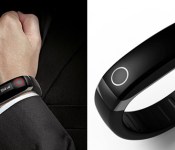
LG debuts Life Band Touch
LG is finally dipping its toes into the wearable technology world with the announcement of its Life Band Touch wristband. With its matte black finish and touchscreen interface, this activity tracker looks appealing. Being able to track your heart rate and calorie consumption, the device seems very similar to other activity trackers such as Nike’s Fuelband but there are some “cool” features that make it stand out from the fitness crowd.

One of the neatest features is that the heart rate monitoring doesn’t occur on the wrist, but works through “Heart Rate Earphones” which checks the wearer’s pulse through blood flow in your ear! It also comes with the standard smartwatch features such as notifications, tells time, and plays music
The Life Band Touch can sync with either Android or iOS devices using Bluetooth 4.0, although nothing specific has been said about what type of devices, smartphone or tablet, it will work with. As CES continues hopefully more details emerge as far as pricing and availability.
Source: LG
The post LG debuts Life Band Touch appeared first on AndroidGuys.
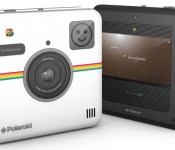
Polaroid’s Socialmatic camera to fuse retro style, instant prints and Android this fall

Last we heard of Polaroid’s Socialmatic camera, which promises to bring back instant prints with a modern flair, it was bound for store shelves in the first quarter of 2014. Here at CES, the firm’s announced that the hardware is cruising for a fall release now that it’s finalized the necessary legal agreements to make it a reality. For those in need of a refresher, the device runs Android to make sharing images a snap and packs a 14-megapixel cam on its front, a 2-megapixel rear-facing sensor, 4GB of storage with expansion via microSD, a 4.5-inch touchscreen and built-in WiFi. Zink’s ink-free paper will do the heavy lifting when it comes to printing photos, so any vintage film can stay stowed in your closet. Polaroid’s Socialmatic shooter is out in the wilds of the CES floor, so stay tuned for a hands-on.
Filed under: Cameras
Source: Polaroid

Whyd’s music-streaming aggregation now open to the public

It was, according to our calendars, nearly 14 months ago that we first checked out Whyd. The music service pulls songs scraped from sites like YouTube and Soundcloud, letting you build streaming playlists out of music often not available through the likes of Spotify and iTunes. And while we haven’t heard so much as a peep out of the service in the intervening year-plus, it’s clear that the team has been working on something over there. Today, the site is finally shedding its long-standing invite-only status, opening up to one and all. The news also brings with it an, ahem, wider variety of features, including Deezer-compatibility, comments, revamped profiles and more to help nudge you in the direction of yet another streaming-music offering.
Filed under: Storage, Internet
Source: Whyd

Avegant Glyph home theater headset isn’t competing with Oculus Rift (hands-on)

We’ve spent gobs of time with variations of Oculus VR’s Rift headset — the original duct-tape prototype, the first dev kit and even an updated HD version. We’ve spoken to creator Palmer Luckey several times, and company reps have graced Engadget stages at both CES 2013 and last March’s first-ever Expand event in San Francisco.
Avegant’s Glyph, however? We’ve only just begun. The home theater headset just got a name, and the first prototype looked an awful lot like what you’d see underneath a Terminator cyborg’s smooth visage. As Oculus did before, the scrappy eight-person team at Avegant is taking its impressive proof-of-concept to Kickstarter in hopes of funding a beta unit: $500 is the base level for a Glyph, and the project is set to go live on January 22nd. And this sentence — right here! — is where we’re gonna stop speaking about the Glyph as if it’s competing with the Oculus Rift. As Avegant’s CEO Ed Tang told us late last week: “We’re not trying to compete with Oculus.”
There’s good reason for that. For starters, the Glyph is really, really different from the Rift. Like, dramatically different. Yes, they’re both video headsets. Yes, they both offer some form of interactivity. What each is trying to achieve, however, is starkly different. The Rift aims for deep immersion — it cuts off your field of view, encompassing your entire spectrum of vision — whereas the Glyph operates more like a set of sunglasses. You can play games on it, but it’s really more suited for movie watching (say, on a plane). Both the alpha model we tried late last week (“hot off the production line!”) and the beta model that’ll ship to Kickstarter backers have a relatively small 45-degree field of view, allowing for a partially obstructed perspective of the world while using the Glyph. It’s this conceit that makes all the difference between the two.
As such, if you’re looking for the immersive virtual reality experience that the Rift offers, stop looking at the Glyph. If you’re looking for a $500 way to buy your own, very personal home/mobile theater (that’s still in beta), the Glyph is spot-on. As previously reported, the Glyph’s image is extremely crisp. Similarly impressive, it can do 3D without any glasses: it projects the image directly onto your retinas rather than using a screen. The effect, however, is more than a little underwhelming. Sure, the image is nice, but it’s surrounded by a massive dead space that feels wasted. Moreover, we spent three to four minutes adjusting the interpupillary distance (IPD) — the space between your eyes — just to make it work. That’s three to four minutes longer than it should take to make a $500 visual entertainment device function.

Another major differentiator from the Rift? Glyph has a fancy pair of headphones built in. If you want to be all the way crazy, you can wear the device like a standard set of (very large) headphones. Normally, though, it just serves as a means to make video viewing more comfortable. It’s a smart addition, but adds yet another layer of adjustment: Not only are you adjusting the IPD, but also how tight the whole apparatus is on your head. The alpha model we tried had a headstrap, though it isn’t planned for the beta. We’re also told that the beta model will be considerably lighter — as it stands, the Glyph rests somewhat uncomfortably on noses.
So, who is the Glyph for? Not just gamers, that’s for sure. A single MHL/HDMI wire will attach the Glyph to virtually anything — we even tried some mobile gaming with a Lightning adapter on an iPhone 5. An expected three-hour battery life, however, applies some serious limitations to viewing on the go. As best we can tell, like Google Glass’ Explorer Edition and Oculus’ Rift dev kit, the Glyph beta unit is meant for early adopters who are willing to put up with a very promising wearable that isn’t ready for retail just yet. Oh, and developers. But not for your parents (or even you, probably) just yet.
Filed under: Gaming, Home Entertainment, Peripherals, Wearables
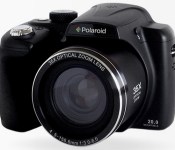
Polaroid’s new bridge cameras pack WiFi sharing, as much as 50x optical zoom

In addition to the quirkier parts of its CES camera lineup, Polaroid’s trotting out a line of bridge shooters with a healthy helping of optical zoom capabilities. Each device in the fleet features a 3-inch display and image sharing over WiFi. At the top of the range sits a model with 50x zoom (iE5036W), 18 megapixels, 1080p video-capture chops and a $299 price tag, with a nearly identical 40x zoom variant (iE4038W) perched just behind it. Interestingly, the version toting just 35x optics (Ixx353W) scores an upgrade to a 20-megapixel sensor. A cam with a 30x lens (iE3035W) helps bring up the rear, along with a 15x zoom flavor that drops its video resolution to 720p and its price to $149. If you intend to recruit one of these gadgets for your photographic endeavors, look for them to arrive in stores sometime this spring.
Filed under: Cameras
Source: Polaroid

3D printing destination Cubify hits 2.0 with curated and branded collections

Even if it completely failed in the consumer market, 3D Systems would still be on pretty solid ground thanks to its strong industrial 3D printing presence. But that hardly means the company is going to half-ass its efforts to capture mindshare from MakerBot and Thingiverse. Before CES can even officially kick off, the company has already announced a pair of new printers (the Cube 3 and CubePro) and the launch of Cubify 2.0 — the next generation of its consumer site for hosting and posting ready-to-print models. While there is a community-driven side to the portal, including user uploaded collections and profiles, there’s also a heavily curated portion that includes partnerships with brands like Nooka and Digital Dollhouse (a virtual playground for kids, who can now 3D print their creations). The collections are divided up into categories like fashion, decor and “mancave,” and include both products that you can print at home on your Cube or, for the more complex products like guitars, you can have 3D Systems print out for you on one of their giant industrial machines.
The company isn’t done yet at CES, either. There’s still a big press event to come, that will feature will.i.am and, more importantly, CEO Avi Reichental will be on our stage for an interview. Even with a trio of exciting announcements already out the door, we’re pretty sure 3D Systems still has something up its sleeve for later in the week.

Alcatel OneTouch Idol Alpha gets a champagne gold option, headed to Europe this quarter

You may recall that back at IFA, Alcatel surprised us with a prototype of its shiny OneTouch Idol Alpha. This time at CES, the company brought along a champagne gold version to tease its European launch this quarter. Like before, both the top and bottom transparent parts are lined up with LEDs, with the top ones acting as notification, and the bottom ones shining a light on the three Android soft keys. It’s rather pretty when you see it up close. Spec-wise, the 3D aluminum frame envelopes a 4.7-inch 720p IPS display with Dragontrail Glass, a 1.2GHz quad-core SoC with 1GB RAM, 16GB of built-in storage and a 2,000mAh battery. There’s no info on pricing just yet, but given Alcatel’s target market, we have a good feeling about this one, and we’ll let you know once we hear more.
Filed under: Cellphones, Mobile

Corning’s new Gorilla Glass will actively kill germs on your smartphone

Every properly-raised gorilla knows it’s not enough to be tough; you also have to be hygienic. Which is surely why Corning has developed an antimicrobial form of its Gorilla Glass that inhibits the growth of algae, mold, mildew, fungi, bacteria and other nasties that might want to take root on a heavily-used touchscreen. The glass contains an ionic silver coating that’s similar to what’s found on other germ-killing surfaces, except that here it’s meant to be “intrinsic” to the material and is therefore claimed to function for the lifetime of a device, whether it’s a phone, tablet, PC or even a piece of medical equipment — although Corning stops short of making any health-related promises. The company also avoids saying whether any antimicrobial gadgets will appear in the near future, because a good gorilla always under-promises and over-delivers.
Filed under: Cellphones, Laptops, Tablets
Source: Corning
 AIVAnet