


Panasonic ups its smart TV game with the VIERA Life+ Screen, complete with voice and facial recognition

Panasonic’s taken to the stage at CES and has just revealed the VIERA Life+ Screen in an effort to “redefine what a 21st Century TV should be.” Televisions under this banner are kitted out with Xbox One-like facial recognition that will display information relevant to users on an “Info Bar” relegated to the lower part of the screen. Voice recognition has also been baked into the set along with a feature called “myStream” that helps you keep favorite channels organized. And of course, it wouldn’t be 2014 without social integration, particularly content sharing and Facebook notifications. When it comes to picture quality, the line of sets shown off today boasts a 4K LED display (which is said to look just as good as the company’s old plasma tech) and will come in 58 to 65 inches when it arrives this year, with an 85-inch — the firm’s first LED TV of that size — joining it later in 2014. Even if you aren’t in the market for a UHD TV, every one of the outfit’s 4K and 1080p sets fresh out this year will have the VIERA Life+ Screen moniker attached.
Filed under: HD
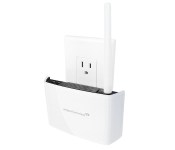
Amped Wireless outs WiFi extender that boosts wireless coverage up to 5,000 square feet

Amped Wireless continues to expand its wireless repertoire with a brand new 802.11 ac Wi-Fi range extender that’s both powerful and compact. Dubbed the REC15A, the device offers a whopping 500 milliwatts of power, four amplifiers and a high-gain dual-band antenna in a relatively small 3-inch by 5-inch package — it even fits neatly into a wall socket thanks to the built-in plug. The company claims that all of that power should result in up to 5,000 square feet of additional wireless coverage, which should be great for those of you with palatial estates or large backyards. The REC15A repeats both 2.4GHz and 5.0GHz WiFi signals and there’s an extra wired port that you can use to attach a networked device like a PC, TV or game console. On the software side of things, it also has parental controls, adjustable settings and free Android and Windows apps that tweak the coverage even more. The REC15A is available for $99.99 and you can pre-order it from Amped Wireless starting today. It starts shipping in the first quarter of 2014.
Filed under: Networking

AT&T planning to launch HD Voice sometime this year

LTE-Advanced? Voice over LTE? HD Voice? This may turn out to be a solid year for AT&T’s network. Alongside the announcement of the ASUS PadFone X at the company’s Developer Summit, AT&T Mobility CEO Ralph de la Vega specified that HD Voice is in the works, and we should start seeing it on devices later this year.
Filed under: Cellphones, Wireless, Mobile, AT&T

Huawei had a pretty good 2013, wants to ship 80 million smartphones this year

At Huawei’s CES press conference, executive VP Colin Giles reminisced on 2013, when the company truly embarked on moving from an ODM to a consumer-facing OEM. By the end of the year, 95% of all handsets left its factories with the Huawei branding attached, and in Q4 2013, smartphone shipments topped 17.5 million. In the previous quarter, the Chinese phone-crafter jumped into the top three manufacturers worldwide, according to various analysts. Despite all the company’s success and rapid growth, there’s no intention to slow down — Giles wrapped things up by setting Huawei’s sales targets for 2014, and no less than 80 million devices will do.
Filed under: Cellphones, Mobile
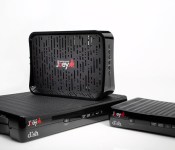
Dish launches a wireless set-top box and one that can record eight shows at once

Dish may have announced a smart TV app yesterday, but that doesn’t mean it’s quite done with the CES announcements. Here in Vegas, the company is showing off two more Dish set-top boxes, both of which are meant to work alongside the Hopper DVR to extend your TV-watching into other rooms of the house. Most notable, perhaps, is the Wireless Joey, which eliminates the physical connection to the Hopper, making it ideal for rooms that either don’t have a coaxial input, or that have a wall-mounted TV setup. Instead of cables, the box uses a wireless access point with 802.11ac WiFi to create a private connection, with room for up to two set-top boxes per access point. Additionally, the aptly named Super Joey adds two additional tuners to allow for recording of up to eight simultaneous shows (any four, plus ABC, CBS, Fox and NBC).
On the software front, the Hopper’s user interface has been fine-tuned so that it’s easier to manage the various tuners. You can also now search by “Recommended Shows.” Meanwhile, the Dish Anywhere app now has transfers built in, so that you don’t have to use a separate app. It’s coming first to iOS and Android devices, with a Kindle version coming later in Q1. Additionally, the Dish Explorer app for iPad is getting voice search for live, on-demand and recorded shows. In terms of availability, we so far know that the Super Joey is coming sometime in Q1, with the Wireless Joey following in Q2. As for the apps, you should be able to enjoy the integrated Transfers right now, though the rest of the app updates aren’t scheduled to roll out until later this year.
Filed under: Home Entertainment, HD

Pebble introduces the Steel, an all-metal smartwatch with an elegant look (video)

To say 2013 was a good year for Pebble is a huge understatement. The company started out at last year’s CES showing off functional versions of its iconic smartwatch — you know, the one that generated over $10 million on Kickstarter in a matter of weeks — and it ended the year by announcing it had pushed more than 300,000 units and was planning to launch a dedicated app store. But while the watch has a healthy ecosystem, loyal following and a sporty look, the Pebble isn’t exactly the kind of device you slap on your wrist for wine-tastings or galas at the local art gallery. For those types of events, you’ll need a premium-looking smartwatch, but good luck finding one; you’ll probably just opt for your traditional Rolex or other fancy piece of wrist jewelry over anything else on the market.
Fortunately Pebble didn’t come to CES empty-handed this year. CEO Eric Migicovsky announced the Pebble Steel at the company’s press conference this morning, which takes the original Pebble watch and encapsulates it in an all-stainless steel, CNC-machined body. If you like the idea of the Pebble, but don’t think it radiates enough elegance or class, the $250 Steel may be more up your alley. The new device will be available alongside its predecessor on January 28th, but you can pre-order it beginning today.
So what did we think about Pebble’s new look? In a nutshell, we like it (although the jury’s still out on the name itself). Keep reading below to get our full take on the new watch, and enjoy the image gallery and hands-on video first.
Before we go any further, let’s make an important clarification. The Pebble Steel isn’t replacing the original version, which will continue to be available for $150 through several different channels. Fortunately, it isn’t creating fragmentation within the Pebble lineup either; aside from a few minor hardware changes (such as a new charger, Gorilla Glass, an anti-fingerprint coating and an LED notification light, which is used to indicate the watch is charging), the Steel adds very little extra functionality. Many of the other specs remain the same: the e-paper display, waterproof design, user interface and battery are identical.
Indeed, the most striking changes to the Steel are all cosmetic, all of which are welcome improvements that give the Pebble a much more mature appearance. The stainless steel body is surrounded by a small, black racing stripe near the top, which doubles as an external antenna; without it, the Bluetooth signal would be consistently obstructed by the watch’s metal chassis. Each Steel will come with two wristbands — leather (below) and metal (above) — but this time, standard bands aren’t going to be compatible. Pebble plans to release the design specs in a 3D-printable format, in case third-party manufacturers want to come up with a wider variety of options.

You can also choose between two available colors: Brushed Stainless and Black Matte. While both models feature the same build material and quality, the black unit’s casing is coated with a Physical Vapor Deposition (PVD) finish that helps make the body more scratch-resistant and slightly more durable.
We’ve always been fond of the original Pebble’s look, but there is definitely something to be said about the fact that the Steel is simply more stylish, not to mention easier to use. It still feels just as comfortable to wear and even the buttons offer a more enjoyable experience; we didn’t feel like we had to push as hard on the Steel’s buttons to navigate around the UI, which is a huge win for the watch’s industrial design.
Earlier we mentioned that the Steel unfortunately doesn’t use the same charger as the original version. Since the new watch is shaped quite a bit differently than its predecessor, the team had to make some adjustments. Fortunately, the result is at least a good one: In theory, since the contacts actually have a little bit more surface area, it charges the Steel faster. Also, don’t worry about having to buy a new one — as you might expect, it’ll come with one in the box.
On the firmware side, the Steel will come with Pebble OS 2.0 built-in, and you’ll be able to take advantage of the company’s new App Store. CEO Eric Migicovsky tells us that more than 6,000 developers have already submitted apps, so the Steel should have a pretty healthy selection of games, watchfaces and other apps when it launches. This list of apps includes ESPN, Pandora, GoPro, Yelp, Foursquare and Mercedes.
Pebble Steel. January 28th. Tell your friends.
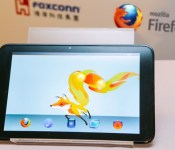
Mozilla kicks off Firefox OS tablet developer program, teases new ZTE phones

As it turns out, Mozilla’s Panasonic smart TV deal is just the start of its Firefox OS plans for this year. The web pioneer has just unveiled a tablet developer program that will give dedicated contributors both reference hardware (initially from Foxconn) and other resources; they’ll help create the tablet-native Firefox OS in the same communal fashion that Mozilla builds its desktop browser. The firm tells us that it wants to start the program shortly after CES, with a goal of finishing its slate interface sometime this year.
The company is also providing the first details of ZTE’s second-generation FFOS smartphones. The Open family is expanding to include two upgraded models, the Open C and the dual-core Open II; there isn’t much more to say at this point, although we should learn more in the near future. If you’re looking for something more tangible, you’ll be happy to hear that VIA Technologies has released a version of its tiny APC Rock desktop PC with Mozilla’s OS pre-installed. The bare system is available by itself for $59, while those who want it in a recycled case (Paper) will pay $99.
Filed under: Cellphones, Desktops, Tablets, Mobile
Source: APC (1), (2), Mozilla Blog

Qualcomm’s AllPlay wireless streaming adds iHeartRadio, Panasonic and Altec Lansing to its list of partners

Though Qualcomm introduced the AllPlay wireless streaming technology at its Uplinq conference in San Diego four months ago, it wasn’t ready for OEMs and app developers to start incorporating into their products. That ends today, however, with the official commercial availability of the AllPlay smart media platform. Several companies have already committed themselves to the standard, like Grooveshark, Tune-In, Rhapsody, iHeartRadio, Panasonic and Altec Lansing, with more on the way. A key factor in AllPlay’s platform is Qualcomm’s new smart audio module — which has an Atheros 2×2 dual-band WiFi SoC — that manufacturers can simply pop in their existing offerings and have it instantly be AllPlay-friendly. Today’s announcement also includes the release of AllPlay’s Click SDK so that developers can start integrating AllPlay functionality into their Android and iOS apps.
As a brief reminder, AllPlay is an audio-streaming solution based on Qualcomm’s AllJoyn connectivity framework. It’s thus designed to be open source, promising universal interoperability among software and hardware that adhere to the AllPlay protocol. That means AllPlay devices should play well with compatible apps and vice versa. Thanks to a Party mode feature, you can play different songs on different speakers throughout the house and have separate volume controls for each. Other goodies include support for a variety of different audio codecs (MP3, AAC, AAC+, FLAC and WAV just to name a few) and DLNA support.
“We prefer the analog approach of interoperability,” says Sy Choudhury, senior director of product management for Qualcomm. Either consumers have to buy into a single company, or they have to settle for something like stereo Bluetooth, which Choudhury says doesn’t offer high enough audio quality. “Snapdragon allowed a lot more interoperability and smaller OEMs to join the mobile market … we’re trying to do the same with the home audio industry.” As for just when we’ll see the first consumer device with AllPlay, that remains to be seen, but it seems like we should expect a few by the end of 2014.
Filed under: Wireless
Source: Qualcomm

Panasonic will bring Firefox OS to your smart TV this year

Firefox OS won’t be confined to small devices for much longer. Panasonic has announced a partnership with Mozilla that will see it launch Firefox OS-powered smart TVs and other “smart screens.” The deal potentially opens up the frequently proprietary world of TV software — since the program guide and other interface elements will be web pages, they won’t be limited to any one company’s hardware. It should also be easier to write remote control apps, personalize the interface and integrate TVs with home automation systems. Panasonic isn’t going into more detail about the hardware at this stage, but it tells us that the first Firefox OS TVs should arrive in the “latter part” of this year.
Filed under: Home Entertainment, Household, Software, HD
Source: Mozilla Blog

Engadget for Android 2.0 is here!

You’ve been asking for a new version of our Android app, and we’ve been listening. And after months of development and testing, Engadget for Android 2.0 is finally here, just in time for you to use it stay on top of all of the latest news from CES! We’ve totally rebuilt the app from the ground up, with a ton of new features and enhancements, including:
- An all new card UI layout: Each card highlights the media within the article, highlighting comment count and share tools
- Most Popular articles lets you get a quick view of what’s trending on Engadget
- Easy content sharing via any app on your device that supports sharing
- Podcasts now play in the background
- Send tips to Engadget directly from the app
- Quick access to sections like Reviews, Videos and Galleries from the side drawer
- Comment counts turn orange as the conversation goes deeper, letting you know where to join in
- Articles now have related content and tags support to find more of the content you love
- Articles also have a “back to top” icon to quickly return to the top of any article from anywhere
- Greatly improved performance
The app is available right now from Google Play, and supports both phones and tablets. Download it today, and let us know what you think!
Filed under: Announcements
 AIVAnet