


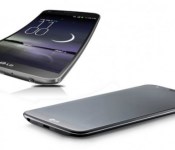
T-Mobile announces the LG G-Flex
 Today, we talk about the LG G-Flex. Since it’s announcement, it’s not been officially available in the US, until now that is. T-Mobile announces today the availability of the G-Flex. There wasn’t much news that came along with the announcement, like a price or availability date, but those are said to be coming within the next few weeks.
What do you think about T-Mobile? Are they making waves in the mobile industry? Is the G-Flex enough to make you switch? It’s enough to make me want to switch, if only I wasn’t locked into a contract with AT&T! What about you? Let us know in the comments below!
T-Mobile Confirms LG G Flex
T-Mobile is ringing in the New Year by further expanding its ever-growing 4G LTE smartphone line-up with the addition of the world’s first curved, flexible smartphone[1] from LG Electronics – the LG G Flex. T-Mobile customers can get the G Flex with the Simple Choice Plan, which offers unlimited talk, text and Web as well as unlimited text and data in 100+ countries – at no extra charge – all with no annual service contract on the fastest nationwide 4G LTE network[2].
The LG G Flex offers T-Mobile customers a more reassuring grip and fit as well as an outstanding voice and sound experience because the distinctively curved design follows the contour of the face. The ultra-thin, ultra-light, flexible 6-inch Plastic OLED display is brighter and more precise making it ideal for watching videos or playing games on-the-go. The G Flex also features the Rear Key control for convenience of using one index finger to power the device on or off and adjust volume. It also has self-healing paint on the G Flex back cover that LG says is designed to help recover from the wear and tear of daily use, including scratches from keys[3]. The advanced smartphone features a 13MP HD camera to capture crisp, detailed, high-quality images and videos. In addition, the LG G Flex includes the world’s first curved battery technology for a smartphone with a capacity of 3,500 mAh for power, sleek design and comfort in the palm of your hand.The new smartphone will include LG-exclusive features such as KnockON(TM), Slide Aside(TM) and Qslide Function, allowing customers to perform several tasks simultaneously. G Flex will also introduce new features such as QuickTheater(TM), which can give users virtually instant access to entertainment apps for the ultimate cinematic viewing experience on the curved smartphone; and Dual Window, which divides the wide 6-inch screen into two separate windows for more efficient multitasking.
Pricing and availability for the G Flex will be shared in the coming weeks.
[1] The flexibility of this product is limited. This phone may be bent flat up to 180 degrees for a limited period of time only. Do not bend inward or twist.
[2] Based on download speeds.
[3] Intended for minor scratches and surface damage caused by ordinary and normal use of the phone only. Not all damage is repairable. Results may vary.

Apple’s U.S. Smartphone Usage Share Continues to Climb
ComScore today released the results of its monthly rolling survey of U.S. mobile phone users for the September-November 2013 period, showing that Apple’s U.S. smartphone market share has increased 0.5 percentage points for a total share of 41.2 percent. Though Apple’s share continues to grow, it still lags behind Android’s total share of 51.9 percent.
When measuring usage by handset manufacturer, Apple continued to come in first place by a wide margin, with Samsung coming in second at 26 percent and Motorola, LG, and HTC bringing up the rear with just over 6 percent share each.

152.5 million people in the U.S. owned smartphones (63.8 percent mobile market penetration) during the three months ending in November, up 3 percent since August. Apple ranked as the top OEM with 41.2 percent of U.S. smartphone subscribers (up 0.5 percentage points from August). Samsung ranked second with 26 percent market share (up 1.7 percentage points), followed by Motorola with 6.7 percent, LG with 6.5 percent and HTC with 6.4 percent.
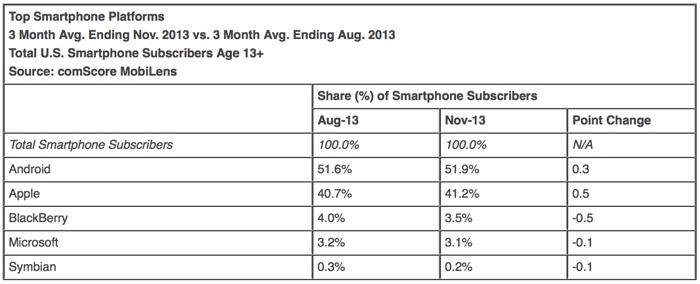
Collectively, Apple and Google control 93.1 percent of the U.S. smartphone market, with BlackBerry, Microsoft, and Symbian losing share during the November period.
ComScore’s data tracks installed user base rather than new handset sales, which means it is more reflective of real-world usage but slower to respond to shifting market trends than some other studies.
     |

How Angela Ahrendts’ Burberry Experience Could Drive the Future of Apple Retail
Later this year, Burberry CEO Angela Ahrendts will move to Apple as a new senior vice president in charge of Apple’s retail and online sales efforts. Before Apple announced her hiring in October, Fast Company spoke extensively with Ahrendts across several non-Apple related interviews. However, since the announcement, she has unsurprisingly declined any interview requests.
In a wide-ranging profile, Fast Company looks at Ahrendts’ job history and work style, the troubles Apple Retail has seen in the past few years, and how her experiences at Burberry could shape Apple Retail’s growth going forward.

Ahrendts’ is not a tech-savvy geek, but she has a vision for how to speak for customers. In an interview with Vishal Sikka, a development executive at SAP, Fast Co. discovered that she exhibits some Steve Jobs-esque tendencies:
She saw a wealth of information… what did customers respond to? What did they like or dislike? What did they share on social media? She thought there must be a way to collect and share such data with the whole Burberry team, as well as combine all six of Burberry’s consumer-intel databases into one salesperson-friendly interface. “She wanted to merge the digital experience with the in-store experience,” Sikka says. She did not know how to do that herself; she freely acknowledges that she is no digital native nor is she fluent in the language of coders and engineers, but she is very good at asking for help. “She is not a geek. She is not technical,” Sikka says. “But she has a vision for things she wants to see, and she has a profound understanding of what technology can do for people.”
Beyond that, Ahrendts put extensive amounts of technology into the sales experience at Burberry. She created a back-end system that allows every Burberry salesperson, across 330 stores, to access all the data that the company has collected on individual customers, including data as detailed as whether customers prefer to browse merchandise with assistance or to be left alone.
The company uses RFID tags extensively, allowing customers to bring a piece of merchandise to a mirror and a video will appear with a model wearing the coat. She also oversaw the creation of a website where users can upload photographs of themselves wearing Burberry attire, allowing users to share their looks and potential buyers to imagine themselves in Burberry garb.
Finally, Ahrendts appears to take a page out of Ron Johnson’s communicative playbook. Johnson was famous for the videos he recorded to be played to all Apple Retail employees at quarterly staff meetings, and Ahrendts currently does weekly videos for Burberry’s 11,000 employees.
At Burberry, she communicates constantly with her 11,000 employees, sending emails to thank them for a particular contribution and frequently jetting to offices and stores around the world (she tries always to be home by Friday night to be with her husband and her kids, who are 18, 17, and 13). She is adamant that significant news be shared first with staff, so that they never learn about their own company by reading the papers. She does a weekly video update–soon, perhaps, Apple staff will joke about how perfect Ahrendts’s hair is, just as they did with Johnson. Her main message is usually “thank you.” Sometimes that’s an epilogue to an all-hands call to action: “I will sit there on the webcast and say, ‘Okay, guys, we’re nearing the end of the quarter and it’s really tight, but I know we’re gonna make it because there’s 11,000 of you out there,’ ” she says. “‘Could you do me a favor? Just one extra call to a customer? ‘Cause if you do that, we’ll win.’”
Angela Ahrendts will join Apple this spring and will continue in her role as Burberry CEO until then. In his email to Apple employees announcing the hire, Tim Cook said Ahrendts’ shares Apple’s values and “focus on innovation” and that she “embraces our view that our most important resource and our soul is our people”.
Apple Retail has been without a leader since John Browett was fired in October of 2012.
| |

Magellan’s new RoadMate GPS stays relevant by including a dash cam

Dedicated GPS units may be less popular these days, but Magellan has figured out a way to justify their existence: strap a dash camera to the back. The company’s upcoming RoadMate 6230T-LM DashCam can both guide you through unfamiliar areas and record video to an SD card, saving you the trouble of mounting two devices in your car. Magellan’s hybrid design is also handy even if you don’t need directions, since you can watch live video from either the built-in camera or an optional wireless backup cam. The new RoadMate won’t ship until April, but it will also cost $230 — a relative bargain next to purpose-built dash cams that offer many of the same features.
Filed under: GPS
Source: Magellan

Dish announces streaming app for PlayStation consoles

A troop of new Joey devices wasn’t the only thing Dish had up its sleeve for CES. In an effort to bring its streaming chops to game consoles, the company has just announced an app for PlayStation that does just that. Dish customers will be able to take advantage of the Hopper’s functionality via its Virtual Joey software on both PlayStation 3 and PS4 consoles to access their favorite TV shows without having to switch devices once that marathon gaming session is up. This software also allows for control via either the DualShock 4 or the Dish remote. The app should arrive for download this spring in the PlayStation Store.
Filed under: Home Entertainment, HD, Sony

Pioneer unveils NEX, its Networked Entertainment eXperience with five new in-car receivers

Pioneer‘s new Networked Entertainment eXperience (NEX) line of products fill the gap between its connected AppRadio set and more traditional in-car products. Pioneer’s five new NEX headunits will take advantage of your smartphone’s (iPhone 4 up and compatible Android set) apps through AppRadio mode and grab your phone’s data connection to improve its built in services and apps. For example, AVICSYNC Networked Navigation (only on AVIC models) will be able to reach out and get local traffic, weather, gas prices and overlay that data right on your maps. Apple’s Siri Eyes Free is also on hand on all NEX receivers by simply poking the icon on the stereo’s display, once activated Siri responds to your every command using the provided mic and plays back through the speakers. Other notable features include Aha Radio across the board, Pandora Station Creation, HD Radio, Sirius-XM ready and support for FLAC lossless files. The The AVIC-8000NEX ($1400 SRP), AVIC-7000NEX ($1200 SRP), AVIC-6000NEX ($900 SRP), AVIC-5000NEX ($750 SRP) and AVH-4000NEX ($700 SRP) should ship by early February.
Filed under: Home Entertainment, Transportation

Live from ASUS’ In Search of Incredible event at CES 2014

3PM ET is the time to set your alarm for ASUS’ time in the CES spotlight. The Taiwanese electronics giant is set to reveal several products, including the dual-OS laptop/tablet combo the company teased late last month. We’ll be bringing you the action live from Caesars Palace in Sin City, so tune in right here for everything ASUS at CES 2014.


Filed under: ASUS

ASUS’ Transformer Book Duet can switch between Android and Windows as a laptop or tablet

If you’re looking for a dual-booting convertible but find ASUS’ Transformer Book Trio a little too clever, you’ll want to check out the company’s just-unveiled Transformer Book Duet TD300. The 13.3-inch PC is really a dual-OS tablet that bundles a keyboard dock with its own hard drive and ports — whether you’re in laptop or tablet mode, you can switch between Android 4.1 or Windows 8.1 on the fly. The slate includes up to a 1080p display, a Core i7 processor and 128GB of solid-state storage; attach the dock and you’ll get up to 1TB in disk space alongside USB, Ethernet and HDMI. ASUS plans to ship the Duet to Asia and Europe late in the first quarter of the year, and to the US by late in the second quarter. When it does ship stateside, the system will start at $599 for a Core i3 model with an “HD” (read: 1,366 x 768) screen, and $699 for a 1080p unit.
Filed under: Laptops, Tablets, ASUS
Source: ASUS

ASUS unveils ZenFone line packing Android, Intel chips and a simple interface

It’s been a while since we’ve seen an ASUS smartphone that wasn’t meant to be used with (or as) a tablet, but the company is making up for that absence by launching the ZenFone line. The ZenFone 4, 5 and 6 all sport dual-core Intel Atom processors and a range of exotic color options. They also tout a new interface layer on top of Android 4.3, ZenUI, that promises both simplicity and a What’s Next feature for tracking your daily schedule. Differences between models largely boil down to screen size and performance. The ZenFone 4 starts things off with its namesake 4-inch 800 x 480 LCD, a 1.2GHz Atom chip, a 5-megapixel rear camera and a front VGA shooter. Move to the ZenFone 5 and you’ll get a larger 720p display with pen and glove support, a 2GHz Atom, an 8MP back camera and 2MP at the front. The ZenFone 6 builds on this with an even bigger (though still 720p) screen and a 13MP rear camera. ASUS hasn’t said when the ZenFone series hits shops, although the absence of LTE suggests that the handsets won’t reach 4G-obsessed US carriers in an official capacity. They’ll definitely be cheap to buy off-contract, however — the ZenFone 4 starts things off at $99, while its 5- and 6-inch counterparts will cost $149 and $199.
Filed under: Cellphones, Mobile, ASUS
Source: ASUS

ASUS reveals the VivoTab Note 8, an 8-inch Windows tablet with Wacom pen input

ASUS’ VivoTab Note 8 has been one of CES’ worst-kept secrets, but we’re still glad to see that it’s finally official. The 8-inch Windows 8.1 tablet is a direct foil for Dell’s Venue 8 Pro, and includes a familiar-sounding 1,280 x 800 IPS display, 2GB of RAM, a 5-megapixel rear camera and an HD-capable front cam. Most of the differences revolve around its namesake pen input; the VivoTab includes a Wacom stylus that can handle 1,000 pressure levels, arguably trumping Dell’s less sophisticated (and purely optional) approach. An ever-so-slightly faster 1.86GHz Bay Trail Atom chip doesn’t hurt, either. The tablet should ship either late in the first quarter or early in the second, with prices starting at a frugal $299 for a 32GB model and climbing to $349 for a 64GB edition.
Source: ASUS
 AIVAnet