



Apple to Announce Q1 2014 Earnings on January 27
Apple updated its investor relations page today to note that it will announce its earnings for the first fiscal quarter (fourth calendar quarter) of 2014 on Monday, January 27. The earnings release typically occurs just after 4:30 PM Eastern Time following the close of regular stock trading, and the conference call is scheduled to follow at 5:00 PM Eastern / 2:00 PM Pacific.

MacRumors will provide running coverage of the earnings release and conference call.
The release will provide a look into initial iPad Air and Retina iPad mini sales during their first quarter of availability as well as iPhone 5s and 5c sales throughout the holiday. Apple reported a record number of iPhone/iPad sales during fiscal 2013, at 150 million iPhones and 71 million iPads.
In its fiscal fourth-quarter earnings call, Apple guided expected revenue of $55–58 billion and gross margin between 36.5 and 37.5 percent. If the company meets even the low end of that guidance, it will count as the strongest quarter for Apple in history.
     |

Intel unveils RealSense hardware and software line, including 3D camera module

The takeaway at today’s Intel press event? All signs point to the RealSense product line — a number of hardware and software products that “make interaction with technology simple, more natural and immersive,” according to Intel’s own words. The first product bearing the compound name is the RealSense 3D camera. Intel describes the product as “the world’s first integrated 3D depth and 2D camera module that helps devices ‘see’ depth much like the human eye,” suggesting that this isn’t just a substitute for Leap Motion or Kinect.
The camera does full-color 1080p and has an on-board sensor for gesture and face detection. The latter of which apparently helps it “understand emotions.” It also recognizes foregrounds and backgrounds, so you can replace that messy room and make it appear as if you’re Skypeing from the Moon. But, if you’re looking for something more practical, you can also use it to scan objects in 3D using 3D System’s Sense software. The RealSense 3D camera is set to be integrated into a number of diverse devices come the second half of this year, including tablets, Ultrabooks, laptops and all-in-ones, from top companies like Acer, ASUS, Dell, Fujitsu, HP, Lenovo and NEC. Seven such devices are being demonstrated today, and Intel itself has a demo unit.
If you’d rather talk to your computer than wave at it, there’s also a next-generation version of Dragon Assistant from Nuance that will be part of Intel’s RealSense push. Of, course, while all this sounds good on paper, it remains to be seen how much people will actually want to wink, point or shout at their laptop to get it to open Netflix or point Chrome towards Engadget.
Filed under: Cameras, ASUS, Intel, HP, Dell, Acer, Lenovo
Source: Intel
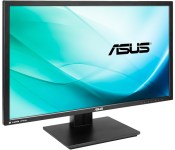
ASUS unveils 28-inch, $799 4K display targeting price-sensitive pros

ASUS’ 31.5-inch 4K monitor may be the ideal display for many content creators, but a typical asking price over $3,000 rules it out for all but the most affluent. Much to our relief, the company is bringing the cost of its technology closer to Earth with a new 28-inch display, the PB287Q. It touts the extra-sharp 3,840 x 2,160 resolution of its bigger sibling, just in a smaller and cheaper form factor. You aren’t giving up much in the way of features, either, as the 28-inch panel boasts a quick 1ms response time, DisplayPort, MHL-capable HDMI and a rotatable design. The real highlight, of course, is the discount — the PB287Q will ship in the second quarter for $799, which both puts it on par with Lenovo’s affordable 4K display and makes it easier to justify for penny-pinching workstation buyers.
Source: ASUS

This is what Netflix’s 4K streaming looks like

Earlier today Netflix CEO Reed Hastings jumped into LG’s press conference to confirm that his company will offer the second season of House of Cards in 4K, streamed directly to Ultra HD TVs from LG and others. Naturally then, we stopped by Netflix’s Las Vegas hotel suite to check out the latest offerings and got an early preview. While Samsung showed off a demo of 4K Netflix last year, that video stream wasn’t really live from the internet so this is our first true taste of Ultra HD content. Obviously it’s a demonstration under controlled settings and non-final hardware, but watching the House of Cards season two trailer and a documentary clip came through impressively sharp.
According to spokesperson Joris Evers, at first the super high-res streams will only be available via embedded Ultra HD TV apps since most devices aren’t ready to decode h.265 HEVC compressed video yet. The demo we saw was actually running through a dedicated decoder, with two separate 4K video profiles set at about 11Mbps and 15Mbps (check after the break for a grab, not meant for quality comparison but to show the bitrate) that both seemed a clear upgrade over current 1080p feeds. We still don’t know exactly when the Ultra HD video will be available, but that may depend on how quickly the next generation of TVs with support for the format hit the streets. Netflix has said it wants to be known as the place to go for 4K content and it appears to be well on its way — assuming you have a healthy broadband connection, of course.


Filed under: Home Entertainment, HD
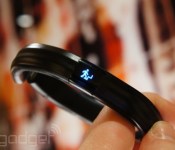
Razer’s Nabu smart band is half fitness tracker and half smart watch (video)

Try as we might, it’s hard to predict what a company like Razer might do. The firm has surprised us year after year with overpowered tablets, shockingly thin gaming laptops and OLED-adorned keyboard interfaces. When tasked with predicting what the outfit would come up with next, we never would have guessed it’d be announcing a fitness tracker in 2014. And yet, it did: the Razer Nabu. When company CEO Min-Liang Tan briefed us on the product, he was careful to dance around the word tracker. “It’s not a smartwatch,” he said. “It’s not a fitness band. It’s what we’re calling a ‘smart band.’” Min gave us an introduction to the device at CES 2014: read on a closer look at the band, and a video of the CEO demoing the product for the first time.
The device is actually an odd combination of both, featuring the bio data-tracking features of fitness products, while also dispensing notifications via two small OLED displays — a small 32-pixel square that displays notification icons, and a larger 128 x 32 panel that ticks off texts, emails and other personal data. By positioning the screens on opposite sides of the user’s wrist, Razer hopes the second screen will act as sort of a privacy screen, keeping folks from reading your texts by glancing at your wrist. The band can also track a user’s location, altitude, steps walked, sleep data and everything else one needs to quantify their body. All of this, Min adds, works right out of the box, for both iOS and Android.

Nabu appears to be a good take on the growing wearables market, but the question still remains: Why is a gaming company building a so-called smart band? Never fear, Min says, “real-world gamification is something we’re really focused on.” Nabu is built on an open development platform, which Min hopes will allow developers to build augmented reality games. Band-to-band communication allows Nabu devices to detect proximity to other Nabu bands, and trade information (think 3DS Street Pass), which could be used to create augmented reality “tag” games, for instance. We can’t say the idea sells us on the product, but it’s something. Developers will be able to pick up Nabu by the end of Q1 2014 for $50, and the company says it should last 7-10 days on a single charge. Razer wouldn’t tell us the final consumer price, but did mention it should fall under $100.

Wysips Connect will make your phone a solar cell that can receive data transmitted through light waves

Remember that 90% transparent solar-cell that stumbled into our CES trailer last year? It’s back, and it’s got some new tricks. Wysips Connect is making its official debut on the show floor this year, and while the transparent panel can still generate electricity through sun exposure, it’s now equipped with LiFi – a visible light spectrum communication technique capable of transmitting data at broadband speeds. If LiFi becomes common in smartphones, shopping malls, airports or hospitals could use the technology to push local map data to a user’s phone, or help them find a product’s location in an oversized supermarket.
All talk? Not quite: Sunpartner Technologies and Oledcomm say that they’ll be announcing the first Wysips Connect equipped smartphone during the show. The jury’s still out on if the technology will take the mobile world by storm, but at least the company is leading by example. We’ll let you know how the solar cellphone fares under the lights of the CES 2014 show floor.
Filed under: Cellphones, Mobile

Here’s a closer look at ASUS’ Zenfone line

At today’s ASUS press conference here in Las Vegas, chairman Jonney Shih unveiled a new line of low-cost Android smartphones, dubbed Zenfones. The devices, which come in a range of 4-, 5- and 6-inches, have dual-core Intel Atom processors inside and run a skinned version of Android 4.3 that ASUS is calling Zen UI. Apart from a focus on imaging software, Shih didn’t elaborate too much on what users could expect from that interface. But it’s clear from our brief time with the handsets that the sleek UI emphasis simplicity by means of cleaner fonts and larger icons. The real kicker, however, for these newly announced Zenfones is their pricing: $100 for the Zenfone 4, $150 for the Zenfone 5 and $200 for the Zenfone 6. And that’s all off-contract.
Developing…
At the top end of this Zenfone spectrum, we have the Zenfone 6. As you can tell from the device’s name, it sports a 6-inch, 720p IPS display that supports stylus and glove input — the latter of which should prove helpful in the winter months. Despite costing only $200 outright, the Zenfone 6 doesn’t come across as a cheap play for consumers’ dollars. To the contrary, it feels solidly built; more like something that could withstand daily wear, tear and general abuse. Though the handset is outsized — it proved nearly too wide for our hand — it’s also incredibly light, which should help to mitigate any issues operating it. Plastic is the material of choice here, but ASUS has crafted the Zenfone 6 in a way that gives it a soft touch, blunt edges and rounded back that fits snugly in the palm.
As far as storage goes, the Zenfone 6 will come in either 8GB or 16GB versions though users will have the option to expand that via microSD. It also features a 3,230mAh battery, 13-megapixel/2-megapixel cameras and support for Bluetooth 4.0 and WiFi b/g/n.
The Zenfone 6 and Zenfone 5 not only share the same 2GHz dual-core Intel Atom Z2580 CPU, so performance on both handsets is quite close, though the additional gigabyte of RAM on the 6 gives it a bit more edge. That said, navigation throughout the UI was brisk and most input actions were effected nearly immediately. It was only with the Zenfone 4, which has a 1.2GHz Intel Atom Z2520, that we noticed a depreciation in performance. But that spec drop is to be expected from the budget-minded Zenfone 4.
Coming in as the mid-ranger in the series, the Zenfone 5 is a slight step down from the 6. The overall construction and body is reminiscent of its larger sibling, but pixel density on its 720 panel is much higher owing to the (relatively) smaller 5-inch display. The reduction in pricing (this device retails for $150) doesn’t necessarily distance it much from the Zenfone 6. The chassis is similar, but shorter and retains an impression of durability and understated elegance.
Filed under: Cellphones, Wireless, Mobile, ASUS

Samsung CES 2014 press event liveblog

Based on what Samsung announced at CES 2013, we have a pretty good idea of what to expect at this year’s show. Namely, some mammoth (and ultra-expensive) UHD TVs, with a few high-end laptops thrown in for good measure. Needless to say, there will be big news, and we will be there taking it all in. Join us for the live play-by-play!


Filed under: Announcements, Home Entertainment, Samsung

Samsung announces its curved 78-inch UHD TV: runs faster, works smarter

Samsung’s new curved UHD TV spans 78 inches and will be one of 10 new 4K sets hoping to convince you to make the upgrade. It’ll be joined by both the 55- and 65-inch models revealed at IFA last year, but thankfully we’ve now got a lot more details on what’s going on underneath those pixels and curves. The 78-inch U9000 model is just 1.2 inches deep, but gets a quad-core processor for all the heavy visual lifting. Samsung’s trying to appeal to those of you that like to use your tablets while watching TV too, with a new Multi-Link mode that will share the screen up to four ways, with the ability to use the built-in web browser or even watch related YouTube videos.
Upgrading the processor from previous models now means that the Smart TV gets to work from 1.8 seconds. Big deal? Well, when it took Samsung’s older models more than five seconds to warm up, it’s a pretty impressive improvement. There’s also those previously teased gesture upgrades, offering up the ability to switch channels and adjust volume with a finger — we didn’t get to test this out at Samsung’s fancy Vegas launch party, but we’ll definitely be running through all those features in the coming days. Following standard CES tradition, the company unfortunately wasn’t sharing pricing or availability details on these UHD TVs, but we’d hazard a guess that we’ll be hearing more in the next few months.
Filed under: Displays, Home Entertainment, HD, Samsung

We just got to watch Samsung’s big-ass 105-inch curved TV

Admit it: if you had the means (and the space) you’d absolutely want to own Samsung’s 105-inch curved 4K television set. Unfortunately, the vast majority of our readers can meet neither of the aforementioned criteria, which is why you must live vicariously through us. We’re happy to provide this much-needed public service. You’re welcome.
What’s it like? Well, the mammoth set is impressive to behold, and as you would expect, it delivers Samsung’s hallmark saturated colors and crisp picture… for the most part. Unfortunately, during our brief time watching the set, it looked like the TV or video feed was malfunctioning, as we saw some occasional pixelation and a single line flash on screen once or twice. Regardless, that 5,120 x 2,160 resolution is truly stunning, even if its 21:9 aspect ratio makes it a bit of an oddball — which is why we only got to see panoramic shots of cities and landscapes instead of regular movie or TV programming. Still, after this, going home to our meager 50-inch set will be tough.
Filed under: Home Entertainment, HD
 AIVAnet