



Apple to Announce Q1 2014 Earnings on January 27
Apple updated its investor relations page today to note that it will announce its earnings for the first fiscal quarter (fourth calendar quarter) of 2014 on Monday, January 27. The earnings release typically occurs just after 4:30 PM Eastern Time following the close of regular stock trading, and the conference call is scheduled to follow at 5:00 PM Eastern / 2:00 PM Pacific.

MacRumors will provide running coverage of the earnings release and conference call.
The release will provide a look into initial iPad Air and Retina iPad mini sales during their first quarter of availability as well as iPhone 5s and 5c sales throughout the holiday. Apple reported a record number of iPhone/iPad sales during fiscal 2013, at 150 million iPhones and 71 million iPads.
In its fiscal fourth-quarter earnings call, Apple guided expected revenue of $55–58 billion and gross margin between 36.5 and 37.5 percent. If the company meets even the low end of that guidance, it will count as the strongest quarter for Apple in history.
     |

CES 2014: Sen.se Announces Wi-Fi-Enabled ‘Mother’ Monitoring System [iOS Blog]
A new company called Sen.se has debuted an electronic device called “Mother,” which is designed to serve as a hub for a series of Motion Cookie tracking devices. Cookies are multipurpose portable sensors able to track a variety of information, including movement and temperature.

As with your real mother, Mother cares about you and loves you. Yet this Mother is programmable. You decide what aspects of your life you want her to handle and she tunes to your current needs. Unlike other devices that specialize in only one area, this Mother knows how to help you in many areas of your daily life: fitness, health, security, well-being and comfort. You decide how she can help simplify your life, ultimately helping you live better, healthier and happier.
Cookies, which interact with Mother, can be stuck on any object and will capture and analyze movements and factors like ambient temperature or closeness to the Mother base station. A Cookie can be placed on any object to measure its whereabouts and its movements. For example, if a Cookie is placed on a dog’s collar, it can track when the dog moves too far away from the base station.
Motion Cookies are the first essential members of the ever growing Mother family.
Small and slick, they can be affixed to almost anything. They have the power to detect and understand the movements of objects and people.
Cookies are endlessly reusable and can be placed on a wide array of objects. They are reprogrammable and are able to handle new functionality at any time. Cookies have a one year battery life and a 10 day memory before needing to resync data with the Mother. 24 cookies can be controlled by a single Mother.

Cookies can send alerts to phones, and Cookies near the Mother will upload collected data to the Internet. A number of apps are designed to work with the system, and Sen.se details several different possible use cases for Cookies and Mother, including fitness tracking, monitoring for intruders, tracking temperature, monitoring medications, and tracking sleep.
Sen.se is comprised of team members that were previously behind a Wi-Fi connected rabbit called Nabaztag, which was a programmable and customizable smart object that could connect to the Internet and display information like weather forecasts and email notifications.
Mother is expected to begin shipping in the spring of 2014 and is priced at $222 for a Mother base unit and four tracking Cookies. Pre-orders will begin in February and additional cookies will be sold in sets of four for $99.
| |
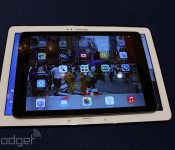
Samsung Introduces 12.2″ Galaxy Tablets Ahead of Rumored iPad Pro Introduction
Some analysts expect Apple to introduce a larger “iPad Pro” later this fall, but Samsung has beaten them to the punch. The Korean firm today announced a pair of 12.2″ Galaxy tablets running Android.

Engadget got a hands on with the 12.1-inch Galaxy NotePro, noting that it “simply isn’t designed for optimal portability” and that it is awkward to hold for long periods of time. Weighing in at 1.66 lbs with a 2560×1600 pixel display at 247 ppi, the device is significantly larger than the iPad Air.
First, let’s discuss the key specs. With a larger Note comes an even larger 9,500mAh battery, an 8MP rear camera paired with a 2MP front camera, “super clear” WQXGA LCD panel, IR support, dual-band WiFi 802.11 a/b/g/n/ac MIMO, USB 3.0 and Bluetooth 4.0. The LTE model promises support for 800/900/1800/2100/2600+850, while you’ll get quad-band HSPA+ (with a max of 21Mbps).
The Note Pro 12.2 runs Android 4.4 KitKat, but the user experience is drastically different than any Note we’ve played with before. Instead of being graced with a standard Android/TouchWiz home screen panel when pressing the home hardware button, you get whisked away to a new interface lovingly called Magazine UX. This experience consists of three separate customizeable screen panels: one for your office/workspace, another for personal use and a last one that handles your social networks and media.
The Verge also has a hands-on video with the new tablets:
There are two 12.2-inch variants — the GalaxyNotePro which includes Samsung’s S Pen functionality, and the Galaxy TabPro which does not — though both include custom Samsung software and firmware. It will come in LTE, 3G and Wi-Fi-only variants and is expected to launch later this quarter. Pricing is not yet available.
Along with the 12.2-inch devices, Samsung introduced several other new Galaxy TabPro tablets, in 10.1- and 8.4-inch variations.
| |

Nuance’s next-generation Dragon Assistant wants to have a conversation

Remember that partnership Intel and Nuance penned way back when? The fruits of their labor is finally here: Nuance’s next-generation Dragon Assistant. The virtual assistant is designed specifically for Intel RealSense technology, and comes with two default personalities: American female or British Butler. The assistant does the normal voice recognition tasks, of course, but Nuance is particularly proud of the program’s conversational skills. Asking the virtual Alfred (yes, we prefer British Butlers, it’s true) who directed Pulp Fiction, for instance, produces the correct answer: “Quentin Tarantino,” but Dragon will also remember you asked that, putting follow up questions (such as, “Hey, who was in that movie?”) into the proper context.
“This latest version of Dragon Assistant is transformative,” Nuance Mobile Vice President Michael Thompson wrote in the company’s press release. “People can have an interactive dialogue that is natural and intuitive, with a voice assistant that listens and understand the context of the conversation.” Neat. Best of all, the new assistant is available today in devices from Acer, Dell, HP Lenovo and more, in Ultrabooks, notebooks and all-in-one PCs. Asus and Toshiba a will follow early this year, and Lenovo will pack the assistant into a tablet sometime in the next few months. Looking for more details? Check out the company’s official announcement at the source link below.
Source: Nuance
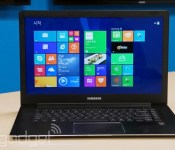
Samsung updates its 15-inch ATIV Book 9 Ultrabook with touch, a higher-res screen and lossless audio

Samsung launched its 13-inch ATIV Book 9 Plus Ultrabook with so much fanfare that it was easy to overlook the not-so-good news: The 15-inch Series 9 wasn’t getting any updates. In fact, you can still buy it today, but with last year’s Ivy Bridge chip and a 1,600 x 900 screen that doesn’t support touch. Great deal, right? Finally, though, Samsung is catching up: The company just announced a new version, the ATIV Book 9 2014 Edition, which ushers in an updated design and more current specs. Of note, Samsung made the screen slightly bigger, stretching it from 15 inches to 15.6, and boosted the resolution to 1,920 x 1,080. That might come as a bit of a disappointment to some, given that the 13-inch version has a 3,200 x 1,800 screen, but Samsung notes that ultra-high-res screens in larger sizes aren’t exactly easy to come by. So maybe you’ll see that in the next-next-gen version.
For now, at least, the screen is a bit brighter (300 nits vs. 250 in last year’s model) and you also get a regular HDMI port this time, as opposed to a micro-sized one. As you can imagine, the addition of the touchscreen, plus that slightly larger footprint, means the ATIV Book 9 is a good deal heavier — four pounds and 0.63 inch thick, versus 3.5 pounds/0.58 inch on last year’s model. The battery size is the same as ever, but thanks to Intel’s newfangled Haswell processors, runtime is now rated at 14 hours, up from 10. Samsung hasn’t revealed pricing yet, but we do know there will be at least two configurations: a Core i5 model with a 128GB SSD, and a Core i7 version with 256GB of storage.
In addition to refreshing the specs, though, Samsung also made some design changes that hint at what the 13-inch model might look like when it eventually receives another update. For starters, it has an aluminum chassis, rather than a magnesium one, and is devoid of all the garish logos we complained about on the ATIV Book 9 Plus. Samsung also retooled the keyboard, adding subtly contoured keycaps with a tactile, rubbery finish and a quieter sound. In our brief hands-on, we were indeed impressed with the feel of the keys, and the backlighting also seems brighter than it used to be. That said, it’s still a flat keyboard; there’s only so much travel you can get on a machine this thin.
There’s one more change you won’t see, but you’ll definitely hear: Samsung added lossless audio support so that if you’re listening to music using headphones or a compatible speaker, you’ll enjoy richer, clearer sound with shockingly little distortion. (You won’t get lossless quality on the notebook’s built-in speakers, though Samsung said it made some improvements there too.) Though this might seem like an obscure spec, given how relatively few of us are audiophiles, a Samsung rep told us that as more streaming services start supporting lossless, it wants to be ready with laptops that can handle it.
Finally, Samsung also refreshed its ATIV One 7 all-in-one, moving from a 23-inch screen to a 24-inch one. Other key specs include 1TB of storage, a Core i5 Haswell processor, dual 7-watt speakers, a tweeter, HDMI in/out ports and the ability to stream music over Bluetooth even when the system is powered down. No word on how much it’ll cost, but Samsung says it will reach the US sometime in the first half of this year. For now, stay tuned for some hands-on pics — and enjoy the photos we already took of the new ATIV Book 9.

BMW unveils prototype self-driving car platform, i Remote app for Samsung Galaxy Gear and driver assistance technology

Automobile manufacturers, long laggard in the ways of technology, have been making a push in recent years to catch up with consumer expectations. BMW is one such car maker, and it’s rolling out a suite of new technologies to improve its cars at CES 2014. First up is an improvement to its suite of driver-assistance technology — ActiveAssist — that’s been built into a new prototype car. Generally speaking, it’s a series of control systems that allow the car to react “to fluctuating grip levels” like during hydroplaning to react and bring the car back under control precisely, automatically and without driver input. It accomplishes this by both braking individual wheels (like existing systems) and adjusting steering input in response to its active monitoring of road conditions using lidar, radar, ultrasound and optical cameras.
BMW is also apparently on board with the recent smartwatch trend, as it’s also built a version of its i Remote app — that lets owners access vehicle information from their mobile device — for Samsung’s Galaxy Gear. The app delivers the BMW i3′s remaining range, battery charge level and any departure times you’ve entered into the app, plus whether or not the doors, windows or sunroof are open. Not only that, Galaxy Gear owners can also send navigation destinations and access the climate controls in their i3, too.
Bavarian Motorworks is also rolling out improvements to its parking-assistance system. Using ultrasound sensors, your car will now find you appropriately sized spaces (as long as you aren’t traveling faster than 22MPH) by evaluating the open spots on either side of the vehicle. It looks for those at least 55cm longer than the car and when you stop the car, press the parking button and hit the turn signal to let it know which side you want to park on, the system then maneuvers your car in for you. No muss, no fuss. Additionally, BMW has improved its Traffic Jam assistant as well. When traveling at 25MPH or slower, the system automagically maintains a set following distance and controls the steering to keep you steady in your lane when traffic gets heavy. The system uses the optical camera located behind the rearview mirror, and works in tandem with the cruise control and Stop & Go systems that provide driver assistance at speeds up to 87MPH.
Curious to know how all this new gear works in the real world? We’ll be getting an i3 ride along here at CES, so stay tuned.
Filed under: Transportation

Gogo’s in-flight WiFi network is now available in Canada

Clue’s in the headline, really.
Filed under: Transportation, Wireless
Source: Gogo

Engadget Podcast 375 – 1.2.14

Hercules has tackled the northeast with snow and delayed this broadcast, providing an eerie look at the moments just before the storm — and by storm, we mean CES. It was a slow news cycle and heavy weather was approaching, so your hosts Brian and Terrence turned their gaze to the highlights of 2013. In that peaceful time before the crew got stuck at various airports en route to Las Vegas, they discuss packing preparedness, New Year’s Eve festivities and Brian’s love for gold toe socks. All this good stuff and more awaits you at the streaming links below in 2014′s very first Engadget Podcast.
Hosts: Brian Heater, Terrence O’Brien
Producer: Jon Turi
Hear the podcast:
11:18 – The year in reviews 2013
28:26 – The biggest stories of 2013
44:54 – Bye, bye, BlackBerry: Alicia Keys out as Global Creative Director come January 30th
Subscribe to the podcast:
[iTunes] Subscribe to the Podcast directly in iTunes (enhanced AAC).
[RSS MP3] Add the Engadget Podcast feed (in MP3) to your RSS aggregator and have the show delivered automatically.
[RSS AAC] Add the Engadget Podcast feed (in enhanced AAC) to your RSS aggregator.
[Zune] Subscribe to the Podcast directly in the Zune Marketplace.
Download the podcast:
Contact the podcast:
Connect with the hosts on Twitter: @bheater, @terrenceobrien
Email us: podcast [at] engadget [dot] com
Filed under: Podcasts

Take that Samsung: LG’s got a 77-inch OLED TV that bends on command (hands-on)

Samsung’s probably kicking back right now, shades on and cocktail in hand, thinking it’s pretty cool with its 85-inch HDTV prototype that can transform from flat to curved on a whim. LG, however, isn’t at CES to watch Samsung score touchdowns from the sidelines, announcing its own 77-inch OLED set that goes from flat to curved on command. All LG needs now is a press conference, subsequent celebrity meltdown, and the two companies are even.
Update: And we just got an exclusive first look. It’s (unsurprisingly) gorgeous. LG’s calling it the first bendable UHD OLED TV — now remember, Samsung’s wasn’t (it looked like LED) and it was a little larger, but it’s a more slender mechanism that does the bending. We were told it’s a combination of “water and gears” that makes it work, but we like how it maintains the finer silhouette. It’s coming to the US sometime between the second half of this year and the start of 2015.
LG’s been working on it for over a year and a half: it moves 7.5 cm to bend, making it eight centimeters narrower in total once at full curve. You can also choose the degree of curvature — in fact, LG told us that the tech can bend even further, but wouldn’t tell us the limits here. Next up for the company: fully flexible TVs and transparent sets. Roll on CES 2015.
Filed under: Home Entertainment, HD, LG
Source: LG

CES 2014: Holi Smart Lamp Coming to U.S. in March [iOS Blog]
Holi yesterday announced that its iPhone and iPad-Controlled smart lamp will be coming to the United States in the near future. Currently, the square 18-LED mood light is available in Europe.
At just over an inch thick and approximately 7.8-inches wide, the Holi light sports a minimalist design that is meant to fit into any room. Much like the Light Strip and the Bloom from Philips’ Hue line of lights, the Holi is designed to be an accent light. With over 500 lumens, it produces more light than a standard 40W bulb. Comparatively, the Philips Hue bulbs come in at 600 lumens, while the Bloom has a 120-lumen bulb.
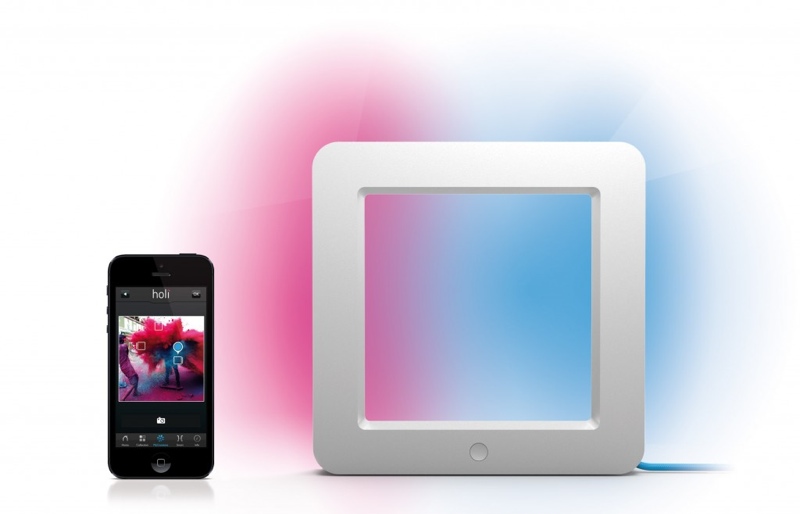
Users can utilize the Holi app to create various lighting effects, which can be shared with the entire Holi community. Holi is able to sync with music, changing color with tempo, and it also serves as an alarm clock with a built-in dawn simulator.
Holi is able to simulate millions of different colors, and it is also able to combine colors with its individual LED bulbs. Similar light offerings, like the Philips Bloom, are limited to a single color. The Holi app can be used to create lighting scenes from photographs, and it includes pre-programmed effects like rotating colors. Three Holi lamps can be synced and controlled from a single iPhone.
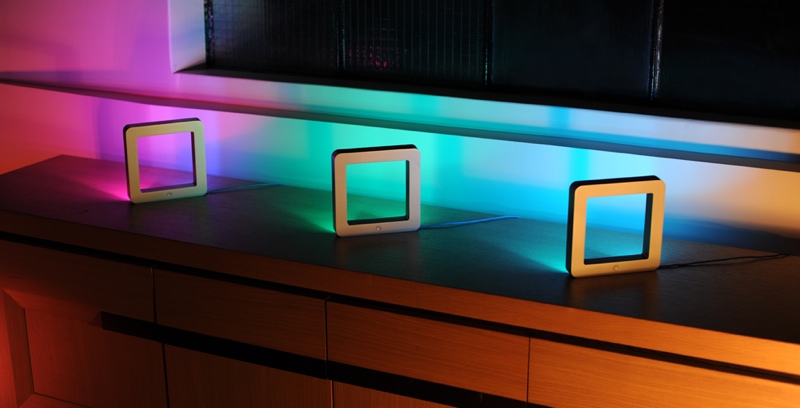
Though U.S. pricing has not yet been released, the lamp retails for €199 in Europe and will likely cost around $200 in the U.S. It is expected to be available beginning in March.
| |
 AIVAnet