


ZTE’s BlueWatch brings Pebble-like features to China (hands-on)

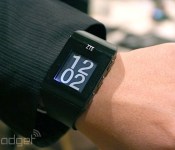
Trends rule at CES, and one of the biggest themes we’ve noticed before the show even officially begins is wearables. Smartwatches, HUDs/glasses and fitness trackers are popping up all over the place, and ZTE is hoping to be part of the excitement by showing off a prototype of its upcoming smartwatch known as the BlueWatch. It’s due in the first half of this year in China, but the company isn’t ready to discuss details on expanding it outside the country yet. The early model we saw was admittedly not a final unit, so we won’t make final judgments on the device just because of a few tweaks that still need to be made (as you can see in the above image, the unit we demoed suffered from bleeding lights underneath the display and wasn’t as bright as we’d like). There was, however, one particular thing that stood out to us when we played with it.
While we’re not going to call it a Pebble clone, the BlueWatch at least has quite a few similar traits. It uses a small e-paper display, tethers via Bluetooth, it features the same trio of buttons on the side to help you navigate the UI and it boasts three watchfaces and a menu setup that Pebble fans will feel eerily at home using. Additionally, you’ll notice a home button on the left, next to a magnetic charger port. Of course, it’s not all alike; the BlueWatch uses a different build and non-detachable wristband. Since the device doesn’t have a SIM, it doesn’t take calls; however, you’ll be able to receive notifications, use the pedometer and check on your social networks like Twitter and Facebook. We’re still awaiting word on more opportunities for third-party developers, but at the moment it doesn’t seem quite clear. As we’re currently seeing a beta product, we have a feeling that we could see a few enhancements in several areas as the project develops.
Filed under: Cellphones, Wireless, Mobile

MakerBot shows off a trio of new apps: Desktop, Mobile and Printshop

Yeah, the hardware was the big reveal at today’s MakerBot press conference (in some cases, quite literally), but the company also had some software to show off; namely a trio of new apps. First off is the new Desktop app, which lets you monitor and control your prints and access MakerWare, a feature that lets you view your print. It’s set to arrive next month for free. Also new is MakerBot Mobile, an app that lets you monitor and control your printer remotely. The app also sends alerts to let you know when the prints are complete. You can also download prints directly from Thingiverse. That one’s also free and will be coming to iOS in the spring, with Android to follow later in the year.
The last addition to the MakerBot ecosystem is Printshop, a way to actually get those pesky 3D models to print. There are two ways to use it: a text feature, which lets you print out words and a bracelet maker, which, as you’ve no doubt already figured out, lets you design your own plastic wrist wearables. The app also features number of “Verified” files from Thingiverse, with easy access to good models. That one is coming to iOS this spring, with Android to follow later.
Filed under: Software

MakerBot unveils a digital storefront, lets you buy 3D models for $1 a pop

“And here’s my ‘one more thing,’” Bre Prettis said with a smile, wrapping up tonight’s MakerBot press conference at CES. Adding onto the company’s much-loved Thingiverse database, MakerBot is offering up a way to purchase high-quality models for printing. The store features a number of collections, which you can either buy together or one piece at a time. The collections feature people, trucks, rocket ships, dragons, aircrafts and animals — all solid choices. All of the sets are available now, with prices starting at $1 for single models and $10 for full collections. If you’ve got a MakerBot Replicator 2 at home, you can print one out today.

AMD brings full-on Android to Windows through BlueStacks

BlueStacks has helped Windows users run Android apps on their PCs for a few years, but now the AMD-backed company is going a step further. The graphics titan has just announced that a new version of BlueStacks will be able to run full-on Android, right on your desktop, tablet or notebook loaded with Microsoft’s operating system. Rather than leaning on the BlueStacks App Player for virtualization, the coming version of the software will run the entire OS, giving folks access to a veritable Android interface, settings, configuration and more. What’s more, apps running through Google’s OS will have access to files that reside on the host desktop. Still, BlueStacks retains the ability to run applications in windows or in full screen. The firm says optimizations courtesy of its 4th-gen APUs help make this possible, but it’s not clear if the software will only work on machines using their silicon. There’s no word on when this refreshed software will drop or what version of Android it supports, but expect more news to trickle out as CES continues.
Filed under: AMD
Source: AMD
Maingear’s Spark is a tiny Steam Machine with laptop internals

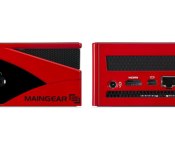
Traditionally, gaming PCs aren’t built with size in mind, but Valve’s Steam Machine initiative has changed the game — now these rigs are taking up residence in the living room. In fact, that’s exactly what Maingear’s Spark was built for. This diminutive PC is built from notebook components: a 3.1GHz AMD A8-5575M processor with Radeon R9 M275X graphics, up to 16GB of DDR3L RAM and support for a 256GB SSD with a spare 2.5-inch HDD tray. All together, the Spark measures in at just over two inches tall and 4.5 inches wide in either direction. Tiny? You bet. Weighing less than a pound, Maingear says it’s the smallest gaming PC they’ve ever offered. Despite its size, the company still had room to squeeze in four USB 3.0 ports, Ethernet and audio jacks and both HDMI and Mini DisplayPort output. Unfortunately, the Spark’s final price point is up in the air, but the company promises it will be “an affordable PC solution.” Spark is set to launch in the first quarter in Windows 7, Windows 8 and Steam OS configurations.
Sony announces Alpha 5000 with 20.1MP sensor, 180-degree display, WiFi for $600 with lens (hands-on)

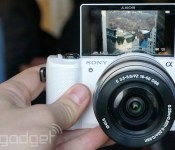
Sony’s NEX branding is officially no more. The Alpha 5000 is the company’s first entry-level camera to drop the familiar moniker, falling instead under the higher-end Alpha lineup. Everything else about this CES model fits the mold, however. There’s a 180-degree tilting LCD that flips forward for self-portraits, built-in WiFi (with NFC) for instantly sharing pictures and videos on the web, Camera Apps for tweaking shots and uploading directly through a wireless hotspot and Sony’s latest 16-50mm power-zoom kit lens for smoother zooming during video capture. On the imaging front, there’s a 20.1-megapixel sensor, a 16,000 top ISO and 1080p shooting at 60i, 30p and 24p. There’s also a built-in flash — an appropriate feature for Sony’s target demographic of beginner photographers stepping up from a less-capable point-and-shoot.
Despite the new name, the Alpha 5000 feels very much like an NEX. There’s a more pronounced grip (think NEX-5T, not 3N), and the same tweaked (and improved) multi-page settings interface that we first met with the Alpha 7 and 7R back in October. Like its recent Sony counterparts, the 5000 charges via its micro-USB port, and it sports an HDMI output (this time, with 4K image support), for photographers looking to share their captures on a TV. Of course, with WiFi built in, you can also transfer shots to a smartphone or tablet, back up your media on a connected computer or boot content to a compatible television via DLNA. You can take a closer look at the Alpha 5000 in the gallery below. Expect it in stores this March in black, white and silver for $600, including the 16-50mm power-zoom lens.
Sony’s latest Action Cam sports splash-proof body, pro features for $300

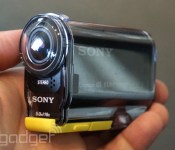
Sony’s targeting amateur shooters and professionals alike with its new HDR-AS100V Action Cam. For consumers, the biggest addition here is the new splash-proof body, which lets you shoot in rain or snow without using the bundled (and relatively bulky) waterproof case. There are also “vast improvements in the optics,” according to Sony, including an updated lens with a fixed 170-degree viewing angle (120 degrees with SteadyShot turned on), an 18-megapixel Exmor R CMOS sensor and new capture options, including 1080/24p, 720/120p or 720/240p video shooting and an ability to snap 13.5-megapixel stills. There’s also an integrated stereo mic and an input jack, should you wish to add an external mic.
Professional shooters can take advantage of new time-code support when editing XAVC S footage with Vegas Pro, making it easy to merge clips from the Action Cam with content from a variety of other cameras. There’s also a new option to shoot at 50 Mbps XAVC S, thanks to the new BIONZ X processor, and a record light up top that makes it easy to confirm that the camera’s actually recording. Cosmetically, the AS100V looks nearly identical to its predecessor, with limited on-camera controls and a basic info readout on the right side and SD and Memory Stick Micro storage in the rear, along with USB, HDMI and a mic jack hidden behind a panel at the bottom of the cam.
The new AS100V will hit stores in March for $300, or $400 when bundled with Sony’s live-view remote. The previous-gen AS30V will remain on the market, albeit with a TBA reduced price. A software update will add livestreaming and a high-speed continuous-shooting mode to both models this summer.

Sony’s new UHD TVs are built to support Netflix in 4K when it arrives

3D? Pah. 2014 is the year that 4K makes its first grand assault upon the mainstream. Naturally, Sony is one of the names leading the charge, and is bolstering the 4K support it added to the Video Unlimited service back in September. The company’s new range of UHD TVs will now pull down 4K video from a variety of sources, but most importantly, will work with Netflix’s forthcoming native 4K streaming. This year’s flagship is the XBR-X950B, available to buy in 95- or 85-inch models, while the middle tier is now occupied by the XBR-900B, offering 79-, 65- or 55-inch units. For those of us who aren’t on the roster of a Major League Baseball team, however, the company is also releasing an “entry level” XBR-X850B line, which can be snagged in 70-, 65-, 55- and 49-inch versions. Each one has the usual cluster of Sony technologies, including X-Reality Pro, Triluminos and ClearAudio+, as well as screen mirroring, NFC and built-in WiFi. All of them will arrive in spring, but there’s no word, yet, on how much these will set you back, but we’d wager that the hardware isn’t yet into the “impulse purchase” category just yet.
Filed under: Home Entertainment, Internet, HD, Sony
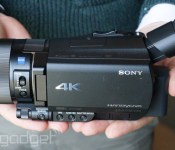
Sony’s compact FDR-AX100 4K Handycam ships in March for $2,000 (hands-on)

Television manufacturers have been peddling 4K TVs for several years now, but just as we experienced during the early years of HD, limited content deters educated early adopters when it comes time to make a purchase. One solution for marketers, while an arguably weak selling point, is that consumers can capture their own 4K footage to play back for family and friends on a compatible high-res set. And while we’re not yet ready to hop in line to make a pricey Ultra HD purchase, Sony’s counting on at least a few deep-pocketed videographers to pull the trigger. If you’re in the market for an affordable 4K camcorder, you probably won’t do much better than Sony’s FDR-AX100 Handycam.
The AX100 is a reasonable alternative to Sony’s recently announced AX1. This compact CES model is considerably more portable, with a 74 percent reduction in size and a 66 percent drop in weight. There’s a 14.2-megapixel 1-inch Exmor R CMOS sensor and a BIONZ X processor, enabling full-resolution 4K shooting at 24p and 30p with XAVC S encoding. There’s an optically stabilized Zeiss Vario-Sonnar T* lens with 12x optical zoom and a seven-bladed aperture, which Sony claims should offer some significant bokeh. A new My Voice Canceling feature reduces vocals from behind the camera, serving to minimize capturing the videographer’s own voice. There’s a 3.5-inch (921k-dot) LCD and an OLED viewfinder for framing; 1/4, 1/16 and 1/64 ND filters; WiFi with smartphone control; and output to a 4K TV via a single HDMI cable. Sony’s Handycam AX100 4K camcorder is set to ship in March for $2,000.

Sony’s new Bravia HDTVs get a wedge-shaped redesign

Unconvinced by 4K? Don’t worry, because Sony’s still got your back. The company has unveiled its 2014-era HDTVs for those who, whatever the reason, aren’t ready to dip a toe into the Ultra High-Definition pool. Both the flagship Bravia W950B and W850B come with a new design, apparently allowing for bigger speakers and a lower center of gravity, reducing the size of the accompanying pedestal. The lesser lights of the new arrivals, including the W800B, W630B and W600B all come with the usual Sony tech, including X-Reality Pro, ClearAudio+ and built-in WiFi, and all will be arriving for various quantities of your cash in the spring.
Filed under: Home Entertainment, HD, Sony
 AIVAnet