



iRobot shows off improved Scooba mop ‘bot, still not ready to tackle the Las Vegas Convention Center

Nothing particularly earth-shattering out of iRobot this CES. A couple of months after dropping a souped-up Roomba in our laps, the company’s ready to do the same for its floor-mopping Scooba. iRobot’s promising “three-times better performance,” on the 450, thanks to a 600RPM brush and improved navigation. The company demoed the ‘bot for us ahead of CES in a pretty tight space. It’s tough to say definitively how well the 450 actually works based on limited time with it (all the more reason to get one for Engadget HQ). But it seemed to do a pretty good job picking up muddy water and spilled Cheerios, combining them into the world’s grossest breakfast cocktail in its tank — which, it turns out, is actually slightly smaller than its predecessor’s.
The device’s Three-Cycle Cleaning Process promises to kill up to 99.3 percent of bacteria (there’s always something, right?), sweeping, soaking and then scrubbing your floor. The ‘bot’s got two cleaning modes: a 40-minute cycle for up to 300 square feet and a 20-minute version for 150 square feet and smaller. That means, interestingly, that no matter how large or small the room is, it’ll spend that much time cleaning things. Also, for the first time, the Scooba plays nicely with Roomba’s Virtual Walls, so you don’t have to run out and pick up a proprietary set, if you’ve got the vacuuming robot sitting around your house. The new Scooba is available today through iRobot’s site for a cool $600. There’s also an upright charging station, so you can dry it out while it charges. That’s gonna run you $80.

Intel unveils ‘dual OS platform’ that runs Android and Windows on a single device

Intel just debuted what it’s calling “dual OS platform” at its CES 2014 keynote, a technology designed to run both Android and Windows on a single device. With the push of a button, the slate onstage switched from Redmond’s OS to Google’s mobile operating system almost instantaneously. It’s a neat trick, but it isn’t the first time we’ve seen it: ASUS showed off a switching Transformer Book Trio earlier this year and followed that effort earlier today with its Transformer Duet — but to be fair, Intel’s demonstration did seem to swap operating systems a bit faster. Between this and AMD’s new use for Bluestacks, we wouldn’t be surprised to see more combo devices crop up in the near future.

Jarvis is Intel’s smart earpiece, and it takes on Google Glass without a display

The next stop on Intel’s wearable train is a smart earpiece, dubbed Jarvis (hello, Iron Man). The hardware listens for voice commands and can act as your personal assistant — and it replies, to boot. You can make appointments cross-referenced with your calendar, check messages and set reminders. Mum’s the word on price, but Jarvis is set for release sometime this year.
Developing…
Filed under: Intel

Intel announces Edison: a 22nm dual-core PC the size of an SD card

Four months ago, Intel unveiled its Quark SoC at IDF. Today at CES 2014, company CEO Brian Krzanich wants to introduce you to Edison, a miniature computer based on the same technology condensed into the form factor of an SD card. The tiny computer is built on the company’s 22nm transistor technology, runs Linux and has built-in WiFi and Bluetooth modules. What’s more, the tiny machine can connect to its own app store. Naturally, the device is aimed at developers, Krzanich says, who he hopes will use it to build the next generation of wearable and connected devices. Even so, Intel is leading by example, and showed a small collection of “Nursery 2.0″ products using embedded Edison chips: a toy frog that reports an infant’s vitals to a parent via an LED coffee cup, for example, and a milk warmer that starts heating when another connected item (the frog, again) hears the baby cry.
Still, even Intel knows that developers need more than a good example to motivate them, and nothing gets the creative juices flowing quite like the promise of an award. To that end, the company has announced the “Make it Wearable” competition, and says it will be offering up to $1.3 million in prizes for developers churning out wearable tech. The full details of the contest weren’t revealed at the show, but Krzanich did say that first prize would walk away with a cool $500,000. Oh, and if you’re eyeballing Edison for your award-winning idea? It’ll be available sometime in mid-2014.
Filed under: Intel
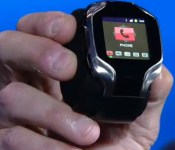
Intel reveals its own smartwatch prototype

Intel is clearly committed to the wearable space — in addition to smart earbuds and a smart headset, it just unveiled its own take on a smartwatch. The prototype it showed is completely independent of other devices for phone and internet access, and it’s clever enough to handle location-based notifications. As with the other wearables Intel is announcing, the wristwear should be available sometime this year.

Typo case marries an iPhone 5s and a BlackBerry Q10, with Ryan Seacrest officiating (hands-on)

Why Typo, of all the names for a smartphone keyboard? The company answers the obvious question with a Wikipedia quote.
A typographical error (often shortened to typo) is a mistake made in the typing process … The term includes errors due to mechanical failure or slips of the hand or finger.
Well, yeah, sure, but that doesn’t really answer the question we — oh, wait, there’s more: “For many of us at Typo, typing on our iPhones is a slow, tedious one- or two-finger affair. Our desire is to avoid making Typos by using the Typo Keyboard.” Ah, so you named it “Typo” because you want people to use it to not make typos — sort of a reverse Orwellian doublethink approach to product naming. You know, like the MacBook Backpain. The Typo harnesses Ryan Seacrest’s deep pockets to the tune of $1 million, in order to address an issue that hardly anyone seems to talk (read: complain) about anymore: the death of the smartphone keyboard.

For the American Idol host, it’s a problem big enough so as to require a low seven-figure investment. And while we could certainly spend the day pondering precisely how much it might have cost for the television personality to purchase a controlling share in troubled QWERTY enthusiasts BlackBerry, we’ll instead focus on where the money ended up. Simply put, the Typo is a case that snaps onto your iPhone 5 or 5s, adding a full QWERTY keyboard to the bottom. It’s not the first keyboard case we’ve seen for the iPhone, though past models have largely stuck to a slider form factor, letting you type in landscape mode and stash the thing out of view when you’re not using it.
The Typo, on the other hand, adds the keyboard to the bottom of the device, a decision that drew immediate comparisons to BlackBerry handsets the moment it was unveiled (not to mention a recent lawsuit). And the similarities aren’t fleeting. The pad looks remarkably like the one you find on the Q10, right down to the thick white lines separating the rows and the beveled keys for speedy touch-typing. There are some issues with the placement — for starters, there’s the fact that it completely covers the iPhone’s large home button, though Typo’s fixed this with the addition of a small button with a square icon in the bottom right-hand corner, so you don’t have to pull the case off every time you need to exit out of a program.

What the company can’t really fix, however, is the nearly one inch it adds to the iPhone’s already long, skinny body. In fact, the press material notes that the final version of the hardware will actually be 1.7 millimeters taller than the beta version we tried out. The other big issue is also pretty clear after analyzing the Typo for a second: The phone is really, really top heavy. Look at how Dana’s holding it in that lead image. That’s no coincidence. She’s propping up the back, due to the really weird center of gravity the case creates. And because it’s not a slider, you’ll have to deal with that keyboard sticking out any time you want to, say, play a game in landscape mode. The upside, as Typo notes, however, is that the removal of the virtual keyboard means you’ve got a lot more screen real estate for typing.
The case’s build quality is actually pretty nice, overall. It has a matte black, soft-touch back, akin to a Mophie, that feels fairly good and offers some tracking for your fingers during that inevitable cradling. The Bluetooth pairing process is pretty straightforward as well. We managed to accomplish that in less than a minute, with the space bar showcasing a nice glowing blue light to let you know when things are ready. The keys are pretty decent — not quite BlackBerry-level, but a lot nicer than other keyboards we’ve tried, and while there’s a bit of a learning curve, that’s to be expected for any new device keyboard.

There’s also a button for backlighting. That’ll likely have an effect on battery life, though with the week of active use you’re supposed to get on a single charge, you’ll probably be all right. And when the battery is about ready to go, you’ll see yet another light warning you that it’s time for a charge. There are holes for access to the necessary buttons and ports, with a micro-USB socket on the left side to charge the keyboard.
All of that will run you $99 when the Typo goes live on the 13th. The case does what it claims, but like the Q10 itself, this feels like an instance of too little too late, as so many of those BlackBerry loyalists who were eagerly awaiting a new device with a decent keyboard eventually jumped ship out of frustration, only to realize that a virtual keyboard wasn’t quite so bad as they’d imagined. If you continue to die a little every time you type on your iPhone’s screen, perhaps this thing is worth a look.
Filed under: Cellphones, Mobile, Apple

All Intel microprocessors shipped in 2014 will be conflict-mineral-free

Intel has announced that its entire 2014 line of microprocessors will be conflict-mineral free (tin, tantalum and tungsten), in its CES keynote address. Previously, the company joined the Electronic Industry Citizenship Coalition and its Conflict-Free Smelter group in an effort to separate itself from the blood-for-materials market. This looks like the logical next step in those efforts. If you’re at the show and want to learn more, the outfit is holding a discussion panel at its booth on Wednesday.
Filed under: Intel
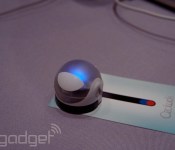
Ozobot is a tiny robot that uses your mobile devices as a playground

All right, we’ve officially figured this one out. It’s definitely the sort of thing it helps to see in-person, which is why we weren’t able to really do it much service the first time out. So here’s the quick explainer: Ozobot is a tiny robot (roughly the size of a twist off bottle top) that is capable of recognizing codes and sensors both on a mobile device and a more analog surface. The company has developed a handful of games that create patterns, which serve as paths for the ‘bot. Ozobot also has built-in lights, which flash in different colors, to let you know what it’s up to. The company pulled out a couple of add-ons and stuck them on an iPad, extending the robot’s course – a race track that kit runs around $120 and ships with two robots, so you can have the little guys compete.
Ozobot can theoretically work with non-digital board games, and the company tells us it’s looking to build partnerships with folks like Parker Bros. It’s also looking for third-party app developers to create more games for its system. From what we saw, the selection is pretty limited at the moment, but there are certainly some cool potential applications for a little tablet-friendly robot like that, should the right developers come on board. In the meantime, the company is set to launch later this year, with the diminutive ‘bot priced at around $59.
Filed under: Robots
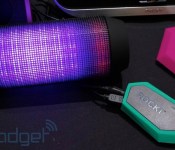
Rocki’s tiny wireless speaker adapter emerges post-Kickstarter with new app compatibility

Rocki, the colorful little facetted device that turns your old sound setup into a wireless speaker system has gone from Kickstarter hopeful to fully funded. We got a change to see the little guy in action at Pepcom tonight and it does what it promises — essentially plugging into your old-school speakers via RCA or audio jack, and making them Bluetooth or WiFi compatible. Since we last spoke, the company has added Spotify and Deezer compatibility to its app so you can bump your favorite jams to those dusty old noise makers. It’s also looking to expand it’s partnerships to work with hardware manufacturers in the future. The $50 pebble is made of hard plastic and comes with a number of rubbery covers and is small enough to hide behind just about any speaker.
Filed under: Home Entertainment, Wireless

Fireweb, LG’s first Firefox OS handset shows up at CES

LG’s first-ever Firefox OS handset has already been making the rounds in Brazil, where’s it been since October. And while we haven’t heard much about US availability on the Fireweb (no real surprise there), the handset did show up here at CES, alongside a smattering of other already-announced phones running the mobile operating system. We played around with the handset a bit and weren’t particularly taken with what it was offering up hardware-wise (again, no giant surprise) — the company isn’t exactly offering up its A-List devices for the browser company’s nascent OS.
The shiny back has a decidedly plastic feel (though it certainly brings it in the gloss department). The four-inch display is a pretty uninspired 480 x 320 and while the 1GHz processor isn’t worth writing home about, it does a descent enough job running those HTML5-based apps. At top, you’ll find the power button and headphone jack, with the volume rocker on the left-side and microUSB jack on the bottom. As mentioned above, you can pick the phone up now, so long as you live in Brazil, and thankfully, the $207 asking price won’t cost you an arm and a lef.
Filed under: Cellphones, Mobile, LG
 AIVAnet