



How to make a CES keynote

Last night, director Michael Bay made an abrupt stage exit during Samsung’s day zero CES press conference. It was awkward, but little more than a square of toilet paper on the bottom of a tennis shoe compared to last year’s Qualcomm keynote. A bizarre mix of stilted theatrics, celebrity appearances and product demos, the presentation was like nothing we’d ever seen — until we took a look back. Qualcomm may have jacked its keynote up on steroids, but many of the tricks it pulled out were already tried-and-true standards. As Sony’s Kaz Hirai prepares to kick things off at CES 2014 this morning, we reflect on 20-plus years of innovative speeches, futuristic predictions and just plain strange behavior.
This is how you make a CES keynote.
Step 1: Think big

John Sculley with Apple’s Newton PDA (Photo by Marty Katz//Time Life Pictures/Getty Images)
When former Apple CEO John Sculley took the stage at the 1992 Winter CES, he set in motion a decade of digital divining by industry bigwigs like Aereo champion Barry Diller and Sony CEO Sir Howard Stringer. Sculley presented a bold vision of the future not only for the US economy and workers on the whole, but also for Apple’s future. His was a world where hand-held devices would lead to a fundamental shift in the way we work and learn. He saw computers, and PDAs specifically, as “revitalizing America’s role” in the global economy by making everyone more productive. The eventual offspring of this line of thinking was the ill-fated Newton. Of course, Apple would eventually return to the idea of a portable computer that embraced many of Sculley’s ideas, but his predictions weren’t exactly spot-on.
Sculley’s not alone. Many of CES’ keynote speakers have painted pictures of the future that were either ill-timed or just plain off. Michael Bloomberg kicked off the 1997 CES with a speech that focused on a new era of digital media distribution. He foretold a robust publishing industry, where writers were in higher demand and readers received the news on digital broadsheets. “The newspaper of a few years from now is made of cloth with transistors hidden in it and essentially a cellular phone with a battery hidden it there as well,” he said.
One year earlier, Compaq CEO Eckhard Pfeiffer spoke of a robust connected home becoming the norm in 2000. His theoretical abode had a computer in every room, each tailored to the needs of its user. In the kitchen, a touch- and gesture-based computer would bring the man of the house CNN Headline News, email, fax and the day’s appointments while he sipped his coffee. In the bedroom, his wife would connect with her doctor through a large-screen PC that also provided weather alerts and restaurant reviews for an upcoming trip to China. Meanwhile, his teenage daughter would connect to her friends in Germany via her I-phone (that’s a capital “I” for internet).
Step 2: Announce something

Bill Gates first appeared on the CES stage in 1995, and in 2000, he gave his first CES kickoff keynote, beginning a 12-year run for Microsoft in that slot. In just over a decade, he and his successor, Steve Ballmer turned the opening night talk from a look at tech’s crystal ball into a platform for launching new products, services and ideas. In 2000, Gates introduced the company’s new Pocket PC and Reader e-book software. The following year, he upped the game showing off the Xbox and teasing “the future of gaming.” Some of these talks were more product heavy than others, but in the time that he was at the helm, Gates announced and demoed everything from smartwatches to internet-connected TVs and HP’s aptly named TouchSmart PC.
It wasn’t all about gadgets during Microsoft’s keynote reign, however. When Ballmer took over in 2009, he announced availability of Windows 7 beta in addition to Windows Live partnerships with Dell, Facebook and Verizon. The following year, Microsoft gave the audience a glimpse at what would become Kinect. That focus on product releases took a turn for the dramatic in 2013, when Qualcomm’s Dr. Paul E. Jacobs took to the stage with a smattering of disparate cultural personalities to unveil its latest processor, the Snapdragon 800.
Step 3: Hire a celebrity

Bill Gates and the Rock show off the Xbox (Photo by Jeff Christensen/Liaison)
With a cast of characters like Archbishop Desmond Tutu, Pacific Rim director Guillermo del Toro, Maroon 5 and even Big Bird, you’d be forgiven for thinking last year’s keynote felt more like an incredibly intricate high school production of Xanadu than a self-serious press conference. While Jacobs’ state of the industry addresses was by far the most star-studded to date, employing celebrities for the occasion isn’t new. Gates enlisted Dwayne “The Rock” Johnson to show off the Xbox in 2001. In 2004, Jay Leno joined him in introducing MSN Video, followed by Conan O’Brien in 2005. To mark his last appearance as the opening keynote speaker in 2012, Ballmer sat down for a conversation with Ryan Seacrest. The following excerpt from that interview demonstrates just how awkward these cameos can be.
Seacrest: I like that. When you said Metro you looked at me in a strange way, or I thought. Is it the jacket, or the sweater, or the combination?
Ballmer: I was going to say it’s a new design and a new year, but you take it from there, for Microsoft and Ryan.
Seacrest: I’m your mascot.
Step 4: Man up

Steve Ballmer crashes the Qualcomm keynote (Photographer: Andrew Harrer/Bloomberg via Getty Images)
As in the boardroom, so on the CES stage. Over the past 20 years, only four of 63 headlining keynote speakers have been women. Of course, Yahoo CEO Marissa Mayer is slated for a talk of her own on Tuesday and Facebook’s Carolyn Everson will return for her second appearance during a panel discussion Wednesday, but all of their fellow speakers share two things in common. You guessed it: an X and a Y chromosome. This may not come as a shock to those who follow the tech industry closely, but it’s a particularly vexing state of being for a conference (and an entire market) that thrives on innovation and change.
Step 5: If all else fails, get weird
Lead image: AP Photo/Julie Jacobson

Audi’s Sport Quattro Laserlight concept officially debuts at CES

Audi teased us with concept drawings of its Sport Quattro Laserlight months ago, and tonight it decided to show off the vehicle in the flesh (or metal and carbon fiber) at CES. Before we wax about the auto’s looks, it’s important to note the machine’s technical details, as they alone inspire a fair bit of awe. The car’s titular feature is its matrix LED headlights, whose laser-like light can cut through through five football fields of darkness. Aside from the futuristic headlamps, the car’s calling card is the combination of electric and gas motors — the latter of which takes it 90 miles per gallon — for a whopping 700 horsepower.
Simply put, Audi’s crafted the Laserlight to look stunning from any angle. From the front, its rectangular beams offer a dose of futurism, and its large grille looks eager to breathe in as much air as possible while tearing through the freeway. From the sides, it’s difficult to ignore how the top of the car swoops down into its base, still leaving room for two seats in the rear. From behind, the iconic lights make a return alongside a carbon fiber accent, which can be found as trim in other areas of the hybrid. Of course, there’s still no word on price or availability, as the automobile is still in the conceptual stage. To ogle at Audi’s Sport Quattro Laserlight yourself, take a peek at the gallery above.
Filed under: Transportation
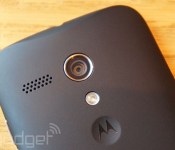
Moto G becomes the first non-Nexus phone in the UK to get Android 4.4 KitKat

If you laid out a mere £135 in the UK for a Moto G sans contract, you now have another reason to feel smug: your handset is the first to get KitKat in Britain, apart from Google’s Nexus devices. The company just announced that all users of the handset in the UK can now grab Android 4.4.2 and all that it entails — like better speed and security, a full-screen mode, gallery photo editing and, love it or not, the new Hangouts. If your Moto G hasn’t notified you yet about the new version, you can manually update it now — to see how, check the source.
Source: Motorola
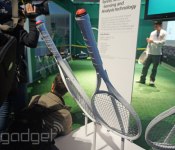
Playing tennis the Sony way… with a racket sensor that analyzes your game (video)

Fancy yourself Nadal or Nole’s equal? We feel safe assuming you aren’t, but Sony’s new tennis sensor, revealed at CES 2014, wants to help you analyze your game to get you ready for the ATP tour… or at least ready to beat the folks at the local country club. The sensor itself is installed in the end of your racket’s handle and is equipped with vibration and gyroscopic sensors to track where those furry little balls strike your racket’s strings, along with your swing speed and ball spin generated. It also has a Bluetooth radio to send your swing data to a paired Android or iOS device. When asked when aspiring We got to take a few whacks with a sensor-equipped racquet ourselves, so head on past the break to see the results.
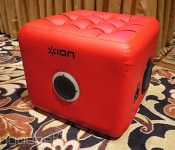
ION Audio’s Sound Lounge speaker lets you get down while you sit down

Ever thought your furniture was missing something? Perhaps some… speakers? ION Audio has seen this terrible oversight and promptly corrected it with its Sound Lounge Bluetooth speaker… ottoman? The sonic-seat has a 2.1 stereo system built right in, and as you might have already figured out, you can hook it up to your phone, tablet or any other Bluetooth media device. If you prefer things with a little more wire, there’s two phono connections around the back (one in- and one output) so you can daisy chain multiple units. There’s also physical volume and bass controls should you want a little more rumble in the jungle.
The 10w (20w peak) speaker inside managed to make itself heard above the fairly chaotic ambient noise of Pepcom, and of course, we couldn’t check it out without taking it for a spin. We can confirm that it’s the most comfortable speaker we’ve ever sat on, and the choice of red and white finishes give it the authentic Manhattan feel that it truly deserves. No word on price or availability just yet, so for now you’ll just have to stand. In silence.
Filed under: Home Entertainment
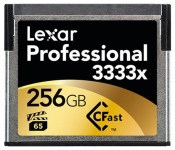
Lexar’s new CFast 2.0 cards boast SSD speeds, but no cameras support them yet

Lexar has just announced new CompactFlash cards using the CFast 2.0 SATA tech format to greatly improve speeds and maybe steal back some thunder from SDHC. The cards, ranging in size from 32GB to 256GB, support a mind-boggling max write speed of 500MB/s, bettering earlier models from SanDisk. That’s easily enough to keep up with even RAW 4K images, let alone the 65MB/s barrier required for the VPG-65 performance guarantee standard. Don’t get too excited yet, though. First off, so far the company has only released engineering samples to help camera manufacturers. Secondly, there aren’t actually any cameras that support CFast 2.0, and the format isn’t backwards compatible whatsoever with current CompactFlash tech. Still, combined with Lexar’s Professional Workflow CFast 2.0 USB 3.0 reader — also just announced — you’ll be able to get superfast speeds on your desktop when it starts shipping sometime in Q1 2014. And when it does get supported by the likes of ARRI’s Amira and other new cameras, it’ll be nice to know you won’t need to cram an SSD into your camera to capture 4K.
Philips launching Android Smart TVs in 2014
Philips has announced that its new lineup of Ambilight TVs will be powered by Android with a release date scheduled for June 2014.
The TVs will also have access to Google Play and Philips Smart TV apps, which in turn would give access to Google applications such as Play Music, Youtube, and possibly Google Now. This is another move from Google to get into your living room and I think it opens up many possibilities for the future of TVs powered by Android.
The TVs are also packing a “powerful quad-core chip” which Philips suggest that it will be able to handle even the most graphic intense Android games.
There are no official models, specs, or pricing, however we hope to hear more soon!
Source: T3
The post Philips launching Android Smart TVs in 2014 appeared first on AndroidGuys.

The Ultimate Money Game: Free Vs Paid Hosting

Nowadays, everything is online – from your friendly corner bookstore to the neighbourhood school. Want to know where the nearest bakery is? Simple, just look it up online! Thus, having a website is crucial for any business – be it big or small.
 Having said that, only having a website is not enough. It’s imperative that the site has a very clean interface and works well (with no downtime). Setting up shop with the right kind web hosting company is the ultimate way to attain these few, but essential goals. So it takes a great deal of care and diligence to choose the right provider that offers affordable web hosting for your site.
Hosting Soul Search!
A web hosting solution should ideally solve the toughest of your problems, besides serving your basic needs. These would include apt storage, quality support mechanisms, upgrades and domain name selections. It’s a World Wide Web of options, options and more options out there!
Paid Hosting Inclusives…
- Better SEO: Search engine crawlers are better able to hunt down your website, when you’re using a unique domain name, offered only by paid hosting services.
- Improved Traffic Handling: Paid web hosting service providers usually guarantee server uptime which means that visitors can always access the website and you’re better able to handle traffic much better.
- Expanding Is Easier: free to add more pages, increase bandwidth, applications and software . The sky is honestly the limit with paid hosting.
- Better Brand Promotion: With modification, updation and enhanced backup options, your brand will stay at the helm of all affairs, and your business will run smoothly.
- User Experience: Users mostly rave about paid hosting services. There is little to complain about. Assistance is round-the-clock ensuring you’re stress free at all times. And what’s more, loading time is better and it even offers multiple domains.
Free Means Headaches…

- Advertising Annoyances: Free web hosting services, in order to gain more advertising revenue, will run countless annoying ads on your website. These ads are not even relevant to your website, and there is little you can do to control them.
- No Dream Domain Name: They don’t allow users to pick and choose a domain name. It is usually the choice of the hosting company.
- Upgrading Blues: Upgrading can be a gigantic task. Switching hosts can be a tedious affair, with users usually giving up on the entire process!
It seems clear, that the only advantages free web hosting offers is that its FREE!
When Do I Take Out The Wallet?
 When you start pushing up the limits of a free service – you’re about to exceed your bandwidth limit, etc – that’s when you should start paying for add-on features or go for upgrades. Be vigilant so as to not fall into the trap of over-paying for services. The best paid services will always make your business look professional.
Author Bio:
With a degree in IT, Kathleen Collins has worked with the top hosting companies for over a decade. Currently she works with Hosting Reviewed, providing an in-depth evaluation of the various hosting companies listed.
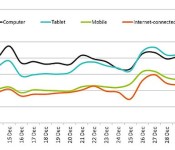
BBC iPlayer tablet viewing overtakes PC for the first time

If you needed further proof tablets are affecting PC usage, the BBC has something it wants to you show you. Eight months after it first saw iPlayer viewing on tablets overtake phones, the broadcaster reports that over Christmas, the rise in iPad, Hudl and sales of other slates helped push tablet viewing past PC streaming for the first time in iPlayer history. The BBC says it saw almost a million downloads (941,000 to be exact) of its iPlayer mobile apps between December 21st and New Year’s Day, as viewers rushed to catch up on the Beeb’s festive programming. Although PCs overtook tablets again before the New Year, the return of big shows like Sherlock could positively skew tablet viewing figures once more, giving us an idea of what trends to expect in the coming year.
Filed under: Desktops, Tablets, Internet, Mobile
Via: The Next Web
Source: BBC Internet Blog
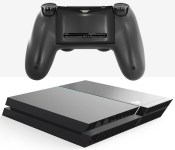
Nyko unveils Qi wireless charging dock, Intercooler for PS4 and a DualShock 4 controller extended battery

It’s CES time, folks, and that means that Nyko’s got a slew of gaming peripherals to show us all. Naturally, next-gen is the order of the day, with the reveal of an Intercooler device that attaches to the rear of your PlayStation 4 to keep it cool. Nyko’s also rolling out a PowerPak replacement battery for Sony’s DualShock 4 controller that doubles up the standard battery pack with a 1,000mAh cell. Additionally, and perhaps puzzlingly, the company is also announcing a Qi wireless charging dock, called the Power Base, built to fit Samsung Galaxy S 4 and Nexus 5 handsets. You can get a glimpse at pictures of all the products in the gallery below, but alas, renders are all we can give you for now — the real products, prices and arrival dates won’t be available until long after CES 2014 is over.
Filed under: Gaming
 AIVAnet