


Lenovo ThinkVision 28 Android powered 4K Smart Display
The Lenovo ThinkVision is an impressive beast with a 4K multi-touch display, but the coolest feature is that it doubles as an Android device running KitKat. This is not your typical display and the price isn’t either, reigning in at $1,199. However, alot cheaper than other 4k displays currently available.
The monitor is completely adjustable to lay parallel to the surface it is on and boast an impressive list of specs. It is no bargain, however given the high resolution display and Android capabilities, its worth a look!
Specs:
- Android 4.4 KitKat
- 28-inch 3840×2160p 4K display
- 2 5-watt speakers
- NVIDIA Tegra processor
- 2GB RAM
- 32GB Internal Storage, expandable MicroSD
- 2.1 MP camera
- WiFi, Bluetooth 4.0 and NFC
- 2 noise cancelling microphones
- DisplayPort, 3 HDMI, USB 3.0, Ethernet
Price: $1,199
Source: CNET
The post Lenovo ThinkVision 28 Android powered 4K Smart Display appeared first on AndroidGuys.
T-Mobile gets exclusive U.S. rights to Sony Xperia Z1S
T-Mobile on Monday announced that it will be the exclusive U.S. carrier for the Sony Xperia Z1S smartphone. In a nutshell, the Z1S is a version of the Z1 which has been optimized for T-Mobile’s network with other, minor hardware tweaks.
Like the Z1 which was announced in September of last year, this one features a 20.7-megapixel camera (BIONZ mobile image processing engine), with a G Lens, and a 1/2.3-inch camera sensor. The camera has a unique burst mode that captures 61 images (30 before you press shutter, 30 after the shutter, and your picture). Additional details in the camera include an augmented reality mode which places the subject in virtual locations, such as with dinosaurs.
Getting away from the camera aspect, the Z1S boasts a 5-inch 1080p HD display with TriLuminos and X-Reality engines and a 2.2GHz quad-core Snapdragon 800 processor. Backed by 2GB RAM, the phone features 16GB internal storage, BLuetooth 4.0LE, Wi-Fi, NFC, GPS, and LTE. The Xperia Z1S runs Android 4.3 Jelly Bean and can withstand up to 30 minutes in 4.9 feet of water.
T-Mobile expects that customers will be able to preorder the Xperia Z1S starting January 13 with online and retail availability on January 22. T-Mobile will offer the smartphone for $0 down with 24 monthly payments of $23 on the Simple Choice Plan.
As an added bonus, Sony is offering customers who purchase the Xperia Z1S and a PlayStation 4 a $100 Visa gift card. The Z1S comes with six free movie downloads (Sony Video Unlimited) and a 60-day free trial of Music Unlimited.
The post T-Mobile gets exclusive U.S. rights to Sony Xperia Z1S appeared first on AndroidGuys.
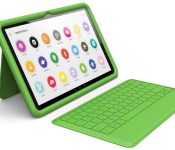
OLPC’s got two new consumer kid tablets and accessories for CES

After months of waiting, we were pretty psyched to finally get our hands on the final version of One Laptop Per Child’s first consumer-facing device, first announced this time last year. The anticipation may have played a role in our disappointment, but inevitably we just couldn’t get behind what was essentially a rebadged Vivitar device from an organization that had done so much hardware innovating for its non-profit wing. OLPC is celebrating this week’s big Vegas show with the announcement of two new slates, and while Vivitar is still the hardware partner for this go ’round, the game has certainly been upped in the spec department. And the company’s also offering up two sizes: the 7-inch XO-2 and the 10.1-inch XO-10, which sort of throws a wrench in what would otherwise be a fairly straightforward naming process. On the whole, the specs are pretty similar with the two devices, right down to the 1,200 x 600 resolution on both.
Inside each, you’ll find a quad-core processor, 1GB of RAM, 8GB of storage and built-in Bluetooth and GPS. The 7-incher will give you seven hours of battery on a charge and its bigger brother should give you more than 12. Both systems are running a heavily modified version of Android KitKat and ship with 100 pre-loaded English and Spanish apps, which the company values at around $200. The tablets themselves will run you $149 and $199, respectively. Also new are those digital microscopes and telescopes that we saw in early forms last year, along with a wireless keyboard, which was designed by superstar designer/OLPC pal, Yves Béhar.
Filed under: Peripherals, Tablets
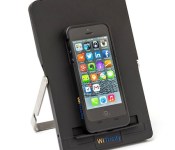
WiTriCity hopes to entice wireless charging partners with iPhone 5/5s reference design

Even though Rezence is poised to become a wireless charging competitor to Qi, it isn’t the only rival in town. WiTriCity has been in the cordless electricity biz since at least 2007 — having partnered up with Toyota for charging its cars for example — but hasn’t really made a real consumer play for handheld devices just yet. That changes today, however, with the company’s first reference design that pairs an iPhone 5/5s sleeve with a wireless charging pad. Like Rezence, WiTriCity uses magnetic resonance to charge compatible electronics, which means the pad can be installed underneath tables or other surfaces and the phone can still be refueled no matter where you place it. Of course, the sleeve is just a proof-of-concept and is not meant for sale, but WiTriCity hopes that this idea will prompt manufacturers to leap to its side. Whether or not this will compete against the likes of Powermats however, remains to be seen.
Filed under: Peripherals, Wireless
Source: WiTriCity
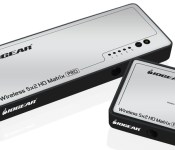
IOGEAR’s latest matrix switcher can stream different video sources to up to four receivers

IOGEAR may’ve departed from the all-black styling we’re used to this year, but it hasn’t been able to dream up anything sexier than another utilitarian title for its latest matrix switcher. The “Long Range Wireless 5×2 HD Matrix Pro” does all the same things IOGEAR’s existing switcher announced at CES 2013 can: wirelessly beam uncompressed 1080p video and audio from any of five digital or analog sources to a receiver plugged into another TV. What you get with the “Pro” version, however, is twice the range (up to 200 ft), and way more importantly, the ability to stream to up to four different receivers instead of just one. They can each pull video from any of the input sources, too, so every daughter box can hit up the main unit up for different content. There is a mark-up for that extra functionality, though — the Matrix Pro will retail for around $700 when it launches later this year.
Filed under: Home Entertainment, Peripherals, HD

The CubeJet promises pro-level 3D printing in a consumer form factor for under $5,000

Like you, we’ve dreamt about owning one of those industrial rapid prototyping machines since the first time we saw one in action. Of course, certain financial and real estate realities have made such fantasies a resolute impossibility for our modest New York City apartment. Priced at “under $5,000,” the CubeJet will likely still be too rich for our blood by the time it launches in the second half of this year, but compared to the $100,000+ plus machines out there, things are certainly heading in the right direction. Ditto for the size – in fact, this pretty would look pretty sweet sitting on our office desk at home.
Thus far, 3D Systems’ consumer-facing machines have relied on the extrusion technology that you find in most printers in that class. This time out, however, the company is tapping into its industrial roots, for a desktop system that is capable of creating full-color, high resolution prints. This being a consumer device, the company’s also focused on offering up a relatively user-friendly interface, though that remains to be seen until we actually get our hands on the printer on the CES floor. We’ll also be joined by the company’s CEO Avi Reichental on our CES stage later today, who will no doubt shed more light on the CubeJet, along with the company’s other announcements.
It’s easy to see where such a device could ultimately fall on the spectrum, no doubt appealing to small businesses with a need for rapid prototyping and really devoted makers with a lot of disposable income. Perhaps “prosumer” is a bit more apt in this case?
Filed under: Peripherals
3D print yourself in chocolate and full-color sugar candy with the ChefJet Pro

Be honest: This is the moment you’ve been waiting for — at least since 3D Systems picked up Sugar Lab a few months back and quite probably even longer. It’s the chance to print yourself and the ones you love in edible, sugary form. In among a slew of notable new printers unveiled by the company this week, CEO Avi Reichental took to our stage to announce two systems capable of printing in sugar and chocolate. The company landed on ChefJet for the name of the models, and it certainly seems to do the trick, borrowing the suffix from its ProJet line of industrial printers, while making it pretty clear who the target audience is here: bakers, chefs, hotels and the like. And honestly, if this thing isn’t all over The Food Network by the end of the year, we’ll eat our hat (printed in chocolate or sugar — take your pick).
The plain, old ChefJet is the smaller of the two, naturally, described by the company as a “countertop” device. The system prints in sugar, chocolate and flavored confection (you pick the flavor) in pretty much any design you can 3D print, including, but not limited to, old standbys like cake toppers and centerpieces. If that’s the only thing that’s been holding you back from that Star Trek-themed wedding, let us be the first to say “Live long and Mazel Tov.” And seeing as how the target audience here is likely not among the most tech savvy, the company’s created special “Digital Cookbook” software to make designing and printing a bit easier for the uninitiated. As its name implies, the ChefJet Pro takes things a bit further, with larger build volume and the ability to create sugar prints in full-color.
The ChefJets are set to launch at some point toward the end of the year. Not a ton more specifics at the moment, but believe us, we’ve got as many questions as you do. Thankfully, we’ve also got the company’s CEO on our CES stage as you read this. We’ll let you know how the prints taste, for starters.
Filed under: Peripherals
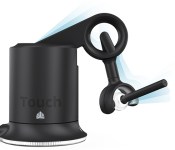
3D Systems gets in the haptic mouse game

3D Systems is hitting this CES like a steamroller. A few months after releasing the Sense handheld 3D scanner, the company’s offering up yet another peripheral for creating 3D models. This time out, the company’s got a bit harder sell in the form of a 3D haptic mouse. For starters, the functionality of such a device isn’t quite so immediately clear as a product that creates 3D images with a wave of your hand. Also, there are already haptic mice on the market – though, like the scanner, the competition has chiefly been targeted toward professions. And while (like the Sense), the price point here certainly isn’t low enough to make this a mainstream product, it may well prove entice for a small cross section of the 3D modeling / printing community.
Of course the tool plays nicely with the company’s recently announced Sculpt software, offering up haptic feedback to give the user the sensation of really creating something with a lump of virtual clay. In fact, the $500 asking price also includes a copy of Sculpt. 3D Systems’ Touch is set to start shipping in Q2.
Filed under: Peripherals

Snapchat hires Washington lobbyist after user database leak

For months, Snapchat ignored a security team’s request to address a couple of security holes. That changed when SnapchatDB! posted users’ partially obscured phone numbers, reportedly to raise awareness. That database leak prompted the startup to acknowledge the privacy breach, and, apparently, to get into the lobbyist game. According to The Hill, the company just hired Washington firm Heather Podesta + Partners to familiarize policymakers with how the app works, as the database leak led to calls for an FTC investigation. If nothing else, Snapchat seems to have landed a powerful ally in the political arena — after all, Podesta was once described as “the number one person you need to know in Obama’s Washington.”
Filed under: Misc
Source: The Hill
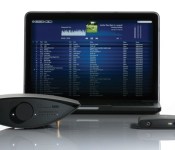
Korg outs two new USB audio interfaces for serious digital sounds

Most of what we tend to see from Korg involves the creation of new sounds, but the firm’s just announced its new AudioGate USB DAC that promises to improve the audio files you already have. There’s a choice of two hardware interfaces depending on your budget/requirements — the DS-DAC-100 and the DS-DAC-100m. Both sport quarter-inch stereo outputs, while the DS-DAC-100 (the one without the “m”) also comes with XLR and RCA connections. The main selling point being that Mac and Windows users can use the interfaces in conjunction with Korg’s AudioGate 3 software to output sound in DSD with a sample rate of upto 5.6MHz. Fancy some of that? Then you only have to wait until March, when both models will be available for either $600 or $350 depending on your connectivity requirements.
Filed under: Home Entertainment
 AIVAnet