



Biz Stone’s Jelly answers your questions through photos and social networks (video)

Twitter co-founder Biz Stone’s Jelly project has been shrouded in mystery for months. Is it a social network? A distributed computing hivemind? As it turns out, Jelly isn’t anything quite so special — but it’s worth checking out all the same. The newly unveiled service expands on Quora’s basic concept, drawing on the collective wisdom of Facebook, Twitter and Jelly itself to both answer questions and identify objects in photos. If you’re stumped, you can forward questions to just about anyone. Jelly’s Android and iOS apps are available today, so it won’t take much to learn whether or not it’s worth the wait.
Filed under: Cellphones, Internet, Mobile
Source: Jelly, App Store, Google Play

Live from the Engadget CES Stage: Pebble CEO Eric Migicovsky

Kickstarter success story Pebble was the darling of last year’s CES, helping to usher in a year in which wearables were all the rage. The smartwatch maker’s CEO Eric Migicovsky will be joining us to discuss what the company has up its proverbial sleeve for 2014, along with the company’s Product Evangelist — and familiar face around these parts — Myriam Joire.
Follow all the latest CES 2014 news at our event hub, and check out our full stage schedule here.
Filed under: Wearables

The Audi Smart Display is a 10.2-inch Android tablet that lives in your car

The german car manufacturer just pulled the curtains back on its Audi Smart Display, a 10.2-inch Android tablet wrapped in brushed aluminum that lives in your auto. The slate is powered by an NVIDIA Tegra 4 chip, boasts crash resistance and the chops to survive temperatures as high as 80C (176F). Of course, drivers aren’t the target users for the device; passengers are.The hardware hooks up to vehicles over in-car WiFi and provides folks along for the ride with access to the web, media and navigation systems, and control over the radio, to boot. It’s not clear what version of Google’s OS it runs or if and when it’ll find its way into autos on the road, but expect more details — and a hands-on — as CES continues.
Filed under: Tablets, Transportation

ZTE’s Nubia 5s and 5s mini show off premium yet playful design (hands-on)

Aside from the Grand S II, ZTE also took the opportunity at CES to show off a couple of other handsets that have so far only made an appearance in China. Both the Nubia 5s and the 5s mini are essentially follow-ups to the Nubia 5 we saw a few months ago, with slightly different designs and specs. The 5s has a very similar look to the 5, with a 5-inch 1080p display and a slim chassis that marries a plastic back with aluminum sides. Measuring 137mm by 68.8mm by 7.6mm and weighing in at 126 grams, the 5s has a surprisingly premium feel thanks to the cool sharp edges on the front and curves on the back. Unlike the 5, the 5s has a dedicated camera button.
Another nice upgrade is that the 5s comes packed with a 2.3GHz Snapdragon 800 SoC, which is certainly an improvement over the S4 Pro on the 5. We didn’t notice any discernible lag while navigating the phone and it feels quite zippy overall, though admittedly we only tried it out for a few minutes. Other specs include a 5-megapixel front camera, a 13-megapixel rear one with optical image stabilization, a 2,300mAh battery, 4k video capture, 2GB of RAM, DLNA, Bluetooth and NFC support. As far as software goes, the Nubia 5s runs a custom ZTE version of Android 4.2. We’re especially intrigued by the camera software, which allows you to fine-tune the exposure, focus and even white balance by dragging certain shape icons across the screen. And of course, there are built-in camera filters a la Instagram as well.

While the 5s is positioned as a higher-end consumer handset, the 5s mini is aimed at a slightly younger audience. This is evident the moment we turned on the screen — the UI was adorned with adorable cartoon animals as shortcut icons. A ZTE rep tells us that this can be customized to the users’ delight via a Nubia store where you can purchase such skins. Also, the back covers come in an array of different sporty colors and can be swapped out if you wish.
Even though it’s called the “mini”, it really isn’t too much smaller than the 5s. Indeed, the 5s mini has a 4.7-inch display, which is just 0.3 inches smaller than its bigger brother. With the measurements of 134.8mm by 65.8mm by 7.6mm and 120grams, the 5s mini has a relatively slim bezel and sports a microSD card expansion slot. Features include a 13-megapixel rear camera, a 5-megapixel front shooter, a 2,000mAh battery, Bluetooth 4.0 and DLNA. The UI is fairly similar to the 5s, and as it sports a 1.7-GHz Snapdragon 600 chip, navigation felt snappy enough. It has the same camera software as the 5s, but it lacks the ability to fine tune the white balance as easily.
So far, the phones are only available in China, though ZTE seems to hint that it could come to the US at a later date. Until then, avail yourself to the gallery photos above to see what you’re missing out.
Filed under: Cellphones, Mobile
Source: ZTE

Live from the Engadget CES Stage: Ford’s Jim Buczkowski

As far as car companies go, Ford has always had a major presence at CES, with CEO Alan Mulally pushing technologies like Sync in his nearly annual keynote address. 2014′s show is shaping up to be no different. We’ll be joined by Jim Buczkowski, the auto giant’s director of electrical and electronics systems to discuss the way forward for automotive technology.
Follow all the latest CES 2014 news at our event hub, and check out our full stage schedule here.
Filed under: Transportation

Imagination Technologies Announces PowerVR Series6XT Successor to Apple’s A7 Chip Graphics
Imagination Technologies yesterday announced a new Series6XT generation of its PowerVR graphics architecture, representing a successor to the Series6 graphics used in Apple’s A7 chip for the iPhone 5s, iPad Air, and Retina iPad mini.
Series6XT cores achieve up to a 50% performance increase on the latest industry standard benchmarks compared to equivalent configurations of previous generation cores. And with a significant increase in raw GFLOPS, Series6XT delivers the industry’s best performance in both GFLOPS/mm2 and GFLOPS/mW.

Apple currently uses Imagination’s quad-core G6430 graphics in the A7, and the new Series6XT architecture brings a GX6450 model as a direct successor with potential for inclusion in future Apple A-series chips. But as noted by AnandTech, typical lead times on moving from licensing announcement to consumer availability suggest that these new graphics options may not appear in shipping chips until the latter half of 2015.
Series6XT is designed to be a moderate feature upgrade and power/performance optimization pass for Series6, integrating various innovations over the past couple of years to keep Imagination’s designs performance and feature competitive. Series6XT comes 2 years after Series6 licensing was announced at CES 2012, and roughly half a year after the first SoCs implementing Series6 GPUs were released to consumers.
Apple has used versions of PowerVR graphics throughout its history of iOS device chip development, leading all the way back to the original iPhone in 2007. In line with Apple’s preference for Imagination’s graphics offerings, Apple has been a leading investor in the graphics company for some time, making several purchases that pushed its ownership stake in Imagination to nearly 10% by mid-2009.
     |
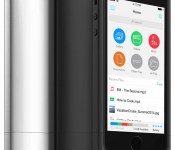
Mophie Debuts ‘Space Pack’ Battery Case With Built-In Storage [iOS Blog]
Mophie today added to its existing lineup of Juice Packs and Powerstations, introducing the new Mophie Space Pack. Like the company’s Juice Packs, the Space Pack is a 1700 mAh battery case, but it also includes built-in storage, increasing the storage capacity of the iPhone by 16 or 32 GB.

Designed for the iPhone 5 and the iPhone 5s, the Space Pack doubles the battery life of the iPhone, connecting via the Lightning port to offer both increased battery and additional storage. The built-in storage can be used for any file type, including photos, videos, and music.
The Space Pack uses an accompanying Space app to organize stored files into Collections that are easily managed. Accessing files does not require a data or Wi-Fi connection and content like music and movies can be played directly from the Space app.
Mophie’s Space Packs will be available for pre-order today, priced at $149.95 for the 16 GB version and $179.95 for the 32 GB model. The cases will begin shipping on March 14.
| |

Belkin Introduces iPhone-Enabled WeMo Crock-Pot Slow Cooker [iOS Blog]
Belkin has introduced a new Crock-Pot-brand slow cooker integrated with the company’s WeMo home automation technology. According to Belkin, this will be the first of a number of WeMo enabled small appliances, including items like space heaters.
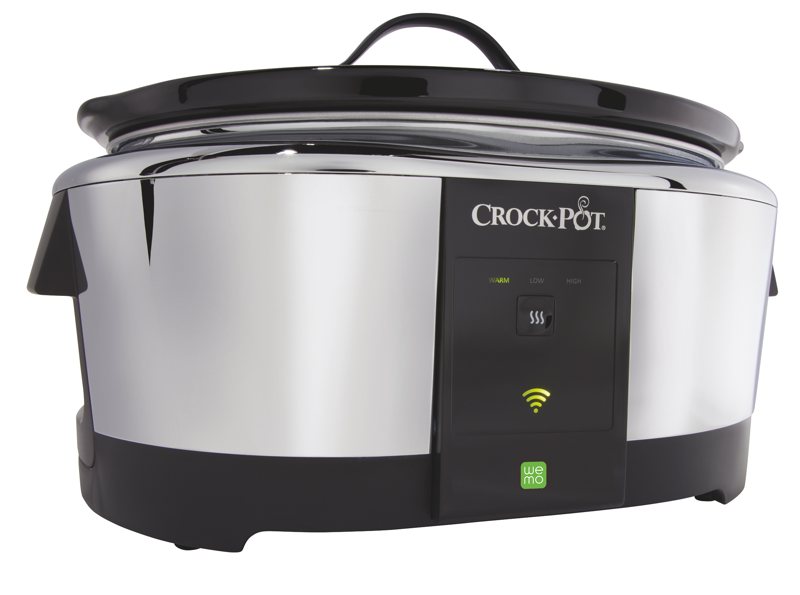
The Wi-Fi-enabled cooker looks nearly identical to other similar slow cookers, with controls on the front for toggling warm, low and high settings — but chefs can use the WeMo iOS app to adjust temperatures and set automated on/off timers.
The “Crock-Pot Smart Slow Cooker enabled with WeMo” will be available for $99.99 this spring.
Belkin also announced new LED light bulbs that work with the WeMo system, similar to Philips’ Hue bulbs.
| |
Apple Releases iOS 7.1 Beta 3 to Developers
Apple today released the third beta of iOS 7.1 to registered developers for testing purposes, following the release of the second iOS 7.1 beta in mid-December. The update is has a build number of 11d5127c and is available via an over-the-air update or through Apple’s developer center website.

The first and second betas of iOS 7.1 bundled multiple bug fixes along with several new features including a new “Button Shapes” option in Accessibility and a more prominent location for Touch ID and Passcode options.
| |
Fitbit compatibility branches out to 12 more Android devices
Fitbit is a great way to track your exercising habits. But if you’re one of the many that doesn’t have a compatible device, today might be your day.
With the company’s announcement at CES and a new update to the Fitbit app, 12 more Android devices will be compatible. Here’s the list of the newly added devices: DROID MINI, DROID ULTRA, DROID MAXX, DROID RAZR M, DROID RAZR HD, DROID RAZR HD MAXX, HTC One, LG G2, Moto X, Nexus 4, Nexus 5 and Nexus 7 (2013). These phones join the ranks of the others that were already compatible, bringing the total Android devices to 17.
James Park, CEO and Co-Founder of Fitbit, states, “Our goal is to add support for even more devices this year so customers can choose the smartphone they want to use to reach their health and fitness goals.”
So, things are looking up for Android and Fitbit this year, and I’d say we’re off to a pretty good start.
The post Fitbit compatibility branches out to 12 more Android devices appeared first on AndroidGuys.
 AIVAnet