



Live from the Engadget CES Stage: NVIDIA VP Ujesh Desai

NVIDIA Vice President of Corporate and Product Marketing (and self-proclaimed “avid gamer”) Ujesh Desai will join us on stage to discuss the company’s broadening plays in the gaming world, including the hand-held powerhouse Shield.
Follow all the latest CES 2014 news at our event hub, and check out our full stage schedule here.

PlayStation 4 sales hit 4.2 million as of December 28th

SCEA CEO Andrew House just took the stage during Kaz Hirai’s CES 2014 keynote to announce some PS4 sales numbers: 4.2 million units sold, as of December 28th. That’s exactly double the figure the company told us last month, notching 2.1 million cumulative sales by December 1st. It’s a seriously impressive start for Sony’s next-gen console, putting it clearly ahead of the 3 million Xbox One sales recorded in 2013 (although Microsoft’s console is available in fewer markets right now).
Moving forward, Sony will build on its sales momentum by launching PlayStation Now, a service that’ll eliminate cross platform compatibility issues by letting gamers stream titles on their PlayStation 4, PlayStation Vita, smartphone and tablet directly from the cloud. Based on Sony’s acquisition of streaming outfit Gaikai, PlayStation Now will come as part of a new subscription model for users, and will kick off with a limited beta starting later this month, followed by a full US rollout in the summer.
Andrew House on stage: “@Playstation 4 sold over 2.1 million units in just 2 weeks. Today we announce we’ve surpassed 4. million.” #CES2014
– Sony Electronics USA (@SonyElectronics) January 7, 2014

ZTE Iconic Phablet: a ridiculous name for large-screen fans on a budget (hands-on)

Regardless of what feelings you may have towards the term “phablet,” as soon as it officially becomes part of the name of a device, you know that word isn’t going away any time soon. It’s just double the trouble when the phone in question is actually called the Iconic Phablet. As the name implies, the Phablet is a large smartphone with a 5.7-inch 720p display, but it doesn’t seem that much different from the Grand S II, which is just two tenths of an inch bigger. It actually feels pretty comfortable to hold, despite the fact that it’s slightly larger, taller and thicker, but the lackluster display is a bit of a disappointment unless it’s marketed at a low price point.
The feature we found most interesting on the phone was ZTE’s version of Multi-Window, which the company threw into its half-stock, half-skinned version of Android 4.3 Jelly Bean. We’ve seen this feature in the Galaxy Note series for a long time now, but ZTE’s option doesn’t require a developer kit, which means any third-party or native app will work just fine no matter what. The Phablet has a three-segmented back, with a standard grey plastic matte build on top and bottom and solid sheet of plastic sandwiched in between. You’ll get an 8MP rear camera with LED flash and a 1MP camera on the front, as well as a 3,200mAh battery, dual-core Qualcomm Snapdragon chipset, 1GB RAM, Bluetooth 4.0+LE and a groan-worthy 8GB internal storage. Finally, the back features a trio of wireless charging pins that will work as long as you get the supported case that clips onto the phone (sold separately, of course).
Curiously, ZTE tells us that the Iconic Phablet will offer a radio with LTE, CDMA and EVDO support, while GSM/EDGE and HSPA+ are nowhere to be found. We’re told that there’s a very good chance that this device will eventually be sold in the US, which means that it’ll land on a CDMA carrier — that is, unless ZTE comes out with a special version that makes it compatible with AT&T and T-Mobile. As with the company’s other CES products, availability and pricing aren’t known just set. We got a few minutes with the device and have uploaded it into our image gallery, and we hope to have a video of the device up soon.
Filed under: Cellphones, Wireless, Mobile

Sony’s launching a new cloud based TV streaming service in the US this year

SCEA president Andrew House just announced Sony’s launching its long-rumored IPTV service, as a cloud based offering with both live TV and video on-demand that personalizes itself for the viewer. According to House, it will be able to pause and resume viewing across multiple screens, including on Sony’s connected devices like the PS4, and third party hardware including the iPad. There aren’t a ton of details yet, but it will start testing later this year. Sony execs claimed as recently as last year that the project was on hold due to issues like the low limits of bandwidth caps, so it will be interesting to see how they work that out.
Big news from Andrew: Today Sony will introduce a new cloud-based TV service that combines live TV content with digital media #CES2014
– Sony Electronics USA (@SonyElectronics) January 7, 2014
Filed under: Home Entertainment, HD, Sony

PlayStation Now streams PlayStation games to PS4, Vita, PS3, tablets and smartphones

Sony has just announced PlayStation Now, a new service for PS4, Vita, PS3, tablets, smartphones and Bravia TVs based on its acquisition of streaming outfit Gaikai. It represents a new subscription model for PlayStation users, and will kick off with a limited beta on PS3 starting later in January, with a wider US release slated for this summer. Games can be rented by the title or subscription and will support PSN features like multi-player, online, trophies and messages, even when you’re on the road. During his CES 2014 keynote, Sony chief Kaz Hirai said that it’ll “enable streaming across your smartphone, Vita, tablet and PS4 wherever, whenever,” even at the same time. To enable that, PS Now is tied to a brand new cloud service, also just announced. There’s no more details for now, but Sony will be showing off the tech here at CES 2014, so stay tuned for more details.
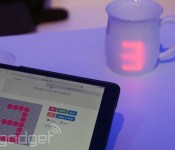
Intel shows off a light-up smart mug, because why not?

Why not indeed? In addition to all the usual stuff (tablets, Ultrabooks, what have you), Intel’s CES booth includes a tablet full of… coffee mugs. Yep, mugs. It’s a bit strange, at first, to see so many photographers crowded around, taking hands-on photos of a porcelain cup. But then you notice the LED lights. Using a companion app, you can program the lights to display numbers, letters and smiley faces, in different colors. Additionally, Intel is showing a demo of it working with an internet-connected baby onesie, in which the lights on the mug pulse to match up with the child’s respiratory patterns.
For now, the mug is just a concept, but Intel hopes it can eventually help bring it to market. In particular, the company is working with a manufacturer in the Chinese city of Jingdezhen, which has a 2,000-year-old porcelain-making tradition, but has been economically depressed in recent years. In the meantime, of course, Intel can’t say when this might go on sale, or how much it might cost. We say, use that time to figure out more uses for the thing. Engadget’s UK editors (born tea experts) have a few suggestions: show someone’s order on the outside, or change colors when that latte starts to get cold.

Live from the Engadget CES Stage: AT&T Mobility’s Glenn Lurie

We’ll be joined by AT&T Mobility’s President of Emerging Enterprises and Partnerships, Glenn Lurie, the executive who helped score the carrier’s exclusives on the iPhone and iPad.
Follow all the latest CES 2014 news at our event hub, and check out our full stage schedule here.
Filed under: Cellphones, Mobile, AT&T

Skullcandy’s women’s line of headphones are purple, flowery and covered in human skulls

We’ll admit that this wasn’t exactly the announcement we were expecting out of Skullcandy. The populist headphone maker is celebrating CES with the launch of a line specifically targeted at the ladies. What, pray tell, does that mean, exactly? Well, according to the press materials:
The collection is designed, colored, cushioned and patterned for females with a pioneering focus on acoustics and fit, unmatched in the electronics space.
The line is apparently the result of “years of research” into the “anatomical and acoustic differences between men and women.” The result is different sizes, shapes, form-fitting ear gels, fabrics and, based on the one image we have, lots of purples and flowers — though it wouldn’t be Skullcandy without some bones on there. The line is launching on March 15th with prices ranging from $30 to $100. Come June, the company will also be launching a line of durable, sweat-resistant sports headphones, as well.
Filed under: Portable Audio/Video
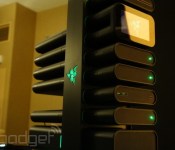
Project Christine offers a glimpse of Razer’s insane future through modular computing

Razer’s Project Fiona was all the talk of CES 2012 — it married console-like controls with a tablet form factor, and packed in real computing power to boot. At the time, CEO Min-Liang Tan was cagey about its retail availability; heck, it didn’t even have a product name at the time. By CES 2013, “Fiona” had become the Razer Edge, and Min’s tune changed from prototype talk to retail ready models.
At CES 2014, the cycle begins anew. Razer’s introducing Project Christine this morning as the show officially opens and thousands of people descend on the Las Vegas Convention Center. Like Fiona before it, Christine is an ambitious project from an ambitious company: a modular-computing initiative with a form factor space aliens would appreciate.
Beyond the news of what Project Christine is, we spent an hour with Razer’s passionate CEO and his support crew diving into what Christine means for the future of Razer, what they think it means for the future of PC gaming and how Christine will go from project to reality by next year.
Fresh off 24 hours of travel, Tan excitedly jumped into pitch mode right after greeting us in a 48th floor Las Vegas hotel suite. Had we seen Razer’s latest Adaro headphones? And how about Nabu, the new wearable Razer’s also debuting at CES? Pay no attention to that shrouded table in the corner.
Of course, the shrouded table was where Christine resided: a massive black PC tower with varying sizes of individual pods (modules), a green underglow vignetting out from underneath its base, all cooled by mineral oil running vertically down the middle. Tan was smart to lead with Nabu and Adaro, as Christine easily sucks the air out of the room. Before we learned about what Christine does, just looking at the prototype was disarming enough. Frankly put, it looks like no other gaming PC we’ve ever seen. That’s a good thing! In its own weird way, Project Christine is a beautiful piece of hardware. It looks like a computer sent from the future, after the Industrial Design Revolution of 2135.
Just look at those modules! Aren’t they bizarre little pods? They enable a wide variety of setups — from the tri-SLI GPU setup running on the reference model here to integrated processing and graphics on a single chip for less-hardcore users. The idea here is to both combat the waste in the PC world of buying annual hardware refreshes and to push back on massive price spikes for PC gamers. “We’re really looking at other models,” Tan told us. “Perhaps to say a subscription model of sorts, that we could interchange modules when they come in. Users don’t have to worry about a huge bump every time there’s new architecture out there.”

Of course, those modules have to be made by someone, and that someone will exclusively be Razer. As of right now, each module uses two self-sealing ports for literal plug-and-play functionality. Adding a new GPU is as simple as plugging one in to the back, and the same goes for more storage, RAM, ports or any other accoutrements you might want.
Modularity requires customization. Anyone who’s tried installing a new video card knows how much fuss can go into even that relatively simple process, and Christine aims to cut that out. As such, the traditional motherboard is broken up into a variety of pieces and scattered throughout the middle spine of the tower. We’re reticent to go into specs of the reference design, if only because it’s just one of many, many builds one could create with Christine. Don’t like that LCD screen? Swap it for a power button. Wanna go all digital and cut Blu-ray from your life? That’s an option. The pieces of Christine that are set in stone, however, are the tower design and modular approach.
That said, Christine is still very much in the “project” stage. Tan’s hoping Christine will generate as much buzz at CES 2014 as Fiona did before it, catapulting the ambitious product from concept to reality. If you ask us, our vote is in with a solid “yes.” But our vote only counts for so much — we’d suggest letting Tan know how you feel directly on Twitter so that we may see a finalized Christine at CES 2015. The cycle must continue!

Sony’s $30k+ Life Space UX projector all-in-one puts a 147-inch 4K screen on any wall

You can tell the veterans from the young upstarts at CES simply by how they announce products. Simply putting a new device on stage and feeding you specs is pretty much amateur hour. (Though, it does make the lives of tech journalists much easier.) The big boys know that you’ve got to bury a product launch among piles of hyperbole and abstract concepts that will (supposedly) improve your entire state of being. Enter Life Space UX. Sony’s concept for a world where your walls become virtual windows into the world around you. You could, for instance, project the sky at various points of the day across your living room walls. (Now, why you’d want to do that, is a different question.) At the heart of the concept is a new Ultra Short Throw Projector that can fill a wall with a bright moving image from an extremely close distance. Specifically it can fill 147 inches of wall space with a full 4K image. There’s even a pair of built in speakers and a cabinet for hiding your various home theater components. But, as you’d expect from something like this, the price tag is not for mere mortals (or those with heart conditions). Sony is hoping to start shipping the short throw projector this summer for between $30,000 and $40,000.
RT @eddybadrina My next purchase #Sony Life Space UX projector. 4k short-throw projector, up to 147in display. #CES2014 #SonyCES
– Sony Electronics USA (@SonyElectronics) January 7, 2014
Filed under: Home Entertainment, HD, Sony
Source: Sony
 AIVAnet