


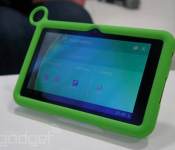
OLPC shows off its two new kid-friendly tablets (hands-on)

OLPC’s Giulia D’Amico swung by our CES stage a little while ago with the organization’s two new tablets in tow – so, naturally, we kindly asked her to stay behind a while, so we could spend a little quality time with the devices. The 7-inch XO-2 looks nearly identical to its predecessor, the company’s first-ever consumer-facing device. It’s still a bit chunky and the rear has that same plasticky dimpled design. There’s also that great Yves Béhar-designed silicone slipcase. The really significant changes are all inside the slate, including a quad-core processor, 1GB of RAM, 8GB of stage and built-in GPS and Bluetooth. The custom Android software will remain largely the same, as well (built this time on top of KitKat), though the company is added more content to its offering.
The 10.1-inch XO-10, meanwhile, shares most of the same internals as its little brother, but brings a truly sleek industrial design that puts the little one to shame. There’s a green metal back (the final color has yet to be determined, though we like the fact that it matches the company’s other offerings) and a much slimmer profile. Of course, the thinner design calls into question just how rugged the bigger model will ultimately be.
Filed under: Tablets
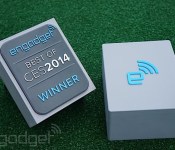
Making Engadget’s Best of CES trophies (video)

As we began putting together our awards proposal for the CEA, we knew we had to blow things out. It was important to make every aspect of the awards uniquely Engadget, with processes that embodied the forward-thinking technology that has come to define our coverage and the annual International CES event. The awards ceremony itself is naturally a big part of that process — as are the trophies we’ll bestow on each of the winners.
But how does one make a trophy with a technological bent? Flashing lights? WiFi? Animatronics? The answer was simple: 3D printing. The space virtually exploded at last year’s CES, with big reveals from a number of the technology’s top players, and it would no doubt only continue to be a major presence for many CESes to come (little did we know then that 2014 would see its own devoted 3D-printing area, due to the influx of companies presenting at the show).
The question of which 3D-printing company to approach with such a task, however, wasn’t readily apparent. New companies and technologies are springing up seemingly every day, with prices dropping, ease of use increasing at a rapid clip and the line between the consumer and industrial spaces beginning to blur. That line is still present, of course, and what we really needed was a company with a large consumer presence that also possesses the infrastructure and technology that come with pro-level devices.
It’s a balance that 3D Systems maintains nicely. The company helped usher in rapid prototyping nearly three decades ago. More recently, it has embraced the consumer space, through products like the Cube and CubeX that are firmly targeted at the ever-expanding world of desktop 3D printing. For its part, the company happily accepted, agreeing to assist in the creation of the trophies and offer up some on-site printing at CES. It was a solution that allowed us to be flexible in design and customization as well as being a lot speedier than more traditional trophy-manufacturing processes.

For the design itself, we turned to Engadget Editor Emeritus Ryan Block, who recently helmed our site redesign. “This one thing I kept coming back to was the idea of unboxing a product, and how it represents the moment where the waiting is finally over and it becomes a reality,” Block said. On the top is the Best of CES Awards seal and the familiar Engadget logo. Open the box and you’ll see an engraved quote from iconic computer science pioneer Alan Kay:
The Best Way to Predict the Future is to Invent it. — Alan Kay
To help make the vision a reality, we brought in Harry Hamill, a Colorado-based 3D modeler, who has been working in the Computer Aided Design world since the mid-’90s. “I work primarily in the jewelry industry specializing in sculptural organic pieces,” Hamill said. “I started working in 3D because I used to hand-carve all my work in metal under magnification and I reached the limit to the level of detail I was able to achieve.”
With the models designed, Block and Hamill took their work to 3D Systems. “We worked closely with [them] in the production process, going through multiple iterations of the design,” Block adds. “The visible material of the trophies is printed using a process called selective laser sintering, which allows us to use a unique aluminum-impregnated nylon composite material that has the slightly metallic appearance of an aluminum casting. The seal itself is printed in a smoother composite plastic, and hand-painted for maximum detail.”
The result is what you see above. The trophies will be printed on site here at CES, customized with the names of the winners. To paraphrase a quote I once saw on the inside of a box, “the best way to predict the future is to print it.”
Filed under: Meta
Yahoo acquires Aviate, promises to fold into Android experience
In another move to bring Yahoo back to its prime, today Yahoo CEO Marissa Mayer took to the stage at CES 2014 to announce its newest acquisition that aligns perfectly with its “team and vision” — Aviate.
Aviate is an Android app that has been in beta for the last few months and automatically organizes your homescreen based on the time of day or location. It places icons, information and shortcuts in smart locations and changes throughout your day.
Yahoo said that they acquired Aviate since it shares their vision for simple and intelligent mobile experiences, and the company hopes to make it a central part of Android-based experiences this year and beyond. Yahoo believes that through Aviate, homescreens will become smarter, more personalized and aware of your context.
Over on its site, Aviate said that they met with Yahoo and it was obvious how aligned their visions are, with Yahoo all about “simplifying and streamlining users’ daily habits through intelligent and beautiful products.” Aviate sees endless opportunities for growth with the Internet giant. It also thanked its users for their ”support, excitement and faith.”
Although Aviate is still in private beta, Yahoo had one more announcement that it is giving out 25,000 invites to people who use code “YAHOO.” It’s first come, first serve, so if you want one, you better hurry!
via Yahoo, Aviate, Keynote video
The post Yahoo acquires Aviate, promises to fold into Android experience appeared first on AndroidGuys.
CES 2014: Native Union Shows Off ‘Jump’ Cable/Battery Charger Combo [iOS Blog]
On the CES show floor, Native Union is demonstrating its new Jump accessory, which combines a Lightning cable with an 800mAh battery pack for simple charging and extra battery life on the go.
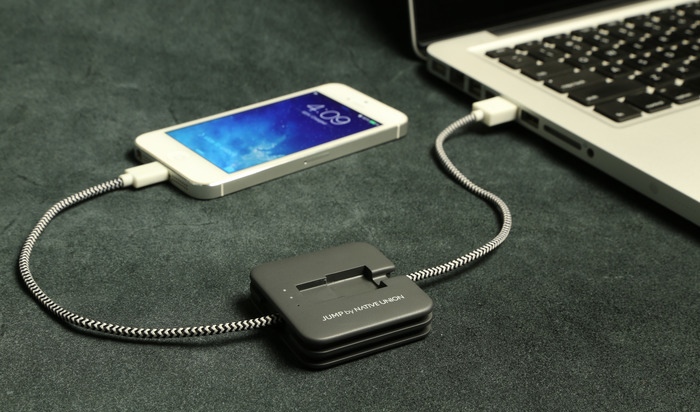
Jump is like standard battery packs, providing battery life to an iPhone, but because it’s also a Lightning cable, the battery portion of the accessory is charged each time the iPhone is charged. This eliminates the need for the battery pack to be charged separately of the iPhone, which is often an inconvenience that requires an entirely separate cable.
The accessory utilizes an AutoCharge circuit prioritization system to detect when the iPhone battery is full, at which point it charges the battery pack portion of the Jump.
JUMP is not just a charging cable; it also provides your smartphone with a substantial power boost wherever you are, without ever having to remember to charge it. Perfect for work, play, and travel.
Unlike power banks, JUMP charges automatically every time you charge your phone, giving you complete reassurance that whatever situation you are in, there’s always power in your pocket.
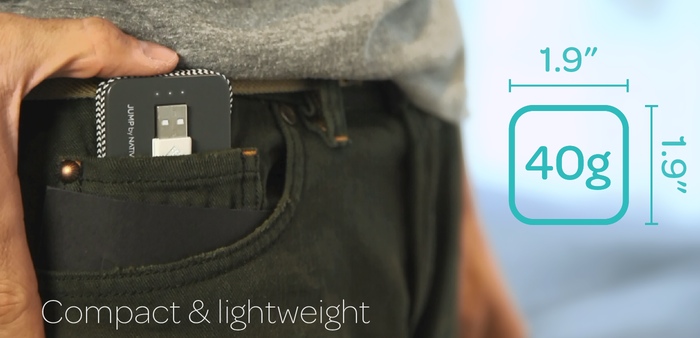
Jump is ultra compact (1.9 inches), weighing less than two AA batteries and fitting easily into a pocket. The 800mAh battery pack delivers an extra 1/3 charge, which equates to an additional 3 hours and 50 minutes of talk time or web browsing.
The Jump is currently a Kickstarter project and can be pre-ordered for a $35 pledge. Currently, the project has received just over half of its funding with 36 days to go and will begin shipping to backers in May of 2014 if full funding is reached.
     |
CES 2014: CubeSensors Monitor Air Quality and Other Environmental Factors [iOS Blog]
At CES this week, a new product was introduced to monitor a variety of home environmental factors in an effort to improve quality of life for its buyers. The CubeSensor is a small cube with seven sensors to “help you live better”, according to the company that makes them.
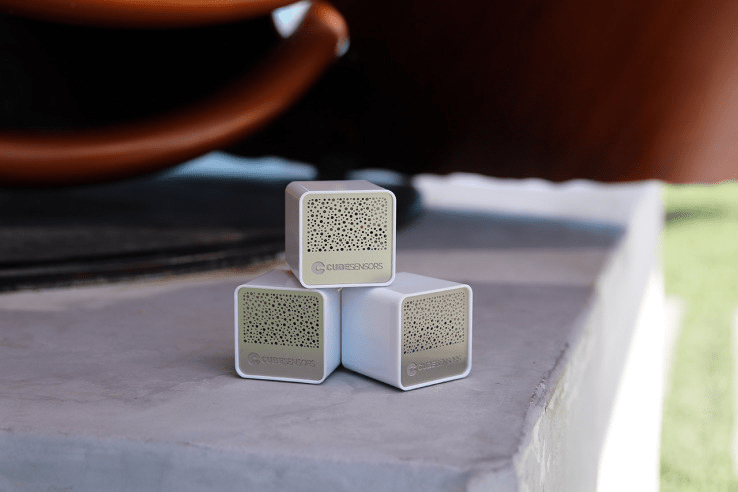
The small devices measure air quality, temperature, humidity, noise, light, and atmospheric pressure and notify users via visual and push notifications so they can make adjustments as needed to improve their environment. A room could be too bright to sleep well, or too dark to work, and users may not notice that their environment could be negatively affecting them.
The idea behind the project comes from consumers growing increasingly interested in data about their own lives, especially where health and fitness are concerned. Yet there’s no all-encompassing product that monitors the health level of your own environment.
Knowing that people often care a great deal about the aesthetics of the home, CubeSensors was designed to be discreet and attractive, with the option to be wirelessly connected (and charged periodically) or plugged in.
CubeSensors are available in 2, 4 or 6 packs, along with a base station, for $300 to $600. They are expected to ship later in the first quarter of 2014.
The CubeSensor demo app is available via the company’s website to see what sort of information the cube shares with its owners.
| |
CES 2014: LG Debuts Earphones That Monitor Heart Rate [iOS Blog]
LG yesterday announced a new set of fitness-oriented earphones, which are designed to offer real-time heart monitoring. The earphones, which connect to a small medallion that is strapped on an arm or waistband, track both metabolic rate and maximum oxygen consumption while allowing users to listen to music. They function through sensors that measure blood flow through the inner ear.

In addition, the Heart Rate Monitor Earphones include an accelerometer that measures a wide range of data, including distance, calories burned, steps taken, and more. It also includes hi-fi sound and a built-in microphone for phone calls.
It’s never been easier —or more tuneful—to track your metabolic rate and cardiovascular fitness (VO2 max). And it’s all accomplished with LG’s revolutionary HRM Earphone Heart Rate Monitor. Because of the unique physiology of the ear, users can count on health and fitness metrics with none of the inconvenience of chests strap measuring devices.
The add-on medallion that connects to the earphones serves as a data processing hub that sends real-time biometric information to an iPhone via Bluetooth, which can be accessed by the LG Fitness app. The earphones are also designed to work in conjunction with LG’s recently announced Lifeband Touch activity monitor. Along with the LG app, the earphones can sync with popular third-party apps like MyFitnessPal and Runkeeper.

The earphones will ship during the first half of 2014 and will retail for $179.99.
| |

CES 2014: 3D Systems Releases iSense 3D Scanner iPad Accessory [iOS Blog]
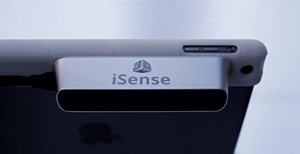 At CES today, 3D Systems introduced an iPad-version of its popular Sense 3D scanner called the iSense. The device clips to the iPad and allows users to scan an object in three-dimensions in real-time, without needing to put the object inside a special scanning box.
The iSense is ideal for physical photography, empowering users to easily capture moments in every dimension. Created for 3DS by Occipital and powered by Structure Sensor technology, iSense can be used on anything and you don’t have to stand still or place an object into a box as required with other 3D scanners. Users simply attach the iSense to an iPad, and they can literally walk around and scan entire objects or environments obtaining a photorealistic copy of the real thing. iSense is powered by the same software as 3DS’ popular Sense scanner.
After scanning an object, users can then transfer the data for editing or duplication via compatible 3D printers. Engadget did an in-depth review of the Sense scanner, the predecessor to the iSense, back in November and found the device to be promising but very much a first-generation product. The site said there is “real potential” for 3D modelers, game developers and the like, but the devices remain very expensive for what they do.
The above video is from the original Sense 3D scanner, not the new iSense. The iSense will be available for $499 in the second quarter of 2014.
Last year, Apple purchased 3D-scanning company PrimeSense, and that company’s Capri sensor enables mobile devices to “see the world in 3D”, a very similar technology to that used in the iSense, though without as much of a focus on 3D printing.
| |
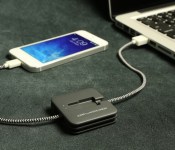
CES 2014: Native Union Shows Off ‘Jump’ Cable/Battery Charger Combo [iOS Blog]
On the CES show floor, Native Union is demonstrating its new Jump accessory, which combines a Lightning cable with an 800mAh battery pack for simple charging and extra battery life on the go.
Jump is like standard battery packs, providing battery life to an iPhone, but because it’s also a Lightning cable, the battery portion of the accessory is charged each time the iPhone is charged. This eliminates the need for the battery pack to be charged separately of the iPhone, which is often an inconvenience that requires an entirely separate cable.
The accessory utilizes an AutoCharge circuit prioritization system to detect when the iPhone battery is full, at which point it charges the battery pack portion of the Jump.
JUMP is not just a charging cable; it also provides your smartphone with a substantial power boost wherever you are, without ever having to remember to charge it. Perfect for work, play, and travel.
Unlike power banks, JUMP charges automatically every time you charge your phone, giving you complete reassurance that whatever situation you are in, there’s always power in your pocket.
Jump is ultra compact (1.9 inches), weighing less than two AA batteries and fitting easily into a pocket. The 800mAh battery pack delivers an extra 1/3 charge, which equates to an additional 3 hours and 50 minutes of talk time or web browsing.
The Jump is currently a Kickstarter project and can be pre-ordered for a $35 pledge. Currently, the project has received just over half of its funding with 36 days to go and will begin shipping to backers in May of 2014 if full funding is reached.
| |

Sprint Spark expands to 11 markets
Sprint today announced that another six markets have started offering Spark LTE speeds. With up to 60Mbps download speed, the tri-band LTE is available in a number Sprint’s recent smartphones. The total footprint, which now stands at 11 markets, sees Texas taking in the lion’s share of new areas.
The six new areas include Dallas, Austin, Fort Worth, Houston, and San Antonio, Texas; Fort Lauderdale, Fla.
These lightning fast Sprint Spark speeds will also be available to Virgin Mobile USA’s Broadband2Go customers once the NETGEAR Mingle Mobile Hotspot touches down. Expected later this quarter, it will provide the same data connections on Virgin Mobile’s Broadband2Go no-contract plans. , which include daily service on Sprint’s 3G/4G LTE networks (where available) for $5/day. Broadband2Go comes in $5/day plans as well as monthly data plans for $25 with 1.5GB or $55 with 6GB. The Mingle connects up to 10 wireless devices simultaneously and works as a dual-mode 3G/4G LTE device.
The post Sprint Spark expands to 11 markets appeared first on AndroidGuys.

Live from the Engadget CES Stage: Scanadu CEO Walter de Brouwer

Health care devices are, once again, all the rage at this year’s CES, and Scanadu’s got one of the more ambitious offerings. The company’s Scout device aims to be a $150 Star Trek-esque tricorder that’ll give users readings for heart and breathing rate, temperature, blood pressure and blood oxygenation levels. We’ve got the company’s founder and CEO Walter de Brouwer to discussion his vision for the future of health care.
Follow all the latest CES 2014 news at our event hub, and check out our full stage schedule here.
Filed under: Peripherals
 AIVAnet