



Vizio’s 4K Ultra HD TVs start at $1,000 for a 50-inch set (video)

If all of the 4K — or 8K! — talk from CES has you jonesing for a new TV, but you’re short on scratch, we’ve got good news. Vizio has announced pricing for its P-series of Ultra HD panels and they’ll sell for a lot less than you might expect. A 50-incher will run you a measly grand. Each five-inch bump in size ups the price $400, all the way up to the $2,600 70-inch set. Given that Vizio has a solid reputation, this line could be a reliable way to watch House of Cards in its native resolution without breaking the bank.
Filed under: Home Entertainment, HD
Source: Vizio
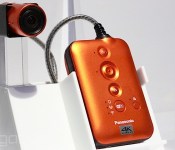
Panasonic’s first-person 4K camera debuts at CES, set for launch in late 2014

Wearable devices and 4K are two of the biggest trends at CES, and Panasonic has managed to make both collide. The outfit’s revealed a UHD camera that folks can wear on their head with the help of a plastic mount that wraps around their ears and neck. While the prototype is nearly identical to the HX-A100 cam the firm debuted at last year’s show (yes, it’s still waterproof), this Ultra High-Definition model is lined with some more powerful innards. Detailed tech specs are being kept under lock and key, but the unit on display was sending a live feed of the pixel-packed footage to a 4K display through a mini-HDMI port — a feature that will be available in the final version. Despite the hardware’s compact form, it produced sharp video free of stuttering, and caught a fairly wide field of view courtesy of its fisheye lens. While there’s no word on pricing, the first-person camera is slated for a release later this year.

Meet WowWee’s MiP: A gesture and app-controlled robot with moves like Jagger

They see me rollin’, they hatin’…
Filed under: Robots
Check out 3Doodler’s upcoming accessories and swappable tips

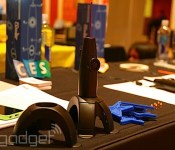
WobbleWorks’ almost finished shipping Kickstarter backers their 3Doodler 3D-printing pens, and next month, post-crowdfunding pre-orders will begin to be filled. The company announced today a US retail launch later this year — a “major retailer” in the UK is also on board, apparently — but in addition to that, it showcased its first round of accessories for the device here at CES. While pricing and availability info elude us, we’ve seen a range of new tips for the pen, from different standard nozzle sizes to square and triangular heads, among others. They’ll come neatly contained within a tool you’ll need to swap them out, the design of which is still being finalized.
If your freehand 3Doodling is more Picasso than Monet, then look forward to the DoodleSuit, which looks like a cradle, but functions more like a computer mouse. Three legs stabilize the pen, and buttons on two of the legs tell it how fast you want heated plastic to come out of the tip. If you’re still struggling to make pretty things, then perhaps you’d better let DoodleBlocks guide you. They’re basically stencils for tracing uniform shapes, and although WobbleWorks only had a star to demo today, more are planned, including some that’ll let you create elaborate 3D shapes, minimal skill required.
Nicole Lee contributed to this report.
Filed under: Misc
Source: WobbleWorks
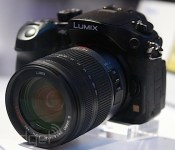
Panasonic’s next GH mirrorless camera will record 4K video, arrive late February for under $2,000

With plenty of 4K displays in Panasonic’s booth, it’s appropriate the firm’s finally shown off a camera in its GH line that records 4K video. The company’s keeping most of the hardware’s specs close to its collective vest, but a representative was able to divulge a few details. UHD content can be recorded at 200 Mbps, and output in a full live feed via a mini-HDMI port (thanks to ALL-I Intra mode) to display on a computer or record to a hard drive. Of course, the Micro-Four Thirds shooter can save footage straight to an SDXC card — a UHS Class 3 prototype variant tuned for such a task was on display — though space will run out fairly quickly.
There’s no word how many megapixels the cam totes, but it will be able to simultaneously snap photos while recording video. More details are set to arrive with the camera’s official release in late February, when it’ll arrive with a price tag of $2,000 or less. In the meantime, look out below for a glimpse of the shooter in the gallery.
Filed under: Cameras

Live from the Engadget CES Stage: The Engadget HD Podcast

CES is always a big show for big TVs, and there’s no reason to expect that 2014′s edition will be any different — though it may well be a bit more… curved than in past years. Join Richard Lawler and special guests for an HD Podcast preview of the week to come.
Filed under: Home Entertainment, HD

This case turns your iPhone into a night vision camera

Thermal cameras are expensive, which is why they’re mostly used by firefighters, contractors and psychotic aliens. Fortunately, that’s all about to change thanks to the FLIR One, which is an iPhone case with a tiny thermal camera stuck on the back. All you have to do is strap your iPhone 5 or 5s into the dock and, once you’ve downloaded the app, you’re ready to go. Using multi-spectral dynamic imaging, it can create hybrid images, adding extra detail to the thermal pictures, or plain-ol’ thermal pictures in the dark. When you point it at a subject, the FLIR will also give you a temperature reading of what you’re pointing the device at.
It took FLIR more than two years of research and development to create Lepton, the camera necessary to make this happen, which is smaller than a nickel. Despite its tiny size, it’s much cheaper than normal thermal lenses, which would normally set you back around $1,000. The company hopes that this will help DIYers to find the leaks in their home, outdoors types to avoid wild creatures and families to navigate dangerous areas like smoke-filled houses. It’ll be available in the spring for $350, with an Android version planned for later in the year.
Billy Steele contributed to this report.
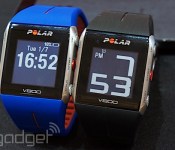
Polar’s latest wearable wants to be more than just a sports watch

When we brought you the news concerning Polar’s V800 a few days ago, we were impressed that it would replace both a running watch and an activity tracker. But when we spoke to the company’s representatives here at CES, it seems that there’s a bigger target to aim for. Polar is currently working on an update to the V800 that would see the device produce notifications and alerts in a similar way to the current crop of smartwatches. The company is also working on an option to offer a store for customizable watch faces, and the ability to buy additional functionality as you require.
Having spent some time with the wearable, we’re still intrigued by its potential. In addition to the tracking and aforementioned features, the V800 will work out your ideal rest period from your exercise history and will even push your location to the cloud for others to track — for example, when you want people to follow your progress during a marathon. There’s a considerable heft to the hardware, standing as proud from your wrist as the Galaxy Gear, for instance. Fortunately, the stainless steel case feels tremendously solid, and we’d expect to say the same for the Gorilla Glass that covers the face. Either way, we’re looking forward to getting it onto our wrists for further examination, mostly because we’d like to try the blue-and-red edition and pretend that we’re Spider-Man.

Seattle kills Gigabit Squared’s fiber internet rollout before it even starts

We knew that Gigabit Squared’s fiber-to-the-home rollout was facing money troubles, but it’s now clear that those problems were just too much to bear. Seattle’s newly elected Mayor Ed Murray tells the Puget Sound Business Journal that his city’s agreement to launch public internet through Gigabit has fallen apart before it could even take on its first customers. The official isn’t ruling out a future deal, but he doesn’t have any alternative providers lined up. Meanwhile, hope springs eternal at Gigabit Squared — the company “look[s] forward” to speaking with Murray about future plans. Before it does, it may want to look into paying its bills.
Filed under: Networking, Internet
Source: Puget Sound Business Journal

Qualcomm to bet big on tablets and connected cars in 2014, says CEO-elect

At Qualcomm’s CES press event, CEO-elect Steve Mollenkopf took the stage to share his optimistic — and perhaps a slightly surprising — vision of 2014. The exec believes that as OSes are becoming more robust and feature-rich, phone makers like Nokia, Samsung, LG and Sony will make a second coming in the tablet market. This becomes an opportunity for Qualcomm and carriers to cash in, with the latter coming up with more innovative and creative ways to bring in more subscriptions, such as by selling the smartphone and the tablet as a pair. Mollenkopf also name-dropped the Amazon Kindle HDX and the Nexus 7 tablets, which are all powered by his company’s Snapdragon chips.
“Remember, we look at the market as a long game, so when we look at OSes and how they’re doing and how we’re progressing, we can be nothing but pleased with how we think that’s setting up long term,” Mollenkopf said.

Much like how smart wearables — including Qualcomm’s own Toq — are just becoming a trend, cars in general are also still in the phase of trying to get connected, said Qualcomm’s ex-COO. Despite its absence in the recently formed Open Automotive Alliance (which is joined by rival NVIDIA), the chip giant thinks it can bring its connectivity expertise to the automobile industry, which is what the recently announced Snapdragon 602a aims to achieve.
“The next phase is the car is going to not only get connected to the internet, but it’s going to be connected to other cars, and it’s going to be doing a lot more sensing on what’s going on in the environment, and making decisions as to what it’s going to do. In order to do that, it needs to embrace technologies that are very similar to what you have in high-end smartphones.”
Mollenkopf assured us that Qualcomm’s not done with smartphones yet, though. The exec’s still seeing rapid development in the emerging markets in terms of features, though he didn’t give an indication on when 64-bit mobile processing — as supported by the entry-level Snapdragon 410 — will become mainstream. Let’s not forget that there’s also full-on LTE deployment in China this year, which Mollenkopf said he’s keen to be a big part of.
 AIVAnet