



Sony’s Life Space UX demo envisions projectors, screens everywhere

Among the announcements Sony dropped during Kaz Hirai’s CES keynote, the Life Space UX project seemed to be most outrageous, pushing an entirely new vision for projectors. We checked out the company’s CES demo booth and found out it actually goes even further than that. The prototype 4K Ultra Short Throw Projector shown on stage and in the demo is expected to cost between $30,000 – $40,000 when it launches later this year.
Similar to the pricey Cinema Beam projector released by LG last year, it can sit very close to a wall even in high-brightness settings and beam a large, clearly visible image. The combination of zoom lenses, three separate SXRD microdisplays and a laser diode light source make it powerful and sharp enough to put out a 147-inch 4K image that’s visible even with the lights on. Its low sleek design and modular setup (it splits apart to reveal speakers and cabinet space within) is made for flexibility and to be “harmonic” with the room when it’s off. Other prototypes in the demo (check out the gallery for a better look) included a projector placed in the lamp over a regular kitchen table for Surface-style interaction, a mirror that turned into a high-res, touchable display and ceiling projectors that shot upwards.
Filed under: Displays, Home Entertainment, HD
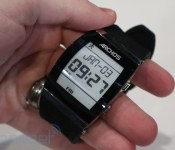
Archos’ Smartwatches don’t want to be smartphones-lite

Archos is coming at the burgeoning smartwatch space in a different way. Rather than hedge its bets on a single device offering, it’s planning to release a trio of smartwatches for every end of the consumer spectrum. The water-resistant smartwatches in question don’t have specific branding attached as of yet — that will presumably come before launch later this summer — but they are easily distinguished by screen size and display tech used.
Unlike the half-baked, it-can-sorta-do-everything Galaxy Gear, Archos’ smartwatch line is hewing more closely to the Pebble route. These Android- and iOS-compatible devices are designed to supplement your smartphone experience, not replace it. And so, users that buy in will have access to notifications (i.e., SMS, emails, text, Twitter, Facebook, etc.), media playback controls and, of course, a clock. What they won’t be able to do is snap photos on a low-resolution camera, talk into their wrists or reply to messages.
The cheapest of the bunch is Archos’ $50 model, a rugged-looking smartwatch that features a 1.55-inch non-capacitive, black-and-white, memory LCD and is rated for between one and two weeks of battery life. For just $50 more, there’s a color capacitive model that steps up the screen size to 1.8 inches (the same size as an iPod nano) and lasts about 36 – 48 hours. Fans of customization and the fashion-conscious will be glad to know the band on this model can be swapped out. And finally, occupying the line’s premium perch, at $130, is Archos’ e-ink smartwatch, which retains the same screen size as the color model, but with an aluminum-encased curved display.
The smartwatch line isn’t slated to launch until sometime this summer, but when it does, don’t expect all three to be available at once. Archos plans to offer only its $50 model initially, with its higher-end models to follow in the months after.
Brad Molen contributed to this report.
Filed under: Wearables
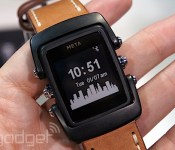
This is the next generation of Meta’s smart watch

MetaWatch, the wearables business that was spun out of watch maker Fossil, has lingered at the periphery of the space for quite a while. Now, however, the outfit has teamed up with the legendary Nokia and Vertu designer Frank Nuovo, who has helped redesign both the branding and the hardware in preparation for a relaunch as the Meta. The hope is that, when this new unit launches in the spring, Meta will be able to jostle as an equal with the Galaxy Gears and Pebbles of this world.
Aside from the name, the biggest innovation has been to shrink the slab-like hardware down to something a little more wrist-friendly. The bezel that surrounded the display has been split into four armatures that pivot — which means that it’ll now drape around your arm rather than jutting out and breaking the line of your sleeve. Considering that the team behind this started at Fossil, which offers a huge amount of interchangeable faces and straps, it’s no surprise to see that Meta will be offered in a wide variety of materials and styles. There’s a flat, shiny plastic model; a chunky (and weighty) stainless steel version; and an aluminum one, which is significantly lighter.
Technology-wise, you’re going to be staring at a 126 x 126 LCD display from Sharp, controlled by a TI MSP 430 microcontroller with a whopping 64Kb RAM. The plan is, at least, that the MetaWatch SDK will be ported over to the new platform, and with it, Bluetooth 4.0 notifications will be pushed from your smartphone to your wrist. The battery will be always on, and will vibrate whenever it demands your attention, requiring a recharge once every seven days or so. Of course, there’s no word (yet) on pricing, but we’re more than a little curious about how this’ll fare when we’re able to get our hands on it.
Filed under: Wearables
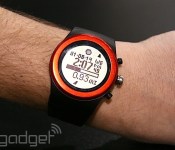
LifeTrak’s new watch combines smartwatch, fitness tracker and ECG machine

Would you like an early clue as to the dominant trend of CES 2014? It’s wearables, and, erm, more wearables. Another watch that’s hoping to earn a space on your wrist is the LifeTrak Zone R415, which grabs a little of everything from the technology buffet with the aim of being all things to all people. From the “smartwatch” table, we’ve got vibrating smartphone notifications that’ll let you know when you get calls, texts and emails. Then there’s dynamic sleep tracking which, like the Jawbone Up, will record your slumber session and wake you when you’re at your most well-rested. From the fitness tracker cart, the company has added a pedometer, calorie counter and activity tracker that’ll keep you informed of how you’re doing in hourly or weekly intervals. Rounding out the selection is an ECG, and by pushing the button on the side of the bezel, it’ll give you your heart rate. Using just a single watch cell battery, the unit should last for up to nine months between replacements and is designed to remain on your wrist, even while you’re in the pool. Holding it in our hand, we found it to be reasonably comfortable and light, and can certainly see some potential in the platform. Naturally, we’ll reserve judgment until we see it launch in Q2, but for now, it seems like it could be worth the $130 price point.
Nicole Lee contributed to this post.
Filed under: Wearables
Xbox One’s first big update will address ‘the Live experience,’ expect streaming before E3

Xbox — and Microsoft in general — doesn’t really show up for CES. It’s not hard to understand why: for a big company like Microsoft, there’s no point in competing with the cacophony of voices shouting for attention. “Whenever we want, we can talk about Xbox stuff and get coverage. Why try to talk with 100,000 other things going on?” Xbox chief product officer Marc Whitten told us in an interview this week. Though Xbox isn’t here to show anything off, Whitten’s in town to meet with partners and, as he put it, “It’s just a good time to pop up and see an environmental scan you can get in an immediate dose.” After a long 2013 head down on the Xbox One launch, he’s finally got a second to take the temperature and see the world outside of Microsoft’s Bellevue, Wash. campus.
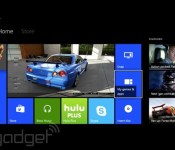
But we’re not here to ask Whitten about the past. Yes, he’s “really thrilled” with the console’s launch (over 3 million sold by the end of 2013). And yes, he’s very happy with the reaction from consumers. That doesn’t mean work’s over, of course. “There are seams in the product [XB1]. There are still seams in the 360, nothing’s ever done,” Whitten said. As such, first up on the fix docket is what Whitten called, “the Live experience.” Essentially, that’s much of the social features on the latest Xbox console. Whitten takes that stuff personally, having worked on Xbox Live as a service for the last 10 years:
“The feedback we’ve gotten is pretty valid; some of the social stuff is hidden or harder to use than it was on the Xbox 360. So you’re gonna see us come out with an update where, well, we’re going to fix those things. As a person who’s been pretty involved in building Xbox Live for the last decade, I take it pretty seriously when people say it’s harder to get into a party, and the defaults aren’t right, and I don’t like the model. So what I’m trying to do with the team is kind of theme some stuff up. Let’s take an update and really go through a big list of what we’re hearing from customers, what we know is broken with the architecture, areas that we want to improve or complete. I think that’s a theme you’ll really see us push on — that Live experience.”
Based on our conversation with Whitten, it sounds like those Live fixes are coming sooner than later. Promised game streaming functionality, however, may not be coming as quickly. “This is not 100 percent,” Whitten prefaced his statement with. “But my general strategy at E3 is to talk about things that are gonna happen from that E3 to the next E3. So, we are not yet to the next E3,” he added with a smile. So, uh, before June then!

Updates in general, though, will come much faster. While Whitten said we’ll still see the traditional large Dashboard updates, the Xbox One was designed around lessons learned from the 360 before it. One major facet of that design facilitates more regular updates. “The Xbox 360, which I’m still very very proud of, the software architecture was built in 2003. Rethinking [updates] based on everything we learned from 360 was a lot of what went into the Xbox One,” he told us. “You’re still gonna see the big, ‘Hey, here’s the cool stuff we’re doing.’ But you’re also gonna see the box just get better faster than you did in the past.”
First up on that front? “Everything from getting more apps out faster, some of the TV stuff — improving some of that, getting the scale of that internationally where we don’t have some of that. So I think you’re gonna see that come pretty quickly,” Whitten said.
The next big push for Microsoft’s Xbox One starts by March’s Game Developers Conference. As it turns out, the Xbox One gets its first major exclusive game that month in Titanfall as well. And hey, if you ask us, there’s serious incentive for Microsoft to have partying up perfected in time for Respawn Entertainment’s big game.
3D Systems bestows Creative Director title on will.i.am

If Alicia Keys and BlackBerry have taught us anything, it’s that music stars aren’t always the best equipped to become the creative director of a tech company. In spite of her songwriting prowess, the “Girl on Fire” singer couldn’t do much to reverse the phonemaker’s eroding fortunes. We’ll say this for will.i.am, however: This isn’t the Black Eyed Peas rapper’s first ballgame. Though, again, his gig with Fusion Garage head Chandra Rathakrishnan also kind of seemed doomed from the outset. Given the sort of show 3D Systems has been having this CES, however, things are definitely looking up for the 3D printing giant. So, maybe they’ve just got a feeling about the guy.
Kickstarter ends 2013 with $480 million in funding, proof that dreams came true

Kickstarter is now a relatively mature company, but that doesn’t mean that it has stopped growing — far from it. The crowdfunding pioneer says in its year-end review that it generated $480 million in pledges from three million people during 2013, a big jump from the $274 million and 2.2 million contributors that it attracted in 2012. It’s also eager to show that the contributions of years past have led to real products. It notes that big-name 2012 projects like the Oculus Rift and Pebble reached backers last year, while more recent successes like the Veronica Mars movie are on the cusp of release. Not everything that Kickstarter touches will turn to gold, but its results suggest that crowd power is here to stay.
Filed under: Internet
Source: Kickstarter

BMW’s autonomous car, or how we drifted into love with a robot

BMW promised, under the banner of its ConnectedDrive platform, to demonstrate some autonomous driving at this years’ CES, and wow did it deliver. Labeled as ActiveAssist, the technology describes both partially and highly automated driving and we were definitely out to sample the highly automated variety. Highly automated driving, as the name suggests means the car will essentially drive itself with you sitting as passenger “up to the car’s dynamic limit”, or as we discovered to about 80 MPH.
The prototype research cars on hand were tuned for CES by removing the external sensors to make them, more than likely, more pleasant to look at. We chose the M235i — because who wouldn’t, given the choice? — though there was a diesel 6-series Grand Coupe as well. Seeing as the sensors were missing, the car was following a pre-defined path, but still completely reactive to its environment. The most compelling example of this was on the second lap of the infield track set up at the Las Vegas Motor Speedway, when we drifted. Yeah, we put our faith in robot hands and got very sideways through a wet section of the track. I was watching the wheel as we slid and was almost hypnotized seeing the wheel constantly spinning to correct our trajectory and keep the slide going.
Sure, the reality of being transported about by your car is a long way off, maybe as much as 10 years. But all the small pieces that spin off from this technology into cars today make the small steps to robot domination fun. Consider things like active cruise control, which can stop the car completely, then resume driving or self-parking cars and it is easy to see that gradual progress. We for one love where this is going, but we wouldn’t be hurt to see it let us race our own cars, you know? Find the video tour and our interview with BMW’s Werner Huber just below.
Filed under: Robots, Transportation

Live from the Engadget CES Stage: the EFF’s Julie Samuels

Electronic Frontier Foundation staff attorney Julie Samuels has quite possibly the greatest job title in the history of job titles: The Mark Cuban Chair to Eliminate Stupid Patents at EFF. She’ll join us to speak about how said stupid patents are hampering innovation.

Nokia Lumia Icon shows up on Verizon’s test site with 20-megapixel PureView camera, 2,420mAh battery

We’ve been seeing leaks of Nokia’s upcoming Lumia 929 for a while, but this time it comes from a pretty official source: Verizon. Earlier today, the phone showed up on Verizon’s test manager site under the name Nokia Lumia Icon, flaunting the same design we saw back in November and, unsurprisingly, a 20-megapixel PureView camera. The site doesn’t betray too many specifics about the phone, but does mention a hefty 2,420mAh battery with support for wireless charging. There’s a price too, but don’t expect it to be final: The test site lists the phone at $777 with or without contract. Want a gander? We’ve headlined this post with a screenshot of the page, but you can find a direct link at the source link below.
Filed under: Cellphones, Nikon
Source: Verizon
 AIVAnet