


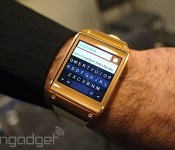
Fleksy keyboard brings predictive touch typing to the Galaxy Gear (video)

Fleksy has already shown that you could use its intuitive touch keyboard on a smartwatch with the Omate TrueSmart, so it only makes sense that someone saw fit to put it on Samsung’s Galaxy Gear. By default, the only way to enter text into the Gear is through voice dictation, which might not be your thing, especially in a crowded environment. As it turns out however, you can choose to sideload software keyboards like Fleksy, which is available through the regular Google Play store, into the Gear. Fleksy COO Ioannis Verdelis found out about this a few weeks ago from the XDA Developer forums, so he installed Fleksy on his Gear and brought it here to CES for us to see. From a brief hands-on, it seems very similar to the version we used on the TrueSmart. Simply tap in your desired words as best you can, and the tiny predictive keyboard will turn your mangled letters into coherent sentences. We took a brief video of it in action, which you can check out below.
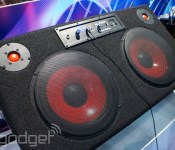
ION’s Road Warrior Bluetooth speaker won’t fit in your bag, costs $399 (hands-on)

ION Audio took to CES 2014 to reveal a number of new products, and the Road Warrior was among them. In typical trade show fashion, we thought it was only appropriate to stop by the company’s booth to check out its not-so-portable Bluetooth speaker. As you can imagine, this thing is big and extremely loud — we were playing Lorde at about half the maximum volume and walked away hugely impressed at the amount of noise it can push out. It wasn’t exactly surprising given its 200-watt power and two 10-inch woofers, but the Road Warrior can definitely turn your tailgate party into one for the ages. ION Audio told us that the model being shown is a prototype, with the final retail version said to feature a thinner body and built-in kickstand. Priced at $399, the Road Warrior won’t be shipping until June, though you can catch an early glimpse of it in our gallery after the break.
Filed under: Peripherals
Watch-out, Archos launching $50 smartwatch by summer
Smartwatchs are a new category and there are only a options available on the market today, but Archos is hoping to change that with its new smartwatch line launching this summer.
Unlike the Samsung Galaxy Gear that carries many of the features of a smartphone, Archos’ devices will be (sort-of) competing with the Pebble directly since its $50 model will feature a 1.55-inch non-capacitive e-ink display and the ability to receive text, email and social media notifications and control media playback, in addition to displaying the time, of course. The unnamed Archos watch is said to get between one and two weeks of battery life.
The smartwatch can’t reply to messages (the Pebble can actually send simple replies thanks to the app Glance), and there is no mention of it being open source or there being any type of app store.
In addition to its cheapest $50 model, two others will be available in the line, but not at launch. The first will be $100 and come with a 1.8-inch color capacitive display and a 36 to 48 hour battery life. The second is the same as the color model, but will feature an aluminum-encased curved display for $130.
via Engadget
The post Watch-out, Archos launching $50 smartwatch by summer appeared first on AndroidGuys.
Hisense’s monster 6.8-inch X1 Android smartphone due in Q2
The line between smartphone and tablet may have been blurred with devices like the Samsung Galaxy Note, but Hisense unveiled something crazy at CES this week, basically a smartphone in a tablet body.
Launching in China before the U.S. this summer, the Hisense X1 features a 6.8-inch 1080p IPS display, Qualcomm Snapdragon 800 processor, 13 MP back-facing camera, 3,900mAh battery and a light skin on top of Android 4.4 KitKat. One downside to the smartphone is that it only supports HSPA+, but an LTE model, the X3, will be coming out as well.
Engadget, who got to spend some time with the device, said that ”the overall user experience zips along smoothly and briskly,” the viewing angles are excellent and the matte plastic back feels great in hand, well two hands.
Hisense is shooting for a late Q2 release for the U.S. market and will release the X1 under the Sliver brand, “primarily for unlocked availability,” but the company is in talks with two U.S. carriers, so there could be a subsidized model.
All that being said, someone had to be crazy enough to launch a smartphone this big. Are you interested or is 6.8-inchs way too much smartphone?
via Engadget
The post Hisense’s monster 6.8-inch X1 Android smartphone due in Q2 appeared first on AndroidGuys.
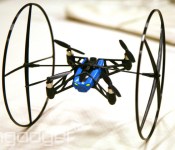
Live from the Engadget CES stage: Parrot product manager Yoni Benatar

We love us some toys, and thankfully so does Parrot. The company has wowed the audience at our stage with its AR.Drone for the past two years, and now it’s time for something new. This year, the company announced two new ‘bots: the wall-crawling Mini Drone and the terrestrial Jumping Sumo.
Filed under: Robots

Microsoft and CES: it’s complicated (not really)

CES: It’s a big deal in the tech world. You know who else is a big deal? Microsoft. So when the tech giant decided to hand over the baton of hosting the event’s opening keynote, ending a 12-year streak, people took notice. Not only that, the software giant also pulled its entire presence on the show floor, causing speculation that Microsoft’s relations with the CEA had degraded over the years, or (more likely) that it had decided the show just wasn’t offering it the kind of airtime it needed for its services and products.
At CES 2014, a Microsoft stand is nowhere to be seen on the show floor. In the build-up to the event, however, a report from the BBC claimed the firm would be “returning” to the show, including an almost polemic quote from the event’s head honcho Gary Shapiro stating that “Microsoft is officially back in the International CES.” This, in turn, was picked up by others, dutifully pointing out that, technically it never left — instead, conducting business away from the show floor. This much is definitely true, as we were part of one such meeting, in which we took the time to find out a little more about the real story behind Microsoft’s sudden departure from the biggest show in tech.
“The keynote and the booth, we haven’t done the last couple of years, but at the same time, the behind-the-scenes meetings with partners, hardware manufacturers, mobile operators and developers are all happening, and that part has actually increased,” Greg Sullivan, director of Windows Phone at Microsoft told us. Clearly, with almost every relevant business partner in town, it’s a great time to talk. Sullivan did go on to say that Microsoft isn’t ruling out a return to the show floor in the future.

Microsoft has many limbs, so it’s not just a case of one faction pulling out. Xbox isn’t here either, and it just launched a once-in-a-decade console. Marc Whitten — chief product officer for Xbox — told us “coming here to talk about new stuff is a little weird, especially for the console market, where so much is driven in November/December.” Yet Sony is here in full force, releasing new PlayStation products, and even theming its non-gaming stuff under the banner “play.” Whitten also told us, in the case of Xbox, it’s more to do with the timing. CES lands just after the big Christmas push, but again, this didn’t seem a concern for Sony; a competitor that’s generally considered to be winning the publicity war.
We’re there; we’re visible; and our products are in booths all over in various form factors.
But if not CES, then what? Sullivan is pragmatic, claiming that it’s a simple case of reallocating budget. A presence on the show floor costs money; money the firm is deciding to spend on other things. Internally organized events like Build are becoming increasingly important for Microsoft. Especially as this gives it the opportunity to host its own show, and not jostle for attention among the thousands at CES. A tactic that Apple employed some time ago (the last presence it had was more than two decades ago), which is clearly working for them. Google, too, has never really done the CES thing, also opting for its own showcase events.
Microsoft’s absence perhaps feels more noticeable due to its long tenure at the CES keynote, making its presence at the show all the more visible. Not that its show floor installations were exactly subtle, either. Its 2011 booth, for example, was a cavernous multi-story complex, almost with its own weather system.

If you spend any time wandering the halls at CES 2014, however, one thing soon becomes obvious: Microsoft is actually present throughout. Its products are so ubiquitous, that even without it trying, tablets, laptops and a host of other devices make sure that famous Windows logo is never far away. Something Chris Flores, director of Communications for Windows is only too aware of. “Although we don’t have a physical booth presence on the floor, we very much have a presence on the floor […] we’re there; we’re visible; and our products are in booths all over in various form factors,” he said.
And here we come to the obvious conclusion. Microsoft isn’t at CES (visibly) because it really doesn’t need to be. It’s also not an indicator of CES’ credibility. We’re told the software firm is also giving Mobile World Congress the same treatment — it will be there, but mainly behind closed doors. Increasingly is looks like the large trade show simply can’t offer the sort of dedicated airtime that a brand like Microsoft requires. This, after all, is the nature of business: assess the value, and make the most profitable decision. For Microsoft — and an increasing number of big names — that decision is to go it alone.

Live from the Engadget CES Stage: Sculpteo CEO Clément Moreau

It’s set up in among a slew of hardware devices in CES’ 3D printing area, but Sculpteo takes a different approach to the space, with made-to-order, cloud-based printing. This year, the French company revealed a batch-printing service, so you can print up a lot of plastic pigs (or just about anything else you want, really) all in one go.
Filed under: Misc

Hands-on with BMW’s self-parking i3

BMW was keen to show off some ConnectedDrive technology at CES in its new i3, so it trucked us — well, i640′d — out to Las Vegas Motor Speedway for a demo. We had a brief look at the BMW i Remote app installed on a Samsung Galaxy Gear, where the car’s battery state, range, lock status and other niceties are displayed. Lost your car on some street after it parked itself? Communication flows both ways with the BMW i3 and by simply asking the car to “make some noise” using the watch, the horn will honk after a short delay.
One of the i3‘s most compelling features is its $1,000 Parking Package. At the push of a button using ultrasonic sensors, the car will both find and then park itself in a spot with as little as 22 inches of extra space. Self-parking cars aren’t new, but the little electric i3 does the complete procedure and doesn’t need driver input on gas or braking. We tried the entire parking procedure and it worked flawlessly as it backed into the spot and then adjusted back and forth a bit to get properly aligned with the curb. Is it worth the $1,000 bucks? If you’re not the most adept driver when it comes to parallel parking, we’d say it absolutely looks worth it. Don’t believe us? Take a peek at the video right below.
Ben Harrison contributed to this report
Filed under: Transportation
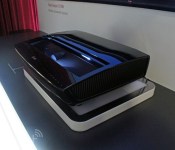
LG sneaks a new version of its ‘Laser TV’ projector into CES 2014

Last year at CES, LG introduced the Cinema Beam HECTO Laser TV projection system that could produce a 100-inch screen from just a couple of feet away, and now it’s showing off a new version. HECTO2 keeps the same 100-inch screen size, but uses an upgraded laser system to provide a claimed 10,000,000:1 dynamic contrast ratio that is 10x greater than the original and only needs six inches of space. Just like the earlier iteration and Sony’s new Life Space UX laser projector, the Cinema Beam brings speakers, smart TV apps and more as an all-in-one package. Other than a likely still-astronomical price — the original launched at about $10k — there’s probably one big reason this isn’t getting a ton of hype. It’s still 1080p, and at a show that’s all about Ultra HD, LG may hold off on the laser-projection push until it can squeeze a few million more pixels in.

Filed under: Displays, Home Entertainment, HD, LG
Watch Engadget’s CES SuperSession featuring Pebble, Oculus, 3D Systems and Leap Motion

Welcome to CES 2015. When we were originally batting around ideas for this year’s Supersession, we suggested something further off, centered around predictions about where all of this is headed in the decades to come. But while CES is all about looking forward, the show’s real bread and butter centers around something more immediate: the gadgets that will define the year to come. With that in mind, we pulled together an all-star panel of forward-thinking innovators who are creating products that are available now (or, in one case, soon to be available). These are companies that aren’t looking to shift paradigms in the future — they’re ready to move and shake things now.
Panelists for the session included Leap Motion CEO Michael Buckwald, Oculus CEO Brendan Iribe, Pebble CEO Eric Migicovsky and 3D Systems CEO Avi Reichental. Full video of the session can be found in the source link below.
[Photo by Will Lipman]
Filed under: Gaming, Meta, Peripherals, Robots, Wearables
Source: CES
 AIVAnet